



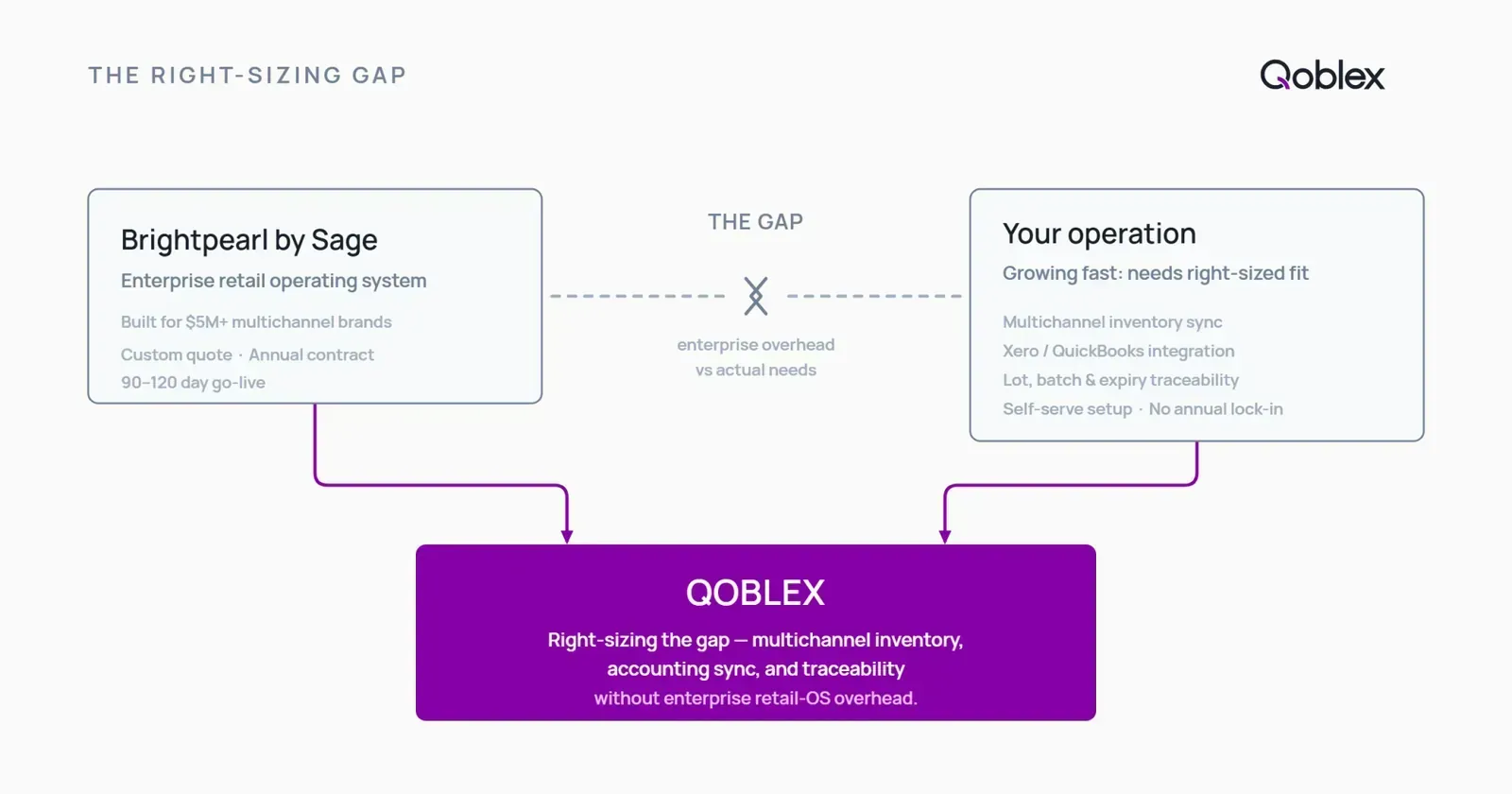
The best alternatives to Brightpearl by Sage in 2026 are Cin7, Linnworks, Qoblex, Unleashed, Zoho Inventory, Katana, and inFlow. Brightpearl is an enterprise retail operating system with custom, quote-based pricing and go-live timelines Brightpearl itself puts at 90 to 120 days on average, built for multichannel brands at meaningful scale. Operators who need multichannel inventory, accounting sync, or traceability without the enterprise overhead have lighter, faster options to choose from.
What is Brightpearl by Sage, and who is it actually built for?
You have probably arrived here for one of two reasons. Either you are running a multichannel retail brand and someone recommended Brightpearl, or you already started a Brightpearl sales conversation and the fit felt bigger than your business. Both are worth taking seriously, and the honest answer depends less on the software than on the shape of your operation.
What does Brightpearl actually do?
Brightpearl by Sage is a retail operating system. That is a real category, not a marketing phrase. It bundles order management, inventory management, a warehouse management system, purchasing, retail CRM, reporting, and workflow automation into one environment, with built-in retail accounting. The point of a retail operating system is that order routing, stock allocation, fulfillment, and finance all live in the same place, so a large multichannel operation does not have to stitch four systems together and hope they agree.
Brightpearl’s warehouse management system includes serial number, lot, and expiry date tracking. If traceability is a hard requirement for you, Brightpearl covers it. That is worth stating plainly up front, because traceability is not the reason a growing operator looks past Brightpearl.
What kind of business does Brightpearl target?
Since Sage completed its acquisition of Brightpearl in 2022, the product has been positioned for larger multichannel retail brands, with deeper ties into the Sage Intacct financial ecosystem. The typical Brightpearl customer runs meaningful revenue across several sales channels at once, has a dedicated operations team, and wants a single system to coordinate all of it. That is a genuine strength for the business it is built for. It is also the thing that makes some growth-stage operators pause: you are looking at an enterprise retail platform when your operation may still be a tier below it.
Does Brightpearl have built-in accounting?
Yes. Brightpearl includes native retail accounting and integrates deeply with Sage Intacct, which is a real advantage if you are already inside the Sage ecosystem. Most of the alternatives on this list take a different approach: they keep your existing accounting platform (Xero or QuickBooks) as the book of record and sync to it, rather than replacing it. Which model is better depends entirely on whether you want your finance system inside your operations platform or kept separate.
Why are operators looking for a Brightpearl alternative?
The reasons people search for a Brightpearl alternative are consistent, and none of them is that Brightpearl is a bad platform. They are all versions of the same underlying question: is this the right size for where my business is right now?
Custom-quote pricing and no published price list
Brightpearl does not publish a price list. Its pricing page is explicit about the model: “One size never fits all. That’s why we build a bespoke set-up for every customer, with simple, tailored pricing.” Every quote is custom and requires a sales conversation. For an enterprise buyer with a procurement process, that is normal and fine. For a growth-stage operator trying to compare options quickly, it means you cannot size the cost until you are already several steps into a sales cycle, and the number that comes back is engineered for retail-scale operations.
How long does Brightpearl implementation take?
Brightpearl states on its own pricing page that customers “go live in 90 to 120 days on average.” That is roughly three to four months. This is not a criticism: a retail operating system that coordinates order routing, inventory allocation, warehouse operations, and accounting across multiple channels should take real implementation work to configure well, and a rushed rollout of a system that central would be the bigger risk. But it is a genuine planning factor. If you need to be operational in weeks rather than a quarter, that timeline is part of the fit question.
Post-acquisition drift toward enterprise
The Sage acquisition in 2022 accelerated Brightpearl’s move upmarket, toward larger brands and tighter Sage Intacct integration. If you evaluated Brightpearl a few years ago and it felt like a fit, it is worth re-checking against where the product sits now. The platform has grown into its enterprise position, which is good for enterprise buyers and part of why smaller operators increasingly look for something right-sized.
Does Brightpearl offer monthly billing?
Brightpearl’s commercial model is enterprise: custom quote, bespoke setup, professional implementation. The published pricing page does not spell out contract length or a monthly billing option, so the accurate thing to say is that terms are set through the sales conversation. If flexible or monthly billing matters to you, ask Brightpearl directly, and note that most of the alternatives below run on straightforward subscriptions.
What to look for in a Brightpearl alternative
Before you look at any specific tool, it helps to be clear about what you are actually solving for. A Brightpearl alternative is not automatically “Brightpearl but cheaper.” It is a different point on the trade-off curve, and the right one depends on your operation.
Core capability checklist
For most growth-stage multichannel operators, the capabilities that matter are: multichannel stock sync across your storefronts and marketplaces, integration with the accounting platform you already use, order management that keeps fulfillment honest, and traceability if your products are lot or expiry sensitive. If you also assemble or manufacture, bill-of-materials and production support belong on the list.
Implementation path
Ask how long each option takes to go live, whether onboarding is self-serve or requires a paid professional-services engagement, and what the contract structure looks like. A tool you can stand up in days with a monthly subscription is a very different commitment from a quarter-long enterprise implementation. Neither is wrong; they suit different stages.
When you need Brightpearl’s depth, and when you don’t
This is the real decision. If you need automated order routing across many channels and locations, retail POS, EDI depth, and demand-driven replenishment at scale, you are describing a retail operating system, and a lighter tool will feel thin. If your operation centers on multichannel inventory management, purchasing, and keeping your accounting in sync, and you need traceability without an enterprise rollout, a tier below Brightpearl is very likely the better fit.
The 7 best Brightpearl alternatives in 2026: quick comparison
No pricing column here on purpose. Brightpearl does not publish figures, and comparing tools on a single monthly number hides the trade-offs that actually matter. The table compares capability and fit; check each vendor’s current pricing page for cost.
| Tool | Multichannel inventory sync | Accounting integration | Lot/batch/expiry tracking | Implementation path | Best for |
|---|---|---|---|---|---|
| Cin7 | Broad multichannel and retail channel coverage | Xero, QuickBooks (and others) | Batch and expiry on all tiers; FEFO enforcement via Advanced WMS on higher tiers | Guided onboarding; heavier than an SMB tool | Multichannel retailers stepping down from Brightpearl’s tier |
| Linnworks | Strong marketplace and channel automation (Amazon, eBay, Shopify) | Xero, QuickBooks | Batch and expiry via WMS module | Structured setup; marketplace-focused | Marketplace-heavy sellers |
| Qoblex | Native Shopify, WooCommerce, Amazon sync | Xero, QuickBooks (kept as book of record) | Lot, batch, serial, and expiry via paid add-on | Self-serve, no setup fee, 14-day free trial | Growth-stage multichannel operators needing inventory plus accounting sync plus traceability, without retail-OS overhead |
| Unleashed | Solid multichannel; Amazon as a paid add-on | Xero (strong), QuickBooks | Batch tracking with FEFO | Tiered subscription; moderate onboarding | B2B wholesale and distribution with inventory depth |
| Zoho Inventory | Multichannel across major channels | Zoho Books, and others | Batch and expiry tracking | Self-serve; free tier available | Small ecommerce teams on a tight budget |
| Katana | Shopify and channel sync | Xero, QuickBooks | Lot tracking via the Traceability add-on | Self-serve; manufacturing-oriented | DTC brands with light manufacturing needs |
| inFlow | Basic multichannel order management | Xero, QuickBooks | Lot and expiry tracking (verify current status) | Simple, fast setup | Small teams wanting straightforward multichannel order management |
Detailed reviews
The order below reflects how close each option sits to Brightpearl’s own tier and who it fits best. It is not a ranking of quality. The right tool is the one that matches your scale and your operational shape.
1. Cin7: best for multichannel retailers stepping down from Brightpearl’s tier
Cin7 is the closest peer to Brightpearl on this list. It carries broad multichannel and retail channel coverage, batch and expiry tracking on all tiers with FEFO enforcement on the Advanced WMS module, and integrations with Xero and QuickBooks. If you looked at Brightpearl because you genuinely operate at retail scale but want a different fit, Cin7 belongs on your shortlist. For a dedicated guide to the Cin7 Core lineup specifically, see our Cin7 Core alternatives comparison.
2. Linnworks: best for marketplace-heavy sellers
If most of your volume runs through Amazon, eBay, and other marketplaces, Linnworks is built for that world. Its strength is marketplace listing and order automation across channels, with batch and expiry tracking available through its WMS module. Implementation is more structured than a self-serve tool. For more on this vendor, see our Linnworks alternatives guide.
3. Qoblex: best for multichannel operators needing inventory, accounting sync, and traceability without retail-OS overhead
This is where a specific, narrower buyer fits. If your business has outgrown a basic tool but you do not need an enterprise retail operating system, Qoblex is built for that middle. It sits between the spreadsheet-and-basic-tool stage and the full retail-OS tier, and it is honest about that: it is not a parity replacement for Brightpearl at full retail scale.
What Qoblex covers well for this stage: native multichannel sync across Shopify, WooCommerce, and Amazon, with Xero and QuickBooks integration that keeps your existing accounting as the book of record rather than replacing it. Lot, batch, serial, and expiry tracking is available as a paid add-on, not part of the base plan, so if traceability is central to your operation, factor that into the plan you choose. Qoblex also ships bill-of-materials and production orders for operators who assemble or lightly manufacture. Setup is self-serve with no setup fee and a 14-day free trial, which is a very different commitment from a quarter-long enterprise rollout.
Where Qoblex is not the answer: retail-scale automated order routing, retail POS, and EDI depth. If those are core to how you run, you are describing Brightpearl’s tier, and Qoblex would feel thin. The right-sizing argument only works when the fit is real. To see the plan structure, check qoblex.com/pricing. For the channels themselves, Qoblex documents its Shopify integration and its Xero and QuickBooks sync on their own pages.
4. Unleashed: best for B2B wholesale and distribution with inventory depth
Unleashed is strong for wholesale and distribution operations that need real inventory depth, with a well-regarded Xero integration and batch tracking with FEFO. Amazon connectivity is available as a paid add-on rather than a core channel. If your business is more B2B than retail, Unleashed is worth a close look. See our Unleashed alternatives guide for a fuller comparison.
5. Zoho Inventory: best for small ecommerce teams on a tight budget
Zoho Inventory has a genuine free tier and affordable paid plans (free plan: 50 orders per month, 1 user, 2 locations), and it fits naturally if you already use other Zoho products. For a small ecommerce team watching costs, it is a sensible starting point. Its ceiling is lower than the tools above it, so plan for the point where you may outgrow it.
6. Katana: best for DTC brands with light manufacturing needs
Katana is oriented around manufacturing, with bill-of-materials, production orders, and Shopify and Xero integration. Lot tracking is available through a Traceability add-on, whose cost Katana no longer publishes. If you are a DTC brand that makes as well as sells, Katana’s production focus is its main draw.
7. inFlow Inventory: best for small teams wanting simple multichannel order management
inFlow keeps things straightforward: basic multichannel order management, native connections to Shopify, Amazon, Xero, and QuickBooks, and a simple, fast setup. It suits a small team that wants to get organized without a heavy platform. Confirm the current status of its lot and expiry tracking on inFlow’s site before you rely on it, as that capability was in beta at our last verification.
When Brightpearl by Sage is the right choice
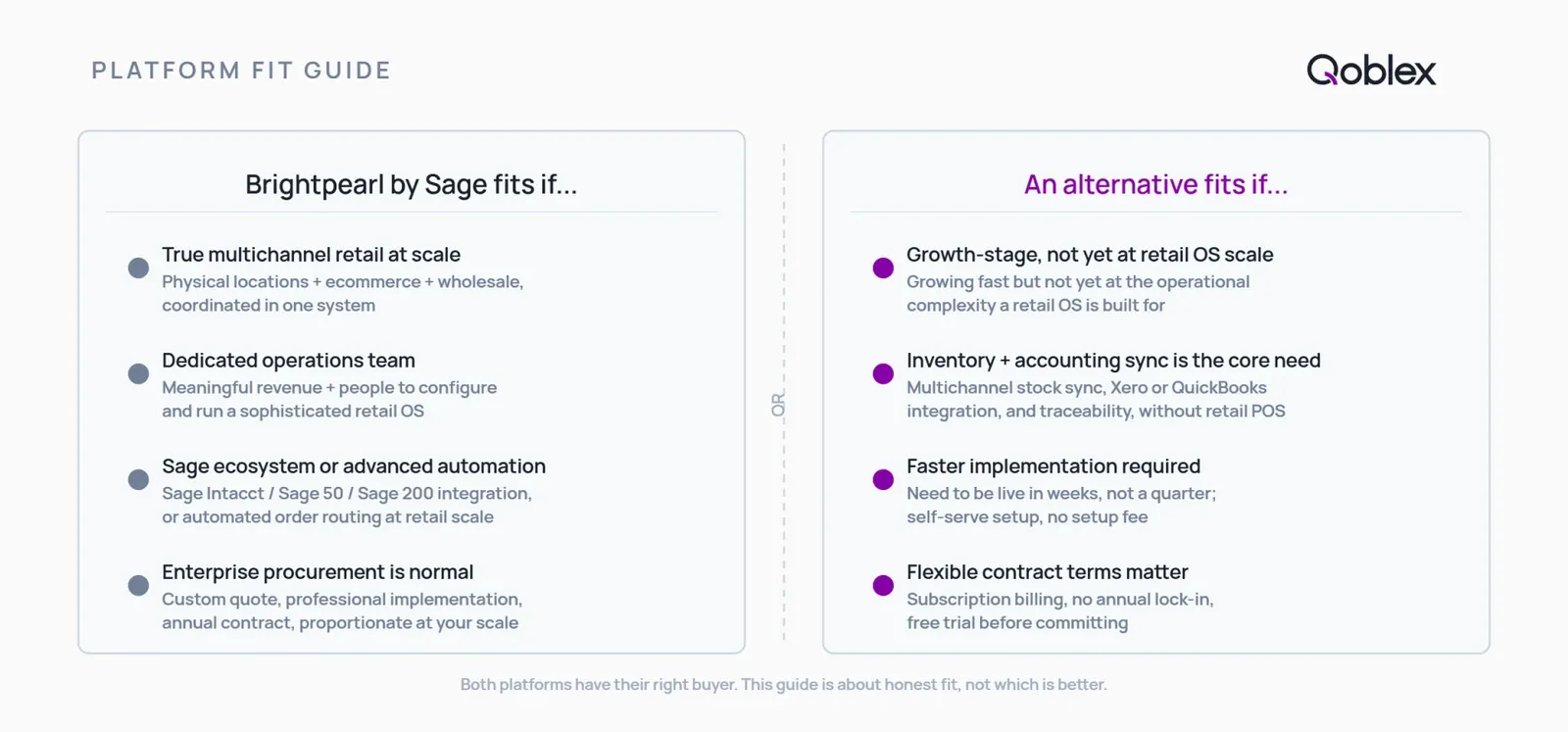
Brightpearl by Sage is a serious retail operating system, and it earns its price for the business it was built for. The question this page answers is not whether Brightpearl is good. It is whether that business is yours yet. For a large set of operators, the honest answer is that Brightpearl is exactly right. Here is who.
You run a true multichannel retail operation, all at once. You sell across physical locations, ecommerce storefronts, and wholesale channels simultaneously, and you need one system to coordinate order routing, inventory allocation, and fulfillment across all of them together. That coordination at scale is what a retail operating system is for.
You are at meaningful revenue with a dedicated operations team. Brightpearl is engineered for brands with the operational volume to justify an enterprise implementation, and with the people to configure and run a sophisticated system well. If you have that team and that volume, the platform’s depth is an asset, not overhead.
You want finance and operations in one environment. Brightpearl’s native retail accounting and Sage Intacct integration mean you manage finance and operations together, not by bolting two systems to each other. For operators who explicitly want that, it removes real friction.
You need advanced retail automation. Automated order-routing rules, demand-driven replenishment, and workflow automation at a scale that a simpler tool’s rule sets cannot reach: this is a core Brightpearl strength, and it matters most exactly when volume and channel count are high.
You are already in the Sage ecosystem. If you run Sage Intacct, Sage 50, or Sage 200, Brightpearl’s deep integration with those products removes an integration burden you would otherwise carry.
You need traceability at retail scale. Brightpearl’s warehouse management system includes serial, lot, and expiry tracking. If traceability is your primary requirement and your operation is at the scale Brightpearl serves, it covers this well. Traceability is not a reason to look elsewhere.
If several of these describe your business, Brightpearl is very likely the right platform, and the alternatives above would leave you wanting. There is no shame in either direction. The whole point of right-sizing is honest fit.
How to evaluate your options: a decision framework
Match your scale and complexity to the right tier
Start from your operation, not the tool. If you are running true multichannel retail at meaningful revenue with a dedicated ops team, you are shopping in Brightpearl’s tier, and Cin7 or Linnworks are your closest alternatives. If you are growing fast, your core need is inventory plus accounting sync plus traceability, and you want to be live in weeks rather than a quarter, you are shopping a tier below, where Qoblex, Unleashed, Zoho, Katana, and inFlow live. Be honest about which describes you today, not where you hope to be in three years.
Questions to ask before a demo
Ask each vendor: how long until we are actually live, and is onboarding self-serve or a paid engagement? Does it keep our existing accounting platform as the book of record, or replace it? Is lot and expiry tracking included or an add-on, and how does it enforce pick order? What does the contract look like, and can we try it before we commit? The answers will separate the tools faster than any feature list.
FAQ
What is Brightpearl by Sage? Brightpearl by Sage is a retail operating system that combines order management, inventory, warehouse management, retail CRM, reporting, and built-in accounting in one platform. Sage acquired Brightpearl in 2022, and the product is now branded Brightpearl by Sage. It is built for multichannel retail brands operating at meaningful scale.
How much does Brightpearl cost? Brightpearl does not publish a price list. Its pricing page states that every setup is bespoke with tailored pricing, so you get a custom quote through a sales conversation. There are no public dollar figures, and third-party estimates vary widely, so the accurate answer is to request a quote directly.
Is Brightpearl suitable for small businesses? It depends on the operation. Brightpearl targets multichannel brands at meaningful scale with dedicated operations teams. A smaller operation is unlikely to justify the enterprise pricing structure and implementation, which is exactly why the alternatives on this list exist.
What is the best Brightpearl alternative for ecommerce? It depends on your channel mix. Cin7 suits broad multichannel retail, Linnworks suits marketplace-heavy sellers, and Qoblex suits operators who need multichannel inventory plus accounting sync plus traceability without retail-OS overhead.
Which Brightpearl alternatives integrate with Xero or QuickBooks? Qoblex, Cin7, Unleashed, Zoho Inventory, Katana, and inFlow all offer Xero and/or QuickBooks integration. Qoblex keeps your existing accounting platform as the book of record and syncs to it, rather than replacing it.
Does Brightpearl offer monthly billing? Brightpearl’s commercial model is enterprise, with a custom quote and bespoke setup. Its published pricing page does not spell out contract length or a monthly option, so ask Brightpearl directly for terms. Most alternatives on this list run on straightforward subscriptions.
How long does Brightpearl implementation take? Brightpearl states on its pricing page that customers go live in 90 to 120 days on average, roughly three to four months. Lighter alternatives are typically live much faster.
Which alternatives support lot tracking and expiry dates? Brightpearl itself includes serial, lot, and expiry tracking in its WMS, so this is not a gap. Among the alternatives: Cin7 offers batch and expiry on all tiers, Unleashed offers batch tracking, Linnworks via its WMS module, Katana via its Traceability add-on, and Qoblex via a paid add-on. Confirm inFlow’s current status directly.
Can I try any of these alternatives before committing? Yes. Qoblex offers a 14-day free trial with no credit card required, Zoho Inventory has a free tier, Katana offers a trial, and inFlow offers a free plan. Trying before you commit is far easier here than with an enterprise procurement process.
Is Brightpearl owned by Sage? Yes. Sage acquired Brightpearl in 2022, and the product is now branded Brightpearl by Sage.
Your next step
The useful takeaway is not “pick this tool.” It is to be honest about your operational stage first. If you are running true multichannel retail at scale with the team to match, Brightpearl by Sage or a close peer like Cin7 is likely the right platform, and the enterprise commitment is proportionate. If you are growing fast, your core need is multichannel inventory that stays in sync with the accounting you already use, and you want traceability without a quarter-long rollout, then a right-sized platform will serve you better. Qoblex is built for that specific middle. Look at where your business actually is today, and let that decide the tier, not the other way around. You can see how Qoblex is structured and priced to check the fit for yourself.