



Manufacturing efficiency isn’t just about working harder—it’s about working smarter. In traditional manufacturing layouts, a single product might travel hundreds of feet across a facility, passing through multiple departments, waiting in queues, and accumulating delays at every step. The result? Extended lead times, excessive inventory, communication breakdowns, and missed opportunities for quality improvement.
Cellular manufacturing offers a fundamentally different approach. By organizing equipment, workers, and materials into dedicated “cells” focused on specific product families, manufacturers can dramatically reduce waste, accelerate production, and improve quality. This methodology, rooted in lean manufacturing principles, has helped countless companies slash lead times by 90%, reduce inventory by 70%, and increase productivity by 100% or more.
Whether you’re managing a small manufacturing operation or overseeing a multi-facility enterprise, understanding cellular manufacturing can transform how you approach production planning and execution. This comprehensive guide will walk you through everything you need to know—from basic concepts to implementation strategies—so you can determine if cellular manufacturing is right for your operation.
What Is Cellular Manufacturing?
Cellular manufacturing is a lean production methodology that organizes workstations, equipment, and personnel into compact, self-contained units called manufacturing cells. Each cell contains all the resources necessary to produce a complete product or product family from start to finish.
Unlike traditional layouts where similar machines are grouped together by function (all lathes in one area, all milling machines in another), cellular manufacturing arranges equipment in the sequence needed to complete a specific production process. This arrangement enables products to flow smoothly through all required operations with minimal handling, transportation, and waiting time between steps.
Definition and Core Principles
At its core, cellular manufacturing is about creating miniature production lines dedicated to specific products or product families. Think of each cell as a self-sufficient production unit where raw materials enter one end and finished products exit the other, with all necessary operations happening in between.
The fundamental principles that drive cellular manufacturing include:
- One-piece flow: Products move through the cell one unit at a time rather than in large batches. This dramatically reduces work-in-process inventory and allows for immediate quality feedback.
- Dedicated resources: Each cell contains all the equipment, tools, and trained personnel needed for its specific product family, eliminating the need to share resources across the facility.
- Minimal material handling: By placing sequential operations adjacent to each other, cellular manufacturing reduces transportation time and distance to near zero.
- Cross-functional workers: Employees in cells are trained to operate multiple machines and perform various tasks, increasing flexibility and reducing idle time.
- Quick problem identification: The compact nature of cells makes defects and bottlenecks immediately visible, enabling rapid corrective action.
- Takt time synchronization: Operations are balanced to match customer demand rate, eliminating overproduction and ensuring smooth workflow.
- Visual management: Status, problems, and performance metrics are immediately visible to everyone in the cell, enabling quick decision-making.
Historical Evolution: From Group Technology to Lean Manufacturing
Cellular manufacturing didn’t emerge overnight. Its roots trace back to the 1920s when American industrialist Ralph Flanders first proposed the concept of group technology—grouping similar parts together for more efficient production. The idea was further developed in Russia by scientist Sergei Mitrofanov in the 1930s, whose work on group technology laid important groundwork.
However, cellular manufacturing truly came into its own in the 1970s when Japanese manufacturers, particularly Toyota, began implementing what would become known as the Toyota Production System. This system emphasized eliminating waste, continuous improvement, and creating flow—all principles that cellular manufacturing embodies.
During the 1980s, cellular manufacturing migrated to the United States as companies sought to adopt just-in-time (JIT) manufacturing practices. By the 1990s, as JIT evolved into what we now call lean manufacturing, cellular organization became recognized as a foundational practice for achieving operational excellence.
Today, cellular manufacturing has expanded beyond discrete manufacturing into service industries, with companies applying cellular concepts to office work, healthcare operations, and other service environments.
How Cellular Manufacturing Works
Understanding the mechanics of cellular manufacturing requires grasping three key concepts: the structure of manufacturing cells, the flow of work through those cells, and the role of people in making it all function smoothly.
The Concept of Manufacturing Cells
A manufacturing cell is a dedicated work area containing a logical grouping of equipment arranged to facilitate the smooth flow of materials through a complete production sequence. Rather than products traveling across an entire facility visiting different functional departments, they remain within a single cell from start to finish.
Consider the production of a metal bracket. In a traditional layout, raw metal might start in a cutting department, move to a drilling department, then to deburring, then to coating, and finally to packaging—with each department potentially located in different areas of the facility. Each move requires material handling, creates waiting time, and increases the risk of damage or loss.
In a cellular layout, all these operations would be located within a single compact area. The cutting machine, drill press, deburring station, coating operation, and packaging area would be arranged in sequence, allowing the bracket to flow smoothly from one operation to the next with minimal handling.
One-Piece Flow and Takt Time
One-piece flow is the practice of producing and moving one unit at a time between operations rather than accumulating batches. This approach offers several advantages:
- Reduced lead time: Products spend less time waiting in queues between operations, dramatically reducing total production time
- Immediate quality feedback: Defects are detected at the next operation within minutes rather than after an entire batch is completed
- Lower inventory carrying costs: Minimal work-in-process means less capital tied up in partially completed products
- Simplified material handling: Moving individual pieces requires less handling than managing large batches
- Faster problem resolution: Issues are identified and resolved quickly before large quantities are affected
- Improved cash flow: Products convert to revenue faster with shorter lead times
- Enhanced flexibility: Easy to switch between products without waiting for batches to complete
To make one-piece flow work effectively, cells must be balanced to match takt time—the rate at which products must be completed to meet customer demand. If your customers order 400 units per day and you operate an 8-hour shift, your takt time is 1.2 minutes (480 minutes divided by 400 units). This means your cell must complete one unit every 1.2 minutes to keep pace with demand.
Balancing workstations within the cell to match takt time ensures smooth flow without bottlenecks or excessive inventory buildup between operations.
Cross-Functional Workforce Requirements
Cellular manufacturing requires employees who can perform multiple tasks within their cell rather than specializing in a single operation. This cross-training provides several benefits:
Workers can move between operations as needed to balance workload and maintain flow. When one machine is running automatically, operators can perform other tasks rather than simply watching the machine. Team members can cover for each other during breaks or absences without disrupting production. Employees develop a broader understanding of the entire production process, leading to better problem-solving and continuous improvement.
This multi-skilled workforce represents a significant departure from traditional manufacturing, where operators typically specialize in one type of equipment or operation. The transition requires investment in training and a cultural shift toward flexibility and teamwork.
Cellular Manufacturing vs Traditional Manufacturing Layouts
The differences between cellular and traditional manufacturing extend far beyond simple equipment arrangement. Let’s examine the key distinctions across several dimensions.
| Factor | Traditional Layout | Cellular Layout |
| Equipment Organization | Grouped by machine type (all lathes together, all mills together) | Grouped by production sequence for product families |
| Material Flow | Complex routing through multiple departments, long travel distances | Simple, linear flow within compact cell, minimal travel |
| Lead Time | Days to weeks due to queue time between departments | Hours to days with one-piece flow and minimal queuing |
| Inventory Levels | High WIP inventory between operations and departments | Minimal WIP inventory, often just one piece between operations |
| Quality Control | Defects discovered after batch completion, delayed feedback | Immediate defect detection, instant feedback to operators |
| Floor Space | Large footprint with aisles and staging areas | 30-50% less space through compact arrangement |
| Worker Skills | Specialized operators focused on single machine type | Cross-trained operators managing multiple machines |
| Flexibility | Difficult to change products, long setup times | Quick changeovers, easy product family variations |
| Communication | Limited between departments, information delays | Direct communication within cell, rapid problem-solving |
| Supervision | Functional supervisors managing departments | Team-based cells with increased autonomy |
Key Differences in Material Flow
Traditional Layout: Products follow a functional routing, moving from department to department based on operation type. A part requiring cutting, drilling, and painting would visit the cutting department, then travel to the drilling department, then move to the painting department—regardless of how far apart these areas are located.
This creates a complex flow pattern often described as “spaghetti flow” due to the tangled paths products take through the facility. Products spend significant time in transit and waiting in queues between departments.
Cellular Layout: Products follow a simple, linear flow within a compact cell. All required operations are located adjacently, and the flow path is short and direct. A part requiring cutting, drilling, and painting would have all three operations within a few feet of each other, arranged in sequence.
This straightforward flow dramatically reduces travel distance and virtually eliminates queue time between operations.
Workforce Organization and Skills
Traditional Layout: Workers typically specialize in operating specific types of equipment or performing specific operations. A lathe operator runs lathes all day, a mill operator runs milling machines all day, and so on. This specialization can lead to high proficiency in narrow tasks but also creates inflexibility and potential bottlenecks.
Cellular Layout: Workers are cross-trained to operate multiple machines and perform various tasks within their cell. A cell operator might load a CNC machine, perform a quality check, operate a deburring process, and package finished goods—all within a short period. This versatility enables better workload balancing and reduces idle time.
Space Utilization and Equipment Placement
Traditional Layout: Equipment of the same type is grouped together, often requiring significant floor space to accommodate all machines plus aisles for material handling between departments. Inventory accumulates in staging areas between operations, consuming additional space.
Cellular Layout: Only the equipment needed for specific product families occupies each cell, and machines are placed close together to minimize travel distance. Inventory between operations is minimal or non-existent with one-piece flow. Studies show cellular layouts typically reclaim 30-50% of floor space compared to traditional arrangements.
Types of Cellular Manufacturing Layouts
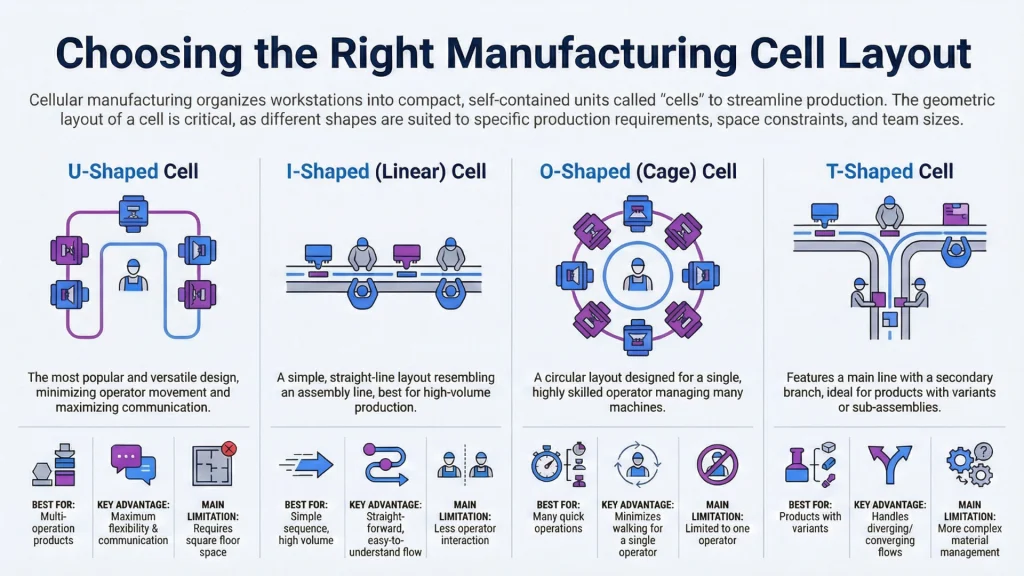
Manufacturing cells can be configured in various geometric patterns, each suited to different production requirements and physical constraints. Understanding these layout options helps you design cells that match your specific needs.
U-Shaped Cell Configuration
The U-shaped cell is the most popular and versatile cell design. Equipment is arranged in a rough U-pattern, with the entry and exit points close together.
This configuration offers several advantages:
- Minimal operator walking distance: Operators can easily access all machines from within the U, reducing movement and fatigue
- Multi-operator flexibility: Multiple workers can operate within the same cell without interfering with each other
- Enhanced communication: The compact design facilitates team communication and visual management across all operations
- Simplified material logistics: Material enters and exits from the same general area, simplifying inbound and outbound logistics
- Maximum machine access: Operators can reach any machine quickly, enabling dynamic workload balancing
- Visual control: Supervisors can observe the entire cell at a glance, immediately identifying bottlenecks or problems
U-shaped cells work well for products requiring multiple operations in sequence and are particularly effective when one or two operators manage the entire cell. The design allows operators to load a machine, walk to the next operation while the first machine runs automatically, and return to unload the first machine when complete—maximizing efficiency.
I-Shaped (Linear) Cell Layout
The I-shaped or linear cell arranges equipment in a straight line, with products entering at one end and exiting at the other. This is the simplest cell configuration and closely resembles a traditional assembly line.
Linear cells work well when production sequences are straightforward and don’t require operators to return to earlier operations. They’re particularly effective for high-volume production where each operation has a dedicated operator. The design also fits well in facilities with long, narrow spaces or where material flow needs to follow a specific direction.
However, I-shaped cells require more floor space than U-shaped cells and can make it difficult for operators to assist each other or balance workload dynamically. They also increase walking distance if operators need to move between non-adjacent operations.
O-Shaped (Cage) Cell Design
The O-shaped or cage cell arranges equipment in a circular or oval pattern, typically operated by a single, highly skilled worker who moves around the interior of the cell.
This design maximizes the number of machines one operator can manage by minimizing walking distance. It works particularly well for operations requiring frequent operator intervention but relatively short cycle times. The circular arrangement allows the operator to follow a consistent path, developing a smooth, efficient rhythm.
O-shaped cells are less common than U-shaped cells but can be highly effective for specialized production scenarios, particularly in job shops or for product families requiring numerous brief operations.
T-Shaped Cell Configuration
T-shaped cells feature a main production line with a secondary branch, creating a T-pattern. This layout is useful when products need materials or components from different sources or when production needs to diverge for customization.
The main stem of the T handles primary operations, while the cross bar can accommodate variant processing, assembly of sub-components, or quality inspection. This configuration provides flexibility for product families with both common operations and specialized variants.
S-Shaped and Custom Layouts
S-shaped cells curve through the available space, useful for working around facility obstructions like columns, existing equipment, or utility connections. While the shape may be irregular, the principle remains the same: sequential operations arranged to create smooth flow.
In practice, many cells don’t conform perfectly to any standard geometric shape. The key is arranging equipment to minimize travel distance, facilitate communication, and enable efficient workflow—regardless of whether the result is a perfect U, I, O, T, or S.
Cell Layout Comparison Table
| Layout Type | Best For | Operator Count | Space Efficiency | Key Advantage | Main Limitation |
| U-Shaped | Multi-operation products, moderate volume | 1-3 operators | High | Maximum flexibility and communication | Requires square floor space |
| I-Shaped | Simple sequence, high volume, dedicated operators | 3-8 operators | Medium | Straightforward flow, easy to understand | Long walking distance, less operator interaction |
| O-Shaped | Many quick operations, skilled single operator | 1 operator | Very High | Minimizes walking for single operator | Limited to one operator, narrow application |
| T-Shaped | Products with variants or sub-assembly needs | 2-5 operators | Medium | Handles diverging/converging flows | More complex material management |
| S-Shaped | Constrained spaces, long process sequences | 2-6 operators | Variable | Works around physical constraints | May have longer travel distances |
Benefits of Cellular Manufacturing
The advantages of cellular manufacturing are substantial and well-documented across industries. Companies that successfully implement cellular manufacturing typically see dramatic improvements across multiple performance metrics.
Reduced Lead Times and Cycle Times
Perhaps the most significant benefit is the reduction in manufacturing lead time—the total time from when production begins until the finished product is ready for shipment.
In traditional batch-and-queue environments, parts spend 95% or more of their time waiting in queues between operations. A part that requires only 30 minutes of actual processing time might take two weeks to complete as it waits in line at each department.
Cellular manufacturing eliminates most of this queue time through one-piece flow and dedicated resources. Lead time reductions of 75-90% are common, with some companies cutting 14-day lead times to 48 hours or less. This responsiveness provides a significant competitive advantage, enabling faster delivery to customers and reducing the need for finished goods inventory.
Improved Quality Control and Defect Detection
Quality improves dramatically in cellular environments for several reasons. When operations are adjacent, defects are discovered almost immediately rather than after large batches are completed. This enables quick corrective action before significant scrap accumulates.
The compact cell layout facilitates communication between operators at sequential operations. If a downstream operator notices a quality issue, they can immediately alert the upstream operator who caused it, enabling instant feedback and correction.
Cross-trained workers develop a better understanding of how their operation affects subsequent steps, leading to more quality-conscious behavior. The visual nature of cells makes quality problems obvious, creating social pressure for consistent performance.
Companies implementing cellular manufacturing typically report defect reductions of 50-80%, with some achieving near-zero defect rates in mature cells.
Typical Performance Improvements from Cellular Manufacturing
| Performance Metric | Typical Improvement Range | Example: Before Cells | Example: After Cells | Business Impact |
| Manufacturing Lead Time | 75-90% reduction | 14 days | 1-2 days | Faster customer delivery, reduced finished goods inventory |
| Work-in-Process Inventory | 60-80% reduction | 6-7 days of WIP | 1 day of WIP | Lower carrying costs, less capital tied up |
| Floor Space Required | 30-50% reduction | 6,000 sq ft | 1,200-3,000 sq ft | Opportunity to expand without new facility |
| Defect Rate | 50-80% reduction | 4% defects | 0.5-1% defects | Lower scrap costs, improved customer satisfaction |
| Setup/Changeover Time | 50-75% reduction | 4 hours | 30-60 minutes | Greater flexibility, smaller economical batch sizes |
| On-Time Delivery | 20-40% improvement | 75% on-time | 95-99% on-time | Enhanced customer satisfaction and retention |
| Labor Productivity | 25-100% increase | 20 units/person/day | 30-40 units/person/day | Lower unit costs, improved competitiveness |
| Return on Investment | Payback in 12-24 months | N/A | N/A | Rapid financial benefits justify investment |
Lower Inventory and WIP Costs
Cellular manufacturing dramatically reduces inventory at three levels. Work-in-process inventory drops as one-piece flow replaces batch processing. Raw material inventory decreases because shorter lead times enable more frequent, smaller deliveries. Finished goods inventory falls because the ability to respond quickly to orders reduces the need for speculative production.
The financial impact extends beyond reduced carrying costs. Less inventory means less capital tied up in materials, less warehouse space required, lower risk of obsolescence, and reduced handling and tracking overhead.
Enhanced Flexibility and Responsiveness
Traditional manufacturing layouts optimize for efficiency in producing large batches of similar items. Changing over to a different product requires coordination across multiple departments, making frequent changeovers impractical.
Cellular manufacturing, with its dedicated resources and simplified flow, enables much faster changeovers. Some cells can switch between products within their family in minutes rather than hours. This flexibility allows manufacturers to produce smaller batches more economically, respond quickly to changing customer demands, and offer greater product variety without significant cost penalties.
The enhanced responsiveness provides strategic advantages, enabling manufacturers to operate with make-to-order models rather than building inventory speculatively.
Improved Employee Engagement and Skills
The cellular approach often leads to higher employee satisfaction and engagement. Cross-training makes work more varied and interesting, reducing monotony. Team-based cells create a sense of ownership and accountability for results. The compact layout facilitates communication and collaboration.
Workers in cells typically develop broader skills and deeper understanding of the complete production process, making them more valuable to the organization and creating better career development opportunities. Many companies report reduced absenteeism and turnover after implementing cellular manufacturing.
Challenges and Limitations
While cellular manufacturing offers substantial benefits, it’s not a universal solution. Understanding the challenges and limitations helps you make informed decisions about whether and how to implement cells in your operation.
Implementation Costs and Equipment Relocation
Moving equipment to create cells involves significant costs. Large, heavy machines may require rigging specialists and facility modifications. Utilities—electrical, compressed air, coolant systems—must be rerouted. Machine foundations may need to be built in new locations.
For facilities with very expensive equipment or “monuments” (extremely large or complex machines that are difficult to move), the cost of creating physical cells may be prohibitive. In such cases, virtual cells—where equipment remains in place but is dedicated to specific product families—may be a more practical alternative.
The good news is that the ongoing operational savings from cellular manufacturing typically exceed the one-time implementation costs, often delivering positive return on investment within 12-18 months.
Machine Breakdown Vulnerabilities
In traditional layouts, when a machine breaks down, work can often be routed to another similar machine in the same department, minimizing disruption. In cellular layouts, since each cell typically has only one of each type of machine, a breakdown can halt the entire cell.
This vulnerability requires robust preventive maintenance programs to minimize unplanned downtime. Total Productive Maintenance (TPM) practices, where operators perform routine maintenance and care for their equipment, become essential in cellular environments.
Some manufacturers mitigate this risk by maintaining spare machines that can be quickly moved into cells when breakdowns occur, or by designing cells with some redundancy for critical operations.
Product Mix and Volume Constraints
Cells work best for product families with stable, predictable demand and similar processing requirements. Products that are produced infrequently or in very small quantities may not justify dedicated cell resources.
Similarly, cells designed for a specific production volume can struggle when demand fluctuates significantly. A cell balanced for 100 units per day may have excess capacity at 50 units per day or insufficient capacity at 150 units per day.
Successful cellular operations often maintain some flexibility by designing cells that can accommodate variable staffing levels (adding or removing operators as volume changes) or by maintaining some traditional “job shop” capability for low-volume, high-variety work that doesn’t fit well in cells.
Change Management and Employee Resistance
The transition to cellular manufacturing represents a significant cultural change. Workers accustomed to specialized roles may resist cross-training. Supervisors may be uncomfortable with increased employee autonomy. Engineers may resist moving expensive equipment or disrupting established processes.
Successful implementation requires strong change management, including clear communication about why the change is necessary, involvement of workers in cell design, comprehensive training, and patience during the learning curve period.
Organizations should expect 3-6 months or more for new cells to reach full productivity as teams develop working rhythms and resolve initial issues.
Implementing Cellular Manufacturing: A Step-by-Step Guide
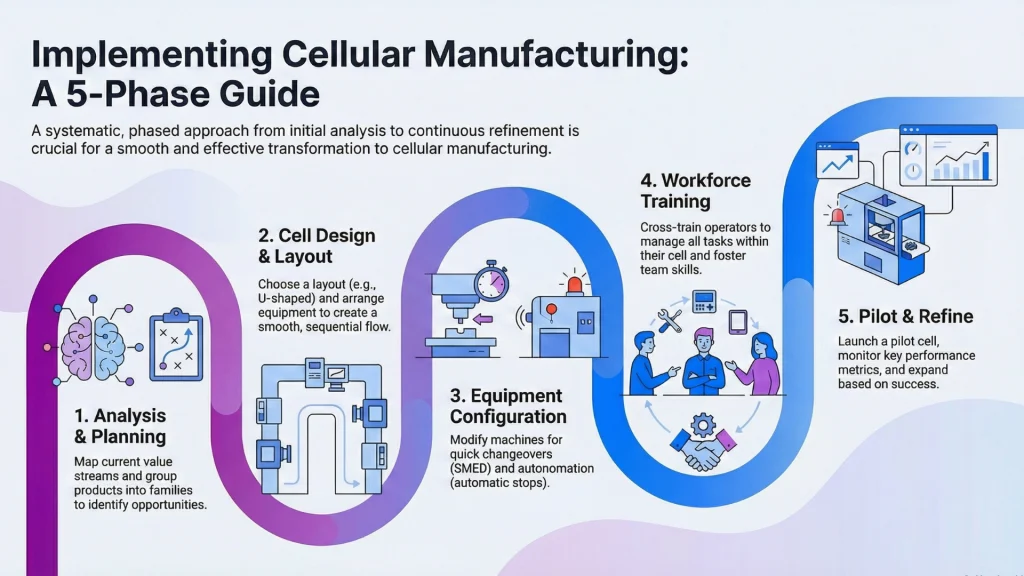
Successfully implementing cellular manufacturing requires careful planning, systematic execution, and continuous refinement. This proven approach guides you through the process.
Phase 1: Analysis and Planning
Begin by understanding your current state and identifying opportunities for cellular organization.
Key Analysis Activities:
- Product-Quantity Analysis: Examine your product mix to identify high-volume candidates for cellular production and group similar items into product families
- Value Stream Mapping: Document current state flow including processing time, queue time, travel distance, and handoffs between departments
- Takt Time Calculation: Determine the production pace required to meet customer demand and ensure cell resources can support that pace
- Capacity Assessment: Calculate equipment and labor capacity needed for each product family within the cell
- Part Family Identification: Group products that follow similar routing sequences or require similar operations
- Waste Analysis: Identify the seven wastes of manufacturing (transport, inventory, motion, waiting, overproduction, over-processing, defects) in current processes
- Current State Metrics: Establish baseline measurements for lead time, inventory levels, quality, floor space, and productivity
Conduct Product-Quantity Analysis: Examine your product mix to identify candidates for cellular production. Look for product families—groups of items that follow similar routing sequences or require similar operations. High-volume products or product families with stable demand are ideal starting points.
The 80/20 rule often applies: 20% of your products typically represent 80% of your volume. Focus initial cellular efforts on these high-runners to maximize impact.
Create Value Stream Maps: Document the current state flow for candidate product families. Track every step each product takes through your facility, including processing time, queue time, travel distance, and handoffs between departments.
Value stream mapping reveals waste in your current process and provides a baseline for measuring improvement. It also helps identify which operations should be included in cells and how equipment should be sequenced.
Calculate Capacity Requirements: Determine the equipment and labor capacity needed to meet demand for each product family within the cell. Use takt time calculations to understand the pace of production required and ensure cell resources can support that pace.
Phase 2: Cell Design and Layout
With analysis complete, design the physical and organizational structure of your cells.
Select Cell Layout Type: Choose the geometric configuration (U-shaped, I-shaped, etc.) that best fits your production requirements, product characteristics, and available space. Consider operator movement patterns, material flow, and communication needs.
Arrange Equipment: Position machines in the sequence required for production flow. Minimize distances between sequential operations while ensuring adequate space for operators to work safely and efficiently. Consider ergonomics, lighting, and access to utilities.
Design Material Flow: Plan how raw materials will be delivered to cells and how finished products will be removed. Implement point-of-use storage for materials and components, placing them as close as possible to where they’re needed.
Plan Visual Management: Incorporate visual controls to make problems obvious and enable quick decision-making. This might include shadow boards for tools, kanban signals for material replenishment, production status boards, and quality metrics displays.
Phase 3: Equipment Configuration and Modification
Prepare equipment to function effectively in the cellular environment.
Equipment Preparation Checklist:
- Right-sizing evaluation: Assess whether large batch equipment should be replaced with smaller, more flexible machines that fit cellular footprints
- Autonomation implementation: Install automatic stop mechanisms and cycle completion signals so operators can confidently manage multiple machines
- Quick changeover procedures: Develop and document SMED (Single-Minute Exchange of Die) methods to enable efficient product switches
- Preventive maintenance upgrades: Enhance maintenance protocols since machine breakdown in cells has greater impact than in traditional layouts
- Ergonomic improvements: Adjust machine heights, positions, and controls for operator comfort and efficiency during multi-machine operation
- Utility modifications: Relocate electrical, compressed air, and coolant connections to support new equipment positions
- Safety enhancements: Install guards, safety interlocks, and emergency stops appropriate for cellular operation patterns
Right-size Equipment: Evaluate whether current equipment is appropriately scaled for cellular production. Large, high-speed machines designed for batch production may need to be replaced with smaller, more flexible equipment that fits better in compact cells.
Implement Autonomation: Modify machines to stop automatically when problems occur and signal when cycles are complete. This autonomation (jidoka) allows operators to manage multiple machines confidently, knowing they’ll be alerted to any issues.
Standardize Changeovers: Develop and document quick-changeover procedures (Single-Minute Exchange of Die – SMED) to enable efficient product switches within cells. Standardization reduces setup time and variability.
Phase 4: Workforce Training and Development
Prepare your team to operate successfully in the cellular environment.
Cross-train Operators: Train cell team members on all equipment and operations within their cell. Begin with basic proficiency on multiple machines, then develop deeper expertise over time. Document standardized work procedures for each operation to support training and ensure consistency.
Develop Team Skills: Since cells function as semi-autonomous units, invest in team problem-solving, communication, and continuous improvement skills. Train teams to conduct root cause analysis, implement countermeasures, and track performance metrics.
Establish Team Leadership: Designate cell leaders or champions responsible for coordinating activities, monitoring performance, and facilitating improvement efforts. These leaders typically emerge from experienced operators who demonstrate both technical skills and leadership ability.
Phase 5: Pilot Implementation and Refinement
Launch cells systematically, learn from experience, and continuously improve.
Start with a Pilot Cell: Rather than transforming your entire facility at once, implement one or two pilot cells for your highest-volume product families. This allows you to learn, refine your approach, and demonstrate results before broader rollout.
Monitor Performance Metrics: Track key indicators to measure cell performance and identify improvement opportunities:
- Lead time: Total time from production start to finished product ready for shipment
- Cycle time: Time required to complete one unit through all operations in the cell
- First-pass yield: Percentage of products that pass through without rework or defects
- On-time delivery: Percentage of orders completed by promised date
- Inventory turns: How many times inventory cycles through the cell annually
- Floor space utilization: Square footage required per unit produced
- Labor productivity: Units produced per operator per shift
- Equipment uptime: Percentage of time machines are operational and producing
- Changeover time: Time required to switch between different products in the cell
- Cost per unit: Total manufacturing cost divided by units produced
Compare these metrics to pre-cell baselines to quantify improvement.
Conduct Regular Reviews: Meet with cell teams daily or weekly to discuss performance, identify problems, and implement improvements. Use the Plan-Do-Check-Act (PDCA) cycle to continuously refine cell operations.
Expand Systematically: Once pilot cells demonstrate success and stabilize, expand cellular manufacturing to additional product families. Apply lessons learned from pilots to accelerate implementation and avoid repeating mistakes.
Cellular Manufacturing in Modern Operations
While cellular manufacturing principles remain constant, modern technology has enhanced how cells are managed and optimized.
Integration with Inventory Management Systems
Real-time inventory management systems have become essential enablers of effective cellular manufacturing. These systems provide visibility into material availability, track work-in-process within cells, and coordinate replenishment—all critical for maintaining smooth flow.
Cloud-based inventory platforms like Qoblex integrate cellular manufacturing operations with broader supply chain activities. When a cell completes products, the system automatically updates inventory levels, triggers replenishment orders for consumed materials, and enables immediate fulfillment of customer orders.
This integration eliminates the manual tracking and paperwork that once burdened cellular operations, allowing teams to focus on production rather than record-keeping. Real-time data also enables faster problem detection and response when material shortages or quality issues threaten flow.
Digital Tools and Real-Time Monitoring
Modern manufacturing cells increasingly incorporate digital technologies that enhance visibility and control. Digital production boards display real-time status, alerting teams to problems or deviations from takt time. Automated data collection systems track cycle times, quality metrics, and equipment performance without manual intervention.
Mobile applications enable supervisors to monitor multiple cells from anywhere, receiving alerts when intervention is needed. Digital work instructions guide operators through procedures with videos and images, improving consistency and reducing training time.
These technologies amplify the inherent benefits of cellular manufacturing by making information more accessible, enabling faster response to problems, and supporting continuous improvement with data-driven insights.
Scaling Cellular Manufacturing Across Multiple Facilities
For companies operating multiple manufacturing locations, cellular manufacturing principles can be replicated across sites while adapting to local conditions. Standardized cell designs enable faster implementation and knowledge transfer between facilities.
Cloud-based systems allow central visibility into cell performance across all locations, enabling comparison of best practices and identification of improvement opportunities. Companies can benchmark cell performance site-to-site, ensuring consistent operational excellence.
Industry Applications and Use Cases
Cellular manufacturing has proven effective across diverse manufacturing sectors, though implementation approaches vary by industry characteristics.
Automotive Manufacturing
Automotive suppliers pioneered many cellular manufacturing practices, using cells to produce components like brackets, housings, and electronic assemblies. The automotive industry’s emphasis on quality, cost reduction, and just-in-time delivery aligns perfectly with cellular manufacturing principles.
Tier 1 suppliers often organize entire facilities into cells dedicated to specific customer platforms, enabling them to quickly respond to customer schedule changes and maintain precise inventory levels.
Electronics and Medical Devices
Electronics manufacturers use cellular manufacturing extensively for circuit board assembly, product testing, and final packaging operations. The high product variety typical in electronics benefits from cellular flexibility, enabling efficient production of many different configurations.
Medical device manufacturers value cellular manufacturing for its quality benefits. The tight integration of operations within cells facilitates traceability and validation requirements, while the visual nature of cells simplifies quality audits and inspections.
Food and Beverage Processing
While food processing presents unique challenges due to strict sanitation requirements and specialized equipment, cellular principles apply effectively. Processing cells dedicated to specific product types minimize changeover and cross-contamination risks while improving flow.
Packaging operations in food and beverage manufacturing particularly benefit from cellular organization, grouping filling, labeling, and case packing operations into integrated cells.
Custom and Make-to-Order Manufacturing
Job shops and make-to-order manufacturers might seem poor candidates for cellular manufacturing due to high product variety. However, by organizing cells around process types rather than specific products, these manufacturers still achieve many cellular benefits.
A machine shop might create cells for different material types (steel parts, aluminum parts, plastic parts) or part families (rotational parts, prismatic parts), each cell containing the equipment most commonly needed for that category.
Frequently Asked Questions About Cellular Manufacturing
What is the difference between cellular manufacturing and assembly line?
While both arrange operations in sequence, cellular manufacturing is more flexible and typically smaller in scale. Assembly lines are optimized for very high volume production of identical items with specialized, dedicated equipment. Cells accommodate moderate volumes of similar product families using more flexible, general-purpose equipment. Cells emphasize cross-trained workers who can perform multiple tasks, while assembly lines typically feature specialized roles. Finally, cells can switch between products within a family relatively easily, while assembly lines are typically dedicated to a single product.
How much does it cost to implement cellular manufacturing?
Implementation costs vary widely depending on facility size, equipment requirements, and complexity. For small to medium operations, initial investment might range from $50,000 to $500,000, including equipment relocation, facility modifications, tooling, and training. However, most companies recover these costs within 12-24 months through operational savings. Equipment that’s difficult to move or requires expensive utility modifications drives up costs. The good news is that implementation can be phased, starting with pilot cells and expanding as ROI is demonstrated.
What industries benefit most from cellular manufacturing?
Cellular manufacturing works best in industries with moderate to high production volumes, product families that share similar processing requirements, and stable demand patterns. Automotive suppliers, electronics manufacturers, medical device producers, fabricated metal products, and consumer goods manufacturers see particularly strong benefits. However, even low-volume, high-mix job shops can apply cellular principles by organizing around process types rather than specific products.
How long does it take to see results from cellular manufacturing?
Initial results often appear within weeks of launching a cell, with immediate reductions in travel distance and queue time. However, reaching full productivity typically requires 3-6 months as teams develop working rhythms, refine processes, and resolve initial issues. Dramatic improvements in lead time and inventory become visible within 1-3 months. Quality improvements may take longer to stabilize as processes mature and root causes are eliminated. Most companies see full financial payback within 12-24 months.
Can cellular manufacturing work for small businesses?
Absolutely. In fact, smaller manufacturers often implement cellular manufacturing more easily than large corporations because they have fewer organizational barriers and can make decisions quickly. Small manufacturers benefit significantly from reduced inventory carrying costs, faster customer response times, and improved quality—all competitive advantages when competing against larger firms. The key is starting small with one or two cells and expanding based on results.
Getting Started with Cellular Manufacturing
The journey to cellular manufacturing begins with education and assessment. Here’s your practical checklist to begin the transformation:
Initial Assessment Checklist:
- Evaluate current layout: Walk your production floor and document how products flow through existing operations
- Identify product families: Group products with similar processing requirements, routing sequences, or production volumes
- Calculate baseline metrics: Measure current lead time, inventory levels, floor space usage, and quality metrics to establish improvement targets
- Conduct value stream mapping: Document the complete production process including all value-added and non-value-added activities
- Assess team readiness: Evaluate workforce skills, management support, and organizational culture for implementing change
- Visit successful implementations: Tour other manufacturers using cellular manufacturing to see principles in action and learn from their experiences
- Develop business case: Calculate potential benefits and implementation costs to justify investment and secure management buy-in
- Start small: Select one or two high-volume product families for pilot cell implementation before scaling across the facility
Start by evaluating your current manufacturing layout and identifying product families that might benefit from cellular organization. Look for high-volume products with stable demand and similar processing requirements.
Visit other manufacturers who have successfully implemented cells to see the principles in action and learn from their experiences. Industry associations, lean manufacturing consultancies, and manufacturing conferences provide valuable networking opportunities and educational resources.
Consider starting with a value stream mapping exercise to understand your current state and identify waste. This analysis often reveals opportunities for cellular organization while building consensus for change among stakeholders.
When you’re ready to move forward, remember that successful cellular manufacturing requires more than physical changes—it demands new ways of thinking about production organization, employee roles, and continuous improvement. Take a systematic approach, invest in training, and commit to ongoing refinement.
How Qoblex Supports Cellular Manufacturing Success
Implementing cellular manufacturing creates new requirements for inventory visibility, production tracking, and coordination across cells. This is where modern cloud-based systems like Qoblex become essential enablers of cellular success.
Qoblex provides the real-time inventory management that cellular operations demand. Track materials consumed by each cell, automatically trigger replenishment when stocks reach reorder points, and maintain visibility across multiple warehouse locations—all critical for maintaining uninterrupted flow in cellular environments.
The platform’s multi-location capability supports facilities organized into multiple cells, treating each cell as a distinct location with its own inventory and production activities. This visibility enables effective capacity planning and workload balancing across cells.
Production order management in Qoblex aligns perfectly with cellular operations. Create production orders for specific cells, track progress in real-time, and automatically update inventory as products complete. Bills of materials integrate with production orders, ensuring cells have the components they need when they need them.
For manufacturers selling through multiple channels, Qoblex’s order management synchronizes customer orders with cellular production. When orders arrive from Shopify, WooCommerce, Amazon, or other channels, Qoblex automatically routes them to appropriate cells based on product type and capacity availability, then tracks fulfillment through completion.
The platform’s demand forecasting capabilities help optimize cell capacity planning, identifying when volume changes might require adjusting cell staffing or resources. Inventory reports provide visibility into cell performance metrics, supporting continuous improvement efforts.
Perhaps most importantly, Qoblex embodies the “Made Simple” philosophy that aligns with cellular manufacturing principles. Just as cells simplify production flow, Qoblex simplifies inventory and production management—giving you the visibility and control needed for cellular success without the complexity and cost of enterprise ERP systems.
Ready to see how Qoblex can support your cellular manufacturing journey? Start your free 14-day trial today and discover how modern inventory management amplifies the benefits of lean production practices.