

Inventory management software for eCommerce and DTC brands
An online store is only as good as the number behind the buy button. Qoblex puts one live count behind every storefront you run, sells bundles without pre-packing them, posts returns to your books as credit notes, and reports margin at what the goods actually cost: freight and duty included, not the invoice price.
What goes wrong when the store is the stock system
A storefront is built to sell. It is not built to know what you have, what it cost, or what happened when the customer sent it back.
Two stores, one shelf, one oversell
A second store or a marketplace listing sells the same unit twice. The refund costs more than the order, and the review costs more than the refund.
Bundles that lie about stock
A gift set listed as its own SKU shows twelve available when one of its components has four. Pre-packing them ties up stock you could sell individually.
Margin that is not margin
The store knows the sale price and the supplier invoice. It does not know the freight, the duty or the return, so the margin it reports is the best case.
One count behind every storefront
Connect each Shopify and WooCommerce store once. Orders come in, stock levels go back out, and every store is selling from the same pool, so the second store cannot sell what the first one just did.
Different stores can carry different price lists, so the same product sells at a different price or in a different currency per storefront, from one catalogue. Landed cost syncs back to Shopify, so the cost your store reports is the real one.
- Shopify and WooCommerce, with stock and orders synced both ways
- A price list per store, for different prices or currencies on the same product
- Landed cost written back to Shopify
See the Shopify and WooCommerce integrations.
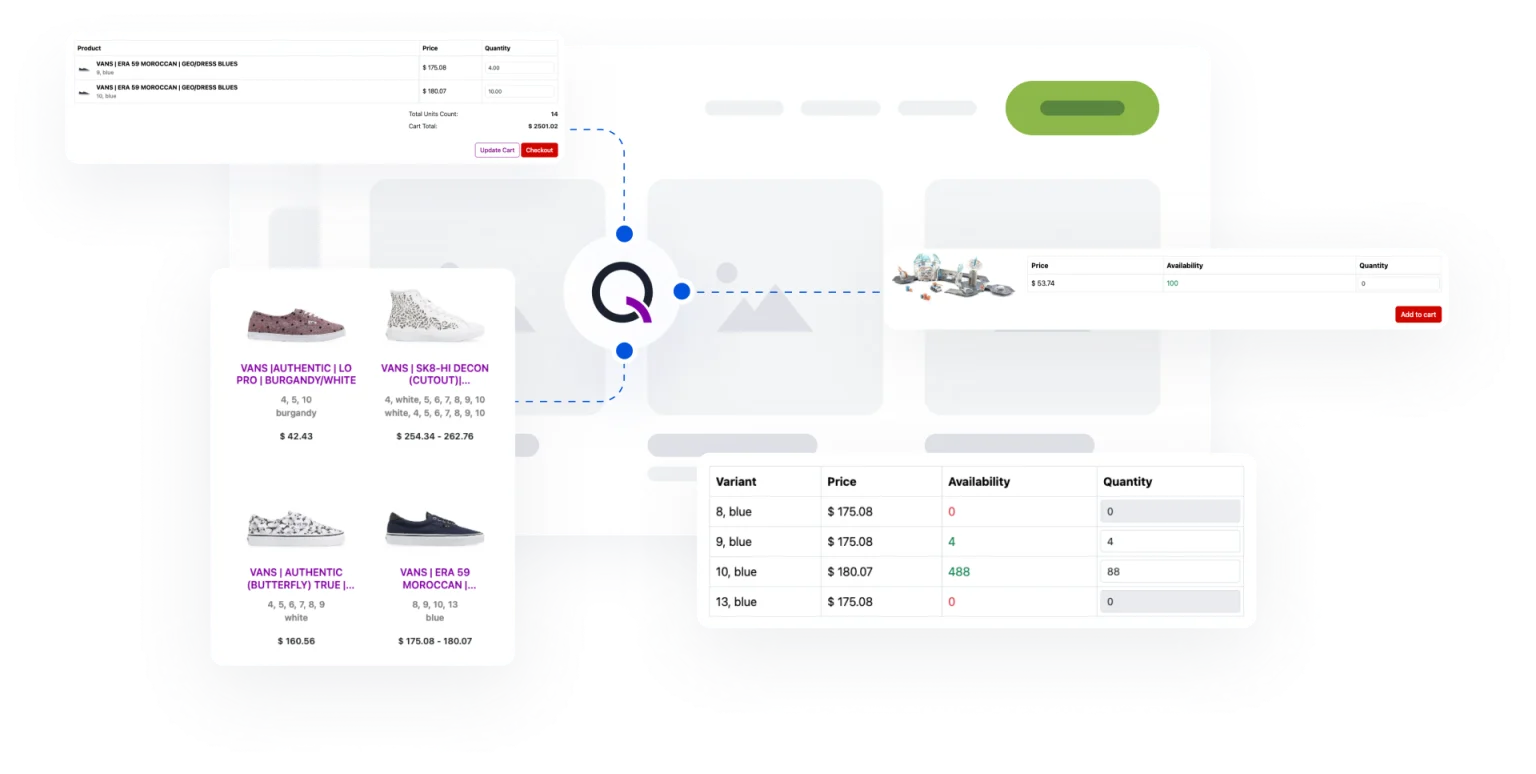
Bundles that draw down their components
A bundle in Qoblex is a grouping, not a pre-packed unit. When the gift set sells, each component comes down; when a component sells on its own, the bundle’s availability moves with it. Nothing is tied up in a box that might not sell, and nothing oversells because a component ran out first.
Unelefante sells a catalogue that is ninety percent bundles and composites. That is the shape of business this was built for.
- Bundles and multi-packs assembled at the point of sale, not in advance
- A bundle report listing every bundle and the components inside it
- Variants (size, colour, option) on the components and the bundle alike
Built for a brand that ships from its own stock
The pieces an online brand actually uses, and where each one is explained.
Multi-store sync
Every store sells from one pool. Stock levels update on every channel as each order lands.
Returns to your books
A refund posts to Xero or QuickBooks as a credit note and adjusts stock on hand and COGS on its own.
Landed cost
Freight and duty allocated across the shipment by value, so a unit’s cost is what it cost to land, not the invoice line.
Margin by product
Sales, COGS, margin and projected profit per product and variant, at the cost on the day it shipped.
Pick, pack and dispatch from a phone
Pick lists on the mobile app, with the camera as the scanner.
A wholesale side when you want one
A private trade store on your own domain, with per-buyer prices, on the same stock as your DTC storefront.

This app is one of the best investments ever! Our inventory problems have been solved. 90% of our products are bundles/composites and Qoblex works perfectly with these types of products. Support is awesome!
Frequently asked questions
Channels, bundles, returns and what a unit really costs.
Which storefronts connect?
Shopify and WooCommerce connect directly, with stock and orders synced both ways, and you can connect more than one store of each. Shopify POS shares the same pool of stock. Other channels can be reached through the API.
How do bundles avoid overselling?
A bundle’s availability is derived from its components, so it can never show more than the scarcest component allows. When the bundle sells, each component is drawn down; when a component sells alone, the bundle count moves with it.
What happens when a customer returns something?
The return is recorded against the order, stock on hand and COGS are adjusted, and a credit note posts to Xero or QuickBooks Online. Your books and your shelf agree without anyone retyping anything.
Does the margin report include shipping I paid the supplier?
Yes. Freight, duty and other charges on a purchase order are allocated across its lines by value and rolled into each unit’s cost when the goods are received. Margin is then reported at that cost. See landed costs.
Can I sell the same product at different prices on different stores?
Yes. Each Shopify or WooCommerce store can be linked to its own price list, in its own currency, from the one catalogue.
How it works
Be up and running in a fraction of the time you’re expecting it to take.
- 1
Talk to an expert
Our experts have helped hundreds of product sellers just like you.
Book a demo - 2
Bring in a specialist
Engage an onboarding specialist to make it much easier for you.
Book a demo - 3
Go live fast
Unlike other systems, we can get you up and running within 1 week.