

Inventory Management API
Every business runs one system Qoblex will never replace, and keeping it in step with your stock usually falls to somebody exporting a file each morning. This inventory management API ends that job: the same engine the app runs on, reachable over HTTP, telling your systems when something changes rather than waiting to be asked. Visit the API reference to see every endpoint.
If a person can do it, the API can do it
Coverage is close to total. Not a slice of the system, and not a read-only export: the same sale orders, stock, purchase orders, shipments, invoices, customers and suppliers your team works with all day. If someone can do it on screen, your code can do it too.
The reference lists every endpoint with a working example, and the whole thing downloads as an OpenAPI file you can point your own tools at.
For the part of your business Qoblex does not run
Every company has one system nobody is going to replace. The API is how that system stops being kept in step by a person with a spreadsheet open at nine in the morning.
Connect the system nobody will replace
Our own integrations cover the sales channels and accounting platforms most businesses use. The API is for the one you have that they do not: an in-house tool, a customer’s ordering portal, a freight provider, a marketplace we have not built for.
Find out when something happens
Webhooks push an event to your endpoint when a record changes, so your system reacts to a shipment or a stock movement as it happens. The alternative is polling every few minutes and being wrong in between, which is the difference between an integration and a scheduled job.
Nothing exotic to learn
REST, resource-oriented URLs, JSON in and JSON out, standard HTTP verbs and status codes. Filtering, sorting and pagination work the same way on every list, and expandable responses let one request return the related records instead of five.
A key you generate yourself
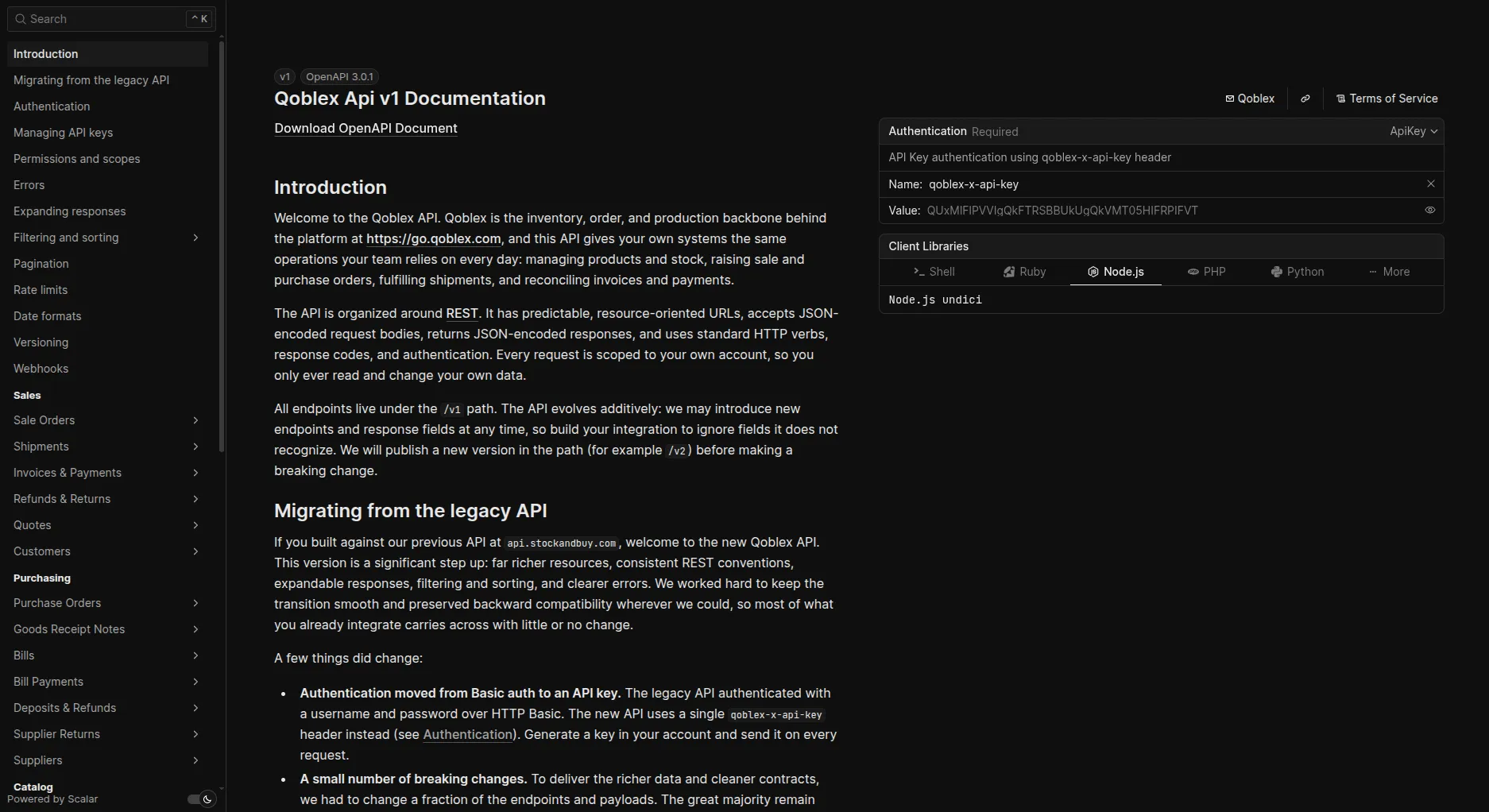
Authentication is one `qoblex-x-api-key` header. Generate the key in your own account, scope what it is allowed to reach with permissions, and revoke it without opening a ticket. Every request is scoped to your organisation, so you only ever read and write your own data.
Changes that do not break your code
Every endpoint lives under `/v1`, and the API evolves additively: new endpoints and new fields can appear at any time, so build to ignore what you do not recognise. A breaking change gets a new version in the path, not a surprise on a Tuesday.
It runs where the rest of Qoblex runs
The platform and its API are hosted on Microsoft Azure. Traffic inside the Azure environment is encrypted, and the network carries the same distributed denial of service protection as the large services that run on it.

We needed to centralise our inventory as we simply could not keep up anymore. So glad we stumbled across Qoblex… After trailing the app it did exactly that and even opened up a pandora’s box of other features that we are now utilising and saving us even more time.
Frequently asked questions
Access, authentication, webhooks and what you can build on it.
Does Qoblex have an API?
Yes. Qoblex is an inventory management system with a full REST API, available on every plan as a paid add-on on Starter and Business and included on Scale. It covers stock, products, sale orders, shipments, invoices, purchase orders, goods receipts, bills and suppliers, authenticates with a scoped API key you generate yourself, returns JSON, is documented as a downloadable OpenAPI 3.0.1 file, and pushes webhooks when records change. See pricing.
What is an inventory management API?
It is an interface that lets your own software read and change stock, orders and purchasing directly, rather than a person exporting a file and importing it somewhere else. A good one covers the whole operation rather than stock levels alone, and tells you when something changes instead of making you ask. This one does both: every resource the app works with is reachable over HTTP, and webhooks push events to you as they happen.
How do I get an API key?
Generate one in your own Qoblex account and send it as a `qoblex-x-api-key` header on every request. There is no application process and no separate developer account. Permissions and scopes control what a key is allowed to reach, so a key built for one integration does not have to be able to do everything.
What can the API actually reach?
The operation, rather than a corner of it. Sales orders, shipments, invoices and payments, refunds and returns, quotes and customers; purchase orders, goods receipt notes, bills and bill payments, deposits, supplier returns and suppliers; and the product catalogue underneath all of it. It is the same engine the app runs on, so what a person can do on screen a system can do over HTTP.
Are there webhooks, or do I have to poll?
There are webhooks. Your endpoint is called when a record changes, so your system can react to a shipment or a stock movement as it happens rather than discovering it on the next poll. Polling still works where it suits you better.
Will an update break my integration?
It should not. Everything sits under `/v1` and the API evolves additively: new endpoints and new response fields can appear at any time, so build your integration to ignore fields it does not recognise. Anything genuinely breaking gets a new version in the path.
I built against the old API. What changes?
The legacy API at `api.stockandbuy.com` still maps closely onto this one, and most of what you already integrate carries across with little or no change. The two differences that matter: authentication moves from HTTP Basic to the `qoblex-x-api-key` header, and a small number of endpoints and payloads changed to deliver richer data. The reference has a migration section covering both.
How secure is it?
The platform and its API run on Microsoft Azure, where traffic inside the environment is encrypted in transit and the network carries automatic protection against distributed denial of service attacks. Requests are scoped to your own organisation, and a key can be revoked or re-scoped at any time.
Can you build a custom integration for us?
No. We do not take on integration work, because it would make us responsible for code we do not run. We will help your developers build it, and we answer questions properly while they do, which is usually what makes the difference to how long it takes.
Is there a Zapier or Make connector?
Not yet. It is on the roadmap. Until then a no-code platform can call the API directly with its generic HTTP step, and webhooks give it something to trigger on.
What does API access cost?
It is a paid add-on on Starter and Business, and included on Scale. See pricing for current terms.
How it works
Be up and running in a fraction of the time you’re expecting it to take.
- 1
Talk to an expert
Our experts have helped hundreds of product sellers just like you.
Book a demo - 2
Bring in a specialist
Engage an onboarding specialist to make it much easier for you.
Book a demo - 3
Go live fast
Unlike other systems, we can get you up and running within 1 week.