


What Is GR/IR and Why Does It Matter for Your Business?
In procurement and supply chain management, the flow of goods and the flow of invoices rarely move in perfect sync. A supplier might deliver products in weekly batches but issue a single consolidated invoice at the end of the month. Alternatively, an invoice might arrive before the goods have even been shipped. This disconnect between goods receipts and supplier invoices is one of the most common challenges in procurement accounting, and it is exactly what the GR/IR (Goods Received / Invoice Received) process is designed to solve.
The GR/IR clearing account, also known as the Purchases Clearing Account or Goods-in-Transit Account, is a temporary holding account in the general ledger. It acts as a bridge between the moment your warehouse receives inventory and the moment your accounts payable department processes the corresponding supplier invoice.
Understanding GR/IR reconciliation is essential for any growing business. Without it, procurement discrepancies can go undetected, leading to overpayments, understated liabilities, inaccurate inventory valuations, and unreliable financial reporting. For small and medium-sized businesses handling dozens or hundreds of purchase orders each month, mastering this process is not just good accounting practice — it is a competitive advantage.
Why Do Goods Receipts and Invoices Fall Out of Sync?
The separation between receiving goods and receiving invoices happens for several practical reasons that are worth understanding, because they directly affect how you need to set up your accounting processes.
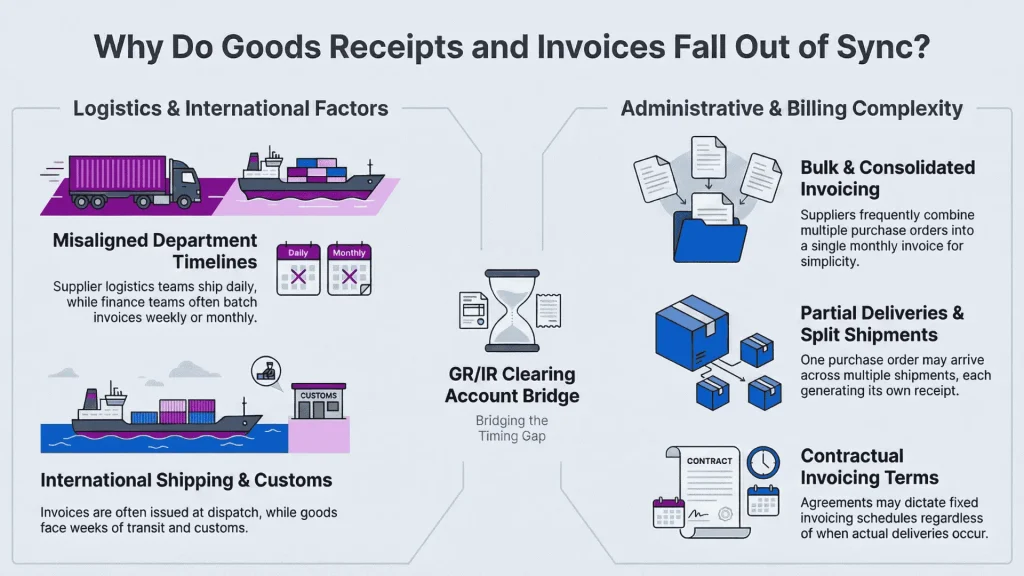
Different teams, different timelines
At your supplier’s end, the logistics team that ships products operates on a different schedule than the finance team that issues invoices. A warehouse manager may dispatch goods daily, while the accounting department batches invoices weekly or monthly.
Contractual invoicing terms
Many supplier agreements define specific invoicing schedules that do not correspond to delivery frequency. For example, a supplier may deliver goods every Tuesday but issue a single consolidated invoice on the last business day of each month. This is especially common in wholesale and B2B procurement relationships.
Bulk invoicing across multiple purchase orders
Suppliers frequently consolidate several purchase orders into a single invoice. This simplifies their accounting but creates additional complexity for buyers who need to match invoice line items to specific deliveries and POs.
Partial deliveries and split shipments
A single purchase order might be fulfilled through multiple shipments over days or weeks. Each delivery creates a goods receipt, but the invoice may cover all deliveries at once or arrive separately for each shipment.
International shipping and customs delays
When goods are imported from overseas, the invoice may be issued at the point of dispatch, but the goods might not arrive at your warehouse for weeks due to transit times, customs clearance, and logistics handling.
All of these scenarios create a timing gap between when your inventory account needs to be updated and when your accounts payable balance should reflect the liability. The GR/IR clearing account is the mechanism that bridges this gap cleanly and accurately.
How GR/IR Accounting Works: Step-by-Step Journal Entries
The GR/IR process involves two key accounting events. Each one triggers a journal entry that flows through the clearing account. When both events have occurred and the amounts match, the clearing account returns to a zero balance, confirming that the transaction is fully reconciled.
Step 1: Recording the Goods Receipt (GR)
When goods physically arrive at your warehouse and are confirmed against the purchase order, the company needs to record the increase in inventory. However, since the supplier’s invoice has not yet been received, the liability cannot be posted to Accounts Payable. Instead, the GR/IR clearing account temporarily holds the credit side of the entry.
| Account | Debit | Credit |
| Inventory (Stock on Hand) | XX.XX | |
| GR/IR Clearing Account | XX.XX |
This entry accomplishes two things: it reflects the real increase in your inventory assets, and it creates a provisional liability in the clearing account representing goods received but not yet invoiced. The inventory is valued at the purchase order price, since that is the best estimate available before the final invoice arrives.
Step 2: Recording the Invoice Receipt (IR)
When the supplier’s invoice is received and verified, the formal liability to the supplier is recorded in Accounts Payable. At the same time, the clearing account is debited to reverse the provisional entry made at goods receipt.
| Account | Debit | Credit |
| GR/IR Clearing Account | XX.XX | |
| Accounts Payable | XX.XX |
If the invoice amount matches the value recorded at goods receipt, the GR/IR clearing account balances to zero and the transaction is considered fully cleared. Any remaining balance in the clearing account signals a discrepancy that requires investigation.
Handling Price Discrepancies Between GR and IR
In practice, the amounts do not always match. Price differences can arise from currency fluctuations, negotiated discounts applied after the PO was created, shipping surcharges, or simple errors. When the invoice amount differs from the goods receipt value, an adjustment entry is required.
In most organizations, the supplier invoice is treated as the source of truth unless there is clear evidence of an error on the supplier’s side. Therefore, the standard approach is to adjust the inventory value (or record the difference in a price variance account) to align with the invoiced amount.
The Three-Way Match: The Gold Standard for Procurement Accuracy
The GR/IR reconciliation process is closely related to what procurement professionals call the three-way match (or 3-way match). This is a fundamental accounts payable control that cross-references three documents before approving a supplier payment:
- Purchase Order (PO) — the original document authorizing the purchase, specifying quantities, prices, and delivery terms.
- Goods Receipt Note (GRN) — the confirmation that goods were physically received, documenting actual quantities and condition.
- Supplier Invoice — the vendor’s bill requesting payment, listing items, quantities, prices, and any taxes or adjustments.
When all three documents agree on quantities, prices, and terms, the invoice is approved for payment. When discrepancies are found, they must be investigated and resolved before payment is released. This process is a critical safeguard against overpayments, duplicate invoices, and procurement fraud.
Why the Three-Way Match Matters
- Prevents paying for goods or services that were never delivered
- Catches pricing errors before they reach your bank account
- Detects duplicate or fraudulent invoices from suppliers or third parties
- Creates a clear audit trail for compliance and financial reporting
- Strengthens supplier relationships by resolving disputes quickly and transparently
- Supports accurate cost of goods sold (COGS) calculations and inventory valuations
GR/IR Reconciliation in Practice: Worked Examples
To make the GR/IR concept concrete, let’s walk through several real-world scenarios with actual journal entries. These examples cover the most common situations you will encounter in procurement accounting.
Example 1: Perfect Match — No Discrepancy
Scenario: A company places a purchase order for 100 units at $10 each. The total PO value is $1,000.
Step 1 — Goods received: All 100 units arrive at the warehouse before the invoice.
| Account | Debit | Credit |
| Inventory | $1,000 | |
| GR/IR Clearing Account | $1,000 |
Step 2 — Invoice received: The supplier sends an invoice for exactly $1,000.
| Account | Debit | Credit |
| GR/IR Clearing Account | $1,000 | |
| Accounts Payable | $1,000 |
Result: The GR/IR clearing account balance is $0. The transaction is fully cleared. The inventory shows $1,000 in new stock, and Accounts Payable reflects the $1,000 liability to the supplier.
Example 2: Price Discrepancy — Invoice Higher Than PO
Scenario: A company orders 100 units at $10 each (PO value: $1,000), but the supplier invoices $1,050 due to a price adjustment or surcharge.
Step 1 — Goods received: Entry based on PO price.
| Account | Debit | Credit |
| Inventory | $1,000 | |
| GR/IR Clearing Account | $1,000 |
Step 2 — Invoice received: The invoice is $50 higher than the goods receipt value.
| Account | Debit | Credit |
| GR/IR Clearing Account | $1,000 | |
| Inventory Adjustment (Price Variance) | $50 | |
| Accounts Payable | $1,050 |
Result: The GR/IR clearing account returns to zero. The $50 price variance is absorbed into inventory value (or posted to a variance account depending on your accounting policy). Accounts Payable reflects the full $1,050 liability.
Example 3: Split Deliveries with Monthly Consolidated Invoice
Scenario: A supplier delivers 50 units per week for 4 weeks at $10 each and issues a single consolidated invoice at month-end.
Each week, as goods arrive, a goods receipt entry is recorded:
| Week | Units | Debit: Inventory | Credit: GR/IR |
| 1 | 50 | $500 | $500 |
| 2 | 50 | $500 | $500 |
| 3 | 50 | $500 | $500 |
| 4 | 50 | $500 | $500 |
Running GR/IR balance after 4 weeks: $2,000 (credit). This represents goods received but not yet invoiced.
Month-end invoice received: The supplier sends a single invoice for $2,000.
| Account | Debit | Credit |
| GR/IR Clearing Account | $2,000 | |
| Accounts Payable | $2,000 |
Result: The GR/IR clearing account returns to zero. All four deliveries are now matched against the single consolidated invoice.
Example 4: Invoice Received Before Goods (Prepaid Scenario)
Scenario: A supplier sends an invoice for $3,000 before shipping the goods, as required by the payment terms (e.g., payment due upon order confirmation).
Step 1 — Invoice received first:
| Account | Debit | Credit |
| GR/IR Clearing Account | $3,000 | |
| Accounts Payable | $3,000 |
At this point, the GR/IR account has a debit balance, indicating that an invoice has been processed but the goods have not yet arrived. This debit balance represents invoiced but not yet delivered items.
Step 2 — Goods received:
| Account | Debit | Credit |
| Inventory | $3,000 | |
| GR/IR Clearing Account | $3,000 |
Result: The GR/IR clearing account returns to zero. The inventory now correctly reflects the received goods, and the full liability sits in Accounts Payable.
Why GR/IR Reconciliation Gets Complicated at Scale
When a business handles a small number of straightforward purchase orders, GR/IR reconciliation is relatively simple. An accountant can easily compare a few invoices against their corresponding goods receipt notes and identify any discrepancies within minutes.
However, as purchase volume grows, the reconciliation process becomes exponentially more complex. Several factors contribute to this increase in difficulty:
- A single purchase order may generate multiple goods receipts (from partial deliveries) and multiple invoices (from progressive billing), creating a many-to-many matching challenge.
- Long-term supplier contracts with open purchase orders can accumulate dozens of receipts and invoices over months, making it difficult to identify which specific delivery corresponds to which invoice line item.
- Multi-currency transactions introduce exchange rate variances that must be accounted for separately from price discrepancies.
- Landed costs such as freight, customs duties, and insurance add layers of complexity to the total cost that needs to be matched against invoices.
- High transaction volumes make spreadsheet-based tracking error-prone and unsustainable, leading to aged open items in the GR/IR account that are difficult to resolve.
Industry data suggests that organizations often set materiality thresholds for resolving GR/IR discrepancies. Small balances below a defined threshold may be written off after a certain aging period (commonly 150 to 270 days), while larger discrepancies require active investigation involving the supplier, accounts payable, procurement, and receiving teams.
This is precisely why growing businesses invest in procurement and order management software that can automate the matching process, flag discrepancies in real time, and provide the visibility needed to keep the GR/IR account clean.
Best Practices for Managing Your GR/IR Clearing Account
Keeping your GR/IR clearing account in order requires a combination of good processes, clear responsibilities, and the right tools. Here are the practices that high-performing procurement teams follow:
- Record goods receipts promptly. Every delivery should be logged in your system on the day it arrives. Delays in recording goods receipts create orphaned invoices that cannot be matched, leading to payment holds and strained supplier relationships.
- Verify goods against purchase orders at the dock. Your receiving team should confirm quantities, item descriptions, and condition against the PO before signing off. Catching discrepancies at receipt is far easier and cheaper than resolving them after invoicing.
- Review the GR/IR account regularly. Do not wait until month-end or quarter-end to check the clearing account. Weekly or bi-weekly reviews help you catch issues early, when they are easiest to resolve.
- Set clear aging thresholds. Define policies for how long a GR/IR balance can remain open before escalation. For example, items older than 30 days might trigger an alert, while items older than 90 days require management review.
- Assign ownership across teams. GR/IR reconciliation should not be the sole responsibility of accounts payable team. Procurement, receiving, and finance teams all play a role, and each should understand their responsibilities in the matching process.
- Use automated matching software. Manual three-way matching is time-consuming and error-prone. Modern procurement systems automate the matching of POs, GRNs, and invoices, flagging only the exceptions that require human judgment.
How Qoblex Simplifies GR/IR Reconciliation for Growing Businesses
For small and medium-sized businesses that are scaling their procurement operations, managing GR/IR reconciliation manually quickly becomes a bottleneck. Spreadsheets break down, discrepancies pile up, and the month-end close becomes a stressful marathon of matching receipts to invoices.
Qoblex has built a sophisticated Purchase Order module specifically designed to handle the complex real-world scenarios described in this article, while remaining intuitive enough for non-specialists to operate confidently.
Three-Way Check Built Into Every Purchase Order
Qoblex’s PO module natively supports three-way matching. The system verifies that the purchase order, goods receipt, and supplier invoice all agree on items, quantities, and prices before allowing a purchase order to be closed. If discrepancies exist, they are flagged immediately so your team can investigate and resolve them before they affect your financial statements.
Partial Billing and Partial Receiving
Real-world procurement is messy. Suppliers deliver in batches. Invoices arrive in installments. Qoblex handles all of this seamlessly, supporting partial goods receipts (GRNs) and partial bills on any purchase order. Each partial receipt and bill is tracked individually and matched against the PO, giving you complete visibility into what has been received, what has been invoiced, and what is still outstanding.
Automated Accounting Sync via GR/IR Clearing Account
Qoblex synchronizes all purchasing-related entries with a GR/IR clearing account that you select from your existing chart of accounts in QuickBooks or Xero. Every goods receipt and every invoice automatically generates the correct journal entries, eliminating manual data entry and reducing the risk of posting errors. The platform also supports moving average cost (MAC) calculations and landed costs, ensuring that your inventory valuations are always accurate.
Powerful Filtering and Reporting
Within the PO module, you can filter purchase orders by delivery status, billing status, supplier, and more. This makes it easy to identify orders that have been partially received but not yet invoiced, or fully delivered but with open billing discrepancies. In addition, Qoblex’s advanced Reporting module lets you build fully customizable reports tailored to your specific operational and financial needs, providing the insights you need for confident, data-driven decision-making.
Conclusion: GR/IR Reconciliation Is a Foundation of Procurement Excellence
The GR/IR clearing account may not be the most visible part of your accounting system, but it is one of the most important. It ensures that every dollar you spend on inventory is accurately recorded, that every supplier liability is properly recognized, and that discrepancies are caught before they can compound into serious financial issues.
For growing businesses managing increasing volumes of purchase orders, deliveries, and invoices across multiple suppliers and channels, mastering GR/IR reconciliation is essential. The three-way match between purchase orders, goods receipts, and supplier invoices is the gold standard for procurement accuracy, and the right software makes it achievable without adding headcount or complexity.
Ready to simplify your procurement accounting? Try Qoblex free for 14 days and see how automated three-way matching, real-time inventory sync, and seamless accounting integration can transform your purchase order management. No credit card required.
Reconciling this in practice
GR/IR differences usually come from receipts and bills being recorded in separate places.
- purchase orders with goods receipts — goods receipts matched against supplier bills
- landed cost tracking — freight and duty carried into the receipt, not booked later