



The best Katana alternatives in 2026 are Qoblex, Zoho Inventory, MRPeasy, Unleashed, Fishbowl, inFlow, Cin7 Core, and Odoo. Katana is a strong manufacturing and MRP tool, but teams that need lot, batch, serial number, and expiry date tracking must purchase the Full Traceability add-on separately. Qoblex is the top pick for SMBs needing inventory, purchasing, light manufacturing, and built-in traceability while keeping Xero or QuickBooks Online as their book of record.
Why look for a Katana alternative?
Most people who go looking for a Katana alternative are not unhappy with Katana as a manufacturing tool. They ran into a specific wall. Usually it is this: the production side works fine, but the traceability their product actually requires, the lot numbers, the expiry dates, the ability to answer “which batch went where” in a hurry, sits in a place they did not expect.
If you make food, beverages, supplements, or cosmetics, that gap is not a nice-to-have. It is the reason you are buying software in the first place.
What makes Katana a strong tool, and where it hits its limits
Katana is manufacturing-first. It is built around a real-time production scheduler, bill-of-materials management, and shop-floor visibility, and for a maker whose core problem is production it does that job well. It also connects natively to Shopify, WooCommerce, Amazon, Xero, and QuickBooks Online, with integrations included on the Free and Core plans rather than sold as a separate paywall. If your day is about turning raw materials into finished goods on a schedule, that is a real strength.
The current plans are Free, Core, and Advantage. If you are reading older comparison pages that mention Starter, Standard, or Professional, those names were retired in a 2026 restructure. The Advantage tier is the enterprise step-up, billed as an annual custom contract.
Where Katana hits its limit for a regulated business is not the production engine. It is what happens when your compliance requirement and your production tool land on different plans.
Does Katana include lot and batch tracking in the base plan?
No. In Katana, serial number tracking, batch tracking, and expiry date tracking are part of the Full Traceability add-on, a separate module purchased on top of the Core base plan. Lot, batch, serial, and expiry tracking are not included in Core itself.
This is not a criticism of how Katana is packaged. Plenty of makers never need lot or expiry tracking at all, and for them a lean Core plan is exactly right. But if you are a food or supplement brand, traceability is not an optional extra you might grow into. It is table stakes on day one. So the practical question becomes whether traceability belongs in the base of the tool you run, or in a module bolted on beside it.
On billing, Katana offers both monthly and annual plans. Annual plans are paid upfront and are non-refundable for their term, which is normal for the category but worth knowing before you sign rather than at renewal.
What should a Katana alternative include?
Before you compare tools, get clear on what you actually need to run. For a business that outgrew a spreadsheet but is nowhere near needing an ERP, a good alternative usually covers most of this:
- Traceability that fits your vertical, in the base of the tool. If you handle food, beverage, supplements, or cosmetics, lot and batch tracking, expiry dates, and recall readiness are the job, not an upsell.
- Light manufacturing that is enough, not more. Bill-of-materials and production orders for real assembly work, without paying for a full MRP suite you will not staff.
- Native accounting sync. A real two-way connection to Xero or QuickBooks Online, so the tool closes your inventory gap while your books stay your book of record.
- Native multichannel. Two-way sync with Shopify, WooCommerce, and Amazon if you sell online.
- Multi-warehouse and purchasing in the same place, so your stock, your suppliers, and your orders agree with each other.
- Billing that matches your risk appetite. Monthly options so you are not locked in while you are still deciding.
Most tools on this list clear the basics. The one thing that separates them for a regulated buyer is that first point, traceability, and specifically whether it is in the base plan or sold beside it.
The best Katana alternatives in 2026: quick comparison
Here is the shortlist at a glance, ranked and compared on the capabilities that actually decide the choice. Capability details for each tool are based on their published product documentation, verified in July 2026; confirm current scope with each vendor before you commit.
A note on cost, since it is usually what started the search. The lighter tools here are self-serve, so you can import your data and be operational without a formal implementation project, while the heavier platforms expect a setup effort to match their depth. We are keeping specific figures off this page because they move; check each vendor’s own pricing page for current numbers, and Qoblex’s pricing here.
Detailed reviews
1. Qoblex, the best Katana alternative for regulated SMBs
Qoblex is the operational system between a spreadsheet and a bloated ERP. It handles inventory, purchasing, order management, light manufacturing, and traceability in one place, and it connects natively to Shopify, WooCommerce, Amazon, Xero, and QuickBooks Online. That last part is the point for a Katana shopper: Qoblex closes your inventory and traceability gap while your existing accounting and sales channels stay your book of record. You are not migrating your whole business, you are plugging the hole in the middle.
For the regulated buyer, the fit is the whole story. You get lot and batch tracking, expiry dates, serial number tracking, purchase orders, multi-warehouse, and native lightweight MRP and bill-of-materials in one platform, rather than a production tool on one plan and traceability on a module beside it. Lot, batch, serial, and expiry tracking come as a paid tracking add-on rather than in the base plan; the structure and current figures are on the pricing page. Setup is self-serve, and there is a 14-day free trial with no credit card.
Best for: food, beverage, supplement, and cosmetics brands, and other SMBs that need real traceability alongside purchasing and light manufacturing, without an ERP-scale implementation.
The trade-off, honestly: Qoblex ships lightweight MRP, not a heavy shop-floor scheduler. If your core problem is complex production scheduling and real-time shop-floor visibility, Katana or MRPeasy may be the better-fitting engine, and that is covered below.
2. Zoho Inventory
If your business already runs on Zoho, Zoho Inventory is the path of least resistance. It handles multichannel orders, batch tracking with expiry dates and FEFO batch selection, and warehouse basics, and it slots neatly into Zoho Books and the wider Zoho suite. There is a free tier for very small operations, which makes it the natural lowest-cost starting point. The catch is that its manufacturing is limited to kits and bundles via composite items, with no BOM or MRP module, so a maker who needs real BOM and production workflows will feel the ceiling.
Best for: small teams already committed to Zoho.
3. MRPeasy
MRPeasy is the closest like-for-like if what you liked about Katana was the manufacturing engine but you want lot and serial traceability with expiry dates without treating it as a separate module. It is a genuine MRP tool for small manufacturers, with production planning, BOM, and stock control, and it connects natively to Xero and QuickBooks Online. If production scheduling is your center of gravity and traceability is a close second, it is worth a serious look.
Best for: lean manufacturers who want MRP depth with traceability in the same tool.
4. Unleashed
Unleashed is a long-standing wholesale and manufacturing platform with batch tracking, expiry dates and FEFO batch selection, serial number tracking, and a deep native Xero relationship. Its multi-level BOM with assembly and disassembly makes it a capable, slightly more traditional B2B tool, and it suits teams whose world is wholesale distribution with some light assembly on top.
Best for: wholesale and light-manufacturing teams anchored on Xero.
5. Fishbowl
Fishbowl is the best-known QuickBooks-tied inventory and manufacturing platform, with lot, batch, serial and expiry tracking as built-in part-tracking types and solid multi-level BOM and manufacturing features in Fishbowl Advanced. If QuickBooks is the center of your world and you want inventory that speaks its language, Fishbowl is a natural fit; it also supports Xero natively. It offers a native Shopify plugin but reaches other channels through its Fishbowl Commerce hub rather than direct connectors, so weigh that against how much you sell online.
Best for: QuickBooks-centric manufacturers.
6. inFlow Inventory
inFlow is a clean, approachable tool for small teams. Its serial number tracking is generally available, while lot/batch tracking with expiry dates is in beta as of mid-2026, so if lot traceability is your reason for buying, confirm its current availability with the vendor before you commit. It offers BOM and multi-level assembly through manufacture orders, and a built-in B2B showroom that is genuinely useful if you take wholesale orders. It bills monthly with no mandatory long-term contract, which lowers the risk while you evaluate.
Best for: small teams that want simple lot tracking and a B2B ordering portal built in.
7. Cin7 Core
Cin7 Core is a step up in weight: a mid-market inventory and warehouse platform with batch, serial and expiry tracking on all plans and real depth. Worth knowing for a regulated buyer: FEFO enforcement, the pick validation that actually blocks a non-FEFO pick, sits in the higher-tier WMS rather than the entry plan, and full MRP is a higher-tier feature too. That depth is the appeal and the friction, because it expects a setup effort and a team to run it. If you are genuinely growing into mid-market WMS needs, it is worth the look. If you are still SMB-sized, it is often more platform than the job requires. We cover it in detail in our Cin7 alternatives comparison.
Best for: growing businesses that need mid-market WMS depth.
8. Odoo Manufacturing
Odoo is an open-source business platform with a modular inventory app that covers lot and serial tracking with four expiry-date categories, plus a full Manufacturing module with multi-level BOMs, routings, and capacity planning. One thing to check for your stack: only Amazon connects through a native Odoo module, while Shopify, Xero, and QuickBooks are reached through third-party App Store connectors, so confirm the sync depth you need before you commit. Odoo is endlessly configurable, which is both the appeal and the warning: real cost and complexity depend heavily on how many apps and users you add, and it rewards teams with the technical appetite to configure it.
Best for: tech-savvy teams that want open-source and are willing to configure.
Does Katana do lot tracking out of the box, or is it an add-on?
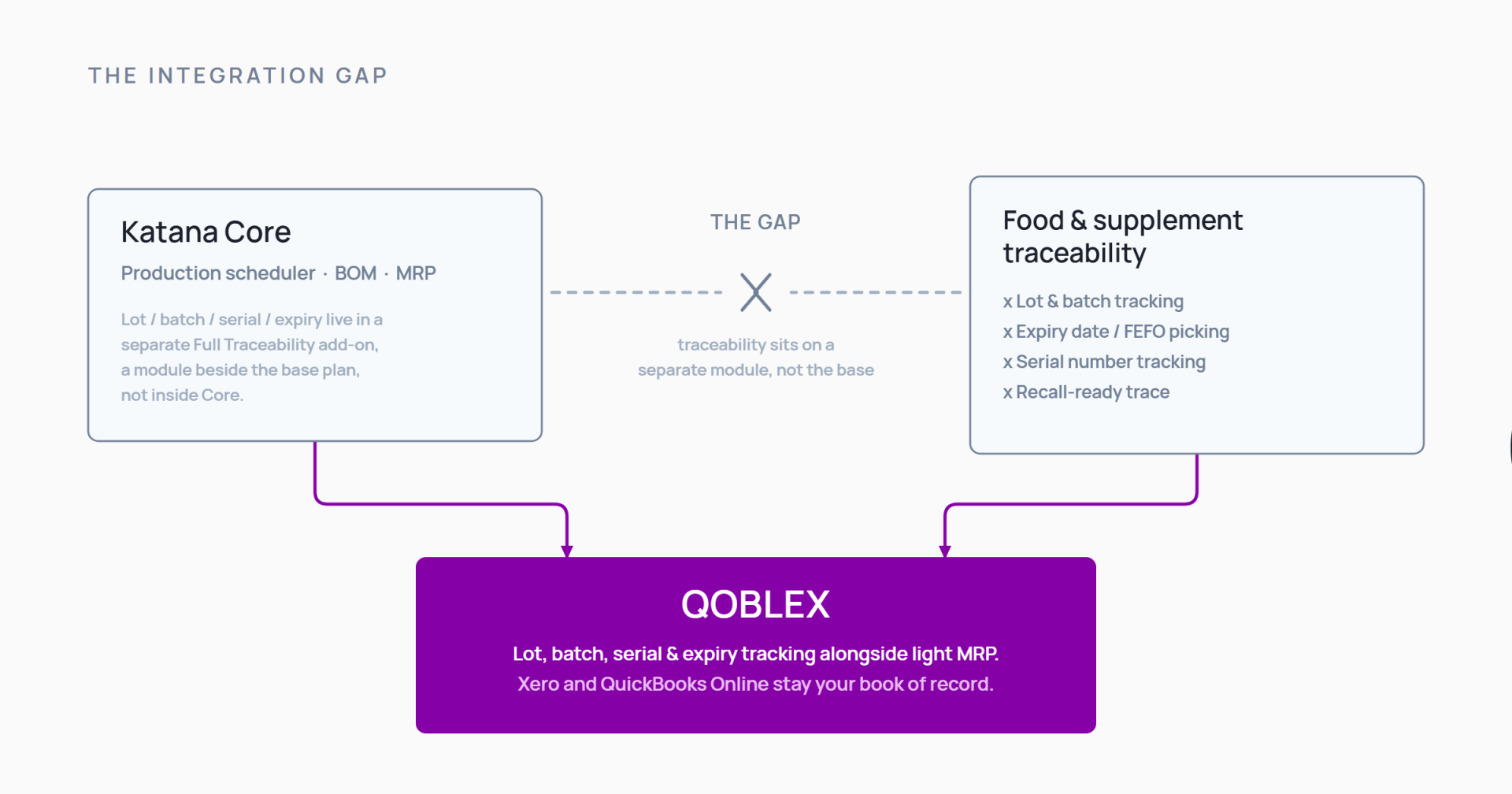
This is the section that decides it for a lot of Katana shoppers, and it is the part most comparison pages skip. If you sell food, beverage, supplements, or anything with a use-by date, traceability is not a feature you compare. It is the reason you are buying software at all.
What the Full Traceability add-on gates in Katana
To recap the structure: in Katana, serial number tracking, batch tracking, and expiry date tracking live in the Full Traceability add-on, a module purchased on top of the Core base plan rather than included in Core. For a maker whose products are unregulated, that split is reasonable: you do not pay for traceability you will never use. For a regulated brand, it means your compliance requirement sits on a separate line from your production tool.
What a food brand or regulated SMB actually needs
The real-world requirement runs as a chain: capture the lot on receipt or production, attach an expiry date, pick so that the soonest-to-expire stock goes first (first-expired-first-out, or FEFO, which orders picking by expiry rather than by receipt date the way FIFO does), and keep the trace intact so that if something goes wrong you can answer one question fast: which lots are affected, and where did they go? That last step is recall readiness, and it is the one that turns a stressful afternoon into a calm, bounded task.
Because that chain has to survive production, the link from raw-material lot to finished-goods batch needs to live inside the system rather than in a spreadsheet stapled to the side. If you want the fuller picture of that vertical, see our guides to lot and batch tracking, expiry and FEFO management, and food and beverage inventory management.
How Qoblex covers it in one place
Qoblex gives you lot, batch, serial, and expiry tracking as a paid tracking add-on on top of its base plan, with self-serve setup and no annual lock-in. Because Qoblex also ships lightweight MRP and bill-of-materials, the trace passes through production instead of stopping at the finished-goods shelf, and your purchasing and multichannel sync sit in the same system rather than in three tools that disagree. The current structure and figures are on the pricing page. The point is not the line item on a spreadsheet. It is that you can be traceable and recall-ready at SMB scale, quickly, while your Shopify, Xero, or QuickBooks Online stay your book of record.
How to pick your Katana alternative
A quick way to narrow it down:
- You sell food, beverage, supplements, or cosmetics and need lot and expiry traceability: Qoblex, then Unleashed or Fishbowl depending on your accounting platform.
- Your core problem is production scheduling and shop-floor visibility: stay with Katana, or look at MRPeasy; choose Qoblex if you also need traceability and multichannel in the same place.
- You want the lowest-cost start and you are already in Zoho: Zoho Inventory.
- You take a lot of wholesale or B2B orders: inFlow or Unleashed.
- You have genuinely grown into mid-market WMS needs: Cin7 Core.
- You want open-source and have the technical appetite: Odoo.
If you are a lean team that wants one platform covering inventory, purchasing, light manufacturing, and traceability, and you want your Shopify and accounting to stay your book of record, Qoblex is the honest first stop.
When Katana is genuinely the right call
Katana earns its place, and it is worth being straight about who it is built for. Choose or stay on Katana when:
- You are a maker or small manufacturer whose core problem is production scheduling and visual MRP: managing BOMs, production orders, shop-floor status, and real-time material availability. That is exactly what Katana is built for, and it does it well.
- You need tight Shopify or e-commerce integration alongside production. Katana’s native multichannel sync across Shopify, WooCommerce, Amazon, Xero, and QuickBooks Online is a genuine strength, not a compromise.
- Your products are not regulated, so you do not need lot, expiry, or serial compliance, or you are happy to add the Full Traceability module because the rest of Katana’s production workflow is the right fit for how you work day to day.
- You are a DTC brand with straightforward manufacturing (apparel, small-batch goods with no strict traceability mandate) and the Katana shop-floor and BOM experience is genuinely what you reach for every day.
If that is you, Katana is a sound choice, and no shortlist should talk you out of it. The question this page answers is the opposite one: if your compliance and traceability needs are the reason you are shopping, the question is whether traceability belongs in the base of your tool or on a module beside it.
How to move from Katana to a new platform
If you decide to move, a calm migration beats a rushed one. A sequence that works:
- Export everything before you cancel. Pull your products, stock levels, suppliers, customers, BOMs, and open orders while you still have full access.
- Reconcile your stock first. Run a full stocktake so you migrate accurate numbers, not accumulated drift.
- Map your accounting ledgers. Identify the accounts your new tool will post to, so the accounting sync lands cleanly from day one.
- Run both systems in parallel for a week or two. Confirm the new platform agrees with reality before you fully cut over.
- Train the team in short, role-based sessions. Purchasing, warehouse, and production each need a focused walkthrough, not one long generic demo.
Done in this order, a switch is a controlled project, not a leap.
FAQ
Does Katana include lot and batch tracking in the base plan? No. In Katana, lot / batch, serial number, and expiry date tracking are part of the Full Traceability add-on, purchased on top of the Core base plan rather than included in Core.
What is the Katana Full Traceability add-on? It is a separate Katana module that adds lot and batch number tracking, serial number tracking, and expiry date tracking. It is not included in the Core base plan and is purchased on top of it.
Is Katana good for food and beverage or supplement manufacturers? Katana can serve these makers, but the lot and expiry tracking a regulated brand needs sits in the Full Traceability add-on, not in Core. If you want traceability in the base of the tool alongside purchasing and multichannel, Qoblex or Unleashed are often a better fit. For the fuller picture, see our food and beverage inventory guide.
What is the cheapest Katana alternative with batch tracking included? Zoho Inventory is the usual lowest-cost entry point and includes batch and expiry tracking, with a free tier for very small operations. Keep in mind that cheapest and best-fit are not the same thing: confirm the tool carries the manufacturing and traceability depth your product actually needs before you decide on price alone.
Which Katana alternatives integrate with Xero and QuickBooks Online? Qoblex, Zoho Inventory, Unleashed, and inFlow all connect to Xero and QuickBooks Online. Confirm the direction and depth of each sync against the vendor’s current documentation for your setup.
Does Katana offer monthly billing without a contract? Yes. Katana offers both monthly and annual billing. Annual plans are paid upfront and non-refundable for their term, and the Advantage tier is an annual custom contract. Read the terms before you sign.
What are the current Katana plan names in 2026? Free, Core, and Advantage. If you see Starter, Standard, or Professional on older pages, those names were retired in a 2026 restructure.
Is Katana a full ERP or a lightweight manufacturing tool? It is a lightweight MRP and manufacturing tool for makers and small manufacturers, not a full ERP. The Advantage tier adds enterprise features, but the core product is built around production scheduling and BOM, not multi-entity ERP consolidation.
Can I migrate my data from Katana to a new platform? Yes. Export your products, stock, suppliers, customers, BOMs, and open orders first, reconcile your stock, then run the old and new systems in parallel briefly before cutting over. See the migration steps above.
Can I try Qoblex before switching? Yes. Qoblex offers a 14-day free trial with no credit card required, so you can load your own data and confirm the fit before committing. See qoblex.com/pricing for current terms.
Conclusion: your next move
Katana is a genuinely good manufacturing tool for the maker it is built for. If your center of gravity is production scheduling and your products are not regulated, it can be exactly right. But if the reason you are shopping is traceability, the lot numbers, the expiry dates, the ability to trace an affected batch without buying a separate module, then the honest question is whether that belongs in the base of your tool or bolted on beside it.
Start by writing down the one operational problem that made you search for an alternative. If it is traceability, or the gap between your inventory and your accounting, that is the gap to close first, and it is the gap Qoblex was built for.

