


Cash based accounting is a straightforward method where income and expenses are recorded only when money is actually received or paid. It provides a clear view of cash flow, making it ideal for small businesses, freelancers, and service-based companies. While simple and easy to manage, this approach has limitations when it comes to long-term financial planning and compliance with standard accounting principles.
What Is Cash Based Accounting?
Cash based accounting is an accounting method where income and expenses are recorded only when cash is actually received or paid. In other words, revenue is recognized when money comes into the business, and expenses are recorded when money goes out, regardless of when the work was performed or the bill was issued.
This method focuses strictly on real cash movement, making it one of the simplest ways to track business finances. Because it mirrors actual bank transactions, cash based accounting provides a clear picture of how much cash a business truly has on hand at any given time.
Cash based accounting is commonly used by freelancers, sole proprietors, and small service-based businesses that do not carry inventory or deal with complex financial structures. While it offers simplicity and immediate cash flow visibility, it does not always reflect long-term financial performance, which is why it is often compared to accrual accounting.
How Cash Based Accounting Works
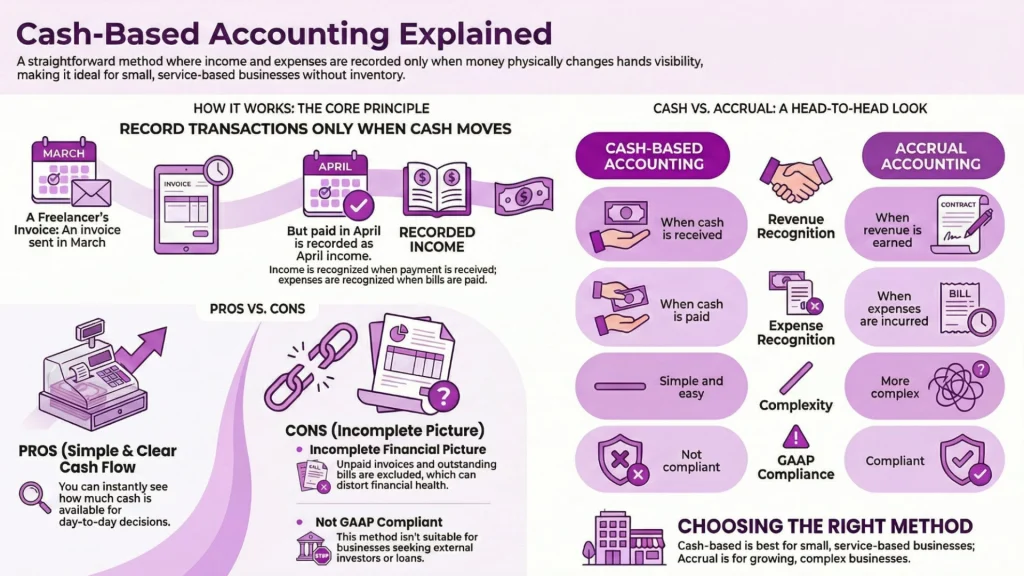
Cash based accounting works by recording financial transactions only when cash physically changes hands. This means that the timing of payments, rather than the timing of invoices or services, determines when revenue and expenses appear in the books.
When a business receives a payment from a customer, that amount is recorded as income at the moment the money is deposited into the bank account or received in cash. If a customer is invoiced but has not yet paid, no revenue is recognized until the payment is actually received.
Similarly, expenses are recorded only when the business pays for goods or services. Bills that are received but not yet paid do not appear as expenses. This approach makes cash based accounting easy to manage and closely aligned with bank statements, but it can delay the recognition of financial obligations.
Cash Based Accounting Examples
To better understand how cash based accounting works, it helps to look at simple, real-world examples.
Imagine a freelance designer who sends an invoice to a client in March for a project worth $2,000. The client pays the invoice in April. Under cash based accounting, the income is recorded in April, not March, because that is when the cash is actually received.
Now consider an expense. The same designer receives a $500 software bill in June but pays it in July. The expense is recorded in July, when the payment is made, rather than in June when the bill was issued. These examples show how cash based accounting strictly follows cash movement rather than economic activity.
Cash Based Accounting vs Accrual Accounting
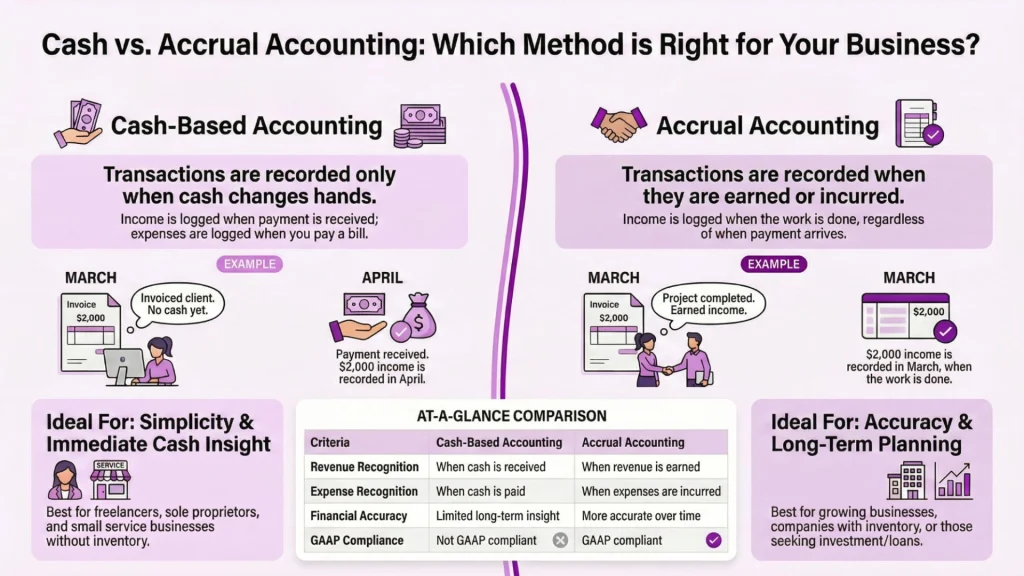
Cash based accounting and accrual accounting differ primarily in when revenue and expenses are recognized. While cash based accounting records transactions only when money is received or paid, accrual accounting records income when it is earned and expenses when they are incurred, regardless of cash timing.
This distinction has a significant impact on how a business’s financial health is portrayed. Cash based accounting emphasizes immediate cash availability, making it easier to track short-term liquidity. Accrual accounting, on the other hand, provides a more accurate picture of long-term performance by matching revenue and expenses to the periods in which they occur.
Because of these differences, each method serves different types of businesses and financial needs. Understanding how they compare is essential when choosing the most appropriate accounting method for your situation.
Key Differences at a Glance
| Criteria | Cash Based Accounting | Accrual Accounting |
| Revenue recognition | When cash is received | When revenue is earned |
| Expense recognition | When cash is paid | When expenses are incurred |
| Complexity | Simple and easy to manage | More complex |
| Financial accuracy | Limited long-term insight | More accurate over time |
| GAAP compliance | Not GAAP compliant | GAAP compliant |
| Best for | Small, service-based businesses | Growing and complex businesses |
Which Method Is Better for Small Businesses?
There is no universal answer, as the best accounting method depends on a business’s size, structure, and financial goals. Cash based accounting is often ideal for small businesses with straightforward operations and immediate cash transactions. Accrual accounting becomes more suitable as businesses grow, take on inventory, or require detailed financial reporting for investors or lenders.
Advantages of Cash Based Accounting
Cash based accounting offers several advantages that make it appealing to small businesses, freelancers, and independent professionals. Its primary strength lies in its simplicity, as it does not require complex accounting adjustments or advanced financial knowledge.
One of the most significant benefits is improved cash flow visibility. Because income and expenses are recorded only when money moves in or out of the business, owners can instantly see how much cash is available. This makes day-to-day financial decisions easier and reduces the risk of overspending.
Cash based accounting also tends to be more affordable to maintain. It requires less bookkeeping effort, fewer accounting resources, and simpler reporting. For businesses with straightforward operations, this method can save both time and money while maintaining clear financial control.
Disadvantages and Limitations of Cash Based Accounting
Despite its simplicity, cash based accounting has several limitations that businesses should carefully consider. One of the main drawbacks is that it does not provide a complete picture of a company’s financial performance. Because unpaid invoices and outstanding bills are excluded, financial reports may appear stronger or weaker than reality.
This method can also make long-term planning more difficult. Since revenue and expenses are tied strictly to cash timing, it becomes harder to track profitability over specific periods or anticipate future obligations. As a result, forecasting and budgeting may lack accuracy.
Additionally, cash based accounting is not compliant with Generally Accepted Accounting Principles. This means it may not be suitable for businesses seeking external investors, loans, or long-term growth. As operations become more complex, these limitations often outweigh the initial simplicity.
Who Should Use Cash Based Accounting?
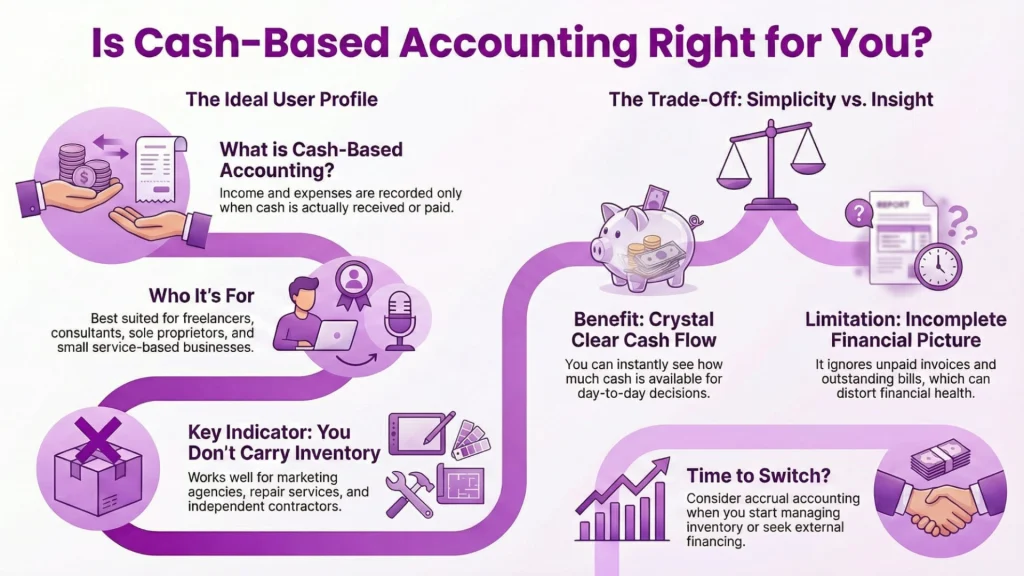
Cash based accounting is best suited for businesses with simple financial structures and predictable cash transactions. It is commonly used by freelancers, consultants, and sole proprietors who provide services and receive payment shortly after invoicing.
Small service-based businesses, such as marketing agencies, repair services, or independent contractors, often benefit from this method because it offers clear insight into available cash without the complexity of advanced accounting rules. Businesses that do not carry inventory or manage long-term contracts are especially well positioned to use cash based accounting effectively.
However, as a business grows in size or complexity, cash based accounting may become less practical. Companies that require detailed financial reporting, manage inventory, or seek outside funding often need a more comprehensive accounting method to support their operations.
Tax Implications and IRS Rules
From a tax perspective, cash based accounting is widely accepted by the Internal Revenue Service, provided certain conditions are met. Many small businesses are allowed to use this method because it aligns taxable income with actual cash received, which can simplify tax planning and cash management.
Under cash based accounting, income is taxed in the year it is received, not when it is earned. Likewise, expenses are deducted in the year they are paid. This timing can offer short-term tax flexibility, especially when businesses want to defer income or accelerate deductions.
However, not all businesses qualify. Companies that carry inventory, exceed certain revenue thresholds, or operate as specific entity types may be required to use accrual accounting. Understanding IRS rules is essential, as choosing the wrong accounting method can lead to compliance issues or the need for formal approval to switch methods later.
When Should You Switch to Accrual Accounting?
As a business grows, the simplicity of cash based accounting can become a limitation rather than an advantage. One of the clearest signs that it may be time to switch to accrual accounting is increased operational complexity. This includes managing inventory, offering long-term contracts, or dealing with delayed customer payments.
Businesses that seek external financing or plan to attract investors often need accrual accounting, as it provides a more accurate and standardized view of financial performance. Lenders and stakeholders typically rely on accrual-based financial statements to assess risk and profitability.
Additionally, regulatory and tax requirements may force a transition. If a business exceeds IRS revenue thresholds or no longer meets eligibility criteria, switching accounting methods becomes mandatory. Making the transition at the right time helps avoid compliance issues and supports long-term strategic decision-making.
Common Mistakes with Cash Based Accounting
While cash based accounting is straightforward, it is often misunderstood or misused. One common mistake is assuming that positive cash flow always means profitability. Because unpaid invoices and future obligations are excluded, a business may appear financially healthy while actually facing upcoming cash shortages.
Another frequent error is neglecting to plan for taxes. Since income is recognized when received, businesses may underestimate future tax liabilities if they do not set aside funds accordingly. This can lead to cash flow pressure during tax season.
Some businesses also rely solely on cash based reports for decision-making, ignoring the lack of long-term visibility. Without tracking receivables, payables, or future expenses, strategic planning becomes less accurate. Recognizing these pitfalls is essential to using cash based accounting responsibly.
FAQ — Cash Based Accounting
Is cash based accounting GAAP compliant?
Cash based accounting is generally not GAAP-compliant. GAAP requires accrual accounting for financial reporting, but small businesses may still use cash accounting for tax purposes.
Can you use cash accounting for inventory?
Typically, businesses with inventory are required to use accrual accounting. Cash accounting is best for service-based businesses without inventory.
Is cash based accounting good for taxes?
Yes, it can simplify tax reporting by aligning income and expenses with cash flow, but eligibility rules must be followed.
Can you switch accounting methods later?
Yes, businesses can switch, but certain IRS approvals and reporting adjustments may be required.
Final Takeaway
Cash based accounting offers simplicity, clear cash flow visibility, and ease of management, making it an ideal choice for small businesses, freelancers, and service-based companies with straightforward operations. By recording income and expenses only when cash moves, business owners gain an accurate view of their available funds and can manage day-to-day finances efficiently.
However, it is important to recognize its limitations. Cash based accounting may not provide a complete long-term financial picture, is not GAAP-compliant, and may become insufficient as your business grows or takes on inventory. Understanding when to switch to accrual accounting is critical for continued success and compliance.
For businesses seeking more detailed guidance, exploring professional accounting tools or consulting with a financial advisor can help ensure accurate records, optimized cash flow, and a smooth transition when needed.