



You launched on Shopify. Then you added Amazon. A wholesale buyer asked for a B2B price list, so you built one. Now you sell in five places, your stock counts never quite agree, and you have oversold a product you did not actually have. This is the moment channel management stops being a marketing concept and becomes a daily operations problem.
This guide covers both sides. First, what channel management actually means and the process behind it. Then, the part most articles skip: how growing retailers, wholesalers, and DTC brands run those channels without the chaos, using real-time inventory sync and consolidated order management. By the end, you will know how to structure your channels, avoid conflict, and decide whether you need software to hold it all together.
What Is Channel Management?
Channel management is the process of organizing, coordinating, and optimizing every route a business uses to sell and deliver its products, whether direct, such as your own online store, or indirect, such as marketplaces, wholesalers, and retailers. Done well, it keeps pricing, inventory, and the customer experience consistent across every channel.
The classic definition comes from distribution and marketing, where “channels” mean the intermediaries who carry your product to the end customer. Distributors, resellers, and value-added resellers sit between the manufacturer and the buyer. That version of channel management is about recruiting partners and managing those relationships.
For modern sellers, the definition has widened. A “channel” today is just as likely to be your Shopify storefront, an Amazon listing, a WooCommerce site, a physical point of sale, or a B2B portal. The strategy still matters, but the hard work has shifted toward execution: keeping every channel synchronized in real time.
Both meanings share the same goal. You want to reach more customers through more routes without losing control of price, stock, or service quality. That balance is what channel management delivers.
Why Channel Management Matters
Every new channel multiplies your reach, and it also multiplies your operational risk. Selling in one place is simple. Selling in five means five inventory counts, five order streams, and five ways for something to break. Channel management is how you scale reach without scaling the mess.
Strong channel management protects three things at once. It keeps your brand consistent across touchpoints, so a customer sees the same product and price wherever they buy. It keeps your margins healthy, because you can see which channels actually make money. And it keeps your operations calm, because stock and orders flow through one coordinated system instead of a dozen spreadsheets.
For a growing business, the payoff is concrete: fewer errors, faster fulfillment, and the confidence to add a new marketplace without dreading the setup. That is why companies managing serious volume treat channel management as core infrastructure. At Qoblex, we have seen this across more than 3.7 billion dollars in merchandise managed through our platform, where the difference between thriving and drowning usually comes down to how well channels stay in sync.
The Cost of Getting It Wrong
When channels drift out of alignment, the failures are predictable and expensive. The most common one is overselling: you sell an item on Walmart that went out of stock on your website minutes earlier. The order gets canceled, the customer leaves a bad review, and your marketplace seller rating takes a hit.
The mirror problem is the stockout. To avoid overselling, nervous sellers hold back inventory on each channel as a safety buffer. That caution quietly starves your best-selling listings and costs you sales you could have made.
Then there is channel conflict, which happens when two of your own sales routes compete against each other. If your DTC site undercuts the wholesale partner who stocks your product, that partner loses trust and may drop your line. Poor channel management turns growth into friction. Good channel management turns it into leverage.
Types of Channels: Direct vs. Indirect
Before you can manage channels, you need to know which kind you are running. Every route to market falls into one of two categories, and most growing brands eventually run both. Understanding the trade-off between them is the foundation of any channel management strategy.
Direct channels put you face to face with the buyer. You own the storefront, the pricing, and the customer relationship. Indirect channels use an intermediary, such as a marketplace or a distributor, who reaches customers you could not easily reach alone. You trade some control and margin for scale.
| Dimension | Direct channels | Indirect channels |
| Examples | Your Shopify or WooCommerce store, POS, B2B portal | Amazon, Walmart, eBay, wholesalers, retailers |
| Control | High. You set price, presentation, and policy | Lower. The platform or partner sets rules |
| Margin | Higher per sale, no marketplace fees | Lower, after commissions and partner discounts |
| Reach | Limited to your own audience | Broad, taps the platform’s existing traffic |
| Customer data | You own it fully | Often limited or owned by the marketplace |
Neither type is better. The right mix depends on your product, your margins, and how much of the customer relationship you want to own. A fashion brand might sell full-price collections on its own site while moving last-season stock through marketplaces.
Channel Architecture Explained
Channel architecture is the blueprint that shows how a product travels from you to the end customer. In its simplest form, it is a straight line: manufacturer sells directly to consumer. In a more layered model, the product passes through a distributor, then a retailer, before reaching the buyer.
A simple way to picture the flow:
- Direct: Manufacturer to customer
- One-tier indirect: Manufacturer to retailer to customer
- Two-tier indirect: Manufacturer to distributor to retailer to customer
Your architecture defines your responsibilities. In a direct model, you handle fulfillment and support yourself. In an indirect model, you rely on partners and must manage pricing carefully so those partners can still make a margin. Designing this deliberately, rather than letting it grow by accident, is the first real act of channel management.
The Channel Management Process: A 5-Step Framework
Channel management is not a one-time setup. It is a repeatable cycle. The traditional process focused on recruiting and evaluating partners; the modern version keeps that thinking but adds the operational sync that eCommerce demands. Here is a five-step framework that works for both distribution partners and digital sales channels.
- Map your channels. List every route you sell through today, direct and indirect, and every route you plan to add. Clarity here prevents surprises later.
- Define channel roles and pricing. Decide what each channel is for and set pricing rules that prevent conflict, so your DTC site and your wholesale partners are not undercutting each other.
- Select and connect your channels. Set up each storefront, marketplace, or partner relationship, and integrate them so data can flow into one place.
- Synchronize operations. Keep inventory, orders, and fulfillment aligned across every channel in real time. This is the execution core, and where most sellers succeed or fail.
- Measure and optimize. Track performance by channel, reallocate stock toward winners, and prune or fix underperformers.
| Step | Focus | Key question |
| 1. Map | Visibility | Where do we actually sell? |
| 2. Define roles | Strategy | What is each channel for, and at what price? |
| 3. Connect | Setup | How do we integrate this channel cleanly? |
| 4. Synchronize | Operations | Is stock accurate everywhere, right now? |
| 5. Measure | Optimization | Which channels earn their place? |
The first three steps are strategy. The last two are where growing businesses spend most of their time, and where the right tools pay for themselves.
Channel Management for eCommerce and Omnichannel Sellers
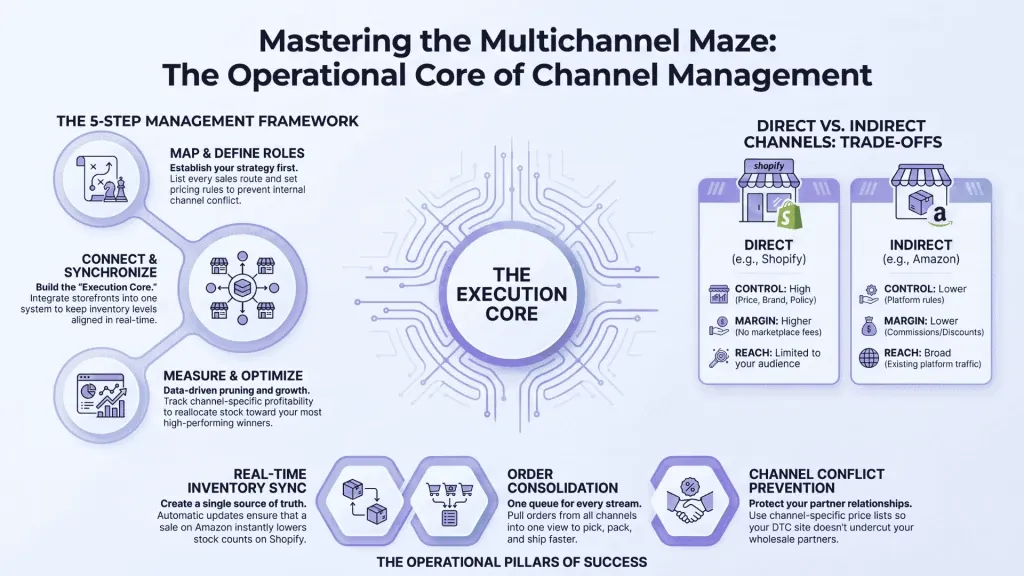
Here is where the theory meets reality. For an online seller, channel management is less about signing distributor contracts and more about making sure a single unit of stock is counted correctly whether it sells on your site, on Amazon, or over the counter. This is the operational discipline behind every smooth omnichannel business.
Your Sales Channels Today
Your channel mix probably looks nothing like a textbook distribution chain. For most growing brands, the channels are a blend of digital storefronts, marketplaces, and increasingly, wholesale. Each behaves differently and demands its own attention.
- Your own online store, built on Shopify or WooCommerce, where you control the experience
- Marketplaces like Amazon, Walmart, and eBay, which bring reach but impose their own rules
- Point of sale, if you also sell in a physical location or at events
- B2B and wholesale, where buyers order in volume at their own negotiated prices
Running these in parallel is the real definition of multichannel selling. The challenge is not launching them. It is keeping them from contradicting each other.
The Operational Core: Real-Time Inventory Sync
If channel management has a single make-or-break function for online sellers, this is it. Real-time inventory sync means that the moment a product sells on one channel, its availability updates everywhere else automatically. Make a sale on Amazon, and your website count drops instantly.
Without this, you are choosing between two bad options: oversell and disappoint customers, or under-list and lose sales to artificial scarcity. Real-time multichannel inventory sync removes the choice. Every channel reads from the same live stock count, which acts as your single source of truth.
This is exactly the problem multichannel inventory management is built to solve. You designate a primary inventory master, connect your channels, and let the system keep stock levels aligned across marketplaces, storefronts, and warehouses. For a cosmetics brand tracking dozens of shades across three sales channels, that accuracy is the difference between a clean fulfillment day and a wave of cancellations.
Order Consolidation and Fulfillment Across Channels
Selling in five places creates five order streams. Order consolidation pulls them into one queue, so your team picks, packs, and ships from a single view instead of logging into each platform separately. This is where multichannel selling stops feeling like five jobs.
A unified order management flow lets you apply the same fulfillment steps everywhere. You generate pick lists, print shipping labels, send tracking notifications, and update stock, all from one place, regardless of where the order originated. For a food and beverage seller shipping perishable goods, that speed and consistency directly protect the product and the customer relationship.
Consolidation also improves accuracy. When every order flows through one order management system, inventory deducts correctly, accounting stays clean, and nothing slips through the cracks between platforms.
Handling Channel Conflict and Pricing in Practice
Channel conflict is not just a strategy-deck concern. It shows up in your pricing table. The most common version for online sellers is your own DTC store undercutting the wholesale partners who resell your product, which erodes their margin and their loyalty.
You solve it with deliberate, channel-specific pricing. Set distinct price lists for retail, wholesale, and each marketplace, and enforce a minimum advertised price where partners are involved. A well-run B2B eCommerce store lets wholesale buyers log in and order at their own agreed prices, separate from your public retail pricing, which removes the conflict at the source.
Channel conflict in practice: An apparel brand sells hoodies at 60 dollars on its own site and supplies boutiques that retail them at 65 dollars. When the brand runs a 40 dollar flash sale sitewide, the boutiques cannot compete and stop reordering. The fix: run promotions on channel-specific SKUs or price lists, not across every channel at once.
Channel Management Software: What It Does and When You Need It
At some point, spreadsheets and manual updates stop scaling. Channel management software centralizes your channels into one platform, automating the sync and consolidation that would otherwise eat your team’s day. It is the practical answer to running many channels well.
Key Features to Look For
Not all tools cover the same ground. Some focus only on listing products; the ones that matter for operations focus on keeping inventory and orders accurate. When you evaluate options, weigh these capabilities.
| Feature | What it does | Why it matters |
| Real-time inventory sync | Updates stock across all channels instantly after each sale | Prevents overselling and stockouts |
| Order consolidation | Brings every channel’s orders into one queue | Faster, more accurate fulfillment |
| Multi-warehouse support | Tracks and allocates stock across locations | Ships from the right place, cuts delays |
| Native integrations | Connects Shopify, WooCommerce, Amazon, and accounting tools | Less manual work, fewer errors |
| Demand forecasting | Predicts what to reorder and when | Avoids both excess stock and stockouts |
| Reporting by channel | Shows revenue and profit per channel | Reveals which channels actually pay off |
The best fit is a system where these features work together, not a patchwork of single-purpose apps you have to stitch together yourself.
Decision Framework: Are You Ready for Software?
You do not need a platform on day one. You need it when manual management starts costing you sales and sleep. Use this checklist. If you answer yes to three or more, it is time.
- You sell on three or more channels and reconcile stock by hand
- You have oversold at least once in the past few months
- You hold safety-buffer stock on each channel because you do not trust your counts
- You log into multiple platforms every day to process orders
- You are about to add a new marketplace and dread the setup
- You cannot easily answer which channel is most profitable
Manual processes work at low volume. The moment complexity outpaces your spreadsheets, software shifts from a nice-to-have to the thing that keeps your business accurate.
How to Measure Channel Performance
You cannot optimize what you do not measure. Once your channels run smoothly, the next job is figuring out which ones deserve more of your inventory, budget, and attention. These are the metrics that tell the truth.
| Metric | What it tells you |
| Channel profitability | Revenue minus all costs and fees, per channel |
| Inventory accuracy rate | How often your displayed stock matches reality |
| Sell-through rate | How quickly stock moves on each channel |
| Reorder rate | Which products and channels drive repeat demand |
| Order fulfillment time | How fast each channel’s orders ship |
| Overselling and stockout rate | How often sync fails or stock runs dry |
Watch channel profitability closely. A marketplace can generate high revenue while thin margins and fees make it your least profitable route. Reporting that breaks results down by channel lets you shift stock toward winners and rethink the rest. Pairing this with demand forecasting turns reactive firefighting into proactive planning.
Frequently Asked Questions
What are the 5 steps of the channel management process?
The five steps are: map your channels, define channel roles and pricing, select and connect your channels, synchronize operations across all of them, and measure and optimize performance. The first three set strategy; the last two handle execution, including real-time inventory sync and channel-level reporting.
What is the difference between channel management and distribution management?
Distribution management focuses narrowly on the physical movement of goods through intermediaries to customers. Channel management is broader: it covers distribution plus pricing, partner relationships, brand consistency, and the coordination of every sales route, direct and indirect. Distribution is one piece of the wider channel management discipline.
What does a channel manager do?
A channel manager oversees a company’s sales and distribution channels. They select and coordinate channels, manage partner or platform relationships, set channel-specific pricing to prevent conflict, and monitor performance. In eCommerce, the role increasingly centers on keeping inventory and orders synchronized accurately across marketplaces and storefronts.
What is channel conflict and how do you prevent it?
Channel conflict happens when two of your sales channels compete in ways that hurt your business, such as a DTC site undercutting wholesale partners. Prevent it with channel-specific pricing, minimum advertised price rules, separate B2B price lists, and promotions targeted to individual channels rather than applied across all of them.
What is channel management software?
Channel management software is a platform that centralizes and automates the operation of multiple sales channels. It syncs inventory in real time to prevent overselling, consolidates orders from every channel into one queue, connects to marketplaces and accounting tools, and reports performance by channel so you can see what truly drives profit.
Key Takeaways
- Channel management is how you sell through many routes, direct and indirect, without losing control of price, stock, or service.
- For modern sellers, the hard part is not strategy but execution: keeping every channel synchronized in real time.
- The five-step process runs from mapping channels to measuring them, with operational sync as the make-or-break middle.
- Overselling, stockouts, and channel conflict are the predictable costs of poor coordination, and all three are solvable.
- Real-time inventory sync and order consolidation are the operational core of multichannel selling.
- Reach for channel management software when you sell on three or more channels and manual reconciliation starts costing you sales.
Channel management stops being abstract the day your fifth channel oversells your best product. The businesses that scale are the ones that treat their channels as one connected system, not five separate jobs. Get the strategy right, then give yourself the tools to keep every channel in sync, and growth becomes something you can add on purpose instead of survive.
Qoblex brings inventory, orders, and your Shopify, WooCommerce, and Amazon channels into one platform, with real-time sync built in. Start your free 14-day trial, no credit card required, and see how simple multichannel selling can be.