


In business, it’s common to invoice and collect payment before the goods are actually shipped. This pattern is especially prevalent in eCommerce, subscription-based businesses, and made-to-order manufacturing. But what happens to your financial statements when the revenue hits the books before you’ve fulfilled the order?
This gap between billing and delivery creates a critical accounting challenge: how do you match the cost of goods sold (COGS) with the revenue it relates to? Getting this wrong can lead to overstated profits, regulatory issues, and audit complications.
In this comprehensive guide, we’ll walk you through everything you need to know about COGS recognition for unearned revenue—what the standards say, why deferring revenue is the right approach, and how to set up the proper journal entries to stay compliant with IFRS 15 and other accounting frameworks.
What Is Unearned Revenue?
Unearned revenue—also referred to as deferred revenue or contract liability—is the money a business receives from a customer for goods or services that have not yet been delivered. From an accounting perspective, this amount is recorded as a liability on the balance sheet, not as income on the profit and loss statement.
Think of it this way: you’ve received the cash, but you still owe the customer something. Until you fulfill that obligation, the payment is not truly earned.
Common Scenarios Where Unearned Revenue Occurs
• Prepaid eCommerce orders: Customers pay at checkout, but the product ships days or weeks later—especially during high-demand periods, stockouts, or when items are sourced internationally.
• Made-to-order products: In custom manufacturing, production only begins after the order is placed. The delivery timeline can range from weeks to months, creating a prolonged gap between payment and fulfillment.
• Backorders: When inventory runs out and customers are billed upfront for items that won’t arrive until the next restock.
• Subscription boxes and recurring deliveries: Payments are collected monthly, but physical shipments follow a different schedule.
• B2B wholesale orders with deposits: Large orders often require prepayment or deposits before production and shipping.
The Timing Mismatch: Revenue vs. Cost of Goods Sold
At the heart of this issue is a fundamental accounting concept called the matching principle. This principle requires that expenses be recognized in the same period as the revenues they help generate. When revenue is recorded in one period but the associated COGS is booked in another, financial statements become distorted.
What Happens Without Proper Matching?
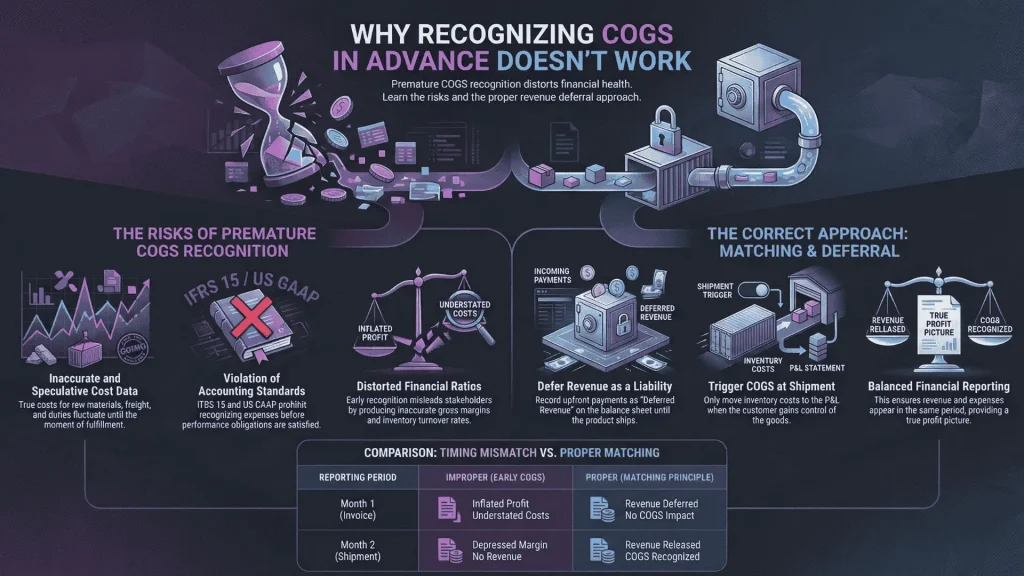
When revenue and COGS are not aligned to the same accounting period, the consequences can be significant. In the period where the invoice is issued, revenue appears inflated while expenses remain understated, making profits look artificially high. Conversely, in the period when the goods are finally shipped, costs hit the P&L without corresponding revenue, which depresses the profit margin.
This creates a financial reporting roller coaster that misleads stakeholders, complicates tax filings, and can raise red flags during audits.
| ⚠️ Real-World ImpactA DTC brand sells $200,000 worth of custom furniture in December, collecting full payment upfront. The products won’t be manufactured and shipped until February. Without deferred revenue entries, December shows $200K in profit with zero costs—while February shows $120K in production costs with no revenue to offset them. |
Why Recognizing COGS in Advance Doesn’t Work
When faced with this timing mismatch, some businesses are tempted to estimate the cost of goods sold and record it at the time of invoicing, before shipment. While this might seem like a quick fix, it presents serious problems.
1. The Actual Cost May Not Be Known Yet
If the goods haven’t been procured, manufactured, or even ordered from a supplier, the true cost is unknown. Raw material prices fluctuate. Freight rates change. Currency exchange rates vary. Labor costs may shift. Recording a placeholder COGS figure introduces speculative data into your financial statements, which undermines their reliability.
For businesses that deal with landed costs—including shipping fees, customs duties, insurance, and handling charges—the final cost of an item can differ significantly from the initial purchase price. This makes advance estimation even riskier.
2. It Violates Accounting Standards and Tax Laws
Global accounting standards explicitly prohibit the recognition of expenses before they’re incurred:
• IFRS 15 (Revenue from Contracts with Customers): Requires that revenue and associated costs be recognized only when performance obligations are satisfied—typically at the point of delivery or shipment.
• IAS 2 (Inventories): Stipulates that inventory should be carried at the lower of cost and net realizable value, and that COGS should only be recognized when the goods leave inventory.
• US GAAP (ASC 606): Mirrors IFRS 15 in requiring revenue recognition tied to the transfer of control of goods to the customer.
• Local tax regulations: In most jurisdictions, deducting costs that haven’t been incurred is not allowed for tax purposes. Premature COGS recognition can result in incorrect tax filings and potential penalties.
3. It Distorts Financial Ratios and Business Decisions
Recognizing COGS early leads to misleading financial ratios, including gross margin, inventory turnover, and operating profit. Management decisions based on inaccurate figures—like reorder quantities, pricing strategies, and cash flow projections—can compound the problem.
The Correct Approach: Deferring Revenue Until Shipment
The universally accepted solution, under both IFRS 15 and ASC 606, is to defer revenue recognition until the performance obligation is fulfilled—i.e., until the goods are shipped or delivered to the customer.
What Does IFRS 15 Require?
IFRS 15 outlines a five-step model for revenue recognition:
1. Identify the contract with the customer
2. Identify the performance obligations in the contract
3. Determine the transaction price
4. Allocate the transaction price to the performance obligations
5. Recognize revenue when (or as) each performance obligation is satisfied
In the context of physical goods, the performance obligation is typically satisfied when the customer gains control of the product—usually at the point of shipment or delivery. Until that point, any payment received should be classified as a contract liability (deferred revenue) on the balance sheet.
How Deferred Revenue Works in Practice
When a customer pays before receiving their goods, the business records the payment as deferred revenue rather than as sales revenue. This ensures the P&L only reflects earned income—revenue for which the corresponding goods have actually been shipped.
Once shipment occurs, the deferred revenue is “released” from the balance sheet and recognized as sales revenue on the P&L. At the same time, the cost of goods sold is recorded, moving the inventory cost from the balance sheet (Stock on Hand) to the income statement (COGS). This ensures revenue and expenses are matched in the same period.
Step-by-Step Journal Entries for Deferred Revenue and COGS
Let’s walk through the complete set of accounting entries needed to properly handle this scenario.
Step 1: At the Time of Invoicing (Before Shipment)
When the invoice is issued and payment is received, many ERP and accounting systems automatically post a revenue entry. However, since the goods haven’t shipped, we need to defer that revenue.
System-generated entry (auto-posted by the ERP):
| Account | Debit | Credit |
| Accounts Receivable / Cash | XXX | |
| Sales Revenue | XXX |
Correction entry to defer the revenue:
| Account | Debit | Credit |
| Sales Revenue | XXX | |
| Deferred Revenue (Liability) | XXX |
This adjustment removes the revenue from the P&L and places it on the balance sheet as a liability. The revenue will remain deferred until the goods are delivered.
Step 2: When the Goods Are Shipped
Once the products are shipped or delivered, two entries need to be recorded simultaneously:
A. Revenue Recognition:
| Account | Debit | Credit |
| Deferred Revenue (Liability) | XXX | |
| Sales Revenue (P&L) | XXX |
B. Cost of Goods Sold Recognition:
| Account | Debit | Credit |
| Cost of Goods Sold (P&L) | XXX | |
| Stock on Hand / Inventory (BS) | XXX |
With these entries in place, both revenue and COGS appear in the same accounting period, ensuring your financial statements are accurate and compliant with the matching principle.
Industry-Specific Challenges and Considerations
eCommerce and Direct-to-Consumer (DTC) Brands
In fast-moving eCommerce environments, the gap between payment and delivery is often short but still significant—especially across month-end or quarter-end reporting periods. Common triggers for deferred revenue in eCommerce include pre-orders for upcoming product launches, international shipments with extended transit times, backorders during peak seasons, and marketplace sales where fulfillment is delayed.
For Shopify, WooCommerce, or Amazon sellers, this challenge is amplified by multichannel complexity. Each sales channel may have its own fulfillment timeline, making it critical to track shipment status at the order level.
Wholesale and B2B Distribution
B2B transactions frequently involve prepayments, deposits, or payment before dispatch. Large wholesale orders may take weeks to prepare, package, and ship. Without proper deferral, monthly reports can show wildly inconsistent margins that don’t reflect actual operational performance.
Made-to-Order and Custom Manufacturing
This is where the problem is most acute. In a made-to-order environment, the production cycle can be long and complex. Customers pay upfront, but the cost of raw materials, labor, and overhead isn’t incurred until the production process begins and completes. Recognizing COGS here is inherently tied to the bill of materials (BOM) and production order lifecycle.
Businesses that manage BOMs need an integrated system that links production completion to revenue recognition and COGS posting. This ensures every production order flows through to the correct accounting period.
The Consequences of Getting It Wrong
Failing to properly defer revenue and match COGS has tangible consequences:
• Overstated profits: Revenue is recognized before costs are incurred, inflating margins in the current period.
• Tax compliance risks: Misstated income can lead to incorrect tax filings, underpayment or overpayment of taxes, and penalties during audits.
• Audit failures: Auditors will flag revenue that is recognized without corresponding performance obligations being fulfilled.
• Misleading stakeholder reporting: Investors, lenders, and board members rely on accurate financials. Inflated revenue erodes trust and can affect funding.
• Poor operational decisions: Reorder points, pricing strategies, and cash flow forecasts all depend on accurate COGS data.
How Inventory Management Software Solves This Problem
Manually tracking deferred revenue and COGS recognition is error-prone and time-consuming, especially for growing businesses that handle hundreds or thousands of orders per month. The right inventory management software automates these workflows and ensures compliance without adding operational overhead.
Key Features to Look For
1. Real-time stock synchronization: Inventory levels update automatically when purchase orders are received and when sales orders are fulfilled, ensuring COGS is only recognized when goods leave your warehouse.
2. Multichannel order management: Consolidate orders from Shopify, WooCommerce, Amazon, and B2B channels into a single system where shipment status drives revenue recognition.
3. Accounting integrations: Direct sync with Xero or QuickBooks Online ensures that journal entries for revenue, COGS, and inventory adjustments are posted accurately and automatically.
4. Production order tracking: For manufacturers, the ability to create and manage bills of materials, track production costs, and trigger COGS recognition upon production completion is essential.
5. Moving average cost (MAC) calculation: Accurate COGS depends on accurate costing. MAC automatically incorporates purchase prices and landed costs to reflect the true cost of each unit sold.
6. Landed cost management: Proper allocation of freight, duties, and other costs to inventory items ensures your COGS reflects the real cost of bringing goods to your warehouse.
| 🚀 How Qoblex HelpsQoblex is a cloud-based inventory and order management platform designed for growing SMBs. It connects seamlessly with Shopify, WooCommerce, Amazon, Xero, and QuickBooks—syncing your stock levels, order statuses, and accounting entries in real time. With features like automated COGS tracking, production order management, landed cost allocation, and multichannel order consolidation, Qoblex helps you keep your financial reporting accurate and compliant. Start your free 14-day trial at qoblex.com. |
Best Practices for Managing Unearned Revenue
To ensure your business handles deferred revenue correctly, consider implementing the following practices:
• Set up clear order state workflows: Use order statuses like Draft, Allocated, Shipped, and Completed to track exactly where each order sits in the fulfillment process. Revenue should only be recognized at the Shipped stage.
• Reconcile monthly: Review your deferred revenue balance at the end of each month to ensure it matches the total value of invoiced-but-unshipped orders.
• Train your team: Make sure everyone involved in order processing and finance understands the difference between invoicing and revenue recognition.
• Use integrated software: An inventory management system that connects to your accounting software eliminates manual journal entries and reduces the risk of errors.
Frequently Asked Questions
What is the difference between unearned revenue and deferred revenue?
These terms are interchangeable. Both refer to income received before the goods or services are delivered. Under IFRS 15, this is classified as a “contract liability” on the balance sheet.
Can I recognize partial revenue for partially shipped orders?
Yes. If you ship part of an order, you can recognize the revenue and COGS for the shipped portion and keep the remainder as deferred revenue. This is known as partial fulfillment, and it’s a common practice in both B2B and eCommerce contexts.
How does this apply to subscription businesses?
Subscription businesses typically recognize revenue over the subscription period, not all at once when payment is received. Each month’s deliverable represents a separate performance obligation. The same principles of deferral and matching apply.
What happens if the order is cancelled after payment?
If the order is cancelled before shipment, the deferred revenue is simply reversed. No COGS entry is needed because the goods were never shipped. The refund is recorded as a debit to the deferred revenue account and a credit to cash or accounts receivable.
Is this relevant for digital products or services?
Absolutely. The same principles apply to any situation where payment is received before the performance obligation is met. For digital products delivered instantly, the timing gap is negligible, but for services delivered over time, revenue must be recognized proportionally.
Conclusion: Build Compliance Into Your Workflow
Properly handling COGS recognition for unearned revenue isn’t just a best practice—it’s a legal and regulatory requirement under IFRS 15, ASC 606, and most local tax frameworks. For eCommerce businesses, wholesalers, and manufacturers, the stakes are particularly high because the timing gap between billing and delivery is a constant feature of operations.
The key takeaways are straightforward: never recognize COGS before the goods are shipped, always defer revenue when invoicing before fulfillment, and use integrated inventory and accounting software to automate these workflows.
By building these practices into your operational systems, you ensure that your financial statements are reliable, compliant, and truly reflective of your business performance.
Ready to streamline your inventory and accounting workflows? Qoblex connects your sales channels, inventory, and accounting software in one platform—so you can focus on growing your business. Start your free 14-day trial today at qoblex.com.