


Your customer just placed a rush order for a product variant you rarely stock. Your production line is set up for a completely different SKU. A week ago, demand for your best-seller spiked unexpectedly, and now you’re scrambling to catch up while sitting on excess inventory of slower-moving items.
Sound familiar? This is the daily reality for growing manufacturers and product businesses navigating unpredictable markets.
Flexible manufacturing offers a way out of this cycle. Rather than rigid production lines that struggle with change, a flexible manufacturing system (FMS) allows you to adapt quickly to shifting demand, produce multiple product types efficiently, and reduce the waste that comes from overproduction or stockouts.
This guide breaks down what flexible manufacturing actually means, the different system types available, and practical steps for implementing manufacturing flexibility in your operations. You will also learn how modern inventory management software connects directly to production agility, helping you respond to market changes without the chaos.
What Is Flexible Manufacturing?
Flexible manufacturing is a production approach that uses automation, computerized controls, and adaptable equipment to efficiently switch between different products or product variations with minimal downtime and setup costs.
At its core, flexible manufacturing prioritizes adaptability over rigid efficiency. Instead of optimizing a production line for a single product at maximum speed, a flexible manufacturing system balances efficiency with the ability to change course when market conditions shift.
Definition and Core Principles
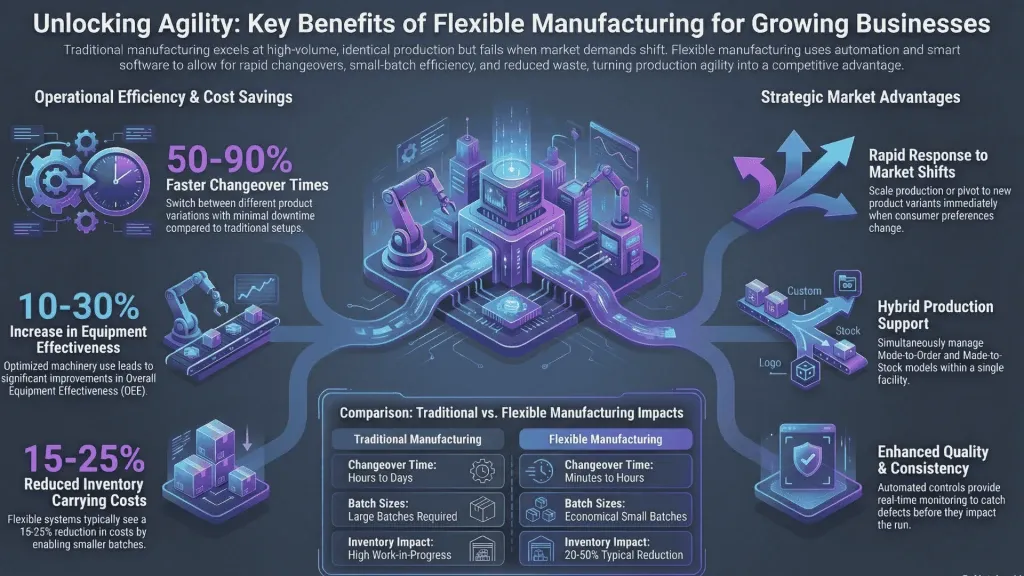
A flexible manufacturing system combines automated machinery, material handling equipment, and centralized computer control to produce a variety of products without significant retooling or downtime. Studies show that well-implemented FMS can reduce changeover times by 50-90% compared to traditional manufacturing setups.
The defining principles include:
- Routing flexibility: The ability to change the sequence of operations or use different machines to complete the same task
- Machine flexibility: Equipment that can perform multiple operations or produce different parts without major modifications
- Volume flexibility: Capacity to scale production up or down based on demand
- Product flexibility: Capability to introduce new products or variants without rebuilding the production line
Traditional manufacturing lines excel when demand is predictable and product variety is limited. Adaptive manufacturing systems shine when you need to handle demand variability, support mass customization, or manage a broad SKU catalog across multiple sales channels.
How Flexible Manufacturing Differs from Traditional Production
Traditional manufacturing follows a straightforward logic: optimize each step for speed and cost when producing large volumes of identical items. This works well for commodity products with stable demand.
The limitations become obvious when market conditions change:
| Aspect | Traditional Manufacturing | Flexible Manufacturing |
| Changeover time | Hours to days | Minutes to hours |
| Product variety | Limited SKUs | Broad product mix |
| Batch sizes | Large batches required for efficiency | Economical small-batch production |
| Demand response | Slow adaptation | Rapid adjustment |
| Inventory impact | High work-in-progress inventory | 20-50% reduction typical |
| Setup costs | High per-changeover | Lower incremental costs |
For businesses selling through multiple channels, managing seasonal variations, or offering customization options, the traditional model creates friction. Flexible automation removes much of that friction by building adaptability into the production process itself.
The Core Components of a Flexible Manufacturing System
A flexible manufacturing system is not a single machine but an integrated network of technologies working together. Understanding these components helps you evaluate what level of flexibility makes sense for your operations.
Computer-Controlled Automation (CNC, Robotics)
At the heart of most FMS implementations are computer numerical control (CNC) machines and industrial robots. These programmable systems can switch between tasks based on digital instructions rather than requiring physical retooling.
CNC machines handle precision operations like cutting, drilling, and milling across different materials and specifications. Modern CNC equipment stores multiple programs, allowing operators to switch production runs with minimal intervention.
Industrial robots add flexibility to assembly, packaging, and material movement. A single robotic arm can be reprogrammed for different tasks, reducing the need for dedicated equipment for each operation.
Material Handling and Logistics Systems
Moving materials efficiently between workstations is critical in flexible production. Automated guided vehicles (AGVs), conveyor systems, and robotic material handlers transport raw materials, work-in-progress items, and finished goods throughout the facility.
Effective material handling reduces bottlenecks when switching between products. Instead of manually reorganizing workflows, automated systems route materials based on real-time production requirements.
Centralized Software and Data Management
The software layer connects everything. A central control system coordinates machine operations, schedules production runs, monitors quality, and tracks inventory movement. This smart factory approach transforms disconnected equipment into a cohesive production ecosystem.
This is where flexible manufacturing intersects directly with inventory management. Production scheduling software needs accurate data on:
- Current stock levels across all locations
- Incoming purchase orders and expected delivery dates
- Sales orders and demand forecasts
- Bill of Materials requirements for each product
Without real-time visibility into inventory and orders, even the most advanced equipment cannot deliver true production flexibility. The machines may be capable of quick changeovers, but if your planning data is outdated or fragmented, you will still struggle to respond effectively to demand changes.
The Human Element: Skilled Workforce Requirements
Flexible manufacturing does not eliminate the need for skilled workers. It changes the nature of the work.
Operators in an FMS environment need broader skills than traditional production line workers. They must understand multiple processes, interpret data from control systems, troubleshoot issues across different operations, and adapt to changing production schedules.
Training investment is significant but pays dividends through improved problem-solving, reduced downtime, and better quality control. The most successful FMS implementations treat workforce development as a core component, not an afterthought.
With these building blocks in place, the next question becomes: which type of flexible system fits your specific situation?
Types of Flexible Manufacturing Systems
Not all flexible manufacturing systems work the same way. The right approach depends on your product mix, production volumes, and how frequently you need to switch between different items.
Sequential FMS
A sequential flexible manufacturing system produces batches of one product type before switching to another in a planned sequence. The system handles changeovers automatically, but production follows a predetermined schedule.
Best for: Businesses with predictable demand patterns and a manageable number of product variants. Furniture manufacturers producing different models on a rotating schedule often use this approach.
Random FMS
Random FMS handles any product in any order without following a fixed sequence. The system can process different items simultaneously, routing each through the appropriate operations based on its requirements.
Best for: High-variety, low-volume production environments. Custom manufacturing operations and job shops benefit from this maximum flexibility.
Dedicated FMS
A dedicated flexible manufacturing system produces a limited set of related products with some variation. It offers less flexibility than random FMS but achieves higher efficiency for its specific product family.
Best for: Manufacturers producing variations of core products, such as medical device companies making different sizes of the same instrument.
Engineered FMS
Engineered systems are custom-designed for specific, complex parts that require precision and consistency. These systems prioritize quality and reliability over broad flexibility.
Best for: Aerospace, defense, and semiconductor manufacturers where specifications are demanding and tolerances are tight.
Modular FMS
Modular systems combine elements from other FMS types, allowing reconfiguration as needs change. Components can be added, removed, or rearranged to match evolving production requirements.
Best for: Growing businesses expecting significant changes in product lines or volumes. The modular approach protects your investment by allowing incremental expansion.
| FMS Type | Flexibility Level | Volume Suitability | Ideal Use Case |
| Sequential | Medium | Medium to High | Rotating product batches |
| Random | High | Low to Medium | Custom and job shop production |
| Dedicated | Low to Medium | High | Product family variations |
| Engineered | Low | Medium to High | Precision components |
| Modular | Configurable | Scalable | Growing businesses with evolving needs |
Key Benefits of Flexible Manufacturing for Growing Businesses
The advantages of flexible manufacturing extend beyond the production floor. For SMEs competing against larger players, manufacturing agility can become a genuine competitive advantage.
Rapid Response to Market Demand Changes
Consumer preferences shift quickly. Supply chain disruptions create unexpected shortages. Seasonal patterns fluctuate year to year. Flexible production systems let you respond to these changes without the long lead times traditional manufacturing requires.
When a product suddenly gains traction through social media or a retail partnership, you can scale production without waiting weeks for line reconfigurations. When demand drops, you can pivot to other products rather than building unwanted inventory.
Reduced Operational Costs Over Time
The initial investment in flexible automation is higher than traditional equipment. However, total cost of ownership often favors FMS over time. Manufacturers implementing flexible systems report 10-30% improvements in overall equipment effectiveness (OEE) within the first two years.
Cost savings come from:
- Lower changeover expenses across product runs
- Reduced scrap and rework through consistent quality
- Decreased inventory carrying costs (typically 15-25% reduction)
- Better utilization of equipment and floor space
- Fewer production delays impacting delivery commitments
For businesses managing dozens or hundreds of SKUs, the efficiency gains compound. Each product changeover becomes a routine operation rather than a disruptive event.
Improved Product Quality and Consistency
Automated systems with computerized controls produce more consistent results than manual processes. Quality monitoring happens in real time, catching issues before they propagate through a production run.
This consistency matters for brand reputation, customer satisfaction, and reducing the hidden costs of returns, replacements, and warranty claims.
Better Inventory Control and Reduced Waste
Flexible manufacturing directly supports leaner inventory practices. When you can produce smaller batches efficiently, you reduce the need to stockpile finished goods or raw materials.
This connection between production flexibility and inventory management deserves emphasis. Many businesses approach these as separate challenges, but they are deeply linked. Production systems that require large batch sizes force higher inventory levels. Adaptive manufacturing systems that handle small batches enable just-in-time production and reduced carrying costs.
Support for Made-to-Order and Made-to-Stock Production
Growing businesses often need to support multiple production models simultaneously. Some products sell best as made-to-stock items with inventory ready for quick fulfillment. Others work better as made-to-order products built after a customer commits.
A flexible manufacturing system accommodates both approaches within the same facility. You can maintain stock of high-velocity items while producing custom or low-volume items on demand. This hybrid model optimizes both inventory investment and customer service levels.
Challenges to Consider Before Implementation
Flexible manufacturing offers significant benefits, but implementation requires realistic planning. Understanding the challenges helps you prepare for a successful transition.
Initial Investment and ROI Timeline
FMS implementation requires capital investment in equipment, software, training, and often facility modifications. For small and mid-sized businesses, this investment is substantial relative to operating budgets.
ROI timelines vary based on production volumes, product complexity, and how effectively you leverage the new capabilities. Most businesses see meaningful returns within 18-36 months, with measurable gains often visible within the first year for high-changeover operations.
Phased implementation reduces upfront risk. Starting with specific production cells or product lines lets you prove the concept before committing to facility-wide changes.
Workforce Training and Skill Development
Your team needs new skills to operate and maintain FMS equipment. This means training investments and potentially hiring for technical roles you did not previously need.
Plan for ongoing skill development, not just initial training. As systems evolve and production requirements change, continuous learning keeps your workforce effective.
System Complexity and Maintenance Requirements
Integrated systems create interdependencies. When one component fails, the impact can ripple through connected operations. Maintenance requirements are more demanding than traditional equipment, often requiring specialized technicians.
Build maintenance capabilities into your planning. Preventive maintenance programs, spare parts inventory, and vendor support agreements protect against costly downtime.
Real-World Flexible Manufacturing Examples
Flexible manufacturing is not theoretical. Companies across industries have implemented these systems to gain competitive advantages.
Automotive Industry (Toyota Lean Manufacturing)
Toyota pioneered many flexible manufacturing concepts through the Toyota Production System. Their approach enables producing multiple vehicle models on the same assembly line, adjusting output based on dealer orders rather than forecasts.
This production flexibility supports Toyota’s legendary inventory efficiency. By building vehicles closer to actual demand, they reduce the carrying costs and depreciation risks that plague competitors relying on speculative production.
Consumer Electronics (Canon, Apple Suppliers)
Electronics manufacturers face extreme demand variability. Product lifecycles are short, and demand can spike or collapse based on reviews, competitor actions, or component availability.
Canon implemented flexible automation across their camera and printer production facilities. Their systems accommodate rapid product updates and seasonal demand variations without maintaining excessive inventory buffers.
Apple’s contract manufacturers have invested heavily in flexible production capabilities, enabling the rapid scaling required for product launches while maintaining quality standards.
Consumer Goods and eCommerce Brands
Direct-to-consumer brands often start with limited product lines but expand rapidly based on customer feedback. Flexible manufacturing enables this growth without rebuilding production capabilities for each new variant.
Brands selling through multiple channels, including their own websites, marketplaces like Amazon, and wholesale accounts, need production systems that can handle diverse order patterns. Flexible automation supports the small-batch, high-variety production these multichannel businesses require.
Food and Beverage Production
Food manufacturers deal with seasonality, limited shelf life, and growing demand for variety. Flexible production lines allow quick changeovers between different products, flavors, or packaging configurations.
This flexibility reduces the waste that comes from producing large batches of items with limited shelf life. Smaller, more frequent production runs keep inventory fresh and reduce spoilage costs.
These examples share a common thread: production flexibility enabled by robust data systems. That brings us to a critical enabler many businesses overlook.
How Inventory Management Software Enables Flexible Manufacturing
The connection between inventory management and manufacturing flexibility is often underestimated. Even the most advanced production equipment cannot deliver agility if your inventory data is unreliable or your planning processes are disconnected.
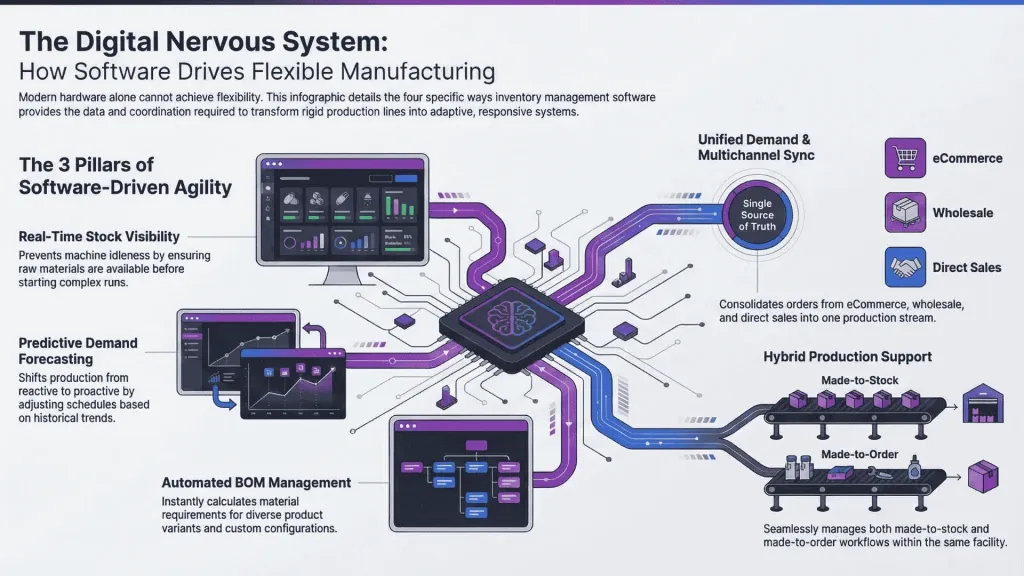
Modern inventory management software serves as the foundation for flexible manufacturing by providing the visibility and coordination these systems require. In the context of Industry 4.0 and smart manufacturing, this software layer becomes the nervous system that makes intelligent production decisions possible.
Real-Time Stock Visibility Across Locations
Flexible production planning requires knowing exactly what you have, where you have it, and what is already committed to orders. Managing inventory across multiple locations, tracking stock movements in real time, and maintaining accurate counts eliminates the guesswork that undermines production decisions.
When raw material levels are visible across warehouses and production facilities, planners can make informed decisions about scheduling and procurement. Without this visibility, flexible equipment sits idle waiting for materials or produces items that cannot be completed.
Demand Forecasting for Smarter Production Planning
Historical sales data, seasonal patterns, and trend analysis help predict future demand. Demand forecasting capabilities turn this data into actionable insights for production scheduling.
Rather than reacting to stockouts or overstock situations, you can anticipate demand shifts and adjust production proactively. This predictive approach maximizes the value of flexible manufacturing investments.
Bill of Materials (BOM) Management for Production Flexibility
Every product you manufacture has a Bill of Materials defining its components. Creating and managing Bills of Materials efficiently is essential for flexible production, especially when dealing with product variants or custom configurations.
When BOMs are accurately maintained in your inventory system, production orders automatically calculate material requirements. This integration ensures you have the components needed before starting a run and prevents the frustrating delays caused by missing materials.
Multichannel Order Synchronization
Businesses selling through multiple channels need production systems that respond to consolidated demand, not fragmented order streams. Inventory software that synchronizes orders from eCommerce platforms, wholesale accounts, and direct sales provides the unified view flexible manufacturing requires.
This synchronization also supports made-to-order workflows. When an order arrives through any channel, production order tracking can immediately route it to manufacturing with complete specifications and material requirements.
Getting Started: Implementation Steps for SMEs
Implementing flexible manufacturing does not require replacing everything at once. A phased approach reduces risk and builds organizational capability over time.
Assess Your Current Production Capabilities
Start by mapping your existing processes. Identify where changeovers are slowest, where bottlenecks occur, and where quality issues arise. This assessment reveals the highest-impact opportunities for flexibility improvements.
Evaluate your current technology stack. How well does your inventory management system support production planning? Do you have real-time visibility into stock levels and order status? Gaps in foundational systems should be addressed before investing in advanced automation.
Pro Tip: Document your current changeover times and costs for your top 10 products. This baseline data becomes essential for measuring ROI and prioritizing improvements.
Identify High-Impact Flexibility Opportunities
Focus initial efforts where flexibility delivers the greatest value. This might be:
- Product lines with frequent changeovers and high setup costs
- Items with unpredictable demand patterns
- Custom or made-to-order products with long lead times
- Production cells with quality consistency issues
Prioritize based on business impact, not technical sophistication. The goal is improving operations, not implementing technology for its own sake.
Choose the Right Technology Partners
Flexible manufacturing requires integrated solutions. Equipment vendors, software providers, and implementation partners should demonstrate experience with businesses similar to yours.
Pro Tip: Ask potential vendors for references from companies at your scale. Enterprise solutions often carry complexity and cost that growing businesses do not need. Look for partners who understand SME constraints.
Look for inventory management and production software that offers manufacturing and production features designed for SME operations. The right platform connects seamlessly with your eCommerce channels, accounting systems, and production workflows.
Start Small and Scale Strategically
Pilot your flexible manufacturing approach with a limited scope. Select one production area, implement improvements, measure results, and refine your approach before expanding.
Pro Tip: Set clear success metrics before starting your pilot. Track changeover time, defect rates, inventory turns, and on-time delivery for the pilot area. Use this data to build the business case for broader implementation.
This incremental strategy builds internal expertise, demonstrates ROI to stakeholders, and reduces the risk of large-scale implementation failures. Successful pilots create momentum for broader adoption.
Ready to take the first step? Explore how Qoblex helps manufacturers gain real-time inventory visibility and streamline production planning with a 14-day free trial.
Frequently Asked Questions
What is the primary goal of flexible manufacturing?
The primary goal of flexible manufacturing is enabling efficient production of varied products with minimal changeover time and cost. Rather than optimizing for a single product, FMS balances efficiency with adaptability, allowing manufacturers to respond quickly to demand changes, support diverse product mixes, and reduce inventory requirements.
What industries benefit most from flexible manufacturing systems?
Industries with high product variety, unpredictable demand, or customization requirements benefit most. This includes automotive, consumer electronics, aerospace, medical devices, food and beverage, and consumer goods. eCommerce brands and businesses selling through multiple channels also gain significant advantages from production flexibility.
How does flexible manufacturing reduce costs?
Flexible manufacturing reduces costs through lower changeover expenses (often 50-90% reduction), decreased inventory carrying costs, reduced scrap and rework, better equipment utilization, and fewer production delays. While initial investment is higher, total cost of ownership typically favors FMS over traditional systems, especially for businesses managing diverse product portfolios.
What is the difference between routing flexibility and machine flexibility?
Routing flexibility refers to the ability to change the sequence of operations or use alternative paths to complete production. Machine flexibility describes equipment that can perform multiple operations or produce different parts without major modifications. Both contribute to overall manufacturing agility but address different aspects of production adaptability.
Can small businesses implement flexible manufacturing?
Yes, small businesses can implement flexible manufacturing through phased approaches that match investment to scale. Starting with specific production cells, leveraging modular equipment, and integrating capable inventory management software allows SMEs to gain flexibility benefits without enterprise-level capital requirements. The key is prioritizing high-impact opportunities and scaling strategically.
Key Takeaways
- Flexible manufacturing enables efficient production of varied products with minimal changeover time, balancing efficiency with adaptability
- The four core components are: CNC/robotics automation, material handling systems, centralized software, and skilled workforce
- Five FMS types exist (Sequential, Random, Dedicated, Engineered, Modular)—choose based on your product mix and volume patterns
- Key benefits include faster demand response, reduced operational costs (10-30% OEE improvement typical), better quality, lower inventory, and support for both made-to-order and made-to-stock production
- Inventory management software is the critical enabler, providing real-time visibility, demand forecasting, BOM management, and multichannel synchronization
- SMEs can start small with phased implementation—assess current capabilities, identify high-impact opportunities, pilot in one area, then scale
Building Manufacturing Agility for Growth
Flexible manufacturing transforms how growing businesses approach production. Instead of fighting against market variability, you build systems that adapt to change as a normal operating condition.
The path forward combines the right equipment, capable software, and skilled people. Production flexibility and inventory visibility work together. Machines that can change quickly need planning systems that tell them what to make and when.
For SMEs navigating competitive markets with diverse product lines and multiple sales channels, manufacturing agility is not a luxury. It is becoming a requirement for sustainable growth.
Start by assessing where rigidity costs you the most. Address foundational gaps in inventory visibility and production planning. Then invest in flexibility where the business impact is greatest.
The businesses that master this balance—efficient enough to compete on cost, flexible enough to respond to opportunity—will be the ones that thrive as markets continue to evolve.