



You know customer orders need to ship on time. You also know your production line has limits. But how do you find the exact pace your team needs to maintain so supply matches demand without building excess inventory or missing deadlines?
The answer is takt time, a lean manufacturing metric that tells you precisely how much time you can spend producing each unit while still meeting customer requirements. Whether you manage a small assembly operation or oversee production across multiple warehouses, understanding how to calculate takt time transforms guesswork into a data-driven production rhythm.
This guide walks you through the takt time formula, provides step-by-step calculation examples, and shows you how to apply this metric to optimize both production efficiency and inventory management. By the end, you will have everything you need to implement takt time in your own operations.
What Is Takt Time?
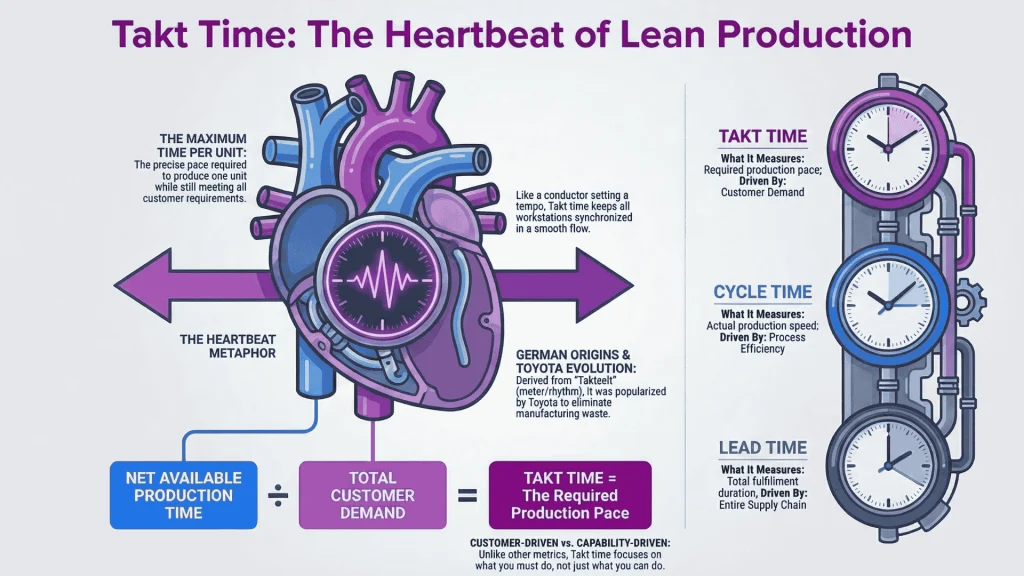
Takt time is the maximum amount of time you can spend producing one unit while still meeting customer demand. It is calculated by dividing your available production time by the number of units customers require. Takt time sets the pace of production to ensure supply matches demand without overproduction.
Think of takt time as the heartbeat of your production line. Just as a conductor sets the tempo for an orchestra, takt time sets the rhythm for manufacturing. When every workstation operates at this pace, products flow smoothly from raw materials to finished goods without bottlenecks or idle time.
Unlike metrics that measure what your production line can do, takt time focuses on what it must do. This customer-driven approach is foundational to lean manufacturing and just-in-time (JIT) production systems.
The Meaning Behind “Takt”
The word “takt” comes from the German Taktzeit, meaning “cycle time” or “meter.” In music, takt refers to the beat or rhythm that keeps performers synchronized. German aircraft manufacturers first applied this concept to production in the 1930s, using takt intervals to move aircraft subassemblies through stations at precisely timed intervals.
Toyota adopted takt time in the 1950s as a core element of the Toyota Production System (TPS). Taiichi Ohno, often called the father of TPS, described takt as the foundation for balancing production lines and eliminating waste. Today, takt time remains essential for any business practicing lean manufacturing or seeking to align production capacity with actual customer demand.
Takt Time vs Cycle Time vs Lead Time: Key Differences
These three time-based metrics often cause confusion because they sound similar. However, each measures something distinct, and understanding the differences is critical for production planning.
| Metric | Definition | What It Measures | Driven By |
| Takt Time | Maximum time allowed to produce one unit to meet demand | Required production pace | Customer demand |
| Cycle Time | Actual time to complete one unit from start to finish | Production capability | Process efficiency |
| Lead Time | Total time from order placement to delivery | End-to-end fulfillment | Entire supply chain |
Takt time answers: “How fast must we produce to meet demand?”
Cycle time answers: “How fast can we actually produce?”
Lead time answers: “How long does the customer wait?”
For optimal operations, your cycle time should be less than or equal to your takt time. If cycle time exceeds takt time, you cannot meet demand without adding capacity, extending hours, or improving efficiency.
The Takt Time Formula Explained
The takt time formula is straightforward:
Takt Time = Available Production Time / Customer Demand
This equation yields the amount of time you can allocate to producing each unit. The result is typically expressed in minutes per unit or seconds per unit, depending on your production volume.
Breaking Down the Takt Time Equation
Let us examine each component:
Available Production Time is the total time your production resources are actually working. This is not the same as total shift hours. You must subtract breaks, meetings, scheduled maintenance, and any other planned non-productive time.
Customer Demand is the number of units customers require within your chosen time period. This figure should come from actual orders, forecasts, or historical sales data rather than production targets set arbitrarily.
The formula works for any time period, whether you calculate takt time daily, weekly, or monthly. The key is using the same time period for both variables.
What Counts as “Available Production Time”
Calculating available production time correctly is where many manufacturers make mistakes. You need to distinguish between gross time and net available time.
Gross Production Time includes:
- Total shift hours
- All scheduled work hours
Subtract these to get Net Available Time:
- Scheduled breaks (lunch, rest periods)
- Team meetings and briefings
- Planned maintenance windows
- Shift changeover time
- Setup and changeover between products
Example calculation:
| Time Element | Hours | Minutes |
| Shift length | 8 hours | 480 min |
| Lunch break | -0.5 hours | -30 min |
| Two 15-min breaks | -0.5 hours | -30 min |
| Morning meeting | -0.25 hours | -15 min |
| Equipment warmup | -0.25 hours | -15 min |
| Net Available Time | 6.5 hours | 390 min |
Pro Tip: Build in a small buffer for unexpected interruptions. Most lean practitioners recommend calculating with 85-90% of theoretical available time to account for minor unplanned stops.
Determining Customer Demand Accurately
Your takt time calculation is only as accurate as your demand data. Inaccurate demand figures produce a takt time that either pushes your team too hard or leaves capacity underutilized.
Sources for demand data include:
- Confirmed customer orders
- Sales forecasts based on historical patterns
- Demand planning software predictions
- Contractual commitments with retailers or distributors
For businesses selling through multiple channels, such as your own eCommerce store plus Amazon or wholesale accounts, aggregate demand across all channels before calculating takt time. Your production line does not care where orders originate; it only needs to know total units required.
If demand fluctuates significantly, consider calculating separate takt times for peak and off-peak periods. This approach helps you plan staffing and capacity adjustments proactively.
How to Calculate Takt Time: Step-by-Step
Follow these three steps to calculate your production takt time.
Step 1: Calculate Net Available Production Time
Start by determining how much actual production time you have in your chosen period.
- Identify your total shift or work hours
- List all scheduled non-productive activities
- Subtract non-productive time from total time
Formula: Net Available Time = Total Shift Time – (Breaks + Meetings + Maintenance + Changeovers)
Step 2: Determine Customer Demand for the Period
Gather your demand data for the same time period used in Step 1.
- Pull order data from your inventory management or ERP system
- Add forecasted demand if you produce to stock
- Combine demand from all sales channels
- Express as total units required
Formula: Customer Demand = Confirmed Orders + Forecasted Orders (for the period)
Step 3: Apply the Takt Time Formula
Divide your available time by customer demand.
Formula: Takt Time = Net Available Time / Customer Demand
Express the result in appropriate units. For high-volume production, seconds per unit often works best. For lower-volume or complex manufacturing, minutes per unit or even hours per unit may be more practical.
Takt Time Calculation Example
Let us work through a realistic example for a consumer electronics manufacturer.
Scenario: Your facility produces wireless earbuds. You operate one 8-hour shift, Monday through Friday. Customer orders for the week total 2,000 units.
Step 1: Calculate Net Available Time
| Time Element | Daily (min) | Weekly (min) |
| Shift length | 480 | 2,400 |
| Lunch (30 min) | -30 | -150 |
| Breaks (2 x 15 min) | -30 | -150 |
| Daily team meeting | -15 | -75 |
| Equipment startup | -10 | -50 |
| Net Available Time | 395 min | 1,975 min |
Step 2: Determine Demand
Weekly customer demand = 2,000 units
Step 3: Calculate Takt Time
Takt Time = 1,975 minutes / 2,000 units = 0.99 minutes per unit (approximately 59 seconds)
Interpretation: To meet weekly demand, your production line must complete one unit every 59 seconds. If your actual cycle time is 45 seconds per unit, you have buffer capacity. If your cycle time is 70 seconds per unit, you cannot meet demand without changes.
Takt Time Calculator
Use this reference table to quickly estimate takt time based on common production scenarios:
| Available Time (hours/week) | Weekly Demand (units) | Takt Time (min/unit) | Takt Time (sec/unit) |
| 40 | 500 | 4.80 | 288 |
| 40 | 1,000 | 2.40 | 144 |
| 40 | 2,000 | 1.20 | 72 |
| 40 | 5,000 | 0.48 | 29 |
| 35 | 500 | 4.20 | 252 |
| 35 | 1,000 | 2.10 | 126 |
| 35 | 2,000 | 1.05 | 63 |
| 35 | 5,000 | 0.42 | 25 |
Quick Calculation Formula:
For a standard 40-hour week with 35 hours of net available time:
- Takt Time (seconds) = 126,000 / Weekly Demand
For daily calculations with 7 net available hours:
- Takt Time (seconds) = 25,200 / Daily Demand
Calculating Takt Time for Multiple Products
Most manufacturers produce more than one product. When your production line handles multiple items with different demand levels, you need a weighted approach to takt time.
Weighted Takt Time for Product Mix
For mixed production, calculate an average takt time that accounts for the relative volume of each product:
Formula: Weighted Takt Time = Total Available Time / Total Combined Demand
This gives you an overall production pace. However, you may also need individual takt times for each product if cycle times vary significantly.
Example: Managing Takt Time Across Product Lines
Scenario: A furniture manufacturer produces three chair models on the same assembly line.
| Product | Weekly Demand | Cycle Time |
| Basic Chair | 150 units | 25 min |
| Premium Chair | 75 units | 40 min |
| Executive Chair | 25 units | 60 min |
| Total | 250 units | – |
Available Time: 2,100 minutes per week (35 hours)
Combined Takt Time: 2,100 / 250 = 8.4 minutes per unit
Now verify feasibility by calculating total required production time:
- Basic: 150 x 25 min = 3,750 min
- Premium: 75 x 40 min = 3,000 min
- Executive: 25 x 60 min = 1,500 min
- Total Required: 8,250 min
Problem: Required time (8,250 min) exceeds available time (2,100 min). This manufacturer needs to add capacity, extend hours, improve cycle times, or adjust the product mix to meet demand.
Why Takt Time Matters for Inventory Management
Takt time is often discussed as a production metric, but its impact on inventory management is equally significant. When production pace aligns with demand, inventory levels naturally optimize.
Aligning Production with Demand
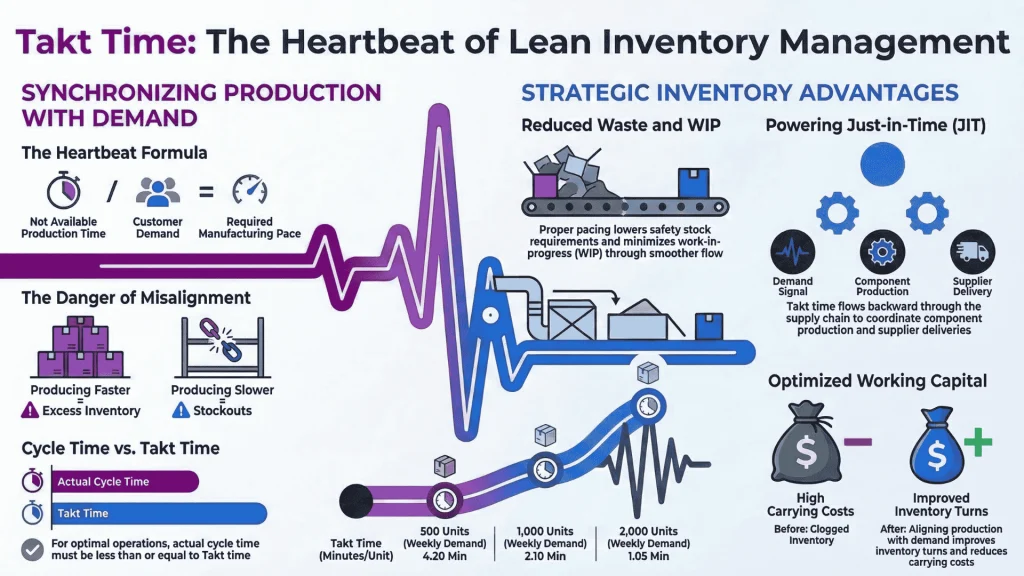
Producing faster than takt time creates excess inventory. Producing slower than takt time creates stockouts and backorders. Either situation hurts your business:
- Overproduction ties up cash in unsold inventory, increases storage costs, and risks obsolescence
- Underproduction disappoints customers, damages relationships, and forfeits revenue
Takt time gives you a target that prevents both extremes. When your team consistently hits takt, inventory turns improve and working capital stays healthy.
Reducing Overproduction and Stockouts
Companies using takt time effectively report significant inventory improvements:
- Lower safety stock requirements because production reliability improves
- Reduced work-in-progress (WIP) as flow becomes smoother
- Better cash flow due to reduced inventory carrying costs
- Higher customer satisfaction from consistent on-time delivery
For eCommerce businesses and multichannel sellers, these benefits multiply. When you sell through Shopify, Amazon, WooCommerce, and wholesale channels simultaneously, synchronized production prevents the overselling and stockout situations that damage marketplace rankings.
Supporting Just-in-Time Manufacturing
Takt time is a prerequisite for just-in-time (JIT) production. Without a clear production pace, JIT becomes impossible because you cannot coordinate material deliveries or downstream processes.
In a JIT environment, takt time flows backward through your supply chain:
- Customer demand sets final assembly takt time
- Final assembly takt time determines subassembly pace
- Subassembly pace drives component production
- Component requirements inform supplier delivery schedules
This pull-based system minimizes inventory at every stage while maintaining the responsiveness to fulfill orders quickly.
Common Takt Time Mistakes and How to Avoid Them
Even experienced operations managers make errors when calculating or implementing takt time. Here are the most frequent pitfalls and how to avoid them.
Forgetting to Account for Downtime
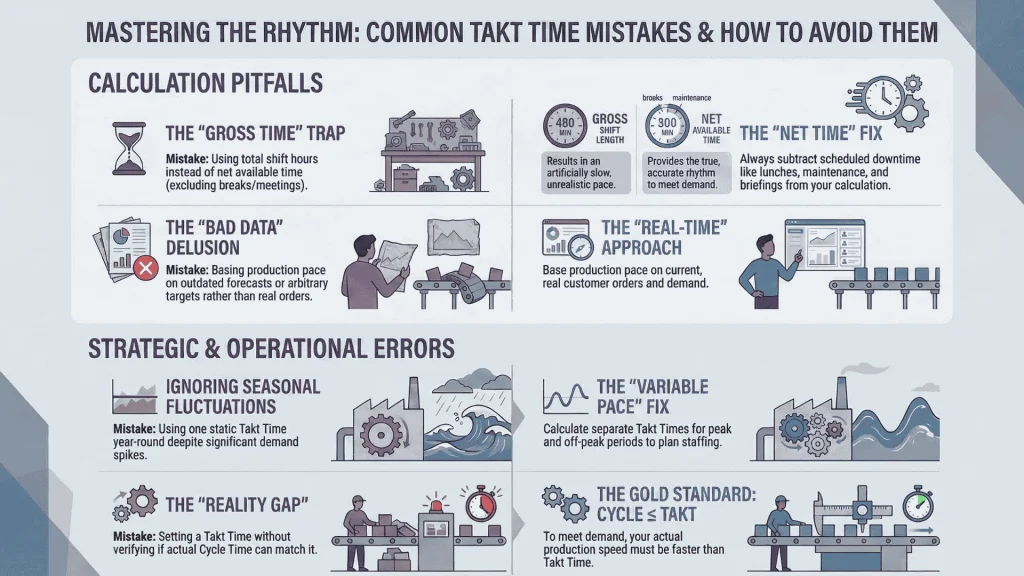
The mistake: Using gross shift hours instead of net available time.
The consequence: Takt time appears longer than reality, leading to understaffing or missed deliveries.
The fix: Always document and subtract all non-productive time. Create a standard template listing every regular interruption so nothing gets overlooked.
Using Inaccurate Demand Data
The mistake: Basing takt time on outdated forecasts, wishful targets, or incomplete order data.
The consequence: Production either cannot keep up with actual demand or produces inventory that does not sell.
The fix: Pull demand data directly from your order management system. Update takt time calculations at least monthly, or more frequently if demand is volatile. Use demand forecasting tools that incorporate historical sales patterns and seasonality.
Ignoring Seasonal Fluctuations
The mistake: Calculating one takt time and using it year-round despite significant demand variation.
The consequence: Underproduction during peak seasons and overproduction during slow periods.
The fix: Calculate separate takt times for distinct demand periods. For example, a toy manufacturer might use different takt times for Q4 holiday season versus Q1-Q3. Plan staffing and capacity adjustments accordingly.
Setting Takt Time Without Considering Cycle Time
The mistake: Calculating takt time without comparing it to actual cycle time.
The consequence: Discovering too late that production cannot physically meet the required pace.
The fix: Always calculate both takt time and cycle time. If cycle time exceeds takt time, you must either improve processes, add capacity, or manage demand expectations.
How to Implement Takt Time in Your Operations
Knowing how to calculate takt time is only the first step. Implementation requires integrating this metric into your daily operations and decision-making processes.
Using Software to Track and Optimize Takt Time
Modern inventory and production management software makes takt time calculation and monitoring much easier than spreadsheet-based approaches.
Key software capabilities to look for:
- Real-time demand aggregation across all sales channels
- Automatic takt time calculation based on current orders and capacity
- Alerts when cycle time approaches or exceeds takt time
- Historical tracking to identify trends and improvement opportunities
- Integration with production scheduling and Bills of Materials
When your inventory management system connects orders, production, and stock levels, takt time becomes a living metric that updates as conditions change rather than a static number calculated occasionally.
Integrating Takt Time with Demand Forecasting
The most effective takt time implementations combine real-time order data with forward-looking demand forecasts.
Reactive approach: Calculate takt time based on current confirmed orders. This works but offers limited planning horizon.
Proactive approach: Use demand forecasting to project orders for the coming weeks or months, then calculate takt time based on projected demand. This allows you to:
- Schedule workforce changes in advance
- Order materials with appropriate lead times
- Plan equipment maintenance during lower-demand periods
- Negotiate with suppliers based on anticipated volume
For businesses with seasonal patterns or promotional cycles, proactive takt time planning is essential for maintaining customer service levels without excessive inventory buildup.
Frequently Asked Questions
What is a good takt time?
There is no universal “good” takt time because the right figure depends entirely on your customer demand and available capacity. A takt time of 30 seconds might be appropriate for a high-volume electronics assembly line, while a takt time of 4 hours could be correct for custom furniture production. The goal is not to achieve a specific takt time but to ensure your cycle time allows you to meet the takt time your demand requires.
How often should you recalculate takt time?
Recalculate takt time whenever demand or available production time changes significantly. At minimum, review takt time monthly. For businesses with volatile demand or seasonal patterns, weekly or even daily recalculation may be appropriate. Toyota, where takt time originated, reviews the metric monthly with adjustment reviews every 10 days.
Can takt time be used in non-manufacturing businesses?
Yes, takt time applies to any operation that produces outputs to meet demand. Service businesses use takt time for processing applications, handling support tickets, or completing consultations. Software teams apply it to sprint planning. Healthcare facilities use it for patient throughput. The principle remains the same: divide available time by required outputs to find the pace needed to meet demand.
What happens if cycle time exceeds takt time?
When cycle time exceeds takt time, you cannot meet customer demand with current capacity. You have four options: improve processes to reduce cycle time, add production capacity (more equipment or shifts), reduce demand by adjusting pricing or marketing, or accept that some orders will be late or unfulfilled. Most lean practitioners prioritize process improvement first, as it addresses the root cause without adding cost.
How does takt time differ for batch production?
For batch production, divide takt time by batch size to find the takt time per batch. If your takt time is 2 minutes per unit and you produce in batches of 24, your takt time per batch is 48 minutes. This means you must start a new batch every 48 minutes to maintain pace with demand.
Key Takeaways
Takt time transforms production management from guesswork to precision by establishing a customer-driven pace for your operations.
Remember these essential points:
- Takt time equals available production time divided by customer demand
- Always use net available time, not gross shift hours
- Compare takt time to cycle time: cycle time must be shorter to meet demand
- Recalculate regularly as demand and capacity change
- Accurate demand data is critical for meaningful takt time calculations
- Takt time directly impacts inventory levels, cash flow, and customer satisfaction
Whether you manufacture products, fulfill orders, or deliver services, understanding and applying takt time helps you work smarter. When production rhythm matches customer demand, you avoid both the cost of excess inventory and the pain of missed deliveries.
Start by calculating takt time for your highest-volume products. Compare the result to your actual cycle times. That comparison alone will reveal whether your current operations can meet demand and where improvements would have the greatest impact.