


You sold the same last unit twice. Now you are canceling an order, refunding a frustrated buyer, and hoping the marketplace does not flag your account. Overselling is one of the most expensive, most avoidable problems in modern retail, and it gets worse with every channel you add. The good news: it is predictable, and there is a full menu of overselling solutions to fix it, from simple buffers to real-time inventory sync. This guide breaks down what overselling is, why it happens, what it costs, and every practical way to stop it, so you can pick the right fix for your business instead of guessing.
Key takeaways
- Overselling means accepting more orders than you have stock to fulfill, usually because your channels are not synced in real time.
- The damage compounds fast: canceled orders, refund costs, lost customers, and marketplace penalties that can suspend your account.
- Solutions range from tactical buffers and safety stock to committed-stock logic and full inventory management software.
- Real-time multichannel sync is the only fix that scales; brands that adopt it typically cut oversell incidents by 90 to 95 percent.
- The right choice depends on your model: a single-store seller, a multichannel scaler, and a manufacturer each need different protections.
What Is Overselling?
Overselling happens when a business accepts more orders for a product than it has physical stock to fulfill. It usually stems from inaccurate stock counts or sales channels that do not update in real time, so an item shows as available online after it has already sold out. The result is canceled orders and disappointed customers.
Overselling is not a sales problem. It is a data problem. Somewhere between the sale and the shelf, your recorded inventory drifted away from your actual inventory, and a customer paid for something you could not ship. In a single-channel store this is rare. Across a website, two marketplaces, and a retail counter, it becomes almost inevitable without the right systems.
The stakes are higher than a one-off refund. Marketplaces track how often you fail to deliver, and they penalize sellers who cancel too much. Understanding the mechanics is the first step to preventing overselling for good.
Overselling vs. Stockouts vs. Backorders
These three terms get used interchangeably, but they describe different situations with different fixes. Knowing which one you are facing tells you which solution to reach for.
| Term | What it means | Customer impact |
| Overselling | You accept an order you cannot fulfill because stock was already gone. | Order gets canceled after purchase; trust is broken. |
| Stockout | An item is out of stock and correctly shown as unavailable. | Lost sale, but no broken promise. |
| Backorder | You knowingly accept an order for out-of-stock inventory, with a clear ship date. | Managed expectation; customer agrees to wait. |
The difference matters. A stockout costs you a sale. A backorder is a deliberate, transparent choice. Overselling is the only one where you take the money first and disappoint the customer second, which is why it does the most reputational damage.
Signs You Have an Overselling Problem
Most sellers do not realize how often they oversell until they add up the canceled orders. Run through this quick self-diagnostic. If three or more of these sound familiar, overselling is quietly draining your margins.
- You cancel or refund orders because “the item was actually out of stock.”
- You manually update stock levels in spreadsheets across channels.
- Your sales channels sync on a schedule (hourly or daily) rather than instantly.
- You have received a marketplace warning about your cancellation rate.
- You keep “safety” stock in your head instead of in a system.
- Bundles or kits sell out even when the individual components show as available.
- Your team spends hours each week reconciling numbers between platforms.
- A viral moment or promotion recently left you scrambling to cancel orders.
If any of these describe your operation, you are not managing inventory. You are chasing it. The sections below map each root cause to a concrete solution.
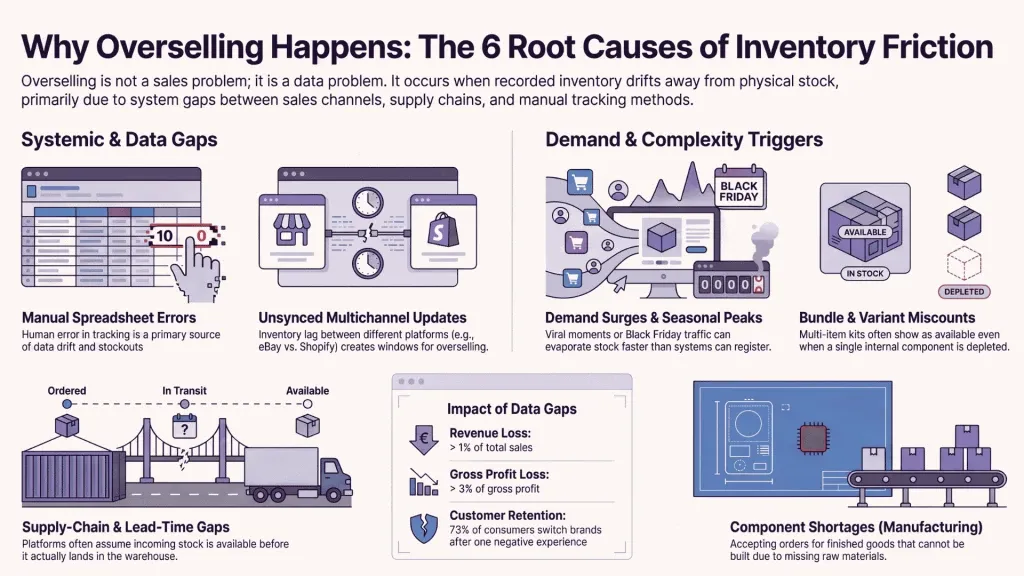
Why Overselling Happens: 6 Root Causes
Overselling rarely comes from a single mistake. It emerges from gaps between your systems, your channels, and your supply chain. Here are the six causes behind nearly every oversell.
Manual and Spreadsheet Errors
Businesses that track inventory with pen, paper, or spreadsheets are the most exposed. A miskeyed count, a missed update, or a duplicated row creates a gap between recorded and physical stock. Shopify notes that inventory record inaccuracy can drive a revenue loss of more than 1 percent of sales and more than 3 percent of gross profit. Manual methods do not scale, and every human touchpoint is a chance to oversell.
Slow or Unsynced Multichannel Updates
This is the number one cause for growing sellers. When one channel updates every hour and another every fifteen minutes, the slower channel keeps selling stock that is already gone. A customer buys your last unit on eBay just as another buys it on your Shopify store. Without real-time inventory sync, both orders go through. The wider your channel mix, the wider the gap.
Demand Surges and Seasonal Peaks
A product goes viral, a campaign overperforms, or Black Friday hits, and available stock evaporates faster than your system can register. Picture a fashion label whose limited drop trends overnight: if inventory updates in batches, the storefront keeps showing sold-out sizes as available during the exact window when demand is highest and mistakes are most visible. Peak season is when overselling turns from an annoyance into a crisis.
Supply-Chain and Lead-Time Gaps
Overselling is not always about outbound sales. Late shipments, production delays, and logistics disruptions create gaps between what your system expects to receive and what actually arrives. If your platform assumes incoming stock is available before it lands in the warehouse, it will happily take orders you cannot ship on time.
Bundle, Kit, and Variant Miscounts
Products sold as bundles, kits, or composite items are uniquely prone to overselling, and almost no competitor guide solves this well. A cosmetics brand selling a gift set may still show the set as available when one component, say a single serum, has run dry. A food and beverage seller’s holiday hamper can oversell the moment one item inside it is depleted. Without logic that ties component stock together, your bundles will oversell silently.
Component Shortages in Made-to-Order Manufacturing
If you manufacture, you can oversell a finished good you cannot actually build because a single component is short. A skincare maker might accept 500 orders for a serum, then discover there are only enough pumps for 300 units. This failure mode is invisible to standard ecommerce tools, which track finished goods but not the components behind them.
What Overselling Really Costs You
Overselling feels like a minor operational hiccup until you add up the full bill. The costs stack across revenue, reputation, and platform standing, and they compound with every incident.
Start with the customer. According to research cited by Shopify, nearly 70 percent of shoppers report a worse view of a brand after they buy an item marked in stock that turns out to be unavailable. Descartes Sellercloud reports that around 40 percent of sellers have to cancel one in ten orders, with inaccurate inventory data as a leading cause. And a consumer survey referenced by Deposco found that 73 percent of consumers say they would switch brands after a single negative experience.
Then there is platform risk. Cin7 notes that marketplaces like Amazon penalize sellers whose cancellation rates climb too high, and sustained failures can lead to account suspension. Losing your Amazon account is not a rounding error. It can be the end of a revenue stream.
Here is a simplified worked example to make the math concrete:
- Suppose your customer acquisition cost is roughly $59, a figure Deposco cites for a small ecommerce business.
- You oversell and cancel 10 percent of a 2,000-order month, so 200 orders get canceled.
- If even 40 percent of those buyers never return, that is 80 lost customers.
- 80 customers times $59 in acquisition cost equals roughly $4,720 in wasted spend, every month, before you count refund fees, support hours, and lost lifetime value.
Across a year, that single leak can cost tens of thousands of dollars. That is the real price of not solving overselling.
Overselling Solutions: The Complete Menu
There is no single fix that fits every business. Instead, think of overselling solutions as a menu that ranges from quick tactical patches to durable structural systems. The table below compares your options at a glance, then each approach is explained beneath it.
| Solution | How it works | Best for | Main limitation |
| Safety stock / buffer | Hold back a reserve the system never sells | Any seller, as a stopgap | Ties up cash and warehouse space |
| Inventory splitting | Assign fixed stock per channel | Very simple 2-3 channel setups | Wastes stock; one channel sells out, another sits idle |
| Manual audits & cycle counts | Regularly recount and correct records | Small, low-SKU operations | Labor-heavy; error-prone at scale |
| Real-time multichannel sync | Every sale updates all channels instantly | Multichannel and scaling sellers | Requires connected software |
| Committed / allocated stock | Reserve units the moment an order is placed | Sellers with quotes, B2B, or holds | Needs a system that supports order states |
| Virtual waiting rooms | Limit checkout concurrency during drops | Flash sales and limited releases | Solves surges only, not everyday sync |
| Inventory management software | Centralizes all of the above in one platform | Businesses serious about scaling | Onboarding investment upfront |
Tactical Buffers: Safety Stock and Buffer Zones
Safety stock, sometimes called buffer stock, is a reserve you deliberately withhold from what you publish as available. If you hold 10 units and set a buffer of 2, your channels only offer 8. It is the simplest first line of defense against overselling, and it buys time to replenish during unexpected demand. The trade-off is real, though: reserved stock ties up cash and storage, so buffers work best as a supplement, not a strategy.
Pro tip: Set a larger buffer on channels with the strictest penalties. Because Amazon punishes cancellations harder than most platforms, give it a lower published quantity than your own website, where you have more fulfillment flexibility.
Inventory Splitting, and Why It Quietly Wastes Revenue
Many teams try to avoid overselling by dividing stock into fixed buckets: 50 units to Amazon, 30 to the website, 20 to eBay. It feels safe. It is also costly. One channel can sell out in days while another sits on idle inventory, so you lose revenue on your best platform while stock stagnates elsewhere. Splitting prevents oversells by capping your own upside. It is a patch, not a solution.
Manual Audits, Cycle Counts, and Reorder Points
Regular cycle counts keep recorded stock aligned with physical stock, and reorder points trigger replenishment before you run dry. These disciplines genuinely reduce overselling for small, low-SKU operations. The problem is scale: as your catalog and channels grow, manual reconciliation becomes a full-time job and reintroduces exactly the human error you were trying to eliminate.
Real-Time Multichannel Inventory Sync
This is the fix that actually scales. Real-time inventory sync means a sale on any channel instantly adjusts stock everywhere else, so no platform ever shows availability that no longer exists. According to Zoho, brands that move from manual tracking to real-time synchronization typically cut oversell incidents by 90 to 95 percent. If you sell on more than one channel, this is the foundation every other tactic sits on.
Committed and Allocated Stock: Reserve at Order Placement
One of the cleanest structural fixes is rarely explained well. Committed stock (also called allocated stock) reserves units the instant an order is placed, before the item ships. That stock is set aside for that order and removed from what is available to sell elsewhere, so it cannot be sold twice. This matters most for sellers who send quotes, hold orders, or run a wholesale operation where the gap between order and fulfillment is wide.
Virtual Waiting Rooms for High-Concurrency Drops
For flash sales and limited releases, overselling can be a traffic problem rather than a sync problem. When thousands of shoppers hit checkout at once, backend systems cannot keep inventory consistent. Virtual waiting rooms meter buyers into the site in a controlled flow so stock allocation stays accurate. This is a specialist tool: it solves the surge scenario well but does nothing for your everyday multichannel accuracy.
Inventory Management Software: The Durable Fix
Inventory management software is a cloud platform that centralizes your stock, orders, and channels in one place, so availability is always accurate and updates happen automatically. It combines real-time sync, safety thresholds, committed stock, low-stock alerts, and reporting into a single system. For any business past the single-store stage, it is the only approach that removes overselling as a recurring worry instead of managing it by hand.
How to Choose the Right Solution for Your Business
The best overselling solution depends on how you sell. Match your model to the framework below.
- If you sell on one channel: Start with disciplined cycle counts, a modest safety buffer, and clear reorder points. You may not need full software yet, but build the habits now.
- If you sell on three or more channels: Real-time multichannel inventory sync is non-negotiable. Manual updates and inventory splitting will cost you more in lost sales and canceled orders than software ever will.
- If you run flash sales or limited drops: Layer a virtual waiting room on top of real-time sync to handle concurrency spikes without overselling.
- If you sell bundles, kits, or composite products: You need a system that links component stock, so a bundle stops selling the moment any component runs out.
- If you manufacture or sell made-to-order: You need bill-of-materials logic and insufficient-stock alerts, so you never accept an order for a finished good you cannot build.
- If you sell wholesale or B2B: Committed stock and allocated order states protect large orders and quotes from being undercut by other channels.
How to Prevent Overselling: A Step-by-Step Implementation Plan
You do not need to do everything at once. Follow this sequence to stop overselling in a way that sticks.
- Audit your current oversell rate. Pull the last 90 days of canceled and refunded orders and tag which were caused by unavailable stock. This is your baseline.
- Centralize your inventory. Move every channel’s stock into one source of truth so you stop reconciling separate spreadsheets.
- Turn on real-time synchronization. Connect your sales channels so every order updates stock everywhere within seconds, not hours.
- Set safety buffers per channel. Assign larger buffers to platforms with strict cancellation penalties and tighter buffers to flexible channels.
- Enable committed stock. Reserve inventory at the moment of order placement so the same unit can never be sold twice.
- Configure low-stock alerts and reorder points. Get notified before items hit zero, and trigger replenishment automatically.
- Link bundles and components. Ensure kits, composite products, and manufactured goods draw down component stock correctly.
- Monitor and refine. Track your oversell rate monthly and adjust buffers and reorder points as sales velocity changes.
Work through these in order and you will convert overselling from a recurring fire into a solved problem.
How Qoblex Prevents Overselling Across Every Channel
Everything above describes the ideal system. Qoblex is built to deliver it without the complexity, keeping inventory management simple even as you scale. The platform already manages more than $3.7 billion in goods for ecommerce brands, wholesalers, and manufacturers, so these safeguards are proven at real volume.
Qoblex keeps stock accurate across Shopify, WooCommerce, and Amazon with real-time synchronization, so a sale on one channel instantly updates the rest and your storefronts never promise stock you do not have. You choose which system is the inventory master, and Qoblex keeps every channel seamlessly aligned.
Underneath that sync, Qoblex gives you the structural protections most tools miss. Committed stock reserves units the moment an order enters the allocated state, so inventory is set aside for that order and cannot be oversold elsewhere. Low-stock alerts and safety thresholds warn you before items run out, and demand forecasting helps you replenish the right amount at the right time. For the cosmetics or food brand shipping gift sets and hampers, composite variants and pack sizes tie component stock together so a bundle stops selling when any component is depleted. And for manufacturers, production orders with insufficient-stock alerts flag when a bill of materials cannot be completed before you commit to an order you cannot build.
Wholesale sellers get the same safeguards inside a private B2B eCommerce Store, where committed stock and unique price lists protect large orders from channel conflicts. It all runs on a cloud platform with a mobile app, multi-warehouse and multi-currency support, and native accounting sync with Xero and QuickBooks. The goal is simple: empower growing teams to sell everywhere and still keep every promise. You can put it to work with a 14-day free trial, no credit card required, and be live in about a week rather than months.
Frequently Asked Questions
How do I stop overselling on Shopify?
Connect Shopify to inventory management software that syncs stock in real time across every channel you sell on. Set a safety buffer so a small reserve is never published as available, and enable committed stock so units are reserved at order placement. Together these prevent Shopify from showing availability that no longer exists.
Can you get banned from Amazon for overselling?
Yes. Amazon tracks seller cancellation and defect rates, and consistently failing to fulfill orders can trigger penalties or account suspension. Cin7 notes that cancellation rates above roughly 2.5 percent put sellers at risk. Real-time inventory sync and per-channel safety buffers are the most reliable way to keep your Amazon metrics healthy.
What is the difference between overselling and a stockout?
A stockout is when an item is out of stock and correctly shown as unavailable, so you simply lose a sale. Overselling is when you accept and charge for an order you cannot fulfill because stock was already gone, forcing a cancellation. Overselling does more damage because it breaks a promise after payment.
Does safety stock actually prevent overselling?
Safety stock reduces overselling but does not eliminate it. By withholding a buffer from published availability, it absorbs small timing gaps and demand spikes. However, it ties up cash and storage, and it cannot fix the underlying issue of channels that fail to sync. Pair safety stock with real-time synchronization for reliable protection.
What is committed (allocated) stock?
Committed or allocated stock is inventory reserved for a specific order the moment it is placed, before the item ships. That stock is removed from what is available to sell on other channels, so the same unit cannot be sold twice. It is one of the cleanest structural defenses against overselling, especially for quotes and wholesale orders.
Key Takeaways: Solving Overselling for Good
Overselling is a data problem disguised as an operational one, and it compounds with every channel, bundle, and peak season you add. Left unmanaged, it drains revenue through canceled orders, refund costs, lost customers, and marketplace penalties that can put your account at risk. The path out is clear: understand which failure mode you face, then move from manual patches toward real-time synchronization, committed stock, and smart buffers that scale with you.
You do not have to choose between growth and accuracy. With the right system, you can sell across every channel and still keep every promise you make to a customer. If you are ready to stop chasing your inventory and start trusting it, a centralized platform like Qoblex, with a 14-day free trial, is the simplest place to begin.