



You know the scenario: Orders are flooding in from your Shopify store, wholesale accounts are placing larger requests, and your production team is scrambling to keep up. But are they working efficiently, or just working harder? Without a clear understanding of your production capacity, you’re essentially flying blind.
Production capacity planning is the discipline that transforms this chaos into control. It’s how successful manufacturers and product-based businesses ensure they can meet customer demand without overextending their resources or leaving money on the table.
This guide breaks down everything you need to know about production capacity planning, from calculating your actual capacity to choosing the right strategy for your business model. Whether you run a make-to-order operation or maintain finished goods inventory across multiple warehouses, you’ll find actionable frameworks to optimize your output.
What Is Production Capacity Planning?
Production capacity planning is the process of determining how much your business can realistically produce within a given timeframe, then aligning those capabilities with expected demand. It considers your available workforce, equipment, raw materials, and time to establish the maximum output your operation can sustain.
Definition: Production capacity planning is a strategic approach to matching your manufacturing capabilities with forecasted demand, ensuring you have the right resources in place to fulfill orders on time while minimizing waste and excess costs.
Think of capacity planning as the bridge between your sales forecast and your shop floor. When a customer asks if you can deliver 500 units by next Friday, capacity planning gives you the data to answer confidently rather than guessing.
Why Production Capacity Planning Matters for Growing Businesses
For small-to-medium businesses, particularly those selling through multiple channels like Shopify, WooCommerce, or Amazon, capacity planning becomes critical as you scale. Here’s why:
Prevents stockouts and backorders. When you understand your true production limits, you can set realistic delivery promises. This keeps customers happy and protects your seller ratings on marketplaces.
Controls costs. Overproduction ties up cash in unsold inventory. Underproduction leads to rush orders, overtime pay, and expedited shipping. Capacity planning finds the balance.
Supports growth decisions. Should you add a second shift? Invest in new equipment? Hire more staff? Capacity data transforms these gut-feel decisions into calculated moves.
Improves cash flow visibility. When you know what you can produce and when, you can better forecast revenue and manage working capital.
Unlike enterprise manufacturers with dedicated planning teams, growing businesses need capacity planning approaches that are practical, not theoretical. The goal isn’t perfection; it’s having enough visibility to make smarter decisions.
The 3 Types of Production Capacity Planning
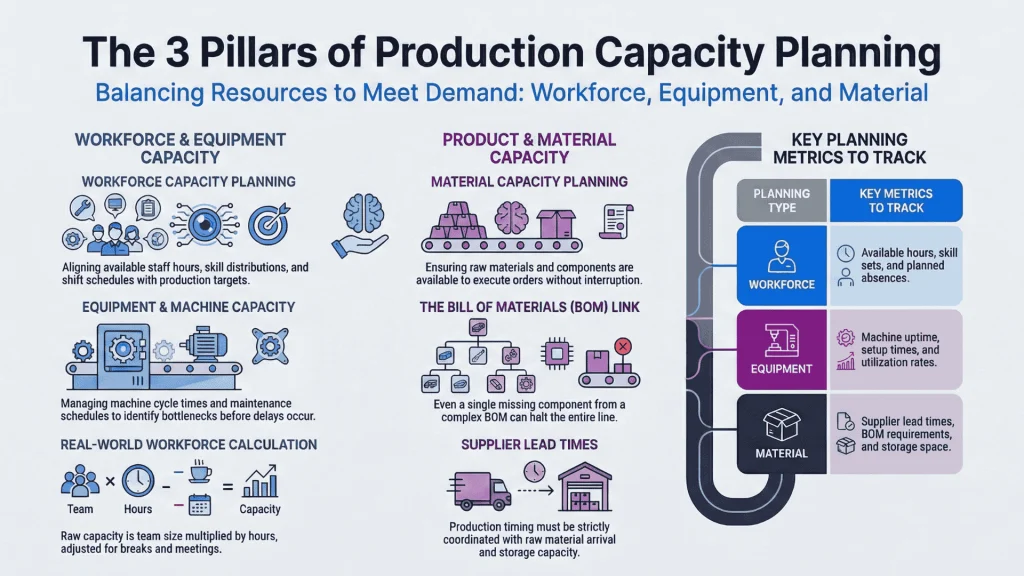
Effective manufacturing capacity planning addresses three interconnected resource categories. Overlooking any one of them creates blind spots that lead to missed deadlines and frustrated customers.
Workforce Capacity Planning
Workforce capacity planning ensures you have enough people with the right skills working the necessary hours to meet production targets. This includes:
- Total available work hours per day, week, or month
- Skill distribution across your team
- Planned absences, training time, and administrative tasks
- Shift scheduling and overtime availability
For example, if your production team consists of four workers each available for 40 hours per week, your raw workforce capacity is 160 hours weekly. But actual productive capacity is lower once you account for breaks, meetings, and non-production tasks.
Equipment and Machine Capacity Planning
Equipment capacity planning focuses on your machinery, tools, and physical production infrastructure. Key considerations include:
- Machine operating hours and cycle times
- Maintenance schedules and expected downtime
- Setup and changeover time between product runs
- Equipment utilization rates
A CNC machine that can produce 20 units per hour has different capacity implications than a manual assembly station. Understanding these constraints helps you identify bottlenecks before they cause delays.
Product and Material Capacity Planning
Product capacity planning, sometimes called material capacity planning, ensures you have the raw materials and components needed to execute production orders. This connects directly to your inventory management processes:
- Raw material availability and lead times from suppliers
- Bill of materials (BOM) requirements for each product
- Work-in-progress inventory levels
- Storage capacity for materials and finished goods
This type of planning is especially critical for businesses with complex products. If your finished goods require 15 different components, a shortage of just one can halt your entire production line.
How to Calculate Production Capacity
Moving from concepts to numbers, let’s examine the formulas that quantify your production capacity. These calculations form the foundation of any capacity planning effort.
The Production Capacity Formula
The basic production capacity formula determines the maximum output possible in a given period:
Production Capacity = (Number of Machines or Workers) x (Available Hours) x (Units per Hour)
Or expressed differently:
Production Capacity = Machine-Hour Capacity / Cycle Time per Unit
Where:
- Machine-Hour Capacity = Number of usable machines x Number of working hours
- Cycle Time = Time required to produce one unit
This gives you theoretical maximum capacity. Actual capacity will be lower due to setup time, breaks, maintenance, and efficiency losses.
Capacity Utilization Rate Formula
Capacity utilization measures how much of your potential output you’re actually achieving:
Capacity Utilization Rate = (Actual Output / Maximum Potential Output) x 100%
This percentage reveals whether you’re underutilizing resources (leaving money on the table) or pushing too close to maximum (risking burnout and quality issues).
Most manufacturing operations aim for a capacity utilization rate between 80% and 85%. This leaves buffer room for unexpected demand spikes, rush orders, and the inevitable disruptions that occur in any production environment.
Worked Example: Calculating Your Production Capacity
Let’s walk through a practical example relevant to an eCommerce brand with in-house production.
Scenario: A company produces custom phone cases. They have 3 production stations, each staffed for 8 hours per day, 5 days per week. Each station can produce 12 cases per hour.
Step 1: Calculate machine-hour capacity
- 3 stations x 8 hours x 5 days = 120 production hours per week
Step 2: Calculate production capacity
- 120 hours x 12 cases per hour = 1,440 cases per week
Step 3: Account for realistic efficiency (assume 85%)
- 1,440 x 0.85 = 1,224 cases per week (realistic capacity)
Step 4: Calculate current utilization
- If actual weekly output averages 1,000 cases:
- (1,000 / 1,440) x 100% = 69.4% capacity utilization
This analysis reveals room to increase output by roughly 20% before needing additional resources, or it might indicate inefficiencies worth investigating.
3 Production Capacity Planning Strategies
Once you understand your capacity, you need a strategy for how to adjust it as demand fluctuates. Three primary approaches exist, each with distinct advantages depending on your business model.
| Strategy | Approach | Best For | Risk |
| Lead | Add capacity before demand increases | High-growth businesses, seasonal preparation | Overcapacity if demand doesn’t materialize |
| Lag | Add capacity after demand is confirmed | Conservative operations, uncertain markets | Stockouts during demand spikes |
| Match | Add capacity incrementally as demand grows | Stable, predictable businesses | Requires accurate forecasting |
Lead Strategy: Scaling Ahead of Demand
The lead strategy involves proactively increasing capacity in anticipation of future demand. You might hire additional staff, purchase equipment, or extend production hours before orders actually require it.
When it works: If you’re preparing for a product launch, entering peak season, or confident in growth projections. An eCommerce brand expecting strong Black Friday sales might ramp up production capacity in October.
The risk: If anticipated demand doesn’t materialize, you’re stuck with excess capacity and higher fixed costs.
Lag Strategy: Scaling in Response to Demand
The lag strategy takes a conservative approach: only add capacity once demand has been confirmed. This means waiting until orders exceed current capacity before making changes.
When it works: In uncertain markets, for new product lines without proven demand, or when cash flow constraints make speculative investment risky.
The risk: Customers may experience longer lead times or stockouts while you scramble to increase capacity. This can damage relationships and marketplace seller ratings.
Match Strategy: Incremental Capacity Adjustments
The match strategy aims to add capacity in small increments that closely follow demand trends. Rather than making large jumps, you make frequent, smaller adjustments.
When it works: For businesses with relatively stable and predictable demand patterns. Works well when you have good demand forecasting capabilities and flexible production resources.
The risk: Requires accurate, timely data to execute properly. Without real-time visibility into sales and inventory, match strategies become guesswork.
The Production Capacity Planning Process: 6 Steps
A systematic approach to capacity planning ensures you consider all variables and make decisions based on data rather than assumptions.
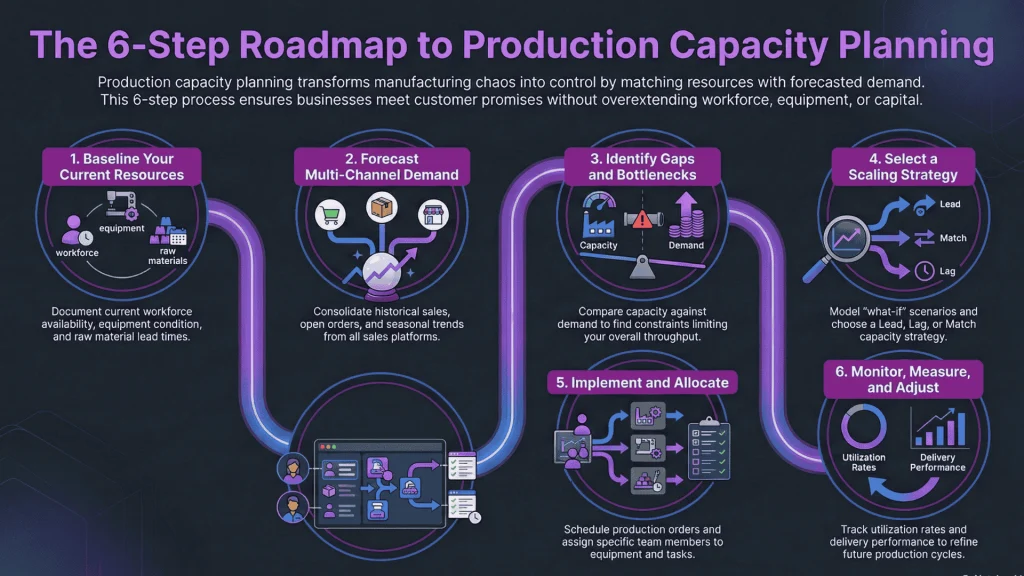
Step 1: Analyze Current Capacity and Resources
Start by documenting what you have available today:
- Current workforce size, skills, and availability
- Equipment inventory and condition
- Raw material stock levels and supplier lead times
- Historical production output and efficiency metrics
Many businesses discover their actual capacity differs significantly from what they assumed. Equipment may be underutilized, or certain team members may be overloaded while others have slack time.
Step 2: Forecast Demand Across Sales Channels
Gather demand signals from all sources where you sell:
- Historical sales data and trends
- Open orders and committed deliveries
- Sales team projections and pipeline
- Seasonal patterns and promotional calendars
- Marketplace trends and category growth
For multi-channel sellers, consolidating this data can be challenging. Information sitting in separate systems for Shopify, Amazon, and wholesale orders creates blind spots. Centralized inventory and order management helps bring these signals together.
Step 3: Identify Capacity Gaps and Bottlenecks
Compare your capacity analysis (Step 1) with your demand forecast (Step 2). Where do shortfalls exist?
Look for bottlenecks, which are constraints that limit overall throughput. Common bottlenecks include:
- A single machine that every product must pass through
- A specialized skill that only one team member possesses
- Raw materials with long supplier lead times
- Quality inspection processes that create queues
Addressing the primary bottleneck should be your first priority, as it unlocks capacity throughout the rest of your operation.
Step 4: Evaluate Scenarios and Select a Strategy
Model different scenarios before committing to a plan:
- What if demand comes in 20% higher than forecast?
- What if a key supplier experiences delays?
- What’s the cost of adding overtime versus hiring?
Choose the capacity strategy (lead, lag, or match) that aligns with your risk tolerance, cash position, and growth objectives.
Step 5: Implement and Allocate Resources
Execute your capacity plan by:
- Scheduling production orders against available capacity
- Assigning work to specific team members and equipment
- Coordinating raw material procurement with production timing
- Communicating delivery timelines to sales and customer service teams
Clear production orders linked to your sales orders ensure nothing falls through the cracks.
Step 6: Monitor, Measure, and Adjust
Capacity planning isn’t a one-time exercise. Continuously track:
- Actual vs. planned production output
- Capacity utilization rates
- On-time delivery performance
- Inventory turnover and days on hand
Use this data to refine future forecasts and adjust your capacity strategy as conditions change.
Production Capacity Planning for Make-to-Order vs. Make-to-Stock
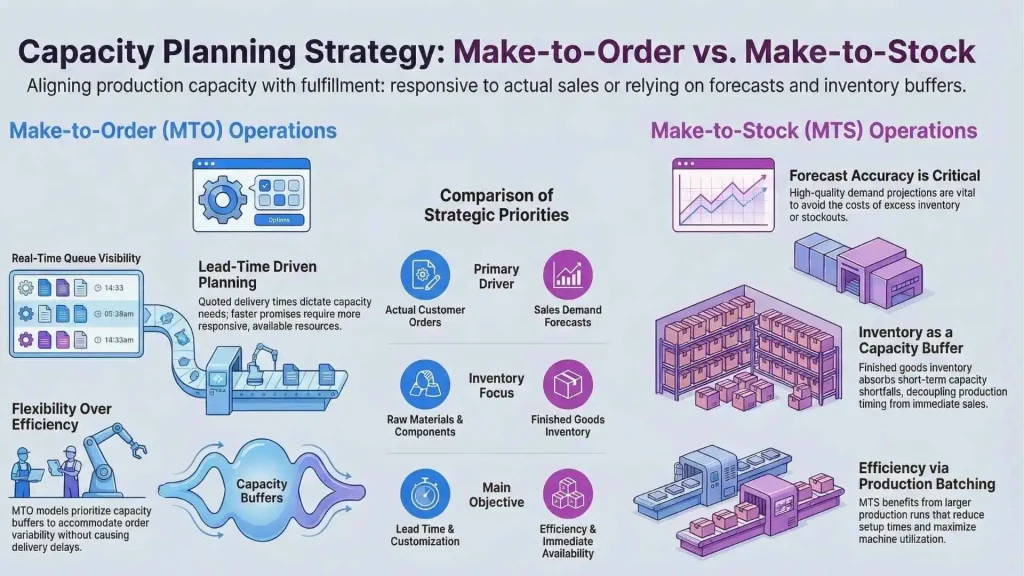
Your production model significantly influences how you approach capacity planning. The considerations differ depending on whether you build products in response to orders or maintain finished goods inventory.
Capacity Considerations for Make-to-Order Production
Make-to-order (MTO) businesses produce goods only after receiving customer orders. Custom manufacturers, personalized product sellers, and configure-to-order operations typically fall into this category.
Key capacity planning factors for MTO:
- Lead time promises drive planning. Your quoted delivery time determines how much production capacity you need available. Promising 5-day delivery requires more responsive capacity than 3-week lead times.
- Order queue visibility is essential. You need real-time awareness of incoming orders to schedule production effectively and identify when capacity is becoming constrained.
- Flexibility matters more than efficiency. MTO operations benefit from capacity buffers that allow them to accommodate order variability without excessive delays.
- Component availability can extend lead times. If your BOM includes items with long supplier lead times, you may need to stock common components even if you don’t stock finished goods.
Capacity Considerations for Make-to-Stock Production
Make-to-stock (MTS) businesses produce goods in advance of orders, holding finished goods inventory to fulfill customer demand immediately.
Key capacity planning factors for MTS:
- Demand forecasting accuracy is critical. Poor forecasts lead to either excess inventory (cash tied up, potential obsolescence) or stockouts (lost sales, unhappy customers).
- Inventory levels buffer capacity constraints. Finished goods inventory can absorb short-term capacity shortfalls, but this comes at a cost.
- Production batching affects efficiency. MTS operations often benefit from larger production runs that reduce setup time, but this requires accurate demand projections.
- Reorder points trigger production. Automated alerts when inventory drops below safety stock levels help maintain continuous production without overproduction.
Many businesses operate with hybrid models, maintaining stock for fast-moving items while producing slower sellers or custom variations to order.
7 Best Practices for Effective Production Capacity Planning
Drawing from successful manufacturing operations, these practices help you get more value from your capacity planning efforts:
- Start with accurate baseline data. Measure your actual current capacity before attempting to plan future needs. Assumptions about equipment speeds or labor productivity often prove wrong.
- Build in realistic buffers. Target 80-85% capacity utilization rather than 100%. This margin absorbs variability and prevents your team from operating in constant crisis mode.
- Connect capacity planning to inventory data. Your finished goods and raw materials inventory levels directly impact what you can produce and when. Integrated systems provide the visibility needed for effective planning.
- Review and update regularly. Static capacity plans become obsolete quickly. Weekly reviews help catch issues early, while monthly or quarterly strategic reviews assess whether your overall approach needs adjustment.
- Document and track bottlenecks. Keep a running list of constraints that limit throughput. Systematically addressing these over time continuously expands your effective capacity.
- Consider seasonality explicitly. If your business has predictable peaks, factor these into capacity planning months in advance. It’s easier to train temporary staff or arrange equipment rentals with lead time.
- Communicate capacity constraints to sales teams. When sales knows what production can deliver, they can set appropriate customer expectations and avoid overpromising.
Common Production Capacity Planning Challenges and How to Overcome Them
Even with solid processes, certain obstacles repeatedly trip up capacity planning efforts.
Inaccurate Demand Forecasting
The challenge: Capacity planning is only as good as your demand forecast. If projections are consistently off, capacity decisions will be misaligned.
Solutions:
- Combine multiple forecasting inputs (historical data, sales pipeline, market trends)
- Track forecast accuracy over time and identify systematic biases
- Use rolling forecasts that update frequently rather than annual projections
- For multi-channel businesses, ensure all sales channels feed into your demand picture
Bottleneck Identification
The challenge: It’s often unclear which constraint is actually limiting overall output. Addressing the wrong bottleneck wastes resources.
Solutions:
- Map your production flow and measure cycle time at each stage
- Look for work-in-progress accumulation, which indicates upstream processes feeding a bottleneck
- Talk to your production team, as they often know where delays occur even if data doesn’t capture it
- Use production tracking to identify where jobs spend the most time waiting
Data Silos and Manual Processes
The challenge: When sales orders live in one system, inventory in another, and production schedules in spreadsheets, getting an integrated capacity picture becomes nearly impossible.
Solutions:
- Consolidate operations data into connected systems rather than disconnected tools
- Automate data flows between sales channels, inventory, and production
- Invest in real-time visibility rather than batch reporting that’s already outdated when you see it
How Software Simplifies Production Capacity Planning
Modern inventory and production management platforms can dramatically reduce the manual effort required for effective capacity planning while improving accuracy.
Key Features to Look For
When evaluating software to support capacity planning, prioritize these capabilities:
- Real-time inventory visibility across raw materials, work-in-progress, and finished goods
- Multi-channel order consolidation that brings Shopify, WooCommerce, Amazon, and wholesale orders into a single view
- Bill of materials management that connects finished goods to component requirements
- Production order tracking with status updates and completion recording
- Demand forecasting tools that analyze historical patterns
- Low stock alerts that trigger before stockouts occur
- Reporting dashboards that surface capacity utilization and production performance metrics
Connecting Capacity Planning to Inventory and Orders
The most powerful aspect of integrated software is the connection between functions that are often managed separately.
When your sales orders, inventory levels, and production orders exist in one system:
- New orders automatically inform production requirements
- Component availability is checked against BOM requirements in real time
- Finished goods production updates inventory available to sell
- Capacity constraints surface before they cause delivery failures
This integration is particularly valuable for growing businesses that don’t have the staff to manually coordinate between departments or reconcile data from multiple systems.
Frequently Asked Questions
What is the difference between capacity planning and production scheduling?
Capacity planning determines how much you can produce over a period of time based on available resources. Production scheduling determines when specific orders or batches will be produced within that capacity. Think of capacity planning as answering “how much” while scheduling answers “when and in what sequence.” Both are necessary, but capacity planning comes first.
How often should you review production capacity?
Most growing businesses benefit from weekly operational reviews that check actual output against planned capacity. Monthly strategic reviews should assess whether capacity levels and strategies remain appropriate. Major reviews are warranted whenever significant changes occur, such as adding equipment, launching new products, or entering peak seasons.
What is a good capacity utilization rate?
Most manufacturing operations target capacity utilization between 80% and 85%. This provides enough buffer to handle variability, rush orders, and maintenance without leaving excessive resources idle. Rates consistently above 90% often indicate overstressed operations prone to quality issues and burnout. Rates below 70% suggest underutilization worth investigating.
How does capacity planning relate to inventory management?
Capacity planning and inventory management are deeply connected. Your raw materials inventory determines what you can produce. Your finished goods inventory affects how urgently you need to produce. Production output updates your stock-on-hand. Effective capacity planning requires visibility into inventory levels, while inventory decisions depend on understanding production capabilities.
Turn Production Capacity Planning Into a Competitive Advantage
Production capacity planning transforms reactive scrambling into proactive control. When you understand your true capacity, forecast demand accurately, and systematically match the two, you can confidently commit to customer delivery dates, invest in growth at the right time, and avoid the costly consequences of both overproduction and stockouts.
For growing eCommerce brands and manufacturers managing multiple sales channels, the key is connecting capacity planning to your inventory and order data. Siloed spreadsheets and disconnected systems make this connection nearly impossible to maintain as you scale.
Start by calculating your current capacity using the formulas in this guide. Identify your primary bottleneck. Choose the strategy that fits your business model. Then build the systems and processes that let you monitor, measure, and adjust as conditions change.
The businesses that master production capacity planning don’t just survive growth, they thrive through it.