


You finally landed that big wholesale account. Orders are flowing in from your Shopify store. Your Amazon listings are gaining traction. Business is growing, and everything should feel exciting.
Instead, you are drowning.
Orders pile up faster than your team can ship them. Inventory counts never match reality. Your warehouse staff works overtime, yet customers still complain about delays. Somewhere in your operations, something is choking the flow of your entire business.
That something is called a bottleneck.
Understanding what a bottleneck means in business is the first step toward eliminating the operational slowdowns that drain your profits and frustrate your customers. This guide breaks down exactly what bottlenecks are, why they happen, and most importantly, how to identify and fix them before they strangle your growth.
What Is a Bottleneck in Business?
A bottleneck in business is a point in your workflow where demand exceeds capacity, causing delays that slow down your entire operation. Just as the narrow neck of a bottle restricts how quickly liquid can pour out, a business bottleneck restricts how quickly work, orders, or products can flow through your processes. The entire system’s throughput is limited by this single constraint point.
The critical thing to understand is that your overall throughput can never exceed the speed of your slowest point. Even if every other part of your operation runs at peak efficiency, one bottleneck limits the output of your entire business.
The Bottleneck Analogy Explained
Picture a highway during rush hour. Four lanes of traffic suddenly merge into two because of construction. No matter how fast cars were moving before that point, everyone slows to a crawl at the merge. The construction zone becomes a bottleneck that determines the flow rate for the entire highway.
In your business, bottlenecks work the same way. Consider this example:
- Your receiving team processes 200 units per hour
- Your quality check handles 150 units per hour
- Your packing station manages 180 units per hour
- Your shipping label printer handles only 80 labels per hour
Your entire fulfillment operation is capped at 80 units per hour, regardless of how efficiently everything else runs. The shipping station is your bottleneck.
Bottleneck vs. Constraint: Understanding the Difference
People often use “bottleneck” and “constraint” interchangeably, but they are not the same thing.
A constraint is any factor that limits your output. Every business has constraints:
- Budget limitations
- Warehouse space
- Staff size
- Equipment capacity
Constraints exist whether or not they currently cause problems.
A bottleneck is a constraint that actively restricts your throughput right now. It is the constraint that has become your limiting factor because demand has exceeded its capacity.
| Aspect | Constraint | Bottleneck |
| Definition | Any factor that limits potential output | A constraint actively limiting current throughput |
| Status | May or may not cause problems | Currently causing delays and backups |
| Example | Your warehouse can hold 10,000 SKUs | You have 10,500 SKUs and inventory is overflowing |
| Impact | Potential limitation | Immediate operational slowdown |
A constraint becomes a bottleneck when workload exceeds its capacity. The same constraint might be perfectly adequate during slow seasons but become a severe bottleneck during peak demand.
Why Business Bottlenecks Matter: The Real Cost of Operational Slowdowns
Bottlenecks are not just inconveniences. They directly impact your profitability, reputation, and team morale. Understanding these costs helps prioritize which bottlenecks to address first.
Financial Impact of Bottlenecks
Operational bottlenecks drain money in ways that do not always show up on obvious line items. When orders take longer to fulfill, you pay more labor hours per order shipped. When inventory sits waiting at a choked production step, you have capital tied up that could generate returns elsewhere.
Consider the math: If a bottleneck adds just 15 minutes of processing time to each order, and you ship 200 orders daily, that is 50 extra labor hours per day. At $20 per hour, you are spending an extra $1,000 daily, which adds up to more than $365,000 annually on a problem you might not even realize you have.
Beyond direct costs, bottlenecks create hidden expenses:
- Rush shipping fees when orders run late
- Storage costs for inventory stuck in queue
- Overtime wages to clear backlogs
- Expedited supplier orders to compensate for delays
- Lost sales from stockouts caused by slow receiving
Customer Experience and Reputation Damage
Today’s customers expect fast, accurate fulfillment. When bottlenecks delay shipments or cause errors, customers notice. And they talk about it.
The ripple effects include:
- Negative reviews mentioning slow shipping that influence dozens of potential buyers
- Eroded trust with wholesale accounts who depend on your reliability
- Declining marketplace performance metrics that affect visibility and ranking
- Customer defection to faster competitors
- Damaged relationships that take months to rebuild
The reputational damage from bottlenecks often outlasts the bottleneck itself. Even after you fix the underlying problem, rebuilding customer confidence takes time.
Employee Burnout and Retention Issues
When bottlenecks create constant backlogs, your team feels the pressure. Staff working around a chokepoint experience daily frustration as their efforts seem to make no difference against an endless pile of work.
Chronic bottlenecks lead to:
- Burnout from constant pressure and overtime
- Higher turnover as frustrated employees leave
- Knowledge loss when experienced staff depart
- Increased training costs for replacements
- Temporary productivity drops that worsen existing bottlenecks
Addressing bottlenecks is not just about operational efficiency. It is about creating a sustainable work environment where your team can succeed.
Key Takeaway: Business bottlenecks cost more than you think. They drain finances through hidden expenses, damage customer relationships, and burn out your team. Quantifying these costs helps justify the investment needed to fix them.
Common Types of Business Bottlenecks
Not all bottlenecks are created equal. Identifying which type you are dealing with helps determine the right solution.
Long-Term vs. Short-Term Bottlenecks
Short-term bottlenecks are temporary disruptions caused by unusual circumstances:
- A key employee taking vacation
- Temporary equipment failure
- An unexpected demand spike
- Seasonal rush periods
These typically resolve themselves or need only quick fixes like temporary staff or workarounds.
Long-term bottlenecks are systemic problems built into your processes or infrastructure:
- Outdated software that cannot scale
- Chronically understaffed departments
- Inadequate equipment for current volume
- Poorly designed workflows
These persist across weeks, months, or even years, consistently limiting your operations. They require strategic changes to solve.
| Type | Characteristics | Examples | Typical Solutions |
| Short-term | Temporary, circumstantial | Employee absence, equipment repair, seasonal rush | Temporary staff, workarounds, wait it out |
| Long-term | Systemic, persistent | Outdated software, understaffed department, inadequate equipment | Process redesign, technology investment, hiring |
Most businesses have both types simultaneously. The danger lies in treating long-term bottlenecks as if they were temporary, expecting them to resolve without fundamental changes.
Process Bottlenecks
Process bottlenecks occur when workflow design itself creates slowdowns. These often develop gradually as businesses grow and their original processes no longer fit their current scale.
Common process bottlenecks include:
- Approval workflows requiring too many sign-offs
- Manual data entry steps between systems
- Sequential processes that could run in parallel
- Redundant quality checks that duplicate effort
- Handoffs that require synchronous communication
These bottlenecks persist because they are embedded in how you do things rather than in any single resource constraint.
Resource and Capacity Bottlenecks
Resource bottlenecks happen when you lack sufficient materials, equipment, or infrastructure to meet demand:
- A warehouse with not enough packing stations
- A server that cannot handle traffic spikes
- Chronic stockouts of key components
- Insufficient storage space for incoming inventory
Capacity bottlenecks are a specific subset where equipment or systems operate at their physical limits. Your labeling machine has a maximum output. Your warehouse has finite square footage. When demand bumps against these hard limits, you have a capacity bottleneck.
People Bottlenecks
People bottlenecks arise when specific individuals become chokepoints in your workflow. This happens most often when:
- Decision-making authority concentrates in too few hands
- Specialized knowledge resides with only one person
- Key roles are understaffed relative to workload
- Critical tasks require specific certifications or skills
The most common people bottleneck in growing businesses is the owner themselves. When every pricing decision, custom order approval, or vendor selection requires the owner’s input, the business cannot scale beyond the owner’s available hours.
Technology and Integration Bottlenecks
Modern businesses often suffer from technology bottlenecks caused by disconnected systems. When your eCommerce platform does not talk to your inventory system, which does not talk to your accounting software, manual data transfer between systems becomes a severe bottleneck.
These integration bottlenecks create:
- Delays at every handoff point
- Data entry errors requiring correction time
- Version control problems across systems
- Staff time wasted copying information manually
- Decision delays waiting for consolidated data
As businesses add sales channels and operational tools, technology bottlenecks tend to multiply.
Key Takeaway: Identify your bottleneck type before jumping to solutions. Short-term bottlenecks need different responses than long-term systemic issues. Process, resource, people, and technology bottlenecks each require targeted approaches.
What Causes Bottlenecks in Business Operations?
Understanding root causes helps you address bottlenecks systematically rather than just treating symptoms.
Disconnected Systems and Data Silos
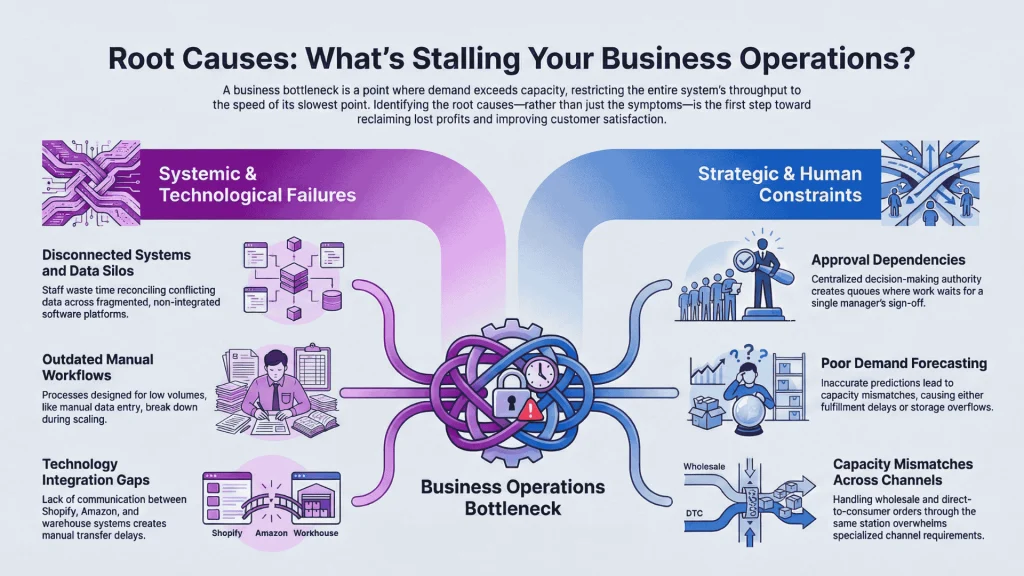
When your sales data lives in one system, inventory data in another, and fulfillment data in a third, every process that needs information from multiple sources hits a wall.
The problems compound quickly:
- Staff waste time hunting for data across platforms
- Manual copying between systems introduces errors
- Updates take hours or days to propagate
- Conflicting information creates confusion
- Reconciliation becomes a bottleneck itself
Which inventory count is correct when your Shopify dashboard shows different numbers than your warehouse management spreadsheet? Reconciling conflicting data becomes its own bottleneck.
Manual Processes and Outdated Workflows
Processes designed for lower volumes often break down at scale. What worked when you shipped 20 orders daily becomes a bottleneck at 200 orders.
Common manual process bottlenecks include:
- Hand-counting inventory instead of barcode scanning
- Handwritten pick lists instead of digital systems
- Spreadsheet-based order tracking
- Email-based approval workflows
- Paper-based quality checklists
Many businesses cling to familiar manual processes even when they have clearly become limiting factors. The comfort of existing workflows often outweighs the pain of change until the bottleneck becomes severe.
Poor Demand Forecasting
When you cannot accurately predict demand, you face a choice between two types of bottleneck:
- Understocking creates fulfillment bottlenecks when you cannot ship orders because inventory is unavailable
- Overstocking creates cash flow bottlenecks and storage bottlenecks as capital sits in slow-moving inventory
Poor forecasting also prevents proactive bottleneck management. Without visibility into upcoming demand patterns, you cannot staff up, increase production, or secure additional inventory before bottlenecks form.
Capacity Mismatches Across Channels
Multichannel sellers face unique bottleneck challenges when channel capacity is misaligned. Your team might handle direct-to-consumer orders efficiently but become overwhelmed by wholesale purchase orders that require different processes.
Channel-specific requirements add complexity:
- Marketplace labeling rules (Amazon, Walmart)
- Platform-specific invoicing formats
- Varying shipping expectations and SLAs
- Different return processing requirements
- Unique packaging or documentation needs
These differences can create bottlenecks even when total order volume seems manageable.
Approval Dependencies and Decision Delays
Every process requiring approval creates a potential bottleneck at the approval step. Work queues up behind whoever holds approval authority:
- Purchase orders waiting for sign-off
- Custom quotes awaiting pricing decisions
- Quality holds pending review
- New vendor approvals
- Exception handling requests
As businesses grow, approval bottlenecks often worsen because decision-making authority does not distribute to match increased volume. The same manager who approved 10 purchase orders weekly now faces 50, but their available time has not increased.
Bottleneck Examples in Business: Real-World Scenarios
Seeing how bottlenecks manifest in specific contexts helps you recognize patterns in your own operations.
Inventory and Warehouse Bottlenecks
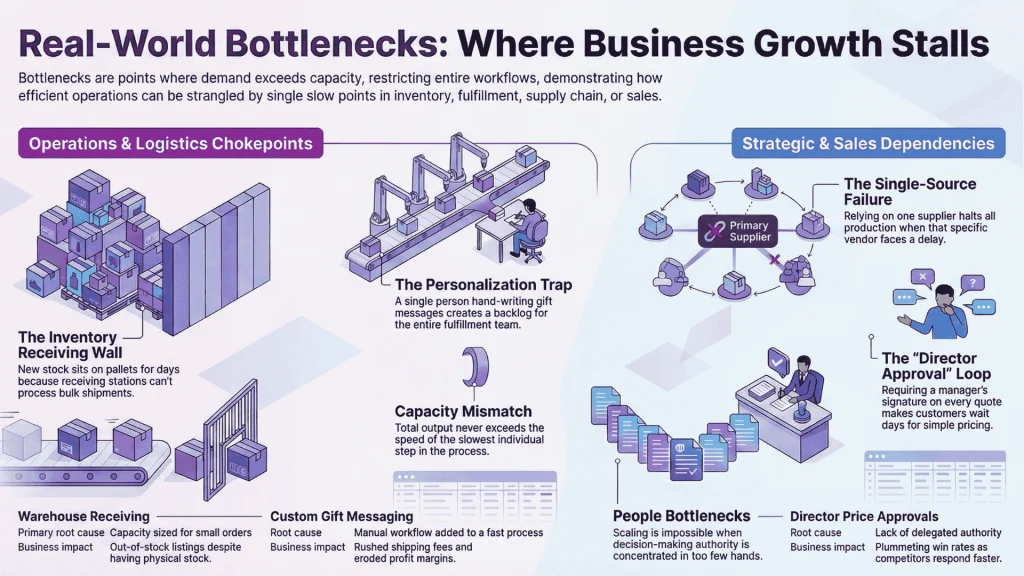
Scenario: An apparel brand selling on Shopify and Amazon sees strong sales, but their single receiving station cannot keep up with incoming shipments. New inventory sits on pallets for days before being logged into the system, counted, and shelved.
Impact:
- Online listings show out-of-stock even when physical inventory exists
- Lost sales to competitors during the receiving delay
- Marketplace rankings drop due to availability issues
- Overselling leads to cancellations and penalties
Root cause: Receiving capacity was sized for direct-to-consumer restocking, not the wholesale bulk shipments that came with scaling to retail partners.
Order Fulfillment Bottlenecks
Scenario: A cosmetics company processes orders efficiently until the custom gift message step. Each order requiring personalization routes to a single team member who hand-writes messages and wraps packages, creating a queue that delays dozens of subsequent orders.
Impact:
- Standard shipping turns into rushed expedited shipping
- Margins erode from unexpected shipping costs
- Holiday backlogs force order cancellations
- Customer satisfaction plummets during peak seasons
Root cause: Personalization was added as a competitive feature without adjusting the fulfillment workflow to handle it at scale.
Supply Chain and Purchasing Bottlenecks
Scenario: A food and beverage distributor sources specialty ingredients from a single overseas supplier. When the supplier faces production delays, the distributor has no alternative source and must halt production of their best-selling products.
Impact:
- Weeks of stockouts damage retail relationships
- Competitors capture shelf space
- Revenue loss during production halt
- Rush orders at premium prices once supply resumes
Root cause: Single-source dependency created a supply chain bottleneck with no redundancy or safety stock to buffer disruptions.
Sales and Customer Service Bottlenecks
Scenario: A wholesale business requires all custom pricing requests to go through the sales director for approval. As the company adds retail accounts, pricing inquiries increase from a few per week to dozens per day.
Impact:
- Potential customers wait days for quotes
- Competitors respond within hours and win deals
- Win rates plummet despite competitive pricing
- Sales team frustration and turnover increase
Root cause: Pricing authority never delegated as the business scaled, creating a people bottleneck at a critical revenue-generating step.
How to Identify Bottlenecks in Your Business
Finding bottlenecks requires systematic investigation rather than assumptions. Follow these four steps to locate where your operations are truly constrained:
- Map your end-to-end processes to visualize workflow
- Analyze your data for patterns indicating delays
- Talk to your team about where they experience slowdowns
- Watch for warning signs that indicate active bottlenecks
Map Your End-to-End Processes
Start by documenting how work actually flows through your business, not how it is supposed to flow. Trace a typical order from the moment it arrives to the moment it ships.
Document each element:
- Every step in the process
- Handoffs between people or systems
- Tools and systems used at each stage
- Time spent at each step
- Who owns each task
Process mapping often reveals bottlenecks that day-to-day operations obscure. You might discover that orders wait in an email inbox for hours, that inventory updates require manual entry in three separate systems, or that a critical quality check depends on one person’s availability.
Pro Tip: Walk through your processes physically. Follow an order through your warehouse. Watch where items sit waiting. Often the physical evidence of bottlenecks, including piled inventory, full queues, and idle downstream stations, makes problems visible.
Analyze Your Data for Patterns
Look at operational metrics for patterns that indicate bottlenecks. Key signals include:
- Increasing lead times for specific process steps
- Growing work-in-progress queues at particular points
- Throughput that plateaus despite increasing inputs
- Error rates that spike at certain process stages
- Cycle times that vary widely for similar tasks
Time-series analysis is especially valuable. Compare metrics across different periods to distinguish temporary spikes from chronic bottlenecks. A fulfillment delay that appeared during your last sale might indicate a capacity bottleneck that only surfaces under peak load.
Pro Tip: Create a simple dashboard tracking cycle time at each major process step. When one step consistently takes longer than others relative to its expected time, you have found a bottleneck candidate.
Talk to Your Team
The people doing the work usually know where bottlenecks exist long before they show up in data. Ask your team:
- Where do you experience delays in your daily work?
- Which steps feel unnecessarily slow or frustrating?
- What would you change about your workflows if you could?
- Where do you spend time waiting for information or approvals?
- What problems do you work around regularly?
Create psychological safety for honest feedback. If staff fear blame for problems, they will hide bottlenecks rather than report them. Frame inquiries as process improvement rather than performance evaluation.
Key Warning Signs of a Bottleneck
Watch for these indicators that suggest bottleneck problems:
- Work accumulates at specific process steps
- Downstream staff frequently wait for upstream work
- One person or resource is always the limiting factor
- Minor disruptions cause cascading delays
- Overtime becomes routine rather than exceptional
- Customer complaints cluster around specific issues
- Error rates increase under normal volume
- Lead times grow while volume stays flat
If several of these signs appear together, you likely have an active bottleneck limiting your operations.
How to Fix and Prevent Business Bottlenecks
Once you identify bottlenecks, address them systematically with solutions matched to their causes.
Streamline and Automate Manual Workflows
Replace manual handoffs, data entry, and repetitive tasks with automated processes wherever possible. Automation eliminates the human capacity constraints that cause many workflow bottlenecks.
Start with these high-impact automation opportunities:
- Order import from sales channels
- Inventory sync across locations
- Routine status updates and notifications
- Standard approval routing
- Report generation and distribution
Look for processes that follow consistent rules. If a step always works the same way based on certain conditions, it is a strong automation candidate. Save human attention for decisions that genuinely require judgment.
Pro Tip: Begin automating your highest-volume, most repetitive process. The time saved compounds daily, and quick wins build momentum for larger automation projects.
Centralize Your Operations Data
Eliminate data silos by bringing inventory, orders, customers, and products into a unified system. When everyone works from the same source of truth, you remove bottlenecks caused by data transfer, reconciliation, and conflicting information.
Centralization delivers multiple benefits:
- Real-time visibility across all channels and locations
- Eliminated manual data transfer between systems
- Reduced errors from duplicate entry
- Faster decision-making with consolidated information
- Easier identification of emerging bottlenecks
Improve Demand Forecasting
Better demand forecasting lets you position resources before bottlenecks form. Use these inputs to anticipate volume changes:
- Historical sales patterns by product and channel
- Seasonal trends and promotional calendars
- Leading indicators like website traffic or inquiry volume
- Market trends and competitor activity
- Customer reorder patterns
Use forecasting insights to proactively adjust staffing, inventory levels, and production schedules. The goal is matching capacity to demand before mismatches create bottlenecks.
Forecasting does not require perfection. Even directional improvements, knowing that demand will increase significantly rather than predicting the exact number, enables better bottleneck prevention than operating blind.
Cross-Train Your Team
Reduce people bottlenecks by ensuring critical knowledge and capabilities exist in multiple team members. Cross-training creates redundancy that prevents single-person dependencies from choking your workflows.
Implement cross-training strategically:
- Identify highest-risk people bottlenecks first
- Document processes before training begins
- Rotate staff through different roles regularly
- Create backup coverage plans for critical functions
- Test redundancy before you need it
Cross-training also improves job satisfaction by adding variety to roles and creating advancement opportunities. Staff who understand multiple functions often contribute better process improvement ideas.
Leverage Technology Integrations
Connect your systems so data flows automatically between platforms. Integrated systems eliminate the manual transfer steps that create bottlenecks and errors.
Prioritize these integration connections:
- eCommerce platforms to inventory management
- Inventory management to accounting software
- Sales channels to fulfillment systems
- Purchasing to supplier communication
- Customer data across all touchpoints
Evaluate potential tools based on their integration capabilities, not just standalone features. A less feature-rich solution that integrates smoothly often outperforms a powerful tool that creates data silos.
| Bottleneck Type | Primary Solution | Implementation Complexity |
| Manual process | Automation | Medium |
| Data silos | System integration | Medium to High |
| Capacity constraint | Equipment/space investment | High |
| People dependency | Cross-training, delegation | Low to Medium |
| Forecasting failure | Analytics tools, process improvement | Medium |
| Approval delay | Authority delegation, workflow redesign | Low |
Frequently Asked Questions About Business Bottlenecks
What is a bottleneck in business terms?
A bottleneck in business is a point in a workflow where work accumulates because that step cannot process items as fast as they arrive. The term comes from how a bottle’s narrow neck restricts flow. In operations, a bottleneck limits total throughput because the entire system can only move as fast as its slowest point.
What is an example of a bottleneck in operations?
A common bottleneck example is a warehouse with one shipping station handling all outbound orders. If picking and packing can process 100 orders per hour but the shipping station handles only 60, orders stack up waiting for shipping regardless of how fast upstream work completes. The shipping station bottleneck caps total fulfillment at 60 orders per hour.
How do you identify a bottleneck in a process?
Identify bottlenecks by looking for work accumulation points, tracking where delays occur, measuring cycle times at each process step, and asking staff where they experience slowdowns. The step where work-in-process inventory piles up, where downstream workers wait for input, or where metrics consistently lag is typically your bottleneck.
What is the difference between a bottleneck and a constraint?
A constraint is any factor limiting your potential output, such as budget, space, or staff size. A bottleneck is a constraint currently limiting your actual output because demand exceeds its capacity. All bottlenecks are constraints, but not all constraints are bottlenecks. A constraint becomes a bottleneck when workflow volume surpasses what it can handle.
How do you fix bottlenecks in business?
Fix bottlenecks by increasing capacity at the constrained point, reducing demand on it, or redesigning processes to eliminate it entirely. Specific solutions include automation, system integration, equipment upgrades, hiring, cross-training, demand forecasting improvements, and workflow restructuring. The right solution depends on the bottleneck’s root cause.
Key Takeaways: Turning Bottlenecks Into Opportunities for Growth
Every growing business encounters bottlenecks. The difference between businesses that scale successfully and those that stall often comes down to how they identify and address these operational constraints.
Understanding what a bottleneck means in business is just the starting point. The real work involves systematically mapping your processes, finding where throughput limitations exist, and implementing targeted solutions. Some bottlenecks require significant investment to resolve. Many others need only workflow adjustments, better tools, or smarter process design.
Remember these core principles:
- Your business can only move as fast as its slowest point
- Not all bottlenecks are equal: identify the type before choosing a solution
- Data and team feedback together reveal bottlenecks faster than either alone
- Prevention through forecasting and integration beats reactive firefighting
- Each bottleneck resolved increases your capacity for growth
The businesses that handle bottlenecks best treat them as improvement opportunities rather than inevitable problems. Each bottleneck you resolve increases your operational capacity and positions you for the next phase of growth.
Start by examining your highest-volume processes for the warning signs outlined in this guide. Talk to your team about where they experience delays. Look at your data for patterns indicating throughput constraints. Then address the most impactful bottlenecks first, building operational resilience one improvement at a time.
Your business can only grow as fast as its slowest point allows. Find your bottlenecks, fix them, and unlock the growth your business is capable of achieving.