



The best MRPeasy alternatives in 2026 are Qoblex, Katana, Fishbowl, Cin7 Core, inFlow Inventory, Odoo, ERPAG, and Unleashed. MRPeasy is a capable, manufacturing-first platform priced per user per month, built around shop-floor scheduling and production control. Teams that need a more ecommerce-native platform, B2B wholesale workflows, or flat-rate pricing that does not compound as headcount grows usually find a better fit elsewhere. Qoblex is the top pick for the multichannel ecommerce plus light manufacturing buyer.
A practical guide written from the operator’s side of the desk: which platform actually fits the way your business runs, not just which one has the longest feature list.
Why look for a MRPeasy alternative?
Most people who go looking for a MRPeasy alternative are not unhappy with it as a manufacturing tool. They hit a specific wall. Sometimes it is the monthly bill climbing every time a new person needs a login. Sometimes it is that the platform is built around production runs, but their actual day is spent keeping Shopify, Amazon, and a growing wholesale order book in agreement. Either way, the tool is doing its job well: it is just doing a slightly different job than the one they need done.
That distinction is worth being precise about, because a lot of comparison pages get it wrong. MRPeasy is not a weak platform, and it is not missing the obvious things. It connects to the sales channels. It tracks lots and expiry dates. The question is not whether it can do a thing. The question is which direction the whole system was built from, and whether that direction matches yours.
What does MRPeasy actually cost in 2026?
MRPeasy uses per-user pricing, with four tiers (Starter at $49, Professional at $69, Enterprise at $99, and Unlimited at $149 per user per month, minimum two users). Annual billing saves you a month, and there are no long contracts.
Per-user pricing is clean and fair when your team is small. The math changes as you grow. Every operator, purchaser, and shop-floor worker who needs to log in adds to the monthly figure, and manufacturing is a headcount-heavy operation. A ten-person team on the Professional tier is a meaningfully different number than the sticker on the first row of the pricing table. Brahmin Solutions, itself an MRPeasy competitor, builds its whole pitch around this compounding math, and while that is a vendor talking its own book, the arithmetic is independently checkable on MRPeasy’s own pricing page. It is a real consideration, not a manufactured one.
Who is MRPeasy built for, and where does its focus show?
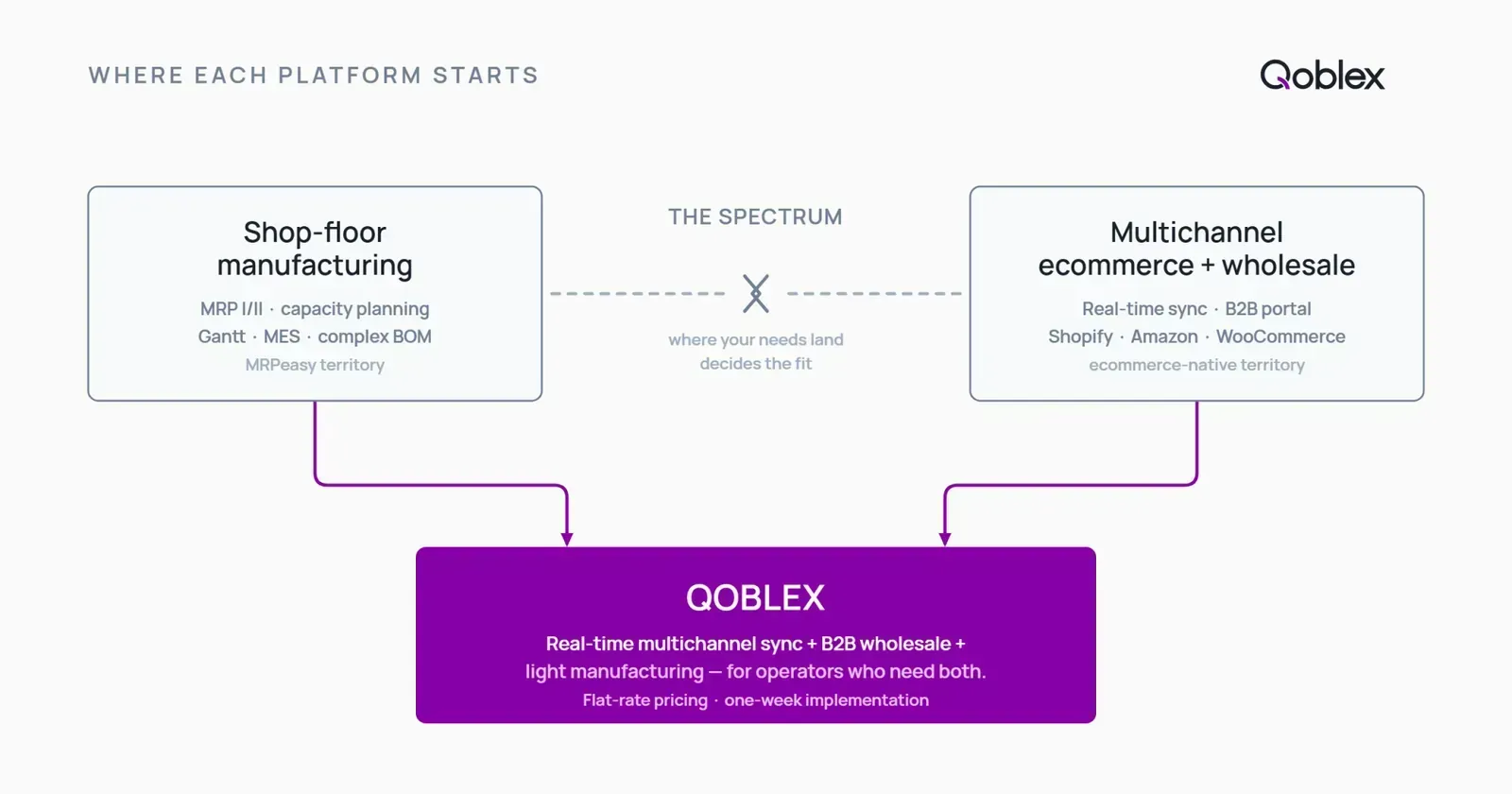
MRPeasy is a manufacturing platform first and everything else second. It is built around MRP I and MRP II, finite-capacity scheduling, Gantt-based rescheduling, a manufacturing execution system for shop-floor reporting, and multi-level BOM with subcontracting and a configurator for matrix products (as described in Qoblex’s own head-to-head comparison; verify current specifics directly with MRPeasy). That is a deep, serious production toolkit. If your daily problem is sequencing production runs against machine and labor capacity, MRPeasy was built for exactly that.
The focus shows in the way everything else attaches to the production engine. Take ecommerce. MRPeasy does connect to Shopify, WooCommerce, Amazon, BigCommerce, and Magento, so anyone telling you it “can’t do ecommerce” is simply wrong. But the shape of that connection tells you where the platform’s center of gravity is. Its Shopify integration imports orders as manufacturing customer orders, and it updates available quantities in Shopify once per hour rather than in real time. For a made-to-order manufacturer with modest online volume, hourly is fine. For a high-volume ecommerce operation where a stale stock number means an oversell, real-time accuracy is the thing you are actually buying software to protect.
What are the most common reasons teams evaluate alternatives?
Put plainly, people leave MRPeasy for one of a few honest reasons:
- Pricing that compounds at team scale. Per-user billing is friendly at three seats and less friendly at fifteen, especially when floor staff need accounts.
- An ecommerce-native workflow. They want a platform that starts from multichannel orders and inventory, with manufacturing added on, rather than the other way around.
- Wholesale and B2B as the main event. Their revenue is distribution, not production, so they want customer-specific pricing, a wholesale portal, and clean order management first.
- A lighter, faster setup. They do not need MRP II depth and would rather implement in a week than spend a quarter configuring a production planner they will not fully use.
If none of those describe you, you may not need to switch at all. We will come back to that honestly later on.
What to look for in a MRPeasy alternative
Before you compare tools, get clear on what you actually run day to day. The right alternative depends far more on the shape of your business than on any single feature checkbox. For a company that has outgrown spreadsheets but is nowhere near needing a full ERP, these are the dimensions that decide it. This is the layer above the specific products, the same evaluation you would apply when shopping any manufacturing inventory software or MRP software for small business.
Manufacturing depth versus operational breadth: know what you actually need
This is the first fork in the road, and it decides almost everything downstream. Some tools go deep on production: scheduling, capacity, shop-floor control. Others go broad on operations: multichannel inventory, purchasing, fulfillment, wholesale, with lighter manufacturing attached. MRPeasy is firmly on the depth side. Be honest about which one you are. If your core daily pain is “what runs on which machine, in what order,” you want depth. If it is “does my stock number agree across every channel and warehouse,” you want breadth.
Pricing model: per-user versus flat-rate at team scale
Per-user pricing rewards small teams and penalizes growth. Flat-rate or module-based pricing does the opposite: a slightly higher entry point that stops climbing as you add people. Qoblex, Cin7 Core, Fishbowl, and Odoo use pricing models that do not scale per user (confirm each vendor’s current tiers), which tends to favor teams heading past ten seats. If you expect to add floor staff or warehouse users, model the two-year cost, not the first invoice.
Ecommerce-native sync versus manufacturing-order-centric integration
Every serious tool on this list connects to Shopify and the major marketplaces. The difference is whether the sync was designed for ecommerce or bolted onto a production workflow. Ask two questions of any platform: how often does inventory update (real-time or batched), and does an online order flow through the system as a first-class sales order or as a translated manufacturing order? For a high-volume online seller, those answers matter more than the length of the integrations page.
Implementation speed: one-week versus multi-month rollout
A production-planning platform with capacity scheduling and MES is a substantial thing to set up, and MRPeasy is honest about that. Lighter operational platforms trade some of that depth for a faster start. If you need to be live and trustworthy in a week rather than a quarter, weight this heavily. Time spent in a half-configured system is time your inventory is not trustworthy.
Which MRPeasy alternatives support lot and expiry tracking?
Several tools on this list include lot, batch, serial, and expiry tracking, though depth and pricing structure vary. Fishbowl includes all four as built-in part-tracking types. MRPeasy includes them natively. Qoblex offers them as a paid add-on. Katana includes them via the Full Traceability add-on purchased on top of the Core plan. Unleashed includes batch and FEFO. ERPAG includes lot and batch with an expiry date parameter. For regulated industries (food, supplements, pharmaceuticals), verify FEFO enforcement at the pick-order level with each vendor before committing.
The 8 best MRPeasy alternatives in 2026: quick comparison
Here is the shortlist at a glance, ranked and compared on the dimensions that actually decide the choice. The MRPeasy facts referenced throughout are drawn from MRPeasy’s own published documentation. The capability labels for the other tools reflect their published product scope and should be confirmed against each vendor’s current documentation before you commit. Qoblex pricing is shown as a structure with a link to the current figures rather than a dollar amount, because published prices go stale and we would rather you see the live number.
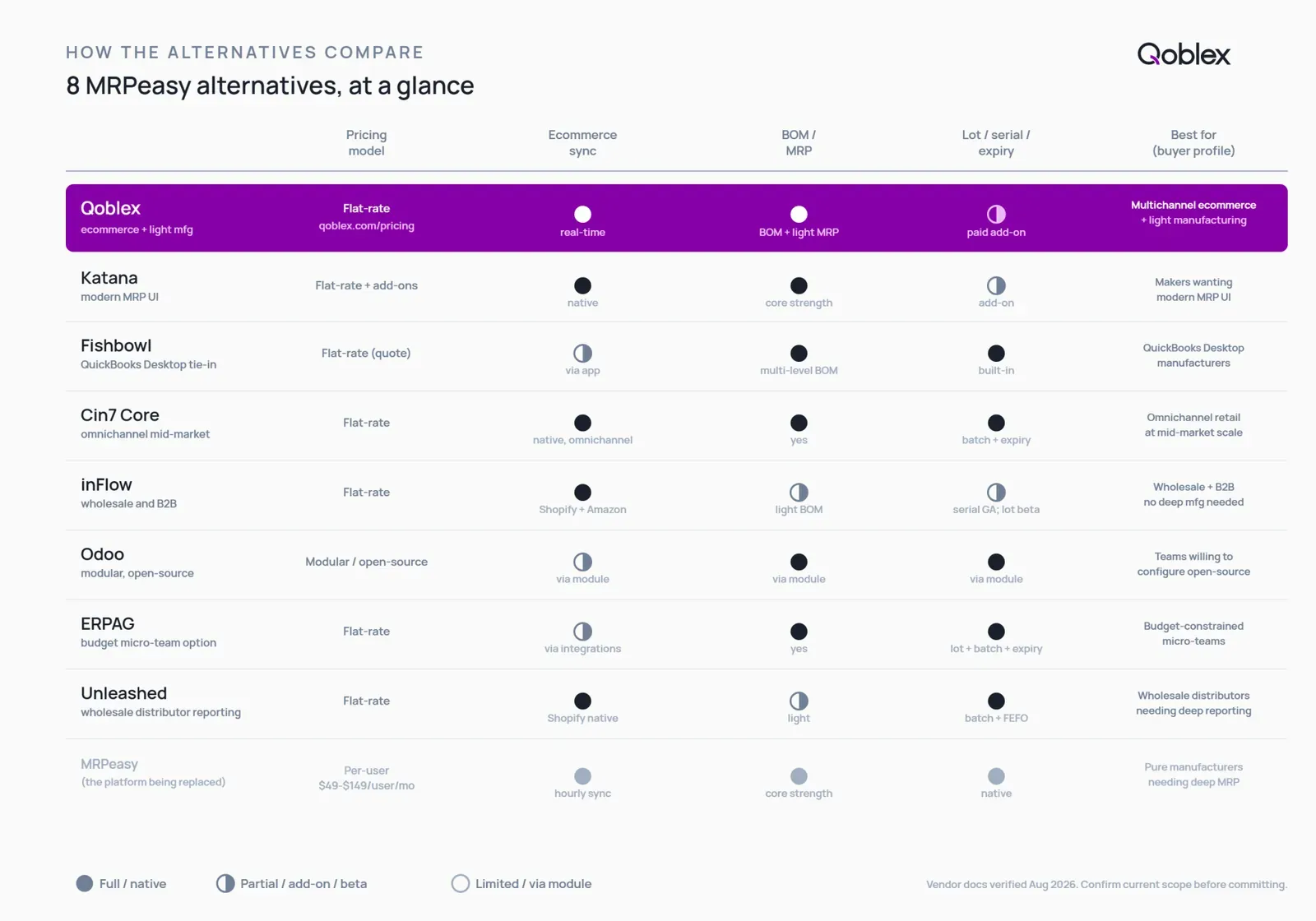
| Tool | Pricing model | Ecommerce-native sync | Light manufacturing (BOM / MRP) | Lot / serial / expiry tracking | Best for |
|---|---|---|---|---|---|
| Qoblex | Flat-rate (see pricing) | Real-time, multichannel | BOM + production orders (light MRP) | Yes (add-on, not base plan) | Multichannel ecommerce + light manufacturing |
| Katana | Flat-rate + add-ons (pricing) | Native | Strong, MRP-focused | Full Traceability add-on | Makers who want a modern MRP UI |
| Fishbowl | Flat-rate (quote) | Via app | Yes | Built-in lot / serial / expiry | QuickBooks Desktop manufacturers |
| Cin7 Core | Flat-rate (pricing) | Native, omnichannel | Yes | Batch / expiry (all tiers) | Omnichannel retail at mid-market scale |
| inFlow Inventory | Flat-rate | Native (Shopify, Amazon) | Light | Serial GA; lot / expiry see note | Wholesale + B2B without deep manufacturing |
| Odoo | Modular / open-source | Via module | Yes (module) | Via module | Teams willing to configure |
| ERPAG | Flat-rate (pricing) | Via integrations | Yes | Lot / batch + expiry | Budget option for micro-teams |
| Unleashed | Flat-rate (pricing) | Native (Amazon paid add-on) | Light | Batch + FEFO | Wholesale distributors who want reporting |
A note on the cells: where a competitor’s traceability or sync depth is not first-party verified for this page, the label above is directional and drawn from published scope. Treat those as a starting point for your own check, not a warranty. The Qoblex and MRPeasy cells are sourced.
Detailed reviews
1. Qoblex: best for multichannel ecommerce plus light manufacturing
Qoblex sits in the operational middle: past the point where spreadsheets stay true, well short of the point where you need a full ERP. It is built from the multichannel side outward. Real-time inventory sync across Shopify, Amazon, and WooCommerce; a built-in B2B wholesale portal with customer-specific pricing; multi-warehouse purchasing and fulfillment; and BOM, production orders, and lot, serial, and expiry traceability for the assembly work most SMBs actually do. Lot, batch, serial, and expiry tracking is available as a paid add-on rather than part of the base plan; see the pricing page for the current structure.
Qoblex uses flat-rate pricing that does not climb per user, and targets a one-week implementation rather than a multi-month rollout. Xero or QuickBooks Online stays your book of record; Qoblex closes the inventory and operations gap alongside it rather than trying to become your accounting system.
Where Qoblex is the right pick: you sell across channels, you do light-to-moderate manufacturing or assembly, you want wholesale handled properly, and you would rather add users without watching the bill climb. Where it is not: if your core problem is finite-capacity production scheduling and MES-grade shop-floor control, Qoblex’s manufacturing is deliberately lighter than MRPeasy’s, and you should stay with a production-first tool. For the feature-by-feature detail, we keep a dedicated Qoblex versus MRPeasy comparison so this page does not have to repeat it.
2. Katana: best for makers and light manufacturers who want a modern UI
Katana is a clean, modern MRP tool with a real-time production planner and strong BOM management, and it connects natively to the major sales channels and accounting tools. It is a genuine peer to MRPeasy on the manufacturing side, often with a friendlier interface. The one thing to check before you commit: lot, batch, serial, and expiry tracking sit in Katana’s Full Traceability add-on, purchased on top of the Core plan, rather than in the base. If you make food, supplements, or anything regulated, price that add-on into your comparison from day one.
3. Fishbowl: best for QuickBooks Desktop users in manufacturing
Fishbowl is the long-standing choice for manufacturers anchored to QuickBooks Desktop, with built-in lot, batch, serial, and expiration tracking as core part-tracking types rather than an upsell. It is an on-premise-leaning, heavier install than the cloud-native tools here, so weight your implementation appetite accordingly. If QuickBooks Desktop is your accounting reality and you want traceability in the base, Fishbowl earns its place.
4. Cin7 Core: best for omnichannel retail plus inventory at mid-market scale
Cin7 Core is a broad omnichannel inventory and order platform with strong retail and warehouse features, batch and expiry tracking across tiers, and native connections across the major channels. It reaches higher up-market than most tools on this list, which is a strength if you are scaling toward mid-market complexity and a mismatch if you are a lean three-person shop. Its published tiers do not scale per user, which helps at team scale.
5. inFlow Inventory: best for wholesale and B2B without manufacturing depth
inFlow is a well-liked wholesale and B2B inventory tool with a clean order workflow and native connections to Shopify, Amazon, Xero, and QuickBooks Online. Manufacturing is light here, so it suits distributors more than makers. On traceability: serial number tracking is generally available, and lot and expiry tracking was in beta as of mid-2026; confirm its current status directly with inFlow before relying on it for regulated stock, because that may have changed.
6. Odoo: best for teams willing to configure an open-source platform
Odoo is a modular open-source suite that can do almost anything, including manufacturing, inventory, ecommerce, and accounting, if you are willing to configure it or pay someone who will. That flexibility is the whole pitch and also the whole caveat. Lot tracking, ecommerce sync, and MRP all live in modules you assemble. If you have technical resources and want to own your stack, Odoo rewards the effort. If you want to be running next week, it will fight you.
7. ERPAG: best budget manufacturing option for micro-teams
ERPAG is the lowest-entry-cost manufacturing-capable option here, with lot and batch tracking including an expiry-date parameter and a tiered structure that includes a handful of users per plan. Cheapest is not the same as best fit, so treat the price as one input rather than the deciding one. For a micro-team that needs basic manufacturing and traceability without a big spend, it is a reasonable starting point.
8. Unleashed: best for wholesale distributors who want deep reporting
Unleashed is a wholesale and distribution inventory platform with strong reporting, batch tracking, and FEFO handling, and a native, real-time Shopify integration. Amazon connectivity is a native paid add-on. Manufacturing is light. If your business is distribution-led and you live in your inventory reports, Unleashed is built for you.
When MRPeasy is genuinely the right call
Here is the part most comparison pages skip, so we will not. MRPeasy earns its place, and for the right business it is the better tool, not the fallback.
Stay with MRPeasy, or choose it, when:
- You are a pure manufacturer whose core daily pain is production control. If sequencing production runs, managing machine and labor capacity, rescheduling on a Gantt chart, and reporting from the shop floor is the actual job, MRPeasy’s MRP I and MRP II, finite-capacity scheduling, and MES are deeper than the lighter MRP in Qoblex or most of this list. That depth is the whole point of the platform, and it is real.
- Your team is small enough that per-user pricing still works. For a three-to-five-person team on the Starter or Professional tier, the economics are perfectly reasonable. The compounding concern is a growth problem, not a starting problem, so if you are not planning to add many logged-in users soon, it may never bite.
- You need multi-level BOM, subcontracting, or a configurator for matrix products at depth. These are areas where lighter alternatives simply do not match MRPeasy, and if they describe your product, that is decisive.
- You are already live on MRPeasy and it is working. Switching has a real cost: data migration, retraining, and workflow disruption. Do not move for marginal savings if the current system is doing the job. That is not loyalty, it is arithmetic.
The honest framing is this. MRPeasy starts from the shop floor and adds the rest. The alternatives on this list mostly start from the other direction: the ecommerce or wholesale workflow, with manufacturing added on. Neither is better in the abstract. The only question that matters is which direction your business actually runs from.
How to choose your MRPeasy alternative: decision framework
You can shortcut most of the comparison by naming your buyer profile honestly:
- Pure manufacturer, production is the job. Stay with MRPeasy, or look hard at Katana for a more modern take on the same manufacturing-first approach.
- Ecommerce plus light manufacturing. Qoblex is built for exactly this: real-time multichannel inventory, wholesale, and enough manufacturing without the weight.
- Wholesale or distribution led. Look at inFlow or Unleashed, depending on whether you weight simple order flow or deep reporting.
- Budget-constrained micro-team. ERPAG for the lowest entry, or Odoo if you have the technical resources to configure open-source.
- Omnichannel scaling toward mid-market. Cin7 Core, or Fishbowl if QuickBooks Desktop anchors you.
For a twenty-person team, the two questions that decide it are almost always: how much genuine production-scheduling depth do you need, and how badly does per-user pricing hurt at your headcount. Answer those two honestly and the field narrows to two or three quickly.
Making the switch: what to expect
Migrating off MRPeasy is manageable but not free. MRPeasy exports the core data you need, BOM, inventory, and orders, in standard formats, so the raw material for a move is there. The real work is the parts that do not export cleanly: rebuilding your workflows, retraining the team, and validating that stock, purchasing, and orders agree in the new system before you trust it. Budget for a parallel period where both systems run and you reconcile, rather than a hard cutover on a Monday. Most alternatives offer onboarding support; Qoblex targets a one-week implementation, though your own data cleanliness is the biggest variable in any timeline.
FAQ
How much does MRPeasy cost per user in 2026? MRPeasy uses per-user pricing across four tiers: Starter at $49, Professional at $69, Enterprise at $99, and Unlimited at $149 per user per month, with a two-user minimum (mrpeasy.com/pricing). Annual billing saves a month, and there are no long contracts.
Is MRPeasy a good fit for ecommerce businesses? MRPeasy has Shopify, WooCommerce, and Amazon integrations, so it can serve an ecommerce business. The integrations are designed around manufacturing order flow, and inventory updates on an hourly cycle rather than in real time. If your primary workflow is high-volume multichannel selling rather than production, a more ecommerce-native platform is often the better fit.
What is the cheapest MRPeasy alternative? ERPAG is the lowest-entry-cost manufacturing-capable option on this list (erpag.com/prices). Cheapest is not the same as best fit, so weigh it against what you actually need to run.
Which MRPeasy alternative is best for small manufacturers? It depends on the need. Katana suits makers who want a modern manufacturing UI; Qoblex suits multichannel sellers who do light manufacturing; and MRPeasy itself is the right answer if deep production scheduling is your core problem.
Does MRPeasy do lot tracking and expiry dates? Yes. MRPeasy includes lot and serial number tracking and expiry date visibility natively. The question for a regulated business is whether its implementation, including FEFO picking, meets your specific compliance workflow, so verify that depth against your requirements.
Which MRPeasy alternatives have flat-rate pricing? Qoblex, Cin7 Core, Fishbowl, and Odoo use flat-rate or module-based pricing that does not compound per user, which tends to favor teams of ten or more.
Does MRPeasy integrate with Shopify? Yes, natively. The integration imports Shopify orders as manufacturing customer orders and updates inventory once per hour. It is built for manufacturing workflow rather than high-volume ecommerce fulfillment.
How hard is it to switch from MRPeasy? MRPeasy exports core data (BOM, inventory, orders) in standard formats. The harder work is rebuilding workflows and retraining. Most alternatives offer onboarding support; Qoblex targets a one-week implementation track.
Who is MRPeasy designed for? Pure manufacturers, roughly 10 to 200 employees, who need MRP I and MRP II production planning, finite-capacity scheduling, Gantt rescheduling, shop-floor reporting, and complex BOM management. If production control is the core need, MRPeasy is strong.
Can I try these alternatives before buying? Yes. Qoblex offers a 14-day trial with no credit card, Katana offers a free trial, and MRPeasy itself offers a 15-plus-15-day free trial with no card required. Most tools on this list let you evaluate before committing.
Which MRPeasy alternative is best for food, beverage, or regulated manufacturing? For regulated industries where lot traceability and expiry date enforcement matter, Fishbowl includes lot, batch, serial, and expiration tracking as built-in part-tracking types. Katana covers this via its Full Traceability add-on. Qoblex offers lot, serial, and expiry tracking as a paid add-on. Unleashed includes batch tracking with FEFO. For any regulated workflow, verify FEFO pick-order enforcement specifically before committing to a platform.
Conclusion: your next move
The useful thing to walk away with is not a ranking, it is a clearer read on your own operation. MRPeasy is a strong platform for the manufacturer it was built for. If production scheduling and shop-floor control are your daily reality, it may be exactly right, and switching would cost more than it returns. If your real problem is keeping multichannel inventory true, running wholesale properly, or getting off a bill that grows every time you hire, the platform you want probably starts from the other direction. Name which of those you are, and the choice mostly makes itself.