



Written from the point of view of an operator who imports stock, sells it on Shopify, and finds that the margin on screen is not the margin in the bank.
You ordered from an overseas supplier three months ago. The goods arrived, you counted them in, and Shopify’s Cost per item field still says what it said the day you created the product: the supplier’s unit price. Then the freight invoice landed. Two weeks later, the duty. Both went into Xero or QuickBooks Online as expenses, correct as accounting entries and completely absent from the number you read when you check a product’s margin.
For a long stretch that was reasonable: one supplier, a shipment a quarter, freight that barely moved. The gap between the price you paid and the cost that landed was small enough to ignore. Then the lanes changed, a second supplier came on, duty on your category moved. Now the margin looks fine and you no longer trust it.
This page stays on that one gap, picking up where our overview of Shopify inventory management (published 23 July 2026) touches on it briefly. It sits under Qoblex’s landed costs hub, which covers freight-and-duty capture across any purchase channel.
Why doesn’t Shopify’s Cost per item field capture your true landed cost?
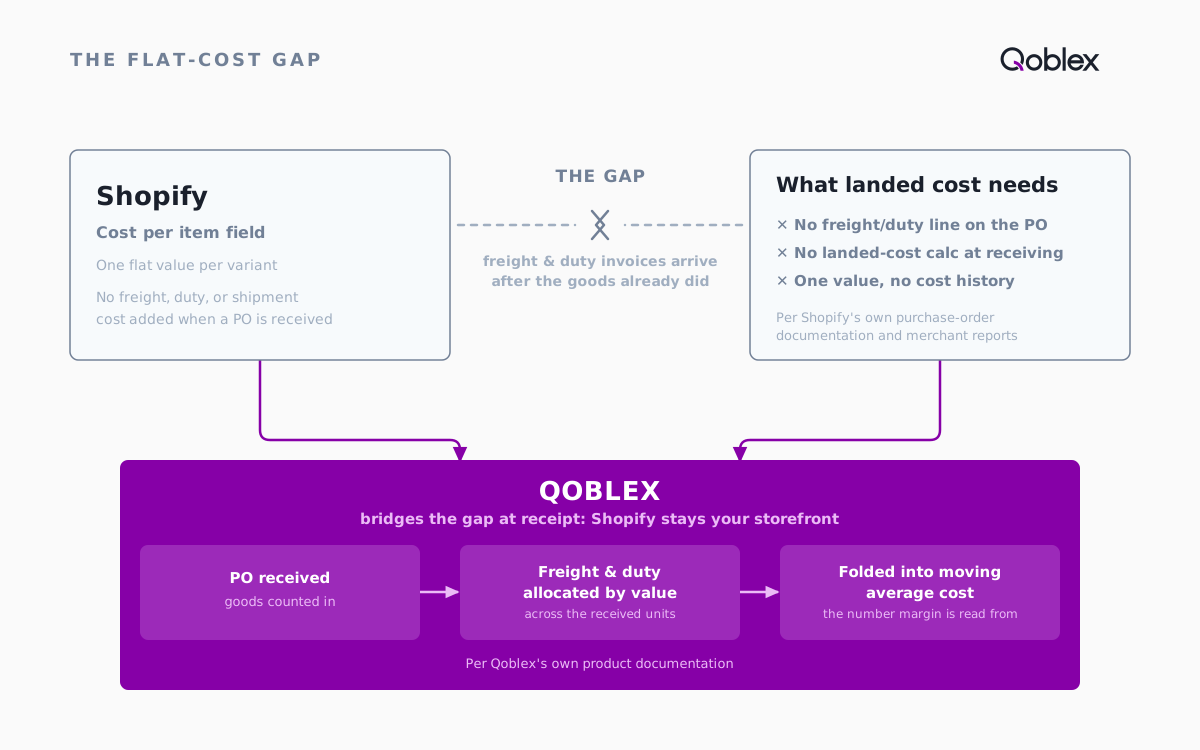
Because it holds a price, not a record of what a receipt cost you.
What does Shopify’s native cost field actually track?
One number per variant: what you paid the supplier, stored until you change it. Buying domestically at a stable price, that is close enough to true.
The limit shows up at receiving. Per Shopify’s own purchase order documentation, a native Shopify PO carries products, quantities, cost, payment terms, and supplier details: no freight line, no duty line, no landed-cost calculation when the stock is received. Merchants in Shopify’s own community describe it as “one scalar per inventory item, no location dimension, no cost layers.”
Why doesn’t the cost update when a freight or duty invoice arrives after the goods do?
Because there is nothing for it to update. Cost per item is a standing value, not a history of receipts, so a cost that surfaces three weeks after the container has no receipt to attach to. Operators in that thread report the consequence: invoices that arrive after the goods have sold leave those margins misstated.
One merchant has publicly asked Shopify for a landed cost field in the purchase order receiving workflow (posted 11 July 2026), describing the existing field as “a single overwritable value with no historical tracking.”
What happened to landed cost tracking after Stocky’s shutdown?
For a slice of merchants this got harder recently.
What could Stocky do for purchase-order costing that native Shopify doesn’t?
Stocky was Shopify’s own purchasing and forecasting app, and the path some merchants leaned on for buying depth the admin does not carry: deeper purchase orders, forecasting, and, for those who set it up that way, spreading shared shipment costs across an order’s lines rather than parking them as a separate expense.
What’s left for freight and duty allocation now that Stocky is gone?
Per Shopify’s own transition guidance, Stocky is no longer available as of 31 August 2026, and it was delisted from the Shopify App Store on 2 February 2026. What remains is the native workflow: create an order, add products, quantities and cost, receive stock. No cost-layer update on receipt, no margin calculation. So the accurate description is not “no purchase orders.” It is basic purchase orders, with no landed-cost computation at receiving.
What does skipping landed cost tracking actually cost you?
Not a catastrophe. Something quieter: decisions made on numbers that lean the same way every time.
How do unallocated freight and duty distort your per-SKU margin?
Every shipment cost that never reaches a unit makes your COGS look lower and your margin look higher than it is. It never errs the other way, so pricing off that number means pricing off an optimistic one.
The second effect is mix. A bulky, low-value SKU absorbs far more shipping cost per unit than a small, high-value one in the same container. Unallocated, the light expensive product quietly subsidises the heavy cheap one, and the line you believe is your best margin may not be.
Why does this get worse on imported or tariff-affected inventory?
Duty is assessed as a proportion of declared value, and freight moves with lane, season, and carrier. On imported stock, freight, duty, insurance, and handling are a larger and far less predictable share of unit cost than on a domestic pallet. The bigger and choppier that share, the further the flat field drifts.
How do you distribute freight and duty across a Shopify purchase order?
Mechanically this is a solved problem. Shared shipment costs get spread across an order’s lines two ways: by value, proportional to what each line cost, or by quantity, divided across units. By value is the usual default, because it tracks how customs charges behave.
Where can you see the full breakdown and a worked example?
The mechanics live in two places we keep current: the landed cost calculator, which carries both methods and a worked example, and the guide to calculating landed cost. For a Shopify merchant the question is not how the arithmetic works, but where it runs, and whether the result reaches the system you read margin from.
How do you add landed cost tracking to Shopify without replacing it?
Three honest options, suited to different sizes of operation.
What do the spreadsheet and single-purpose-app options look like, and where do they fall short?
The spreadsheet is where almost everyone starts, and it is a legitimate answer. Export the PO lines, add the freight and duty totals, allocate, and you have a real landed unit cost. For a handful of POs a quarter, that may be all you need.
It thins out in four places: when the invoice arrives after the goods have sold; when one freight bill covers several purchase orders; when the bill is in a different currency from the PO; and, the quiet one, when the corrected number stays in the spreadsheet and never reaches the system where anyone reads margin.
Apps are the second option, and two different jobs get called landed cost on the Shopify App Store. Some are customer-facing: Zonos calculates duty and tax at checkout, so you can collect it from the shopper. Others are merchant-side: Landara allocates freight and duty into a landed unit cost per receipt, records it as a dated FIFO cost layer, and writes the updated cost back to the Shopify variant. Be clear which problem you are buying a fix for.
What does an operations layer add that a single-purpose app doesn’t?
Context. Allocation is one step inside a purchasing workflow that also holds the order, the supplier, the receipt, and the stock it creates. Run it there and the corrected cost is simply what the item costs from that point on. Run it in a separate tool and you have one more sync to trust.
How does Qoblex handle landed cost on Shopify purchase orders?
Qoblex is the operations layer here: purchasing and costing, while Shopify does what it is good at.
What happens when you receive a PO in Qoblex?
The allocation happens at receipt. Per our landed cost calculator page: “When you receive a purchase order in Qoblex, it distributes the landed costs such as freight and duties across the received units by value and folds them into the item’s moving average cost.” What that moving average does as new stock arrives at different prices is a separate subject, inventory costing.
Does it handle multi-currency freight bills and freight split across multiple POs?
Yes, and these are the two cases that break spreadsheets first. Per the Qoblex purchase orders page, Qoblex supports extra supplier charges such as shipping and freight, supports “freight bills that are related to one or multiple purchase orders,” and those bills “can be in a different currency than the purchase orders they are related to.” One forwarder invoice covering three POs, billed in a currency none of them used, is an ordinary week for an importer.
Does Qoblex replace Shopify, or does Shopify stay the storefront?
Shopify stays the storefront. Per the Qoblex Shopify integration page, Qoblex captures Shopify orders immediately, syncs stock levels back in real time, supports more than 200 currencies, and runs several Shopify stores from one dashboard. Shopify keeps checkout and point of sale, Xero or QuickBooks Online stays your book of record, and Qoblex gets the real cost into the number before anyone reads a margin off it. If you manufacture rather than only resell, the same question shows up in production costing, covered in our guide to food COGS and landed cost.
| Capability | Shopify (native) | Qoblex + Shopify |
|---|---|---|
| Cost field per variant | Single flat value, no freight or duty roll-in on receipt | Landed cost folded into moving average cost when a PO is received |
| Freight and duty allocation across PO lines | None natively; Stocky, sunset 31 August 2026, was the path some merchants used | Automatic, by value, at receipt |
| Multi-currency freight bills | Not documented as a native capability | Yes, a freight bill can be in a different currency than its PO |
| One freight bill across several POs | Not documented as a native capability | Yes |
| Native PO fields | Products, quantities, cost, payment terms, supplier details | The same, plus freight and extra-cost lines with landed-cost distribution |
When is Shopify’s native cost tracking enough?
Often enough that this section matters. Adding a costing layer before you have a costing problem is only complexity you do not need yet.
Which Shopify sellers genuinely don’t need landed-cost allocation?
If you buy domestically from one supplier, pay no duty, and freight is a small, predictable line relative to product cost, the flat Cost per item field is honestly fine. Load it with your unit price plus your usual freight allowance and the error stays small, stable, and in the same direction on every SKU, so it will not change a pricing or range decision. Low volume points the same way: at a few POs a quarter, spreadsheet reconciliation is feasible.
When does a flat cost-per-item estimate stop being good enough?
Watch the signals, not the calendar. Freight and duty becoming a material and variable share of unit cost, usually when you start importing. More than one supplier or lane, so no single allowance fits every SKU. A tariff-exposed category where the rate moves. Invoices that arrive after the goods have sold. Enough SKUs and POs that reconciliation becomes a job rather than a task. And the operator’s own tell: someone has to remember which purchase orders were corrected by hand, because the system does not know.
With one or two of those true, an allowance in the cost field is still defensible. With four, the flat number has stopped being an estimate.
Frequently asked questions
Does Shopify track landed cost natively?
No. Cost per item is a single flat value per variant, and per Shopify’s own purchase order documentation a native purchase order carries products, quantities, cost, payment terms, and supplier details, with no freight or duty line and no landed-cost computation at receiving. Merchants in Shopify’s community describe the cost field as one scalar per inventory item with no cost layers.
What happened to landed cost tracking after Stocky shut down?
Stocky, the app some merchants used for deeper purchasing and for spreading shipment costs across an order, is no longer available as of 31 August 2026 and was delisted from the Shopify App Store on 2 February 2026, per Shopify’s transition guidance. What remains is the basic native purchase order workflow, with no landed-cost computation at receipt.
How do you allocate freight and duty across a Shopify purchase order?
By value, proportional to what each line cost, or by quantity, divided across units. By value is the usual default. The full breakdown and a worked example are in the Qoblex landed cost calculator and the guide to calculating landed cost.
What’s the difference between Shopify’s Cost per item field and landed cost?
Cost per item is the flat purchase price you enter and leave standing. Landed cost is what a unit cost once freight, duty, insurance, and handling are added and spread across the units received. Shopify holds the first and computes nothing toward the second: a merchant feature request (posted 11 July 2026) asks for a landed cost per unit captured at receiving, calling the existing field a single overwritable value with no historical tracking.
Does Qoblex replace Shopify for landed cost tracking?
No. Shopify remains the storefront, checkout, and point of sale, and Xero or QuickBooks Online remains the book of record. Per the Qoblex Shopify integration page, Qoblex captures Shopify orders immediately and syncs stock back in real time. Its costing role is at receipt, where it “distributes the landed costs such as freight and duties across the received units by value and folds them into the item’s moving average cost,” per the landed cost calculator page.
When is Shopify’s native cost tracking enough on its own?
When you source domestically from a single supplier, pay no duty, and freight is a small, predictable share of product cost: the flat field will be slightly wrong in a stable way that does not change pricing decisions. It stops being enough when freight and duty become a material and variable share of unit cost, when multiple suppliers or lanes make one allowance unfit, or when PO volume outgrows manual correction.