



Amazon Seller Central runs your FBA channel well. This page maps exactly where it stops for a multi-channel seller and how to close that gap.
Amazon Seller Central manages FBA stock, IPI scores, and restock recommendations for your Amazon channel. What it cannot do is see your Shopify or WooCommerce stock, sync a master inventory count across channels, track lot numbers or enforce FEFO picking, manage purchasing, or connect to Xero or QuickBooks. Dedicated inventory software sits as the operations layer above Seller Central, connecting your Amazon channel to the rest of your business while your accounting stays book of record.
You sell on Amazon, and FBA has been good to you. Seller Central tells you what is in the fulfillment centers, flags stranded inventory, warns you before you run out, and nudges you to restock. Then you added your own Shopify store, and maybe a WooCommerce site too. Now the same units live in two places at once in your head, and you spend Monday mornings reconciling numbers that should already agree. You open Seller Central to plan a restock, and the restock tool is confident, helpful, and completely blind to everything selling outside Amazon.
That is not a mistake in how you set things up. Seller Central was built to run your Amazon channel, and it runs it well. The trouble starts when Amazon becomes one channel of several, because the tools that make FBA easy only ever see FBA. This page names exactly what Seller Central does natively, where it stops for a multi-channel seller, and how to connect Amazon to the rest of your operations while your accounting stays your book of record. If your bigger question is the whole cross-channel picture, start with our guide to multichannel inventory management software and treat this page as the Amazon-specific piece.
What does Amazon Seller Central natively do for inventory management?
Amazon does have real inventory management built in, and it is worth naming precisely, because the gap only makes sense once the starting point is clear.
What the FBA Inventory dashboard covers
Seller Central includes a native FBA inventory planning dashboard. It shows real-time stock levels across Amazon’s fulfillment centers, flags stranded inventory (units Amazon cannot sell because a listing problem broke the link between product and offer), and gives you an IPI score, the Inventory Performance Index, on a 0 to 1000 scale with a minimum threshold of 400. The IPI is built from four components: your excess inventory percentage, your stranded inventory percentage, your sell-through rate, and your in-stock rate. It also tracks inventory age, and Amazon applies a storage utilization surcharge on stock held past 26 weeks, with FBA capacity limits tightened in 2025 from six months to five months of projected sales. As of April 1, 2026, all FBA inventory must carry unique FNSKU labels, and the older commingling approach ended. For running the Amazon channel itself, these tools are genuinely useful. None of that is the gap.
What are FBA Restock Recommendations, and what they cannot see
Seller Central also gives you FBA restock recommendations, built from your FBA sales velocity and your FBA capacity limits. Told when to reorder and how much, most sellers find these helpful. Here is the boundary that matters: those recommendations are Amazon-only signals. They read your Amazon sales velocity and nothing else. They do not know that the same SKU is also moving on Shopify, or that a WooCommerce promotion last week cleared half your buffer. If Amazon is your only channel, that is fine. The moment you sell anywhere else, a restock plan built from Amazon velocity alone is a plan made blind to total demand. That is the sharpest expression of the silo, and it is the one that quietly costs the most.
What does Amazon Seller Central not do for a multi-channel seller?
Seller Central runs the Amazon channel. It was never meant to run the business around that channel. Here is what it does not do natively.
No cross-channel inventory sync
Seller Central does not sync inventory across channels with Shopify, WooCommerce, or any other platform. Each channel keeps its own stock count independently. When you sell a unit on your own store, Amazon does not know. When Amazon ships one, Shopify does not know. This is where split stock comes from: the same physical units represented in two systems that never talk, so you either hold a safety buffer on each channel (and tie up cash) or you run thin and oversell. Neither is comfortable.
No lot numbers, batch tracking, or FEFO picking
Amazon FBA asks for an expiry date when you send expirable products to its warehouse, and all units in a case must share the same date. What it does not do is track lot numbers or batch codes, and there is no FEFO (first-expired-first-out) picking policy in Seller Central. So Amazon knows a unit expires, but not which production lot it came from, and it will not guarantee the soonest-to-expire stock ships first across your operation. If a supplier flags a bad batch and you need to know which orders it reached, that answer is not in Seller Central. For a fuller treatment, see lot control and compliance.
No purchase order management or supplier workflows
Seller Central has no native purchase order creation, no supplier management, and no inbound matching between what you ordered and what arrived. It also has no bill of materials, assembly, or kitting workflow, so if you build or bundle before shipping to FBA, there is nowhere in Seller Central to define components or track a production run. Restocking, for Amazon, means creating a shipment to a fulfillment center. The upstream work of buying from suppliers and receiving goods lives entirely outside the tool.
No accounting sync with Xero or QuickBooks
Seller Central does not sync natively with Xero or QuickBooks Online. Your settlement reports, fees, and reimbursements do not flow into your books on their own. For a single channel that is a manageable monthly chore. Across several channels it becomes a reconciliation project every close.
The multi-channel seller’s silo at a glance
| Capability | Amazon Seller Central (native) | Qoblex + Amazon (operations layer) |
|---|---|---|
| FBA inventory dashboard / IPI score | Yes, native | Amazon stays your FBA interface; Qoblex syncs the data |
| FBA restock recommendations | Yes, but an Amazon-only signal | Demand view across all connected channels |
| Cross-channel inventory sync (Shopify / WooCommerce) | No | Yes |
| Lot / batch number tracking | No | Yes, a paid add-on |
| Expiry tracking / FEFO picking | Case-level expiry entry for FBA shipments only; no FEFO | Yes, with FEFO picking (paid add-on) |
| Multi-warehouse stock | FBA fulfillment centers only | Yes, your own warehouses |
| Purchase order management | No | Yes, with a 3-way check (purchase orders) |
| BOM / assembly / kitting | No | Yes (manufacturing) |
| Xero / QuickBooks Online sync | No | Yes, two-way |
| Accounting / book of record | Not applicable | Stays in Xero or QuickBooks Online |
What does dedicated Amazon inventory management software add?
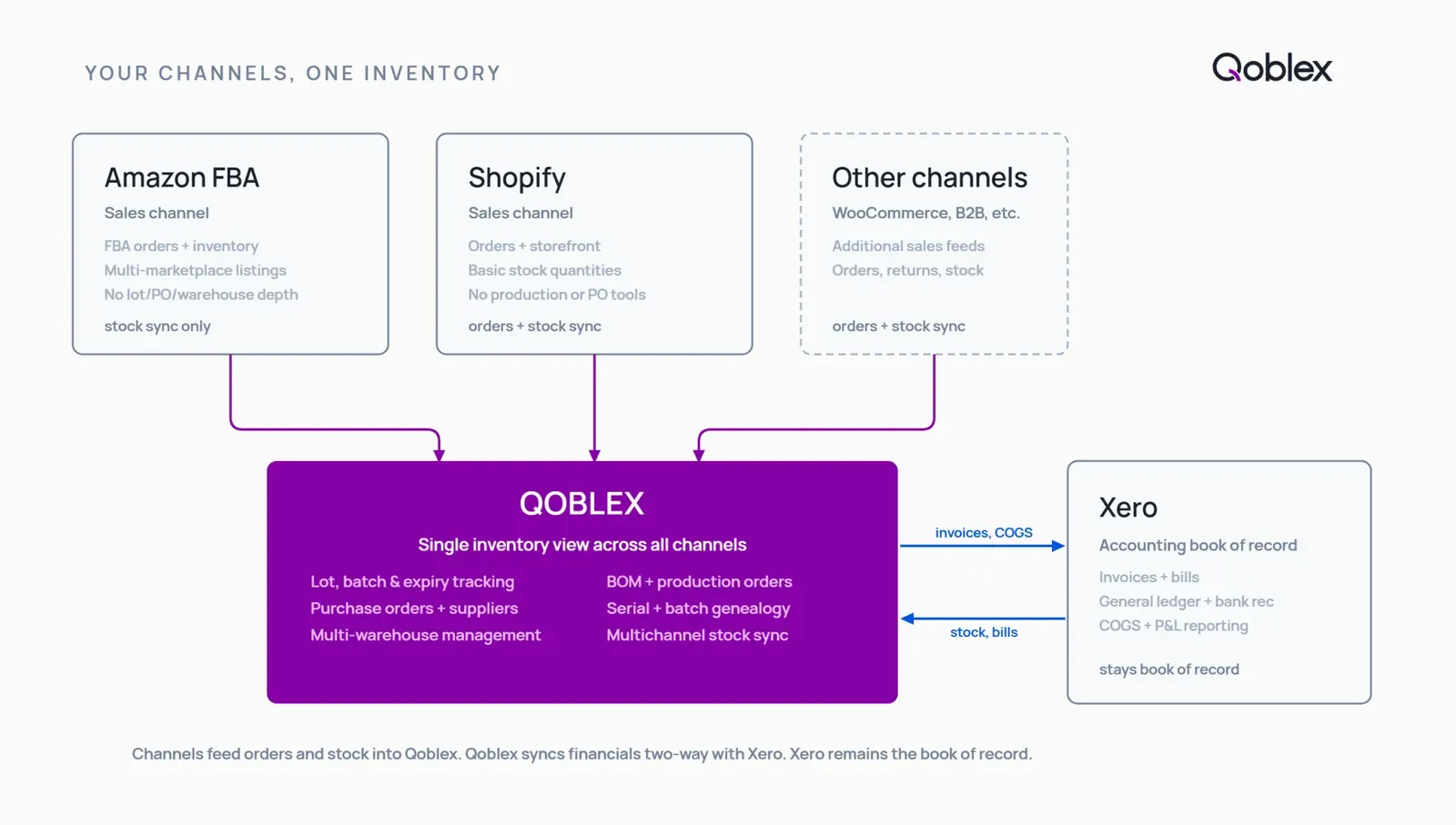
Amazon inventory management software is an operations layer that sits above your storefronts and below your accounting. It is not a replacement for Seller Central, and it is not just a sync tool. It holds one master truth about your stock, your purchasing, and your traceability, and it keeps every channel and your books reading from it. Here is what that layer does mechanically.
One master inventory count across channels
Instead of Amazon, Shopify, and WooCommerce each keeping a private number, the operations layer holds one centralized inventory count, and a sale on any channel updates available stock everywhere automatically. Your Amazon listing shows the synced aggregate quantity. There is one number, and it is true.
Allocated stock prevents double-selling across Amazon and other channels
The mechanism that stops overselling is allocated stock. The instant an order lands on any channel, those units are reserved and removed from available-to-sell before the channels finish updating. Because every connected channel reads from that shared, already-reduced figure, the same units cannot be sold twice. This is what closes the gap between Amazon and your own store during a busy sales period.
Lot and expiry tracking across every order, regardless of channel
Traceability lives in the operations layer, not in any single storefront. Lot number, batch, and expiry are recorded once and follow the unit from receiving to the shipped order, whether that order came from Amazon, Shopify, or WooCommerce, with FEFO picking so the soonest-to-expire stock goes first. The channel shows the aggregate quantity; the lot detail stays in one place. Shopify sellers can read the channel-specific version at expiry and lot tracking for Shopify sellers.
Purchasing and restocking with a full-demand view
Because the layer sees every channel, reorder decisions are made against total demand, not Amazon velocity alone. Purchase orders, supplier records, and receiving all live here, upstream of the FBA shipment you still create in Seller Central.
Accounting stays current automatically
Orders, invoices, and costs flow to your accounting on their own, so the books stay current across every channel without a monthly reconciliation project. Your accounting platform stays your book of record. The operations layer feeds it; it does not replace it.
How Qoblex connects Amazon FBA to your full operations
Qoblex is one example of that operations layer, built for the messy middle between spreadsheets and a full ERP. Here is how it maps to the gaps above.
Amazon and FBA integration
Qoblex lists Amazon and Fulfillment by Amazon as native integrations and syncs inventory and sales data with Amazon and FBA. You keep using Seller Central for FBA-specific work; Qoblex connects that channel to everything else you run.
One master count across Shopify, WooCommerce, and Amazon
Qoblex holds the centralized count across Shopify, WooCommerce, and Amazon, with allocated stock and real-time inventory control preventing the double-sell.
Multi-warehouse stock for sellers who hold their own inventory
If you also ship from your own locations, Qoblex tracks multi-warehouse stock with real-time transfers between them, so FBA is one node in your network rather than the whole picture.
Lot, expiry, and FEFO across all channel orders (paid add-on)
Qoblex adds lot, serial, and expiry tracking with FEFO picking across purchases, sales, transfers, adjustments, and manufacturing. This is a paid add-on, not part of the base plan; see qoblex.com/pricing for current detail.
BOM, production orders, and assembly for sellers who build before FBA
If you assemble, bundle, or manufacture before shipping to Amazon, Qoblex provides bills of materials, production orders, assembly and kitting, and lightweight MRP.
Two-way Xero and QuickBooks Online sync
Qoblex syncs two ways with Xero and QuickBooks Online, so invoices, purchase orders, returns, and refunds move automatically. Your accounting stays your book of record. If Xero is your accounting system, our guide to Xero inventory management covers what it does natively and what to add.
What Qoblex does not replace in Seller Central
Qoblex does not replace Seller Central for FBA-specific workflows. You still create shipments to Amazon, handle FNSKU labeling, raise FBA removal orders, and manage your IPI inside Seller Central. Amazon stays your FBA operations interface. Qoblex adds the cross-channel master count, purchasing, traceability, and accounting sync that Seller Central does not provide. For a full-demand forecasting view across every channel and what each plan includes, check qoblex.com/pricing.
When are Amazon’s built-in tools enough?
Adding an operations layer is not the right move for everyone, and it is worth being honest about where the line sits.
An Amazon-only seller with simple SKUs, no other sales channel, and no lot or expiry requirement may be perfectly fine on Seller Central and the FBA tools alone. The IPI dashboard, restock recommendations, and inventory age tracking are real and useful for a single-channel FBA business, and there is no reason to add software just to have it.
A very small operation is a similar case. If one or two people touch every shipment and the real stock number still fits in a spreadsheet kept alongside Seller Central, and that manual check is still honest and fast, then adding software adds complexity without a return. Spreadsheets are how plenty of good businesses started. The signal to add a layer is when a second channel opens, a third person joins the warehouse, or the spreadsheet stops agreeing with reality.
At the other end, if your scale genuinely requires a full ERP, with EDI, advanced available-to-promise, or complex multi-plant scheduling, an SMB operations layer is not the right fit. Knowing which stage you are at is more useful than any feature list.
FAQ
Does Amazon have its own inventory management software?
Yes. Amazon Seller Central includes a native FBA inventory planning dashboard with real-time stock levels, an IPI score (0 to 1000), stranded inventory detection, restock recommendations, and inventory age tracking. What it does not do is sync stock across channels, track lot numbers, enforce FEFO picking, manage purchasing, or connect to accounting platforms.
What is the IPI score and how does it affect FBA sellers?
The IPI (Inventory Performance Index) is Amazon’s score, on a 0 to 1000 scale with a minimum threshold of 400, measuring how efficiently you manage FBA stock. It has four components: excess inventory percentage, stranded inventory percentage, sell-through rate, and in-stock rate. A score below 400 can trigger FBA capacity restrictions.
Can Amazon Seller Central sync inventory with Shopify?
No. Amazon Seller Central and Shopify each maintain their own stock count independently. A dedicated operations layer (such as Qoblex) sits between the two and holds the master count, so a sale on either channel updates available stock across both automatically.
Does Amazon FBA track lot numbers or expiry dates?
Amazon FBA asks for a case-level expiry date when you create an FBA shipment for expirable products. It does not track lot numbers, batch codes, or serial numbers, and it has no FEFO picking policy. Lot-level and expiry-level traceability for your operations must be managed in a separate system.
Does Qoblex integrate with Amazon FBA?
Yes. Qoblex lists Amazon and Fulfillment by Amazon as native integrations and syncs inventory and sales data with Amazon and FBA. See qoblex.com/pricing for plan and integration detail.
Does Qoblex replace Amazon Seller Central?
No. Qoblex is the operations layer above Seller Central. You still use Seller Central for FBA-specific workflows: creating shipments to Amazon, FNSKU labeling, FBA removal orders, and IPI management. Qoblex adds the cross-channel master count, purchasing, lot and expiry tracking, and accounting sync that Seller Central does not provide.
How does Qoblex prevent overselling across Amazon and other channels?
Via allocated stock. The moment an order arrives on any channel, Qoblex reserves those units and removes them from available-to-sell before the channel counts update. Every connected channel reads available stock from that shared, already-reduced figure, so the same units cannot be sold twice.