


Import duties can consume 15-25% of your product costs before you sell a single unit. For growing businesses, this upfront payment strains cash flow and limits the capital available for marketing, inventory expansion, and operations. A bonded warehouse offers a strategic solution by allowing you to store imported merchandise without immediately paying duties or taxes.
With the global bonded warehouse market projected to reach $273.6 billion by 2031, more businesses are discovering the financial advantages of duty-deferred storage. This guide explains the bonded warehouse meaning in plain terms, covers the 11 classes recognized under U.S. law, and helps you determine whether bonded storage makes sense for your business.
Whether you run an eCommerce brand importing seasonal inventory or a wholesale operation managing high-value goods, understanding how bonded warehouses work can unlock significant financial and operational advantages.
What Is a Bonded Warehouse?
Bonded Warehouse Definition: A bonded warehouse is a secure storage facility authorized by U.S. Customs and Border Protection (CBP) where imported goods can be stored without immediate payment of customs duties, taxes, or fees. Goods remain under customs supervision and can be held for up to five years. Duties are only paid when merchandise is withdrawn for domestic consumption, or goods can be re-exported duty-free.
The concept dates back to the 1800s when governments recognized the need for supervised storage that would protect revenue while giving importers flexibility. Today, bonded warehouses serve as critical infrastructure for international trade, handling everything from consumer electronics to alcohol and tobacco products.
Bonded Warehouse Definition
A customs bonded warehouse operates under strict federal regulations outlined in 19 CFR Section 19.1. The facility can be owned by the government or operated by private companies that have posted a customs bond with CBP. This bond serves as a financial guarantee that all duties and taxes will eventually be paid.
When goods enter a bonded warehouse, they are considered to still be “in transit” from a customs perspective. The importer and the warehouse proprietor share liability for the merchandise under the warehouse bond. This liability is only canceled when goods are exported, destroyed under customs supervision, or withdrawn for domestic consumption after duty payment.
How Bonded Warehouses Work: A Step-by-Step Overview
Understanding the flow of goods through a bonded warehouse helps clarify why this storage option appeals to importers seeking duty deferral and inventory flexibility.
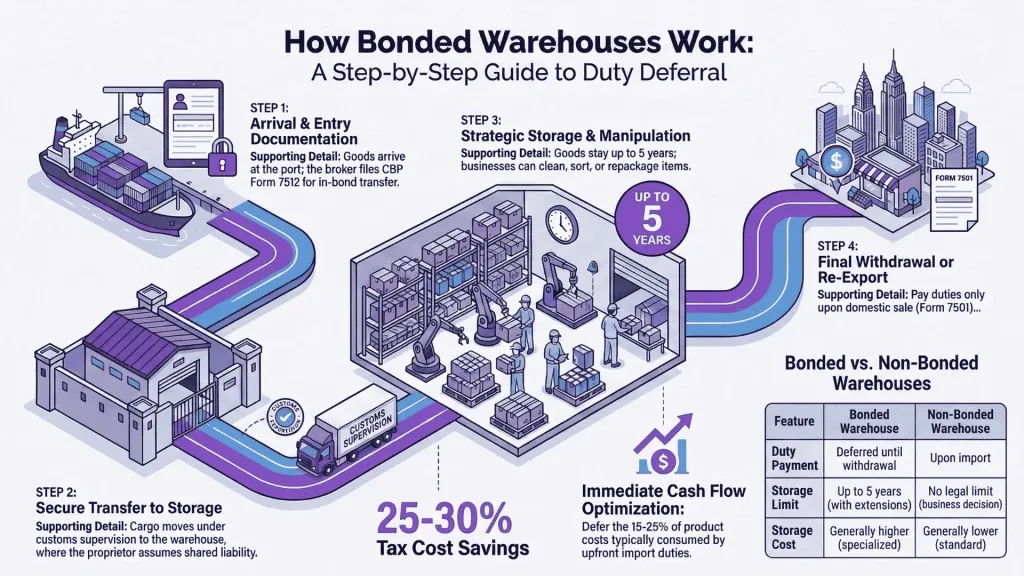
Step 1: Arrival and Documentation Imported goods arrive at a U.S. port of entry and remain in carrier custody. The importer or customs broker files the necessary entry documentation, including CBP Form 7512 for in-bond transfer.
Step 2: Transfer to Bonded Storage Goods move from the port to the customs bonded warehouse under customs supervision. The warehouse proprietor logs the merchandise into their inventory system and assumes shared liability.
Step 3: Storage Period Merchandise can remain in bonded storage for up to five years from the date of importation. During this time, certain manipulations are permitted, including cleaning, sorting, repacking, and relabeling. However, manufacturing operations are restricted to specific warehouse classes.
Step 4: Withdrawal or Re-Export When you are ready to sell goods domestically, you file an entry summary (CBP Form 7501) and pay applicable duties at the rate in effect at withdrawal. Alternatively, you can re-export merchandise without ever paying U.S. import duties.
Key Terminology: Bonded Goods, Customs Bond, and Warehouse Proprietor
Before diving deeper, here are the essential terms you will encounter when working with bonded warehouses.
Bonded Goods: Imported merchandise stored under customs control with duties and taxes not yet paid. These goods cannot enter U.S. commerce until proper clearance occurs.
Customs Bond: A financial guarantee, typically issued by a surety company, that ensures the government will receive all duties, taxes, and fees owed. Bond premiums generally range from 0.5% to 2% of the covered duty amount.
Warehouse Proprietor: The entity responsible for operating the bonded warehouse and maintaining compliance with CBP regulations. The proprietor supervises all transportation, receipts, deliveries, and security within the facility.
Duty Deferral: The postponement of customs duty payment until goods leave bonded storage for domestic sale. This is the primary financial benefit of using a bonded warehouse.
The 11 Classes of Bonded Warehouses in the United States
U.S. Customs and Border Protection authorizes eleven distinct classes of bonded warehouses, each serving specific purposes. Understanding these classifications helps you identify which type fits your operational needs.
| Class | Type | Primary Purpose |
| Class 1 | Government-Owned | Storage of merchandise under CBP examination, seizure, or pending release |
| Class 2 | Private Bonded | Storage exclusively for goods belonging to the warehouse proprietor |
| Class 3 | Public Bonded | General storage of imported merchandise for any importer |
| Class 4 | Bonded Yard/Shed | Storage of heavy or bulky merchandise, including liquid tanks |
| Class 5 | Bonded Bins | Storage of grain in designated building sections |
| Class 6 | Manufacturing | Production of goods solely for export using imported materials |
| Class 7 | Smelting/Refining | Processing of imported metal-bearing materials |
| Class 8 | Manipulation | Cleaning, sorting, repacking, or conditioning imported goods |
| Class 9 | Duty-Free Stores | Sale of duty-free merchandise to departing travelers |
| Class 10 | International Travel | Storage of goods for sale aboard aircraft |
| Class 11 | General Order | Storage of unclaimed or undelivered merchandise |
Public vs. Private Bonded Warehouses
Most importers work with either Class 2 (private) or Class 3 (public) bonded warehouses. The distinction matters for your operational flexibility and cost structure.
Public Bonded Warehouses (Class 3) accept merchandise from any importer willing to pay storage fees. These facilities offer lower barriers to entry since you do not need to establish your own bonded facility. Public warehouses typically charge higher per-unit storage rates but require no significant upfront investment.
Private Bonded Warehouses (Class 2) are used exclusively by the proprietor for their own imported goods. Large-volume importers often find private bonded storage more cost-effective over time, though the initial setup requires CBP approval and ongoing compliance management.
For growing eCommerce brands and SMB importers, public bonded warehouses usually provide the best balance of flexibility and cost efficiency. You gain access to duty deferral benefits without the administrative burden of operating your own bonded facility.
Specialized Bonded Warehouse Types (Class 6-11)
Beyond standard storage, specialized bonded warehouse classes serve niche requirements.
Class 6 Manufacturing Warehouses allow production using imported materials, but finished goods must be exported. This class appeals to manufacturers serving international markets who want to avoid U.S. duty on components that never enter domestic commerce.
Class 8 Manipulation Warehouses permit cleaning, sorting, repacking, and other conditioning activities that do not constitute manufacturing. Many importers use Class 8 facilities to prepare goods for the U.S. market while duties remain deferred.
Class 9 Duty-Free Stores represent the familiar airport shops where travelers purchase goods for use outside U.S. customs territory. These warehouses operate under unique regulations governing sales to departing passengers.
Benefits of Using a Bonded Warehouse
What makes bonded warehousing worth the additional complexity? The bonded warehouse benefits extend far beyond simple duty deferral. Strategic use of duty-deferred storage can transform your import operations and strengthen your competitive position.
Duty Deferral and Cash Flow Optimization
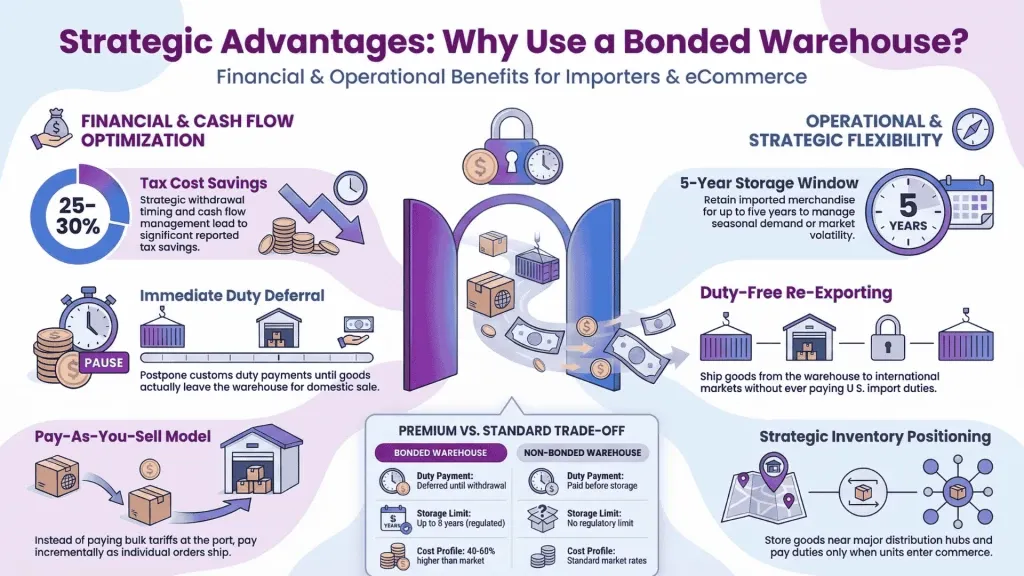
The most significant advantage of bonded warehousing is the ability to postpone customs duty payment until goods actually enter U.S. commerce. Instead of paying tariffs at the port when your shipment arrives, you pay only when merchandise leaves the bonded warehouse for domestic sale.
Companies using bonded warehouses have reported tax cost savings of 25-30% compared to immediate duty payment, primarily through improved cash flow management and strategic withdrawal timing.
Consider this example: An eCommerce apparel brand imports 10,000 handbags valued at $50 each. At a 15% tariff rate, immediate duty payment would total $75,000. By storing inventory in a bonded warehouse, the company pays duties incrementally as orders ship. If monthly sales average 2,000 units, duty payments spread across five months rather than hitting cash flow all at once.
This deferred duty approach improves working capital and aligns tax payments with actual revenue generation.
Pro Tip: If you anticipate tariff rate decreases in the coming months, a bonded warehouse allows you to pay duties at the lower rate effective at withdrawal, not at import. This flexibility has become particularly valuable given ongoing trade policy shifts and tariff volatility.
Long-Term Storage (Up to 5 Years)
Goods can remain in bonded storage for up to five years from the date of importation. This extended timeline provides remarkable flexibility for businesses dealing with seasonal products, market uncertainty, or slow-moving inventory.
If demand for your imported goods drops unexpectedly, you can hold merchandise in bond while waiting for market conditions to improve. This beats the alternative of paying duties on inventory that may sit unsold for months.
Duty-Free Re-Export Options
If goods stored in a bonded warehouse are never sold domestically, they can be re-exported without paying U.S. import duties. This benefit proves invaluable for businesses that serve multiple international markets from U.S.-based inventory.
Imagine you import electronics from Asia and store them in a California bonded warehouse. If orders come from Canada or Europe, you can ship directly from the bonded facility without ever paying U.S. tariffs. The goods technically never entered U.S. commerce.
Strategic Inventory Positioning
Bonded warehouses allow you to position inventory close to major markets before committing to duty payment. By storing goods in bonded facilities near key distribution hubs, you reduce delivery times while maintaining financial flexibility.
This approach works particularly well for businesses selling through multiple channels. You can fulfill orders from Amazon, Shopify, and wholesale accounts from the same bonded inventory, paying duties only on the specific units that ship.
In an era of tariff uncertainty and shifting trade policies, this flexibility provides a strategic hedge against sudden duty rate changes.
Bonded Warehouse vs. Non-Bonded Warehouse: Key Differences
Understanding the distinction between bonded and non-bonded storage helps clarify when each option makes sense for your operations.
| Factor | Bonded Warehouse | Non-Bonded Warehouse |
| Customs Status | Under CBP supervision | No customs oversight |
| Duty Payment | Deferred until withdrawal | Paid before storage |
| Storage Duration | Up to 5 years (regulated) | No regulatory limit |
| Storage Costs | 40-60% higher than standard | Standard market rates |
| Security Requirements | CBP-mandated protocols | Standard security |
| Permitted Activities | Manipulation under supervision | Unrestricted operations |
| Bond Requirement | Customs bond required | No bond needed |
| Best For | Importers seeking duty deferral | Domestic inventory storage |
The primary trade-off comes down to cost versus flexibility. Bonded warehouses charge premium rates due to compliance requirements and security measures. However, for importers facing significant duty obligations, the cash flow benefits often outweigh the higher storage fees.
Non-bonded warehouses make more sense when duties have already been paid or when storing domestically-sourced inventory. Many businesses use a combination of both, keeping some inventory in duty-deferred storage while maintaining separate non-bonded facilities for cleared goods.
Bonded Warehouse vs. Free Trade Zone (FTZ): Which Is Right for You?
Both bonded warehouses and Free Trade Zones offer duty deferral benefits, but they operate under different rules and serve distinct purposes. Understanding the bonded warehouse vs FTZ comparison helps you choose the right option for your supply chain optimization strategy.
Comparison Table: Bonded Warehouse vs. FTZ
| Factor | Bonded Warehouse | Free Trade Zone (FTZ) |
| Customs Territory | Within U.S. customs territory | Outside U.S. customs territory |
| Customs Entry | Required upon warehouse admission | Filed only at withdrawal |
| Storage Duration | Maximum 5 years | Indefinite |
| Manufacturing | Limited to Class 6 (export only) | Allowed with duty benefits |
| Duty Rate Timing | Rate at withdrawal | Rate at admission or withdrawal |
| State/Local Taxes | Subject to inventory taxes | Often exempt |
| Merchandise Processing Fees | Per-entry fees apply | Weekly entry consolidation available |
| Setup Complexity | Lower barrier to entry | Higher regulatory requirements |
| Bond Requirement | Required for each entry | Covered under FTZ operator bond |
| Best For | Short-term storage, re-export | Manufacturing, long-term storage |
When to Choose a Bonded Warehouse
A bonded warehouse typically works best when you need:
- Short to medium-term duty deferral on imported inventory
- Flexibility to re-export goods that may not sell domestically
- Lower setup costs compared to FTZ establishment
- Access to multiple locations since bonded warehouses are more widely available
- Straightforward storage without complex manufacturing operations
Bonded warehouses also make sense when you anticipate tariff rate decreases. Since duties are assessed at the withdrawal rate, not the import rate, you can benefit from lower tariffs that take effect while goods are in storage.
When to Choose an FTZ
A Free Trade Zone may better suit your needs if you require:
- Manufacturing or assembly operations on imported components
- Indefinite storage without the five-year limitation
- Exemption from state and local inventory taxes (varies by jurisdiction)
- Inverted tariff benefits where finished goods have lower duty rates than components
- Weekly entry consolidation to reduce merchandise processing fees
FTZs involve more complex compliance requirements and higher setup costs. Most FTZ users are larger enterprises with dedicated trade compliance teams. For SMB importers, bonded warehouses typically offer a more accessible entry point into duty deferral strategies.
Bonded Warehouse Costs and Fees
Understanding the full cost picture helps you evaluate whether bonded storage makes financial sense for your import operations.
Storage Fees and Rate Structures
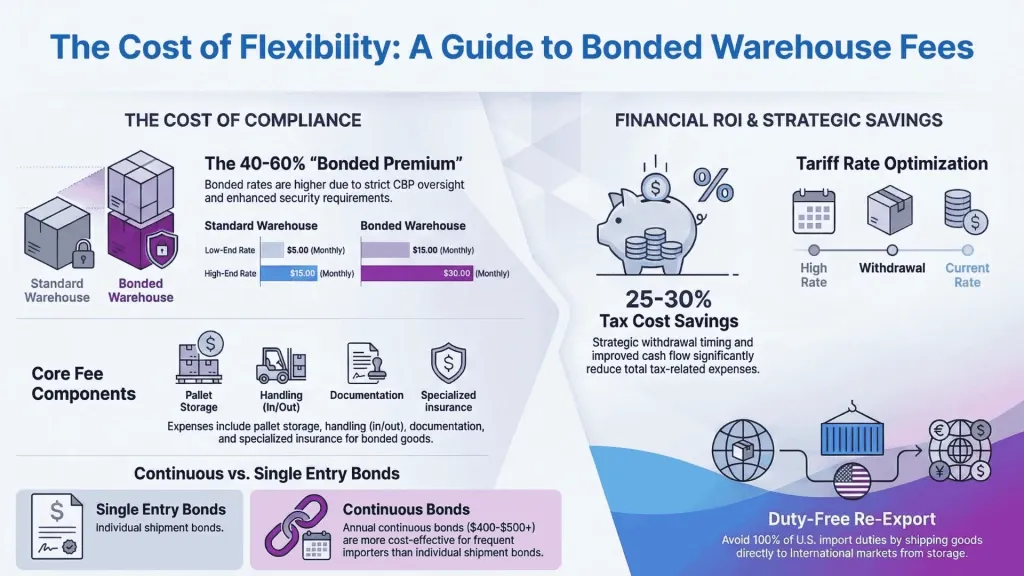
Bonded warehouse costs run approximately 40-60% higher than standard warehouse rates. This premium reflects the specialized compliance requirements, enhanced security, and CBP oversight that bonded facilities must maintain.
Typical fee components include:
- Storage fees: Charged per pallet, square foot, or cubic meter. Rates vary by location, with warehouses near major ports commanding higher prices.
- Handling charges: Fees for receiving, unloading, and loading goods when they enter or leave the facility.
- Documentation fees: Administrative costs for maintaining customs records and filing required reports.
- Insurance: Coverage specific to bonded goods may incur additional premiums.
For a rough estimate, expect to pay $15-30 per pallet per month for bonded storage, compared to $8-15 for standard warehousing. Actual rates depend on your location, volume, and the specific services required.
Customs Bond Requirements
Using a bonded warehouse requires a customs bond to guarantee duty payment. Two bond types apply:
Single Entry Bond: Covers one specific import transaction. Typically priced at $50-100 plus a percentage of the goods’ value.
Continuous Bond: Covers all import activity for a 12-month period. Required for businesses making multiple imports annually. Premiums generally run $400-500 per year plus a percentage (0.5-2%) of expected duties.
If you regularly import goods, a continuous bond proves more cost-effective than purchasing single entry bonds for each shipment.
Pro Tip: Work with an experienced customs broker to determine the optimal bond amount. Overbonding ties up unnecessary capital, while underbonding can result in CBP holds on future shipments.
Hidden Costs to Consider
Beyond direct fees, factor in these potential expenses:
- Compliance costs: Staff time or consultant fees for managing bonded inventory documentation
- Inventory tracking: Additional systems or processes to distinguish bonded from non-bonded stock
- Opportunity costs: Higher storage rates reduce your margin compared to standard warehousing
- Late withdrawal penalties: Goods exceeding the five-year limit face forced duty payment or forfeiture
Weigh these costs against the cash flow benefits of duty deferral. For high-duty products with uncertain demand, bonded storage often pays for itself. For low-duty items with predictable sales, standard warehousing may prove more economical.
Common Goods Stored in Bonded Warehouses
Bonded warehouses accommodate a wide variety of products, but certain categories benefit most from duty-deferred storage.
Alcohol and Tobacco: These heavily regulated products face significant excise taxes in addition to import duties. Bonded storage defers both tax types until sale.
Electronics and Technology: High-value items with volatile demand patterns benefit from flexible duty timing.
Apparel and Fashion: Seasonal inventory can be held in bond until the appropriate selling season, avoiding premature duty payment.
Luxury Goods: Watches, jewelry, perfume, and designer accessories often carry substantial duty rates that make deferral attractive.
Automotive Parts: Components for vehicles and machinery can be stored and manipulated before domestic distribution.
Cosmetics and Skincare: Import restrictions and testing requirements make bonded storage useful while goods await regulatory clearance.
Food and Beverage: Non-perishable imported foods, specialty chocolates, coffee, and wine frequently utilize bonded facilities.
With these diverse product categories benefiting from duty-deferred storage, the question becomes: how do you manage this inventory effectively?
How to Manage Bonded Warehouse Inventory Effectively
Tracking inventory across bonded and non-bonded locations introduces complexity that requires thoughtful systems and processes. Effective supply chain optimization depends on accurate visibility into where your inventory sits and its customs status.
Tracking Bonded vs. Non-Bonded Stock
Accurate inventory visibility becomes critical when some stock carries duty obligations while other inventory has already been cleared. Mixing bonded and duty-paid goods creates compliance risks and accounting headaches.
Best practices for tracking bonded inventory include:
- Separate location codes for bonded and non-bonded warehouse sections
- Clear SKU designation to identify bonded status at the item level
- Regular stocktakes to reconcile physical inventory with customs records
- Audit trails documenting movement between bonded and non-bonded status
Many businesses struggle to maintain this visibility using spreadsheets or basic systems. As import volumes grow, the risk of errors increases significantly.
Syncing Warehouse Data with Your Accounting System
Bonded inventory affects your financial reporting in specific ways. Duties represent a cost that must be recognized when goods enter commerce, not when they arrive at the warehouse. This timing difference requires careful accounting treatment.
Your systems should track:
- Inventory valuation that reflects landed costs including estimated duties
- Duty accruals for goods in bonded storage
- Payment timing to match duty expense recognition with customs clearance
- Cost of goods sold calculations that incorporate actual duty paid
Integrating your warehouse management data with accounting software like Xero or QuickBooks helps maintain accurate financials without manual reconciliation. Look for inventory systems that support multi-location tracking and can sync landed costs automatically.
Inventory Management Software for Importers
The right software simplifies bonded warehouse management by providing:
- Multi-warehouse visibility across bonded and non-bonded locations
- Stock on hand tracking with location-specific quantities
- Purchase order management linked to specific bonded warehouse receipts
- Landed cost calculations that incorporate duties and shipping
- Integration with eCommerce platforms like Shopify, WooCommerce, and Amazon
Growing importers often find that dedicated inventory management software pays for itself through reduced errors, improved cash flow visibility, and streamlined customs compliance.
Pro Tip: When evaluating inventory software, prioritize solutions that offer multi-location tracking with landed cost support and accounting integrations. These features become essential as your bonded warehouse operations scale.
Is a Bonded Warehouse Right for Your Business?
Not every importer benefits equally from bonded storage. How do you determine if the added complexity is worth it for your specific situation? Consider these factors when evaluating whether to incorporate bonded warehousing into your supply chain.
Questions to Ask Before Using Bonded Storage
How significant are your duty obligations? If import duties represent a substantial percentage of your product cost, deferral creates meaningful cash flow benefits. For products with minimal duty rates, the higher bonded storage fees may outweigh the savings.
How predictable is your sales velocity? Bonded storage shines when demand uncertainty exists. If you know exactly how much you will sell and when, paying duties upfront may simplify operations.
Do you serve multiple markets from U.S. inventory? Re-export benefits make bonded warehouses attractive for businesses fulfilling international orders from domestic stock.
Can your systems track bonded vs. non-bonded inventory? Without proper tracking, the compliance risks of bonded storage may outweigh the benefits.
What is your tolerance for complexity? Bonded warehousing adds administrative requirements. Ensure you have the resources to manage compliance properly.
Industries That Benefit Most from Bonded Warehousing
Certain business models align particularly well with bonded storage strategies:
- Seasonal importers who bring in large quantities ahead of peak selling periods
- Multichannel sellers fulfilling domestic and international orders from common inventory
- High-value goods importers facing substantial duty obligations
- Distributors who hold inventory for multiple customers before domestic sale
- Companies navigating tariff uncertainty who want flexibility as trade policies evolve
If your business fits these profiles, bonded warehousing deserves serious consideration as part of your import strategy.
Frequently Asked Questions About Bonded Warehouses
How long can goods stay in a bonded warehouse?
Imported goods can remain in a bonded warehouse for up to five years from the date of importation. After this period, merchandise must either be exported, destroyed under customs supervision, or withdrawn for domestic consumption with full duty payment. Failing to take action can result in goods being treated as abandoned and subject to forfeiture by CBP.
What is the difference between a bonded warehouse and a customs warehouse?
The terms are often used interchangeably. A customs warehouse and a bonded warehouse both refer to facilities authorized to store imported goods without immediate duty payment. The “bonded” designation refers to the customs bond that guarantees eventual duty payment. Some countries use different terminology, but the core concept remains the same.
Do I need a customs bond to use a bonded warehouse?
Yes, using a bonded warehouse requires a customs bond. The bond serves as a financial guarantee to CBP that all duties and taxes will eventually be paid. Most importers purchase a continuous bond covering all annual import activity, which costs approximately $400-500 per year plus a percentage of anticipated duties. Your customs broker can help arrange appropriate bond coverage.
Can I manufacture goods in a bonded warehouse?
Manufacturing is permitted only in Class 6 bonded warehouses, and finished goods must be exported. Standard bonded warehouses (Class 2 and 3) allow manipulation activities like cleaning, sorting, and repacking, but not manufacturing operations. For manufacturing with duty benefits, a Foreign Trade Zone may better suit your needs.
What happens if goods exceed the 5-year storage limit?
When merchandise approaches the five-year limit, you must either withdraw it for domestic consumption (paying applicable duties), export it, or request destruction under customs supervision. If no action is taken, goods become subject to forfeiture. CBP may auction or dispose of abandoned merchandise, and you remain liable for any duties owed.
Key Takeaways: Bonded Warehouse Meaning Simplified
Understanding the bonded warehouse meaning and how these facilities operate can provide significant advantages for businesses engaged in international trade.
Core benefits to remember:
- Bonded warehouses defer duty payment until goods enter domestic commerce, improving cash flow
- Merchandise can remain in bonded storage for up to five years
- Goods can be re-exported without ever paying U.S. import duties
- Eleven warehouse classes serve different operational needs, with Class 3 public warehouses being most common for importers
- Companies report 25-30% tax cost savings through strategic use of bonded warehousing
Key considerations:
- Bonded storage costs run 40-60% higher than standard warehousing
- A customs bond is required to use bonded facilities
- Proper inventory tracking systems are essential for compliance
- Not all businesses benefit equally; evaluate your specific duty obligations and sales patterns
For growing eCommerce brands and SMB importers, bonded warehousing often provides the financial flexibility needed to scale international operations without straining working capital. Combined with robust inventory management software that tracks landed costs and syncs with your accounting system, bonded storage becomes a powerful tool for optimizing your import supply chain.
Ready to take control of your inventory across bonded and non-bonded locations? Explore how Qoblex simplifies multi-warehouse inventory tracking with seamless accounting integration. Start your 14-day free trial and see how streamlined inventory management supports smarter import operations.