



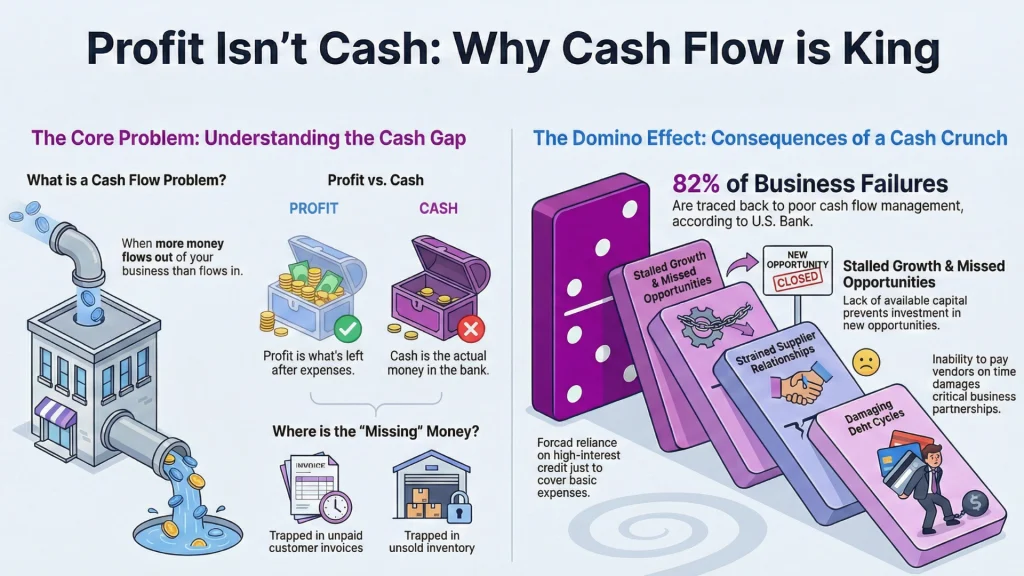
You check your bank account and your stomach drops. Despite solid sales last month, there’s barely enough cash to cover payroll. Sound familiar? You’re not alone. According to U.S. Bank research, 82% of business failures can be traced back to poor cash flow management. The harsh reality is that even profitable businesses can collapse when they can’t access the cash they need, when they need it.
Cash flow problems don’t discriminate. Whether you’re running a thriving eCommerce store, a growing wholesale business, or a manufacturing operation, the challenge remains the same: keeping enough cash flowing through your business to cover expenses while investing in growth.
This guide breaks down the ten most common cash flow problems and provides actionable solutions you can implement immediately. From optimizing inventory management to restructuring payment terms, you’ll discover practical strategies that address the root causes of cash flow challenges.
What Are Cash Flow Problems and Why Do They Matter?
Cash flow refers to the movement of money in and out of your business. When more cash flows out than flows in, or when incoming cash arrives too slowly to meet your obligations, you have a cash flow problem. This creates a dangerous gap between your financial commitments and your available funds.
Here’s what makes cash flow different from profit: your income statement might show a healthy profit, but if that money is tied up in unpaid invoices or excess inventory, you can’t use it to pay rent, vendors, or employees. A business can be profitable on paper while simultaneously struggling to survive.
The consequences of poor cash flow management extend beyond immediate financial stress:
- Inability to pay suppliers on time, damaging critical business relationships
- Missed growth opportunities due to lack of available capital
- Forced reliance on high-interest credit to cover basic expenses
- Difficulty attracting investors or securing favorable financing terms
- Inability to take advantage of supplier discounts for early payment
- Increased stress and reduced focus on strategic business decisions
- Risk of insolvency despite having a fundamentally sound business model
Nearly two in five startups fail because they run out of cash, according to CB Insights. Even established businesses aren’t immune. Retailers alone lost $818 billion last year to inventory distortion, with 52% from stockouts and 44% from overstocks. Both scenarios directly impact cash flow, either through missed sales or capital trapped in unsold goods.
Understanding the specific cash flow problems affecting your business is the first step toward solving them. Let’s examine the ten most common issues and their solutions.
The 10 Most Common Cash Flow Problems (And How to Fix Them)
1. Late Customer Payments Draining Your Cash Reserves
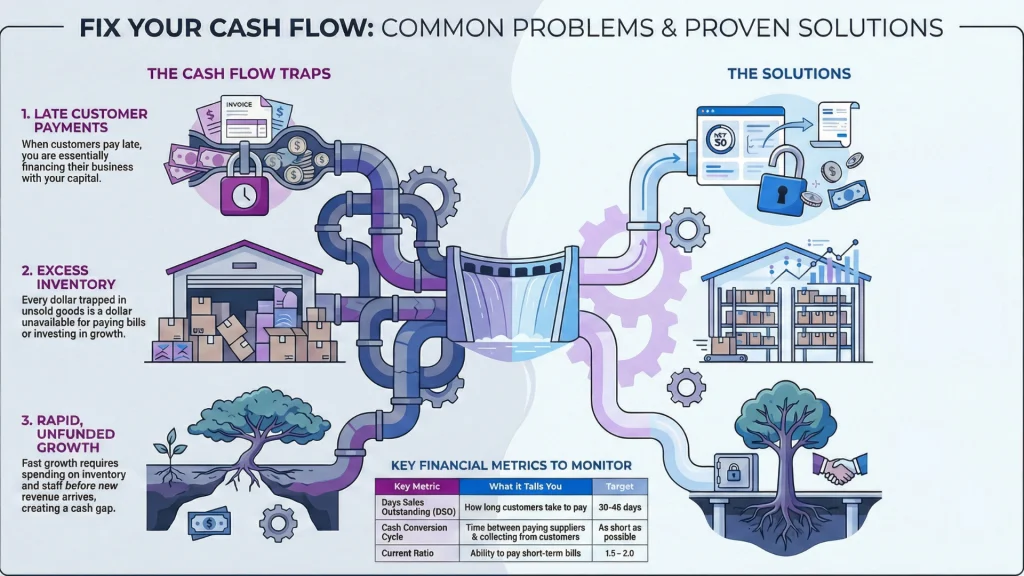
Late payments represent one of the most frustrating cash flow problems for business owners. You’ve delivered the product or completed the service, the revenue is earned on your books, but the actual cash remains out of reach. When customers take 30, 60, or even 90 days to pay, your business operates in a constant state of cash scarcity despite strong sales.
The problem compounds when you’ve already paid your suppliers and employees to fulfill those orders. You’re essentially financing your customers’ operations with your working capital, creating an unsustainable cycle that drains your cash reserves.
How to solve delayed accounts receivable:
Implement automated invoicing systems that send invoices immediately upon delivery. Every day of delay represents lost cash flow opportunity. Modern inventory management software like Qoblex can trigger automatic invoice generation when orders are fulfilled, eliminating the gap between delivery and billing.
Tighten your payment terms. If you currently offer net 60 terms, consider shifting to net 30 or even net 15 for new customers. For established customers, negotiate shorter terms or offer early payment discounts. A 2% discount for payment within 10 days can accelerate cash inflow significantly.
Consider these payment acceleration strategies:
- Require deposits for large orders, particularly from new customers
- Accept multiple payment methods including credit cards and ACH transfers
- Send payment reminders automatically at 7 days before due date, on due date, and at intervals after
- Establish clear late payment fees and enforce them consistently
- Review customer payment histories regularly and adjust terms for chronic late payers
- Offer small incentives for customers who pay early or maintain perfect payment records
Use technology to your advantage. Payment platforms that integrate with your business systems can send automatic follow-ups, track payment status, and flag accounts requiring attention. This removes the awkwardness of personally chasing payments while ensuring nothing falls through the cracks.
2. Excess Inventory Tying Up Your Capital
Inventory represents one of the largest cash investments for product-based businesses, yet it’s also one of the most common sources of cash flow problems. When you purchase inventory, cash immediately leaves your business. That money remains locked up until you sell the product and collect payment from the customer.
Overordering or misjudging demand leaves you with warehouses full of products and bank accounts running on empty. You can’t pay bills with excess widgets. Meanwhile, you’re paying for warehouse space to store unsold goods, and those products risk becoming obsolete or going out of season.
The inverse problem creates equal damage. Insufficient inventory leads to stockouts, missed sales opportunities, and customers turning to competitors. Finding the optimal balance directly impacts your cash flow health.
How to optimize inventory for better cash flow:
Implement demand forecasting to predict future sales based on historical data, market trends, and seasonal patterns. Modern inventory management systems use algorithms to analyze your sales history and recommend optimal reorder points and quantities. This data-driven approach removes guesswork from purchasing decisions.
Qoblex’s demand forecasting feature helps businesses determine exactly how many units they’re likely to sell and when to replenish stock. This prevents both stockouts and overstock situations, keeping cash flow optimized.
Focus on inventory turnover ratios. Calculate how quickly you’re selling through inventory by dividing your cost of goods sold by average inventory value. Higher turnover means less cash tied up in stock. Target different turnover rates for different product categories based on margins and demand patterns.
Consider Just-In-Time (JIT) inventory strategies for appropriate products. Rather than maintaining large quantities on hand, order smaller batches more frequently. This approach requires reliable suppliers and accurate demand forecasting but can dramatically improve cash flow by reducing inventory investment.
Track inventory metrics religiously:
- Days inventory outstanding (DIO) – how long products sit before selling
- Stock-to-sales ratio by product category
- Slow-moving inventory that’s tying up cash
- Dead stock that should be liquidated
- Seasonal inventory patterns and optimal stock levels
Use inventory management software that provides real-time visibility across all locations and sales channels. When you can see exactly what’s in stock, what’s committed to orders, and what’s available across your entire operation, you make smarter purchasing decisions that preserve cash flow.
For products that aren’t moving, take action quickly. Offer promotions, bundle slow-sellers with popular items, or use liquidation channels to convert stagnant inventory back into cash. Every dollar trapped in dead stock is a dollar unavailable for productive business activities.
3. Poor Financial Visibility and Forecasting
One of the biggest warning signs of impending cash flow problems is not knowing you have cash flow problems. Many business owners operate without clear visibility into their financial position, making decisions based on incomplete information or gut feeling rather than data.
When you don’t track where money comes from and where it goes, you can’t anticipate shortfalls or identify opportunities. You’re essentially driving your business with your eyes closed, reacting to problems only after they become crises.
How to gain financial clarity:
Implement comprehensive financial reporting systems that track cash flow in real time. Your accounting software should provide instant visibility into cash position, outstanding invoices, upcoming bills, and projected cash flow for the coming weeks and months.
Create cash flow forecasts that project your financial position over the next 13 weeks at minimum. Update these forecasts weekly, adjusting for actual results and changing circumstances. This rolling forecast helps you spot potential shortfalls early enough to take corrective action.
| Key Financial Metrics to Monitor | What It Tells You | Target Range |
| Current Ratio | Ability to pay short-term obligations | 1.5 – 2.0 |
| Quick Ratio | Ability to pay bills without selling inventory | 1.0 or higher |
| Days Sales Outstanding (DSO) | How long customers take to pay | 30-45 days |
| Days Payable Outstanding (DPO) | How long you take to pay suppliers | 30-60 days |
| Cash Conversion Cycle | Time between paying suppliers and collecting from customers | As short as possible |
| Operating Cash Flow Ratio | Cash generated from operations vs. current liabilities | Above 1.0 |
Separate business and personal finances completely. Using business accounts for personal expenses makes tracking nearly impossible and creates confusion come tax time. Maintain distinct accounts and pay yourself a regular salary rather than taking random draws from business funds.
If financial management isn’t your strength, get help. Many businesses benefit from fractional CFO services, providing expert financial guidance without the cost of a full-time executive. A financial professional can implement systems, interpret data, and help you make informed decisions that protect cash flow.
4. Seasonal Sales Fluctuations Creating Cash Gaps
Most businesses experience some degree of seasonality. Retail businesses surge during holidays, B2B companies see year-end rushes as clients spend remaining budgets, and temperature-dependent businesses follow weather patterns. These predictable cycles create cash flow challenges when businesses fail to plan accordingly.
The problem occurs when you treat peak season revenue as the new normal, increasing expenses to match temporarily high income. When the inevitable slow season arrives, fixed costs remain while revenue drops, creating a cash crunch.
How to manage seasonal cash flow:
Build cash reserves during peak seasons specifically designated for slow periods. Calculate your average monthly burn rate during low seasons and set aside enough to cover at least three months of operating expenses. This reserve acts as a buffer, smoothing out the peaks and valleys of seasonal revenue.
Create a 12-month cash flow projection that accounts for your seasonal patterns. Review historical data to understand typical revenue fluctuations and plan expenses accordingly. This forecast helps you avoid committing to fixed costs your business can’t sustain year-round.
Implement these seasonal strategies:
- Negotiate flexible payment terms with suppliers that align with your cash flow cycles
- Use seasonal employees rather than maintaining year-round staffing at peak levels
- Pursue off-season revenue opportunities or complementary product lines
- Arrange a line of credit before you need it, providing access to capital during slow periods
- Delay major capital expenditures until after peak season when cash reserves are highest
- Consider seasonal pricing strategies that incentivize purchases during slower periods
- Plan marketing campaigns that extend peak seasons or stimulate off-season demand
Work closely with suppliers to align inventory purchases with anticipated demand. Order conservatively for slow seasons and increase orders as your peak approaches. Demand forecasting tools help you fine-tune these decisions, ensuring you have sufficient stock without overcommitting cash.
5. Uncontrolled Business Expenses
Expenses have a tendency to creep upward over time. Subscriptions you signed up for but no longer use. Vendor contracts that renew automatically at higher rates. Additional services that seemed necessary at the time but don’t deliver proportional value. These incremental increases compound, gradually eroding cash flow without triggering alarm bells.
The problem intensifies when businesses lack systematic expense tracking and approval processes. Without clear visibility into spending patterns, costs rise unchecked until cash flow problems force a reactive crisis management approach.
How to control expenses and improve cash flow:
Conduct a comprehensive expense audit every quarter. Review bank statements, credit card charges, and accounts payable to identify every dollar leaving your business. For each expense, ask whether it directly contributes to revenue generation or operational necessity.
Use this expense review checklist:
- Identify all subscription services and recurring charges
- Determine when you last used each service and its ROI
- Research whether you’re paying competitive rates for essential services
- Consolidate vendors where possible to gain volume discounts
- Eliminate redundant tools or services providing overlapping functionality
- Renegotiate contracts with key vendors, leveraging your payment history
- Consider annual vs. monthly payments where discounts apply
Implement expense approval workflows that require manager sign-off for purchases above specific thresholds. This creates accountability and prevents impulsive or unnecessary spending. Many accounting systems include approval features that route requests through proper channels before commitments are made.
Compare your expense ratios to industry benchmarks. Understanding how your cost structure stacks up against similar businesses helps identify areas of overspending. Focus particularly on variable costs that should scale with revenue but often become inflexible overhead.
Monitor your gross margins closely. If margins are thin, even efficient operations may struggle to generate sufficient cash flow. Review your cost of goods sold, identify opportunities for supplier negotiations, and ensure your pricing adequately covers both direct costs and reasonable contribution to overhead.
For Qoblex users, the platform’s moving average cost (MAC) tracking ensures accurate product costing, helping you identify margin issues before they impact cash flow. Real-time cost visibility across your entire inventory enables informed pricing decisions.
6. Rapid Growth Outpacing Cash Generation
Growth seems like the ultimate business goal, but rapid expansion can strangle cash flow faster than almost any other problem. When sales accelerate quickly, you must invest in additional inventory, hire more staff, expand facilities, and increase marketing, all before receiving payment from those new sales.
This creates what financial professionals call the “growth paradox.” Your business appears successful based on sales metrics, yet you’re constantly cash-strapped, unable to fund the very expansion driving your success.
How to manage growth without destroying cash flow:
Pace your growth deliberately rather than pursuing every opportunity simultaneously. Evaluate whether you have the cash reserves and operational capacity to support expansion before committing. Sometimes the most strategic decision is growing more slowly to maintain financial health.
Secure financing before you need it. When your business is growing and financially healthy, you have maximum negotiating leverage with lenders. Establish a line of credit or secure growth capital while you can access favorable terms, creating a cushion for expansion expenses.
Tighten payment terms for new customers acquired during growth periods. While established customers may enjoy net 30 or net 60 terms, new customers should prove their creditworthiness first. Consider requiring deposits for large orders or shorter payment windows until you’ve established a payment history.
Monitor these growth warning signs:
- Sales are increasing but bank balance is decreasing
- You’re consistently drawing on credit lines to cover operations
- Accounts receivable are growing faster than revenue
- Inventory is increasing faster than sales
- You’re routinely paying suppliers late despite higher revenue
- Staff overtime is becoming the norm rather than exception
- You can’t easily explain where cash is going despite rising sales
Focus on operational efficiency during growth periods. Streamline processes, automate repetitive tasks, and invest in systems that scale. Inventory management software becomes particularly critical during expansion, preventing overstock situations that trap cash while ensuring you can fulfill orders reliably.
7. Weak Profit Margins Squeezing Cash Flow
You can’t overcome cash flow problems through volume alone if your margins are too thin. When the difference between revenue and cost is minimal, even successful businesses struggle to generate sufficient cash to cover operating expenses and reinvest in growth.
The problem often develops gradually. Costs increase due to inflation or supplier price hikes, but competitive pressure prevents proportional price increases. Discount strategies intended to drive volume erode margins. Without regular margin analysis, businesses wake up one day wondering why strong sales don’t translate to healthy cash flow.
How to improve margins and cash flow:
Review your pricing strategy comprehensively. When did you last increase prices? How do your prices compare to competitors? Research shows that 43% of consumers will pay more for greater convenience, and 42% will pay more for friendly, welcoming service. Your value proposition may support higher prices than you realize.
Test price increases strategically, starting with your best-selling products or those facing less competition. Monitor sales closely to determine elasticity. Often, businesses discover that modest price increases have minimal impact on volume but significant impact on profitability and cash flow.
Analyze your cost structure to identify reduction opportunities:
- Negotiate better terms with suppliers based on volume or payment history
- Consolidate purchases with fewer suppliers to gain volume discounts
- Review shipping and logistics costs for optimization opportunities
- Evaluate your product mix, potentially discontinuing low-margin items
- Assess labor efficiency and identify process improvements
- Consider value engineering to reduce production costs without compromising quality
- Explore alternative suppliers or materials that maintain quality at lower cost
Use Qoblex’s cost tracking features to maintain accurate visibility into product profitability. The platform’s moving average cost calculations reflect your true costs including landed costs, ensuring pricing decisions are based on complete financial information.
Implement margin requirements for different product categories. High-volume, competitive products might operate on thin margins, but niche or specialized items should command premium prices. Balance your portfolio to achieve overall margin targets that support healthy cash flow.
8. High-Interest Debt Payments
Debt isn’t inherently problematic for business. Many successful companies leverage financing to fund growth, smooth cash flow cycles, or make strategic investments. The problem occurs when debt becomes expensive or when repayment obligations consume too much of your cash flow.
High-interest credit cards, merchant cash advances, or short-term loans with steep repayment terms can create a vicious cycle. You borrow to solve a cash flow problem, but the repayment obligation worsens your cash position, forcing additional borrowing at even less favorable terms.
How to manage debt and improve cash flow:
Evaluate your current debt structure. List all outstanding obligations, their interest rates, payment terms, and monthly costs. Calculate what percentage of revenue goes toward debt service. If this exceeds 20-25%, your debt load is likely constraining cash flow and limiting business flexibility.
Explore refinancing opportunities for high-interest debt. If your business has improved financially since you took the original loan, you may qualify for better terms. Even reducing interest rates by a few percentage points can free up significant monthly cash flow.
| Debt Management Strategy | Best Used When | Potential Cash Flow Impact |
| Debt Consolidation | Multiple high-interest loans | Reduces monthly payments 15-30% |
| Refinancing | Credit score or revenue has improved | Saves 3-7% in interest costs |
| Term Extension | Need immediate payment relief | Frees short-term cash, increases total cost |
| Debt Negotiation | Financial hardship situation | Can reduce principal owed |
| Line of Credit Conversion | Revolving debt with high rates | Lowers interest, improves flexibility |
Consider debt consolidation if you’re managing multiple obligations. Combining several loans into one with a lower rate simplifies management and often reduces total monthly payments. This frees cash flow while making your debt more manageable.
Build relationships with multiple lenders before you experience problems. Banks, credit unions, online lenders, and alternative financing sources each have different criteria and advantages. Having established relationships provides options when you need capital or refinancing.
Avoid merchant cash advances except in genuine emergencies. These products often carry effective annual percentage rates exceeding 50%, creating debt traps that destroy cash flow. Almost any alternative, including credit cards, provides more favorable terms.
9. Customer Concentration Risk
Relying heavily on one or two major customers creates dangerous cash flow vulnerability. While landing a large client feels like success, concentration above 30% of revenue in any single customer puts your business at significant risk.
If that key client experiences financial difficulties, changes vendors, negotiates aggressive payment terms, or simply reduces orders, your cash flow suffers immediate and severe impact. The problem compounds because your operations have likely scaled to serve these major accounts, creating fixed costs that can’t easily adjust to lost revenue.
How to reduce customer concentration risk:
Actively diversify your customer base. While it’s tempting to focus entirely on your largest customers, allocating resources to customer acquisition and smaller account development protects long-term cash flow. Aim to keep any single customer below 20% of total revenue.
Implement tiered payment terms based on customer size and reliability. Larger customers often expect extended terms, but this creates cash flow challenges for your business. Consider requiring deposits, progress payments, or shorter terms that align with your own obligations to suppliers.
Develop a systematic approach to customer diversification:
- Set quarterly targets for new customer acquisition across different segments
- Invest in marketing channels that attract diverse customer types
- Develop product lines or services that appeal to different markets
- Create case studies and testimonials that attract similar-sized prospects
- Build partnerships or distribution relationships that provide customer diversity
- Monitor concentration metrics monthly and take action when thresholds are exceeded
- Maintain relationships with past customers who might return as your business grows
Be cautious about custom products or services that work only for specific large customers. This creates additional concentration risk beyond just revenue dependence. Your inventory, equipment, or expertise becomes less valuable if that customer relationship ends.
10. Supplier Payment Timing Mismatches
The timing gap between when you must pay suppliers and when customers pay you creates one of the most fundamental cash flow challenges. You need to purchase inventory or materials, often paying immediately or within 15-30 days, but may not receive customer payment for 30-90 days. This gap must be bridged with working capital.
The problem intensifies when you lack negotiating leverage with suppliers or haven’t optimized payment terms to match your cash flow cycle. You’re essentially financing the time gap with your own cash reserves.
How to optimize payment timing:
Negotiate extended payment terms with suppliers whenever possible. If you currently pay net 15, ask about extending to net 30 or net 45. Many suppliers will accommodate good customers, especially if you have a solid payment history.
Simultaneously work to accelerate incoming payments from customers. If suppliers give you 30 days but customers take 45, you’ve created a 15-day cash flow buffer. This breathing room prevents constant cash crunches.
Consider these payment optimization strategies:
- Offer to consolidate purchases with fewer suppliers in exchange for better terms
- Request early payment discounts from suppliers when you have excess cash
- Coordinate inventory purchases with anticipated customer payments
- Use supplier financing programs where available
- Establish vendor relationships that understand your seasonal patterns
- Consider supply chain financing solutions that extend terms without harming supplier relationships
Use inventory management software to coordinate purchasing with actual demand. Qoblex helps businesses align purchase orders with sales orders, ensuring you’re not buying inventory before you need it. This reduces the working capital required to bridge timing gaps.
Track your cash conversion cycle, which measures the time between paying suppliers and collecting from customers. The shorter this cycle, the less working capital you need. Focus on optimizing all three components: collecting faster, managing inventory efficiently, and paying strategically.
Prevention: Building a Cash Flow Management System That Works
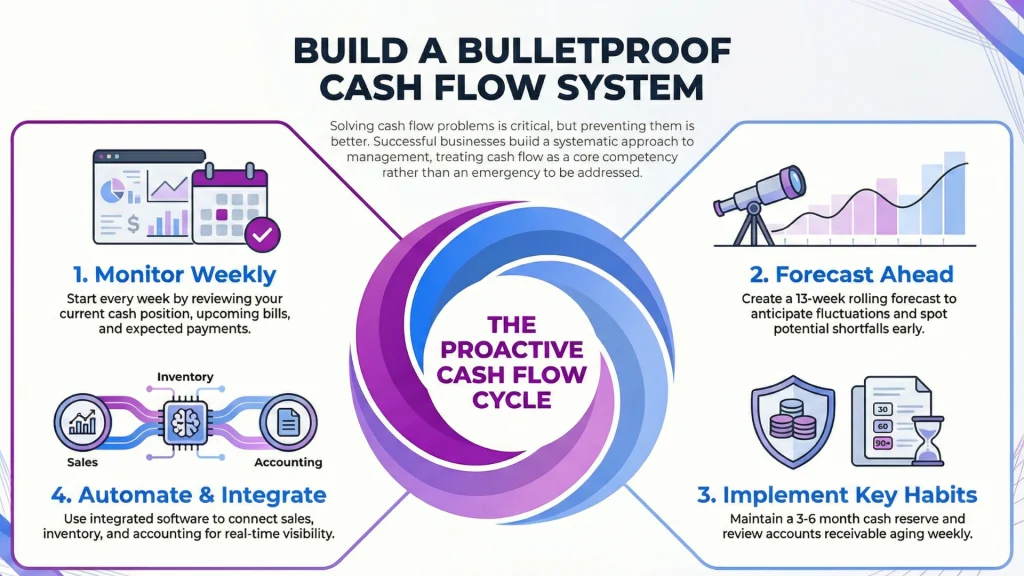
Solving immediate cash flow problems is critical, but preventing future crises requires implementing systematic management practices. The most successful businesses treat cash flow management as a core competency, not an afterthought addressed during emergencies.
Start with weekly cash flow monitoring. Review your current cash position, upcoming bills, expected receipts, and projected position for the next 4-6 weeks every Monday morning. This becomes your early warning system, flagging potential problems while you still have time to respond.
Create a 13-week rolling cash flow forecast. This provides visibility beyond the immediate future, helping you anticipate seasonal fluctuations, large expenses, or periods requiring additional capital. Update this forecast weekly based on actual results and changing circumstances.
Implement these cash flow management best practices:
- Maintain a cash reserve equal to 3-6 months of operating expenses
- Set cash flow triggers that automatically alert you to problems
- Review accounts receivable aging weekly and follow up on late payments immediately
- Analyze cash flow variance between forecast and actual, learning from differences
- Create separate accounts for taxes, growth investments, and operating expenses
- Establish approval processes for capital expenditures above specific thresholds
- Review profit and loss statements alongside cash flow statements monthly
Automate everything possible. Modern business software can handle invoicing, payment collection, expense tracking, and financial reporting without manual intervention. This eliminates errors, reduces administrative time, and ensures consistent processes that protect cash flow.
Invest in integrated business management systems that connect your inventory, sales, purchasing, and accounting functions. When these systems work together, you gain real-time visibility into how operational decisions impact cash flow. You can see immediately how a large purchase order affects your cash position or how a big sale will flow through to available funds.
How Inventory Management Software Solves Cash Flow Problems
For product-based businesses, inventory represents the single largest investment and most significant opportunity for cash flow optimization. The connection between inventory management and cash flow is direct and powerful. Every dollar tied up in excess inventory is a dollar unavailable for other business needs.
Traditional inventory management, whether manual spreadsheets or disconnected systems, creates cash flow problems through poor visibility, inaccurate forecasting, and inability to optimize stock levels across multiple locations and channels.
Modern inventory management software like Qoblex transforms how businesses manage this critical asset, directly improving cash flow through several mechanisms.
Real-time inventory visibility prevents cash traps. When you can see exactly what’s in stock across all warehouses, what’s committed to orders, and what’s available to sell, you avoid overordering. Real-time synchronization with sales channels ensures inventory decisions reflect actual demand, not guesswork.
Demand forecasting optimizes inventory investment. Qoblex analyzes historical sales data, seasonal patterns, and trends to recommend optimal reorder points and quantities. This data-driven approach prevents both stockouts (missed sales) and overstock (trapped cash). Businesses report reducing inventory carrying costs by 20-30% while simultaneously improving product availability.
Multi-channel management eliminates fragmentation. When you sell across Shopify, Amazon, WooCommerce, and B2B channels, managing inventory becomes exponentially complex. Qoblex centralizes inventory across all channels, preventing overselling while optimizing total inventory investment. One unified system means one source of truth for cash flow planning.
Automated reordering prevents emergency purchases. Low stock alerts and automated purchase order generation ensure you reorder at optimal times, avoiding expensive rush orders or premium freight charges. This disciplined approach to procurement protects margins and cash flow.
Integration with accounting systems provides complete financial visibility. When your inventory management connects seamlessly with QuickBooks or Xero, you see the complete financial picture. Inventory values, cost of goods sold, and cash flow implications appear in real time, enabling informed decisions that balance operational needs with financial health.
| Cash Flow Challenge | How Qoblex Solves It | Typical Impact |
| Excess inventory tying up cash | Demand forecasting and optimized reorder points | 20-30% reduction in inventory carrying costs |
| Stockouts causing missed sales | Real-time visibility and low stock alerts | 15-25% improvement in product availability |
| Poor cost visibility | Moving average cost and landed cost tracking | 10-15% improvement in pricing accuracy |
| Manual processes causing delays | Automated purchase orders and invoicing | 50-70% reduction in administrative time |
| Multi-channel inventory chaos | Centralized inventory across all sales channels | Eliminates overselling and duplicate orders |
| Supplier payment timing | Integrated purchase order management | Better cash flow planning and forecasting |
The ROI of proper inventory management extends beyond direct cost savings. When you’re not constantly firefighting inventory problems, you focus on strategic activities that drive growth. When you’re not tying up excess cash in stock, you can invest in marketing, technology, or expanding your team.
Businesses using Qoblex report that improved inventory management typically pays for the software within 60-90 days through a combination of reduced carrying costs, fewer stockouts, lower emergency freight charges, and improved purchasing decisions.
When to Seek Professional Help
While many cash flow problems can be addressed through better systems and processes, some situations require professional expertise. Recognizing when you need help prevents problems from escalating beyond recovery.
Consider engaging professional assistance when you experience these warning signs:
- Consistent difficulty making payroll on scheduled dates
- Regularly using credit cards to pay basic operating expenses
- Inability to explain where cash is going despite tracking efforts
- Rapid growth creating cash shortages you can’t resolve
- Debt payments consuming more than 25% of revenue
- No clear understanding of your actual cost structure or margins
- Failed attempts to implement cash flow management systems
Several types of professionals can help address cash flow challenges, each bringing different expertise to the problem.
Fractional CFOs provide executive-level financial guidance without full-time costs. These professionals typically work with multiple businesses, offering strategic insights, implementing financial systems, and helping with forecasting and planning. They’re particularly valuable for growing businesses that need CFO-level expertise but can’t justify a full-time hire.
Business accountants or bookkeepers ensure your financial records are accurate and current. Without reliable numbers, you can’t effectively manage cash flow. These professionals implement proper accounting practices, reconcile accounts, and produce the reports necessary for informed decision-making.
Business consultants or coaches provide outside perspective on operational issues affecting cash flow. Sometimes you’re too close to the problem to see solutions. An experienced consultant can identify inefficiencies, suggest process improvements, and hold you accountable for implementing changes.
Industry-specific consultants understand the unique cash flow challenges in your sector. Retail, manufacturing, wholesale, and service businesses each face different issues. A consultant with relevant experience can provide targeted solutions that generic advice misses.
The cost of professional help is typically far less than the cost of cash flow problems left unaddressed. Business failure, damaged credit, lost opportunities, and stress-related health issues all carry higher price tags than investing in expert guidance early.
Frequently Asked Questions About Cash Flow Problems
What is the number one cause of cash flow problems?
While many factors contribute to cash flow difficulties, late customer payments represent the most common cause. Even profitable businesses struggle when revenue earned on the books isn’t accessible as cash. The solution involves implementing automated invoicing, tightening payment terms, and creating systematic follow-up processes for overdue accounts.
How quickly can I improve my cash flow?
Some improvements happen immediately while others require weeks or months. You can implement automated invoicing, review payment terms, and audit expenses within days, generating impact in the current month. Inventory optimization, margin improvements, and structural changes take longer but provide sustainable benefits. Most businesses see measurable cash flow improvement within 30-60 days of implementing recommended strategies.
Can a profitable business still have cash flow problems?
Absolutely. Profitability measures revenue minus expenses over time, but cash flow tracks actual money movement. You can show profit while waiting 60 days for customer payments, with cash tied up in inventory, or after making large capital purchases. This disconnect between profit and cash is why cash flow management deserves separate attention from P&L optimization.
What’s the difference between cash flow and profit?
Profit is an accounting concept calculated by subtracting expenses from revenue during a specific period. Cash flow represents actual money moving in and out of your business. You can be profitable but cash-poor if money is tied up in inventory, receivables, or investments. Conversely, you might have positive cash flow temporarily while actually losing money if you’re depleting inventory or delaying supplier payments.
How much cash reserve should my business maintain?
Most financial experts recommend maintaining reserves equal to 3-6 months of operating expenses. The appropriate amount depends on your revenue stability, seasonal fluctuations, and access to credit. Businesses with unpredictable revenue or significant seasonality need larger reserves. Companies with steady income and available credit lines can operate with smaller cushions. Calculate your monthly burn rate and ensure reserves can cover at least three months during your slowest period.
Take Control of Your Cash Flow Today
Cash flow problems feel overwhelming when you’re in the middle of them, but they’re solvable. The strategies outlined in this guide address the root causes of cash shortfalls, providing actionable steps you can implement immediately.
Start with the areas creating the most significant impact for your specific situation. If late payments are draining your reserves, focus on accounts receivable optimization. If excess inventory is tying up capital, prioritize demand forecasting and inventory management. If you lack financial visibility, implement robust reporting systems before addressing other issues.
Remember these key principles:
Prevention is easier than crisis management. Implementing systematic cash flow monitoring prevents problems from escalating into emergencies. Weekly reviews and rolling forecasts provide early warning systems that give you time to respond.
Inventory optimization provides the biggest lever for product-based businesses. The connection between inventory investment and cash flow is direct and powerful. Modern inventory management software like Qoblex can transform how you manage this critical asset.
Small changes compound into significant improvements. You don’t need to fix everything simultaneously. Implementing even three or four strategies from this guide will materially improve your cash flow within 60 days.
Technology eliminates administrative burden while improving accuracy. Automated systems handle routine tasks consistently, freeing your time for strategic decisions while ensuring nothing falls through the cracks.
Professional help is available when you need it. You don’t have to solve these problems alone. CFOs, accountants, and consultants can provide expertise and outside perspective that accelerates improvement.
Your next step is taking action. Choose the two or three strategies that address your biggest cash flow challenges and commit to implementing them this week. Set specific deadlines, assign responsibility, and track results.
For businesses managing physical inventory, optimizing inventory management provides the fastest path to improved cash flow. Qoblex helps businesses reduce inventory carrying costs by 20-30%, improve product availability by 15-25%, and gain real-time visibility across all sales channels and locations.
Ready to see how better inventory management can solve your cash flow problems? Start your free 14-day trial of Qoblex today. No credit card required. Experience how real-time inventory visibility, demand forecasting, and multi-channel management can free up cash trapped in excess stock while ensuring you never miss a sale due to stockouts.
Your business deserves better cash flow. The tools, strategies, and systems to achieve it are available now. The only question is when you’ll implement them.