


Quick answer: Yes. Merchandise inventory is a current asset. It sits on the balance sheet under current assets because a business expects to sell it and convert it into cash within one operating cycle (usually 12 months). It is recorded at cost until it sells, at which point its value moves to cost of goods sold (COGS).
For retailers, wholesalers, and distributors, understanding how to properly classify merchandise inventory on financial statements is fundamental to accurate accounting and financial reporting. Whether you’re a small business owner reviewing your balance sheet or a finance professional ensuring GAAP compliance, knowing the correct classification of merchandise inventory matters for everything from tax reporting to securing business loans.
This guide provides a comprehensive explanation of merchandise inventory classification, why it qualifies as a current asset, and how proper tracking impacts your business’s financial health.
Quick Answer: Yes, Merchandise Inventory Is a Current Asset
Merchandise inventory is classified as a current asset on a company’s balance sheet. This classification applies because businesses expect to sell this inventory and convert it into cash within one operating cycle, typically 12 months. Under generally accepted accounting principles (GAAP), any asset that a company plans to sell or consume within one year qualifies as a current asset.
For many retailers and wholesalers, merchandise inventory represents their single largest current asset. A grocery retailer, for example, might hold millions of dollars in unsold food products, while an auto dealer could have significant capital tied up in vehicle inventory. This makes accurate tracking and classification critical for financial health assessment.
What Is Merchandise Inventory?
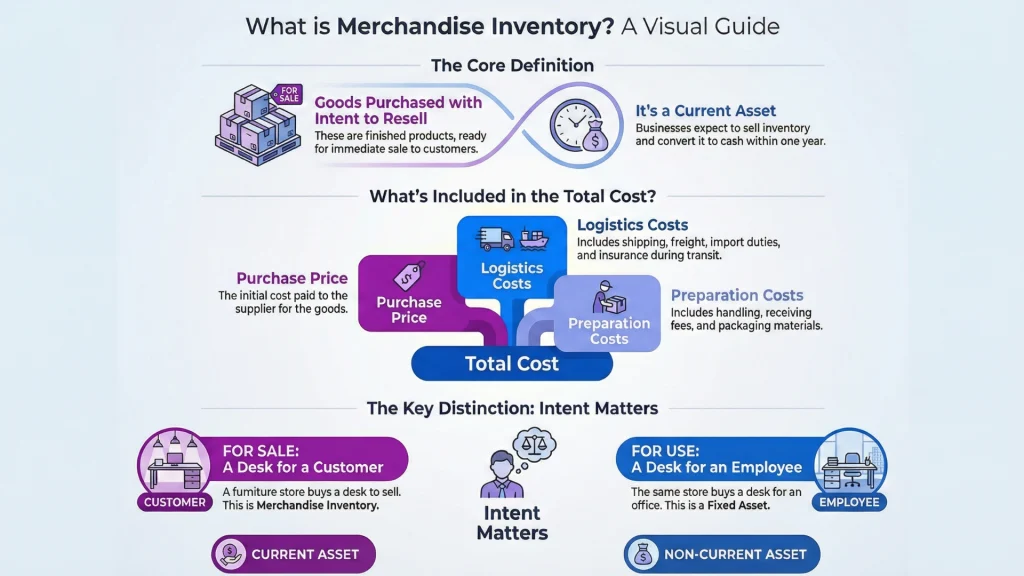
Merchandise inventory refers to the finished goods that a business has purchased from suppliers with the intent to resell to customers for profit. Unlike raw materials or work-in-progress inventory used in manufacturing, merchandise inventory consists of products ready for immediate sale.
Merchandise Inventory Definition
In accounting terms, merchandise inventory represents the cost value of all goods a company owns that are intended for resale. This includes:
- Products displayed in retail stores
- Items stored in warehouses or distribution centers
- Goods in transit from suppliers
- Stock held at consignment locations
- Products in fulfillment centers awaiting shipment
The key distinction is intent. A furniture retailer purchases desks to sell to customers, making those desks merchandise inventory. However, if the same retailer buys desks for employees to use in the office, those desks are classified as fixed assets (furniture and fixtures), not inventory.
What Merchandise Inventory Includes
The value of merchandise inventory encompasses more than just the purchase price paid to suppliers. It includes all costs necessary to make the goods ready for sale:
- Purchase price of the goods
- Shipping and freight costs
- Import duties and tariffs
- Insurance during transit
- Handling and receiving costs
- Packaging materials
For example, if a clothing retailer purchases 100 shirts at $20 each ($2,000) and pays $150 in shipping plus $50 in import duties, the total merchandise inventory value is $2,200, or $22 per shirt.
Understanding Current Assets vs Fixed Assets
To understand why merchandise inventory qualifies as a current asset, you need to grasp the fundamental differences between current and fixed assets in accounting.
What Qualifies as a Current Asset?
Current assets are resources that a business expects to convert into cash, sell, or consume within one operating cycle or one year, whichever is longer. These assets support day-to-day operations and provide liquidity for meeting short-term obligations.
Common current assets include:
- Cash and cash equivalents
- Accounts receivable (customer payments owed)
- Merchandise inventory
- Marketable securities (short-term investments)
- Prepaid expenses
- Supplies
Current assets appear at the top of the balance sheet and are listed in order of liquidity, with cash first and inventory typically following accounts receivable.
What Are Fixed Assets?
Fixed assets, also called non-current or long-term assets, are tangible resources a business owns and uses over multiple years to generate revenue. These assets are not intended for sale and provide value through their use in operations rather than their resale.
Examples of fixed assets include:
- Land and buildings
- Machinery and equipment
- Vehicles
- Furniture and fixtures
- Computer systems and technology infrastructure
- Leasehold improvements
Fixed assets are capitalized on the balance sheet and depreciated over their useful life, whereas merchandise inventory is expensed through cost of goods sold (COGS) when sold.
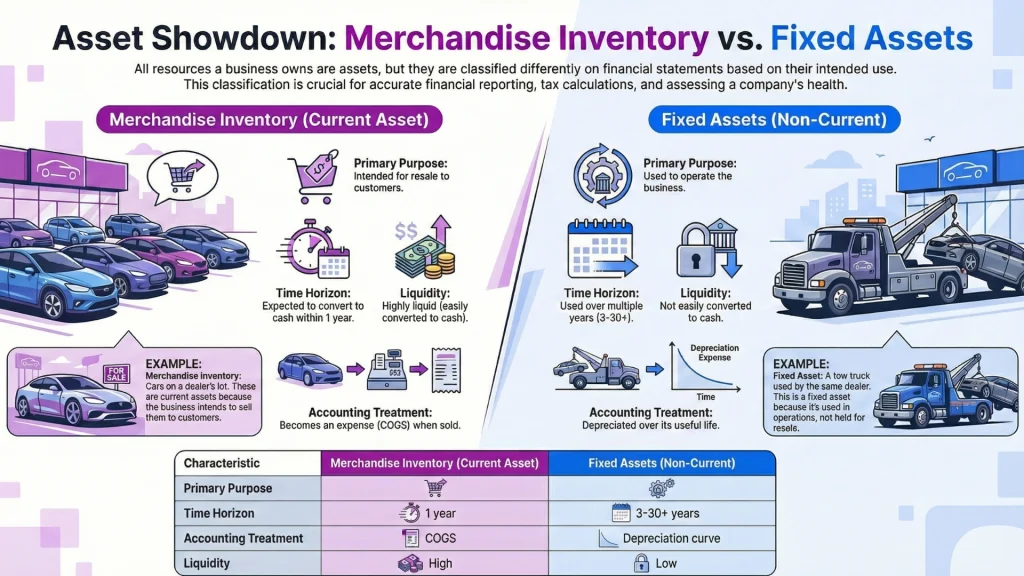
Key Differences Between Current and Fixed Assets
| Characteristic | Current Assets | Fixed Assets |
| Time horizon | Converted to cash within 12 months | Used over multiple years (3-30+ years) |
| Purpose | Intended for sale or consumption | Used to operate the business |
| Liquidity | Highly liquid | Not easily converted to cash |
| Balance sheet placement | Listed first on balance sheet | Listed after current assets |
| Accounting treatment | Expensed when sold (COGS) | Depreciated over useful life |
| Examples | Inventory, accounts receivable, cash | Equipment, buildings, vehicles |
| Impact on working capital | Included in working capital calculation | Not included in working capital |
Why Merchandise Inventory Is Classified as a Current Asset
The classification of merchandise inventory as a current asset is based on several accounting principles and operational realities.
The 12-Month Rule in Accounting
Under GAAP, an asset qualifies as current if the company expects to realize its value within one operating cycle or 12 months, whichever is longer. For most retailers and wholesalers, the operating cycle is less than a year. They purchase goods, sell them to customers, collect payment, and repeat the cycle multiple times annually.
Consider a bookstore that receives a shipment of bestsellers. The books typically sell within weeks or months, generating cash that the business uses to purchase more inventory. This rapid turnover keeps merchandise inventory firmly in the current asset category.
Liquidity and Business Operations
Merchandise inventory represents a liquid asset because businesses can convert it to cash relatively quickly through normal sales operations. While not as liquid as cash or accounts receivable, inventory occupies the middle ground on the liquidity spectrum.
The speed of conversion depends on the business model:
- Grocery stores turn inventory in days or weeks
- Fashion retailers may have seasonal inventory cycles of 3-6 months
- Luxury goods retailers might hold inventory longer but still expect to sell within a year
- Auto dealers typically sell vehicles within several months
Even businesses with longer inventory holding periods usually sell their merchandise within 12 months, maintaining its current asset status.
Expected Conversion to Cash
The fundamental characteristic that defines merchandise inventory as a current asset is the expectation of conversion to cash. When a business purchases inventory, it creates a current asset on the balance sheet. When that inventory sells:
- The inventory account decreases (credit to inventory)
- Cash or accounts receivable increases (debit to cash/AR)
- Cost of goods sold increases (debit to COGS expense)
- Revenue increases (credit to sales revenue)
This conversion from inventory to cash completes the operating cycle and generates profit, which is why accurate merchandise inventory tracking directly impacts reported profitability.
How Merchandise Inventory Appears on Financial Statements
Understanding how merchandise inventory flows through financial statements helps clarify its classification and importance.
Balance Sheet Classification
On the balance sheet, merchandise inventory appears under the current assets section. A typical balance sheet structure shows:
Assets
- Current Assets
- Cash and cash equivalents
- Accounts receivable
- Merchandise inventory
- Prepaid expenses
- Total current assets
- Fixed Assets
- Property, plant, and equipment
- Less: accumulated depreciation
- Total fixed assets
- Total Assets
For a mid-sized retailer, the current assets section might look like this:
- Cash: $250,000
- Accounts receivable: $400,000
- Merchandise inventory: $1,200,000
- Prepaid expenses: $50,000
- Total current assets: $1,900,000
In this example, merchandise inventory represents 63% of total current assets, highlighting its significance in the company’s asset structure.
Impact on Current Assets Calculation
Merchandise inventory directly affects several important financial metrics:
Current Ratio = Current Assets ÷ Current Liabilities
This ratio measures a company’s ability to pay short-term obligations. A healthy current ratio typically ranges from 1.5 to 3.0, depending on the industry. Because merchandise inventory often represents the largest current asset, its value significantly influences this metric.
Quick Ratio = (Current Assets – Inventory) ÷ Current Liabilities
Also called the acid-test ratio, this metric excludes inventory to measure immediate liquidity. The difference between current ratio and quick ratio reveals how dependent a company is on inventory sales to meet obligations.
Working Capital Implications
Working capital, calculated as current assets minus current liabilities, represents the funds available for day-to-day operations. Merchandise inventory is a major component of working capital for retailers and distributors.
Effective inventory management optimizes working capital by:
- Maintaining sufficient stock to meet customer demand
- Avoiding excess inventory that ties up cash
- Minimizing carrying costs and storage expenses
- Reducing the risk of obsolescence or spoilage
A business with $2,000,000 in current assets (including $1,200,000 inventory) and $800,000 in current liabilities has working capital of $1,200,000. If inventory management improves and the company reduces inventory to $900,000 while maintaining sales levels, working capital increases to $1,500,000, providing greater financial flexibility.
Merchandise Inventory vs Other Asset Types
Clarifying what merchandise inventory is NOT helps prevent classification errors in financial reporting.
Merchandise Inventory Is NOT a Fixed Asset
The most common question is whether merchandise inventory could ever be a fixed asset. The answer is almost always no, based on these key differences:
Intent: Merchandise inventory is purchased for resale, while fixed assets are acquired for use in operations.
Time frame: Inventory is expected to sell within one year, while fixed assets provide value over multiple years.
Accounting treatment: Inventory becomes an expense (COGS) when sold, while fixed assets are depreciated over time.
Example: A car dealership holds vehicles as merchandise inventory because it intends to sell them. However, the dealership’s service department vehicles are fixed assets because they’re used in operations, not for resale.
Merchandise Inventory Is NOT a Liability
Another common misconception is confusing inventory with liabilities. Merchandise inventory is an asset that provides future economic value to the business. It becomes a liability only in the narrow sense of accounts payable when the business has received inventory but not yet paid the supplier.
The transaction flow clarifies this:
- Business orders inventory: No accounting entry yet
- Business receives inventory: Debit to merchandise inventory (asset), credit to accounts payable (liability)
- Business pays supplier: Debit to accounts payable, credit to cash
- Business sells inventory: Debit to cash/AR, credit to sales revenue; debit to COGS, credit to inventory
When COGS Becomes an Expense
While merchandise inventory is an asset, the cost of goods sold is an expense. This distinction is crucial for understanding financial statements.
When merchandise inventory sits unsold, it remains an asset on the balance sheet. Only when the inventory sells does its cost transfer to the income statement as COGS expense. This matching principle ensures that revenue and the expenses incurred to generate that revenue appear in the same accounting period.
For example, a retailer starts January with $10,000 in beginning inventory, purchases $50,000 in additional inventory during the month, and ends January with $15,000 in unsold inventory. The calculation is:
Beginning Inventory ($10,000) + Purchases ($50,000) – Ending Inventory ($15,000) = COGS ($45,000)
The $45,000 COGS represents the inventory that converted from an asset to an expense during January.
Accounting Methods for Merchandise Inventory
Several accepted methods exist for valuing merchandise inventory, each with different implications for financial reporting.
FIFO (First In, First Out)
FIFO assumes that the oldest inventory items are sold first. This method typically results in:
- Lower COGS during inflationary periods (older, cheaper costs are expensed first)
- Higher gross profit and net income
- Higher ending inventory values on the balance sheet (newer, higher costs remain)
- Better matching of current costs to current revenues
FIFO is widely used because it reflects the physical flow of goods in most businesses. Grocery stores, for example, naturally sell older products first to prevent spoilage.
LIFO (Last In, First Out)
LIFO assumes that the newest inventory items are sold first. This method results in:
- Higher COGS during inflation (newer, higher costs are expensed first)
- Lower gross profit and net income
- Lower ending inventory values (older, lower costs remain)
- Potential tax advantages by reducing taxable income
LIFO is less common internationally and is not permitted under International Financial Reporting Standards (IFRS), though it remains acceptable under US GAAP.
Weighted Average Cost Method
This method averages the cost of all inventory items available for sale during the period. It:
- Smooths out price fluctuations
- Produces moderate COGS and profit figures
- Is simple to calculate and apply
- Works well for businesses with homogeneous products
The weighted average is recalculated each time new inventory is purchased, providing a balanced approach to valuation.
| Valuation Method | Cost Flow Assumption | COGS (Inflation) | Ending Inventory Value | Tax Impact | Best For |
| FIFO | Oldest costs first | Lower | Higher | Higher taxes | Perishable goods, reflecting actual flow |
| LIFO | Newest costs first | Higher | Lower | Lower taxes | Non-perishable goods, tax planning |
| Weighted Average | Average of all costs | Moderate | Moderate | Moderate | Commodity products, stable pricing |
Perpetual vs Periodic Inventory Systems
Beyond valuation methods, businesses must choose between perpetual and periodic inventory systems:
Perpetual System: Updates inventory records in real-time with each sale or purchase. Modern point-of-sale systems and inventory management software enable automatic tracking, providing current inventory levels at any moment.
Periodic System: Updates inventory records at specific intervals (weekly, monthly, quarterly, annually) through physical counts. This manual approach is less accurate and provides no real-time visibility.
For businesses using inventory management software like Qoblex, a perpetual system offers significant advantages in accuracy, efficiency, and decision-making capability.
Calculating Merchandise Inventory Value
Accurately calculating merchandise inventory value is essential for proper financial reporting and business management.
The Basic Formula
The ending merchandise inventory formula is:
Ending Inventory = Beginning Inventory + Purchases – Cost of Goods Sold
This formula reconciles inventory from one period to the next and helps verify physical counts against accounting records.
Step-by-Step Calculation Example
Let’s walk through a complete merchandise inventory calculation for a retail clothing store:
Given information:
- Beginning inventory (January 1): $50,000
- Purchases during January: $80,000
- Sales revenue in January: $120,000
- Gross profit margin: 40%
Step 1: Calculate COGS using the gross profit margin:
- COGS = Sales Revenue × (1 – Gross Profit Margin)
- COGS = $120,000 × (1 – 0.40) = $72,000
Step 2: Calculate ending inventory:
- Ending Inventory = Beginning Inventory + Purchases – COGS
- Ending Inventory = $50,000 + $80,000 – $72,000 = $58,000
Step 3: Verify the calculation makes sense:
- Total goods available for sale: $50,000 + $80,000 = $130,000
- Goods sold: $72,000
- Goods remaining: $58,000
- Checks out: $72,000 + $58,000 = $130,000
This $58,000 ending inventory becomes the beginning inventory for February and appears as a current asset on the January 31 balance sheet.
Beginning and Ending Inventory
Understanding the relationship between beginning and ending inventory is crucial for maintaining accurate records:
- Beginning Inventory: The value of merchandise on hand at the start of an accounting period. This equals the ending inventory from the previous period.
- Ending Inventory: The value of unsold merchandise at the end of an accounting period. This is determined through physical count or perpetual system records.
The calculation creates a continuous chain:
Period 1 Ending Inventory → Period 2 Beginning Inventory → Period 2 Ending Inventory → Period 3 Beginning Inventory
Any error in one period’s ending inventory automatically creates an error in the next period’s beginning inventory, highlighting the importance of accurate counting and valuation.
Why Accurate Merchandise Inventory Tracking Matters
Proper merchandise inventory management extends far beyond simple compliance with accounting standards.
Financial Reporting Accuracy
Inaccurate inventory values directly distort financial statements:
- Balance Sheet: Overstated inventory inflates current assets and total assets, making the company appear more financially healthy than it actually is.
- Income Statement: Incorrect inventory values distort COGS, which affects gross profit, operating income, and net income.
- Cash Flow Statement: Inventory changes affect cash flow from operations. Growing inventory consumes cash, while decreasing inventory generates cash.
These distortions can mislead investors, lenders, and management, potentially resulting in poor business decisions.
Tax Implications
Merchandise inventory valuation has direct tax consequences. Lower ending inventory increases COGS, which reduces taxable income. Higher ending inventory decreases COGS, which increases taxable income and tax liability.
Businesses must maintain consistent valuation methods year over year. Changing methods requires IRS approval and can trigger tax consequences. Additionally, the IRS may adjust inventory values during audits if they believe valuation is unreasonable.
Inventory Turnover and Business Health
Inventory turnover ratio measures how efficiently a business sells and replaces inventory:
Inventory Turnover Ratio = Cost of Goods Sold ÷ Average Inventory
Where: Average Inventory = (Beginning Inventory + Ending Inventory) ÷ 2
A higher turnover ratio generally indicates:
- Strong sales relative to inventory levels
- Efficient inventory management
- Less capital tied up in unsold goods
- Lower risk of obsolescence
- Reduced carrying costs
Conversely, low turnover may signal:
- Weak sales or declining demand
- Overstocking or poor purchasing decisions
- Obsolete or slow-moving merchandise
- Inefficient inventory management
- Higher carrying costs eating into profits
Industry benchmarks vary significantly. Grocery stores might turn inventory 15-20 times annually, while jewelry retailers might turn inventory only 1-2 times per year.
To work out inventory turnover for your own numbers, use the free inventory turnover calculator: enter COGS, beginning inventory and ending inventory and it returns your turnover ratio and days sales of inventory (DSI).
Cash Flow Management
Merchandise inventory represents invested cash that won’t return until the goods sell. This creates a fundamental tension in inventory management:
- Too little inventory risks stockouts and lost sales
- Too much inventory ties up working capital and increases costs
Effective inventory management balances these competing pressures to optimize cash flow. Businesses can improve cash flow through:
- Demand forecasting to purchase appropriate quantities
- Just-in-time inventory practices when feasible
- Negotiating better payment terms with suppliers
- Identifying and liquidating slow-moving inventory
- Using inventory management software for real-time visibility
Merchandise Inventory Examples Across Industries
Merchandise inventory looks different depending on the industry, but the current asset classification remains consistent.
Retail Apparel: Clothing, shoes, and accessories displayed in stores and held in backstock. Fast-fashion retailers might turn this inventory monthly, while luxury brands may hold inventory for full seasons.
Automotive Dealers: New and used vehicles on the lot. This represents significant capital investment, often financed through floor plan loans. Average turnover is typically 60-90 days.
Grocery Stores: Food products, beverages, and household goods. High turnover (days or weeks) but low profit margins require tight inventory control to maintain profitability.
Electronics Retailers: Computers, smartphones, televisions, and accessories. Rapid technological change creates obsolescence risk, making inventory velocity critical.
Furniture Stores: Display models and warehouse inventory. Longer sales cycles and bulky products result in lower turnover and higher carrying costs.
Book Retailers: Physical books and magazines. Returns from publishers and seasonal demand patterns complicate inventory management.
Wholesale Distributors: Large quantities of products purchased from manufacturers and sold to retailers. Typically operate on thin margins with high volume and rapid turnover.
Common Exceptions and Special Cases
While merchandise inventory is almost always a current asset, some special situations deserve attention.
Long-Term Inventory Holding Scenarios
Certain industries may hold inventory for extended periods:
Wine and Spirits: Aged wines and whiskeys may be held for years before sale. However, these are still classified as current assets because the business intends to sell them, even if the timeline exceeds 12 months.
Aerospace and Defense: Aircraft manufacturers may have multi-year production cycles. Components and work-in-progress remain current assets despite the extended timeline because they’re intended for sale within the operating cycle.
Large-Scale Construction: Contractors may hold materials for long-term projects. These materials remain current assets tied to specific projects expected to complete and generate payment.
The key factor is intent to sell, not the specific timeframe, though anything held beyond the operating cycle requires special disclosure in financial statements.
Obsolete or Damaged Inventory
When merchandise inventory loses value due to damage, obsolescence, or market changes, businesses must write down the inventory to its net realizable value:
- Obsolete inventory: Technology products superseded by newer models, fashion items out of season, or discontinued products
- Damaged inventory: Goods damaged in storage, transit, or handling
- Slow-moving inventory: Products with little to no sales activity over extended periods
The write-down process reduces the inventory asset value and creates an expense on the income statement, directly impacting profitability. Businesses should regularly review inventory for obsolescence and take write-downs when necessary to maintain accurate financial statements.
How Qoblex Helps You Track Merchandise Inventory Accurately
Managing merchandise inventory manually through spreadsheets creates risks of errors, inefficiency, and limited visibility. Modern inventory management platforms like Qoblex provide automated solutions that ensure accurate tracking and reporting.
Real-Time Inventory Visibility
Qoblex provides instant visibility into merchandise inventory across all locations:
- Live inventory counts updated with each sale, receipt, or transfer
- Multi-location tracking for businesses with multiple warehouses or retail locations
- Low-stock alerts to prevent stockouts
- SKU-level detail for complete inventory transparency
This real-time visibility enables better decision-making and ensures your balance sheet accurately reflects current inventory values at any moment.
Automated Accounting Integration
Qoblex integrates seamlessly with leading accounting platforms including Xero and QuickBooks Online:
- Automatic inventory value updates in your accounting system
- Accurate COGS calculations with each sale
- Proper current asset classification on balance sheets
- Elimination of manual data entry and reconciliation
This integration ensures your financial statements remain accurate and compliant with accounting standards while reducing the administrative burden on your team.
Multi-Location Tracking
For businesses operating multiple warehouses, retail stores, or fulfillment centers, Qoblex provides centralized inventory management:
- Consolidated view of inventory across all locations
- Inter-location transfer tracking
- Location-specific reorder points and stock levels
- Allocation of inventory to specific channels or customers
This capability is essential for accurately calculating total merchandise inventory value across your entire operation, ensuring your balance sheet reflects the complete picture of your current assets.
How you classify inventory feeds directly into your financials. To keep the wider picture in view, track the cash flow metrics every SMB should monitor.
Frequently Asked Questions
Is merchandise inventory always a current asset?
Yes, merchandise inventory is consistently classified as a current asset in virtually all scenarios. The classification is based on the business’s intent to sell the inventory within the operating cycle (typically one year), not on how long the inventory has actually been held. Even if specific items remain unsold for more than 12 months, they remain current assets as long as the business intends to sell them in the normal course of operations.
Can merchandise inventory ever be a fixed asset?
No, merchandise inventory cannot be classified as a fixed asset. The fundamental purpose distinguishes them: merchandise inventory is purchased for resale, while fixed assets are acquired for use in operating the business over multiple years. If a business purchases goods with the intent to use them rather than sell them, those goods are fixed assets, not inventory. For example, office computers are fixed assets, but computers held by an electronics retailer for sale to customers are merchandise inventory.
How is merchandise inventory different from other inventory types?
Merchandise inventory specifically refers to finished goods purchased for resale. This differs from:
- Raw materials inventory: Components and materials used in manufacturing
- Work-in-progress inventory: Partially completed goods in production
- Finished goods inventory (manufacturing): Completed products manufactured by the company
All are current assets, but merchandise inventory applies specifically to wholesalers, retailers, and distributors who buy and resell finished products without manufacturing them.
What happens to merchandise inventory when it’s sold?
When merchandise inventory sells, it transitions from an asset to an expense. The accounting entries are:
- Record the sale: Debit cash or accounts receivable, credit sales revenue
- Record the cost: Debit cost of goods sold (expense), credit merchandise inventory (asset)
This process reduces the current asset on the balance sheet and creates an expense on the income statement, properly matching the cost of goods with the revenue generated from their sale.
Is merchandise inventory a debit or credit?
Merchandise inventory has a normal debit balance because it’s an asset account. When inventory increases (purchases or receipts), you debit the inventory account. When inventory decreases (sales or write-offs), you credit the inventory account. On the balance sheet, the merchandise inventory figure represents the net debit balance remaining in the account at the period end.
Final Thoughts: Managing Your Merchandise Inventory Asset
Merchandise inventory stands as a current asset that demands careful management and accurate tracking. Its proper classification on your balance sheet affects everything from loan applications to tax filings, while effective management directly impacts profitability and cash flow.
Understanding that merchandise inventory is a current asset helps frame your approach to inventory management. These goods represent invested capital that must convert to cash within your operating cycle. The faster you turn inventory while maintaining customer satisfaction, the better your cash flow and return on investment.
Modern businesses benefit from automated inventory management solutions that provide real-time visibility, accurate valuation, and seamless accounting integration. Whether you’re tracking merchandise inventory across multiple locations or managing a single retail store, accurate systems ensure your financial statements reflect reality and support informed business decisions.
By maintaining proper inventory accounting practices, implementing appropriate valuation methods, and leveraging technology solutions like Qoblex, you can optimize your merchandise inventory management and strengthen your business’s financial foundation.
Ready to gain complete control over your merchandise inventory? Start your free 14-day trial of Qoblex today and see how real-time inventory tracking transforms your current asset management.