


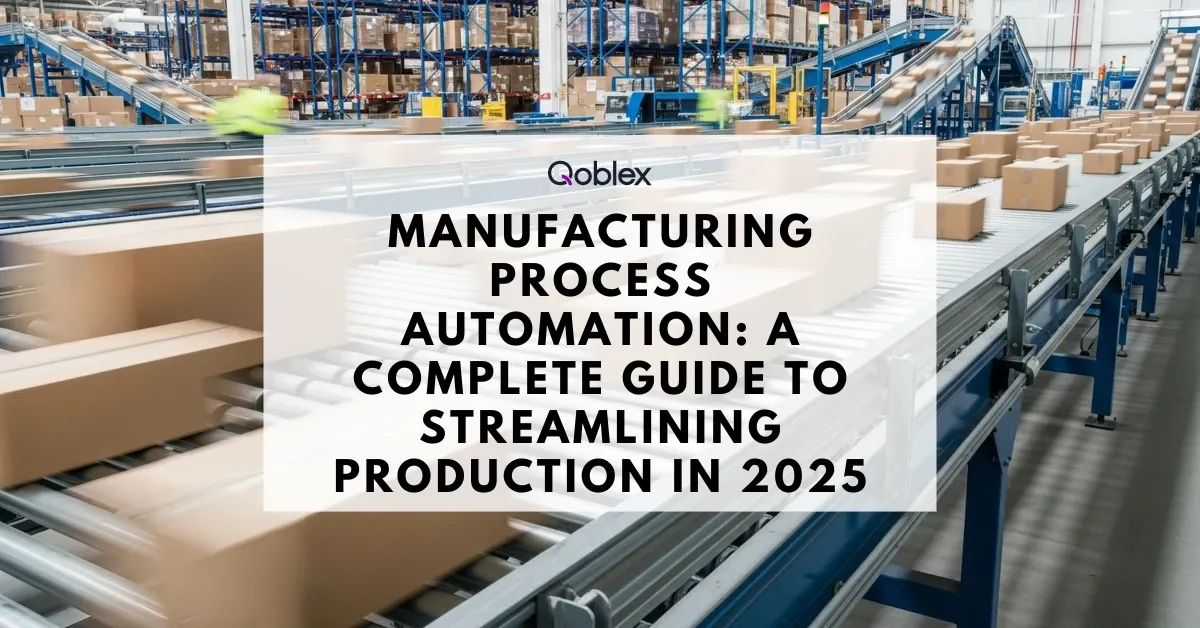
Manufacturing floors across America face a critical challenge: overwhelming order volumes with insufficient workforce to meet demand. Labor shortages, rising operational costs, and increasing pressure to deliver quality products faster have made one thing crystal clear—manual processes alone can no longer sustain competitive manufacturing operations.
Manufacturing process automation offers a proven solution. By implementing intelligent systems that handle repetitive tasks, monitor production in real time, and optimize workflows, manufacturers are reducing costs by up to 30% while increasing output and maintaining consistent quality standards.
This comprehensive guide walks you through everything you need to know about manufacturing process automation, from understanding different types to implementing a practical step-by-step framework that delivers results.
What Is Manufacturing Process Automation?
Manufacturing process automation refers to using technology, software systems, and machinery to perform production tasks with minimal human intervention. Rather than relying on manual labor for repetitive operations, automated systems handle everything from material handling and machine loading to quality inspection and inventory tracking.
Modern manufacturing automation leverages advanced technologies including Internet of Things sensors, artificial intelligence, machine learning algorithms, and cloud-based platforms to create intelligent production environments. These systems don’t just execute tasks—they learn, adapt, and optimize performance based on real-time data.
The scope varies significantly based on your needs. Some manufacturers start by automating a single bottleneck process, such as implementing barcode scanning for inventory tracking. Others pursue comprehensive strategies that transform entire production lines into connected, data-driven operations.
Why Manufacturing Process Automation Matters Now
The Labor Crisis
Over the next decade, approximately 76 million baby boomers will retire from the workforce, while only 46 million new workers will be available to replace them. This demographic shift creates an unprecedented labor shortage that manual operations simply cannot overcome.
Research indicates that manufacturing automation could generate an additional $4.9 trillion annually in global productivity by 2030. Meanwhile, 42% of manufacturing tasks will be completed using automation by the end of this year.
Key Drivers Behind Adoption
- Labor cost pressure: Automated systems perform the work of three to five employees depending on the task, operating continuously without breaks or turnover concerns
- Quality consistency demands: Manual processes inherently introduce variability, while automation delivers identical results every time
- Competitive pressure: When competitors automate and achieve faster turnaround with lower costs, you must respond or risk losing market share
- Data visibility needs: Modern manufacturing requires real-time insights that manual tracking methods cannot provide
- Technology accessibility: Cloud-based platforms and user-friendly interfaces mean manufacturers no longer need massive capital investments or specialized IT teams
Types of Manufacturing Process Automation
Understanding the different automation categories helps you select the right approach for your specific production environment.
Comparison Table: Automation Types
| Type | Best For | Flexibility | Investment | Changeover Time | Example Use Cases |
|---|---|---|---|---|---|
| Fixed Automation | High-volume, single product | Very Low | High | Hours to Days | Automotive assembly, chemical processing |
| Programmable Automation | Batch production, multiple products | Medium | Medium-High | 30 mins to 2 hours | CNC machining, industrial robots |
| Flexible Automation | Mixed production, custom orders | High | High | Minutes or None | Advanced robotics, modern assembly lines |
| Intelligent Automation | Complex, data-driven operations | Very High | Medium-High | Minimal | AI-powered quality control, predictive systems |
Fixed Automation: High-Volume Production
Fixed automation involves configuring production equipment to manufacture specific products in high volumes. Once programmed, these systems execute the same sequence repeatedly with minimal variation. This approach excels in industries requiring massive production runs of identical items, such as automotive assembly lines where robotic stations weld specific components for thousands of vehicles.
Advantages:
- Extremely low per-unit costs at high volumes
- Consistent quality with zero variation
- Maximum production speed for specific products
- Minimal ongoing programming requirements
Limitations:
- Difficult and expensive to reconfigure for new products
- High initial capital investment
- Inflexible to market changes
- Long changeover times between product types
Programmable Automation: Batch Production Flexibility
Programmable automation bridges fixed systems and fully flexible operations. These systems can be reprogrammed to handle different products, making them ideal for batch production environments. Industrial robots with programmable controllers exemplify this category—the same robotic arm can handle different components by loading new instructions.
The tradeoff comes in changeover time. Switching from one product to another requires loading new programs and potentially changing tooling, during which equipment sits idle. This automation works best when you have predictable batch schedules with sufficient run lengths to justify changeover effort.
Flexible Automation: Real-Time Adaptability
Flexible automation represents the most advanced category, capable of switching between different products with minimal or no downtime. Modern robotic systems connected to manufacturing execution software receive instructions about what to produce next through network connections, automatically reconfigure themselves, and begin manufacturing without human intervention.
This enables mixed-model production lines where different products move through the same equipment in any sequence, supporting make-to-order manufacturing models. While technology requirements are more sophisticated, flexible automation provides the only viable path to efficient operations for manufacturers dealing with high product variety or rapidly changing demand.
Intelligent Automation: AI-Powered Manufacturing
Intelligent automation incorporates artificial intelligence and machine learning to create systems that not only execute tasks but continuously optimize performance. Machine learning algorithms examine production variables to determine optimal settings for speed, quality, and resource utilization. Predictive maintenance systems monitor equipment health and schedule repairs before breakdowns occur.
What distinguishes intelligent automation is continuous improvement—systems evolve and become more effective over time as they process more data and learn from outcomes.
Core Benefits of Manufacturing Process Automation
Quantified Benefits Overview
- Production capacity: 40-60% increase through 24/7 operations
- Labor costs: 30-50% reduction in direct labor expenses
- Quality defects: 50-80% reduction in defect rates
- Inventory accuracy: Improvement from 70-80% to 95-99%
- Equipment utilization: Increase from 60-70% to 90%+ efficiency
- Safety incidents: 40-60% reduction in workplace injuries
- Operating costs: Overall reduction of 20-35%
- ROI timeframe: Typical payback in 18-36 months
Increased Production Output and Efficiency
Automated systems operate continuously without fatigue, breaks, or shift changes, multiplying production capacity compared to manual processes. Machine monitoring data reveals manufacturers implementing automation commonly report efficiency figures exceeding 90%, meaning equipment operates productively more than 90% of available time versus 60-70% for manual operations.
Reduced Operating Costs
Labor represents one of the largest expense categories in manufacturing. Automated systems deliver immediate reductions by performing work that would otherwise require multiple employees. Energy costs decrease with reduced heating and cooling requirements, while precision minimizes material waste. Quality improvements generate substantial hidden savings through fewer defects, less rework, and reduced warranty claims.
Improved Product Quality and Consistency
Automated processes execute tasks with precision that human workers cannot match. Robotic systems position components with repeatability measured in fractions of millimeters. Every product emerges identical to the previous one, eliminating the natural variation that occurs with manual production even among highly skilled workers.
Enhanced Worker Safety
Automation removes employees from dangerous situations involving heavy machinery, moving materials, repetitive motions, and exposure to chemicals or extreme temperatures. Robotic systems handle tasks that would otherwise expose workers to injury risks, while automated inspection eliminates exposure to intense heat, bright light, and toxic fumes.
Better Inventory Management and Control
Automated inventory management systems track every movement in real time using barcode scanners or RFID readers. This continuous tracking eliminates inventory discrepancies that plague manual systems. Automated demand forecasting analyzes historical patterns to predict future needs, optimizing stock levels and improving cash flow.
Key Technologies Enabling Manufacturing Automation
Technology Stack Overview
| Technology Category | Primary Function | Key Benefits | Implementation Complexity | Typical Cost Range |
|---|---|---|---|---|
| Robotic Process Automation | Physical task execution | 3-5x productivity increase | Medium-High | $50K-$300K per cell |
| Machine Monitoring & IoT | Real-time data collection | 20-30% efficiency gain | Low-Medium | $5K-$50K initial |
| Manufacturing Execution System | Production coordination | 15-25% throughput increase | Medium-High | $30K-$200K |
| Inventory Management Software | Stock tracking & forecasting | 30-50% inventory reduction | Low-Medium | $200-$500/month SaaS |
Robotic Process Automation (RPA)
Modern robotic systems combine mechanical capabilities with advanced sensors, vision systems, and intelligent controls. Collaborative robots (cobots) represent an accessible entry point, working safely alongside employees without requiring safety cages.
Common Robotic Applications:
- Material handling: Moving raw materials from storage to production areas
- Machine tending: Loading components onto machines and unloading finished parts
- Assembly operations: Joining components, installing fasteners, applying adhesives
- Packaging: Placing products into boxes, applying labels, preparing shipments
- Quality inspection: Visual verification, measurement, defect detection
- Welding and joining: Precision joining operations in controlled environments
Integration with other systems amplifies capabilities—when robots connect to inventory platforms, they receive instructions about which materials to retrieve based on actual production needs.
Machine Monitoring and IoT Sensors
Machine monitoring systems use sensors to collect data about runtime, cycle times, production counts, downtime events, and performance metrics. Temperature, vibration, and power consumption sensors continuously stream data to analytical platforms that transform raw measurements into actionable insights.
Predictive maintenance represents one of the most valuable applications, enabling scheduled maintenance during planned downtime rather than reactive repairs after unexpected breakdowns. Planned maintenance typically costs 30-40% less than emergency repairs while avoiding lost production.
Manufacturing Execution Systems (MES)
MES solutions serve as the operational backbone coordinating production activities. These platforms manage work orders from creation through completion, translating sales orders into detailed production instructions. The system tracks progress in real time, integrates quality management directly into workflows, and provides genealogy documentation for regulatory compliance.
Inventory Management Software
Comprehensive inventory platforms connect materials management with production operations, order fulfillment, and financial systems. Modern systems track stock across multiple dimensions—quantities on hand at each location, materials committed to production orders, quantities in transit, and stock allocated to customer orders.
For manufacturers, specialized inventory software like Qoblex handles production-specific requirements including Bill of Materials management, production order tracking, automated reordering, manufacturing cost tracking, and demand forecasting. The platform manages complex scenarios such as composite products, pack sizes, and multi-location inventory across warehouses and production facilities.
How to Implement Manufacturing Process Automation: 7-Step Framework
Implementation Roadmap
| Phase | Timeline | Key Activities | Success Metrics |
|---|---|---|---|
| 1. Assess Current Processes | 2-4 weeks | Document workflows, identify pain points, establish baselines | Completed process maps, baseline metrics |
| 2. Identify Opportunities | 1-2 weeks | Prioritize automation candidates, evaluate ROI potential | Ranked opportunity list |
| 3. Calculate ROI | 1-2 weeks | Develop financial models, set measurable goals | Approved business case |
| 4. Choose Technology | 2-4 weeks | Evaluate vendors, select solutions, plan integration | Signed contracts |
| 5. Pilot Programs | 8-12 weeks | Implement pilot, train users, measure results | Validated approach |
| 6. Scale Systems | 3-6 months | Roll out broadly, integrate systems, build capability | Full deployment |
| 7. Monitor & Optimize | Ongoing | Track performance, continuous improvement | Target KPIs achieved |
Step 1: Assess Your Current Processes
Begin by thoroughly documenting how production operates today. Create process flow diagrams mapping material movements and information flows. Interview workers performing each task to identify problems and improvement opportunities. Analyze performance metrics including production output, cycle times, defect rates, and operating costs to establish baselines.
Step 2: Identify Automation Opportunities
Focus on applications where automation delivers greatest impact:
- Repetitive tasks: Operations requiring identical actions hundreds of times daily
- High-volume runs: Products manufactured continuously justify automation investments through scale
- Error-prone processes: Where mistakes cause significant costs
- Bottleneck operations: Slow processes constraining overall production capacity
- Dangerous tasks: Operations exposing workers to injury risks
- Data collection needs: Areas lacking visibility into performance metrics
Step 3: Calculate ROI and Set Clear Goals
Develop detailed financial models showing all implementation expenses including equipment purchases, installation, facility modifications, infrastructure upgrades, training, and potential production disruptions. Calculate benefits conservatively based on documented current costs.
Establish specific, measurable goals such as “reduce cycle time from 45 to 30 seconds” or “achieve 99.5% inventory accuracy” rather than vague objectives like “improve efficiency.”
Step 4: Choose the Right Technology Stack
Select appropriate automation technologies balancing capability requirements against budget constraints. Evaluate solution providers carefully, checking references from similar manufacturers. Prioritize integration capabilities—automation systems must exchange data with existing accounting, eCommerce, and business applications.
For inventory and production management, platforms like Qoblex deliver comprehensive manufacturing automation specifically designed for small and mid-size manufacturers. Implementation takes approximately one week rather than months, and the cloud-based architecture eliminates on-premise server requirements.
Step 5: Start Small with Pilot Programs
Select pilot applications that demonstrate automation value without risking mission-critical production. Define clear success criteria before beginning, involve frontline workers throughout implementation, and document everything during pilots. Measure results rigorously, comparing actual performance against baseline measurements.
Step 6: Scale and Integrate Systems
After successful pilots, expand implementation systematically. Prioritize based on ROI and strategic importance. Maintain momentum by moving steadily from one project to the next. Focus on integration as you expand—individual automation solutions deliver value, but integrated systems that share data deliver exponential benefits.
Step 7: Monitor, Measure, and Optimize
Establish dashboards tracking key performance metrics for automated processes. Review performance data regularly with responsible teams. Compare actual results against original goals, capture operator feedback, and update systems as technology evolves. Document improvements and share lessons across your organization.
Real-World Applications Across Industries
Automotive Manufacturing
Automotive production represents the most extensively automated sector. Assembly lines utilize hundreds of robots performing welding, painting, material handling, and component installation. Spot welding robots join body panels with millimeter precision, while paint robots apply coating uniformly across complex surfaces. Quality inspection systems use machine vision to detect defects invisible to human inspectors.
Food and Beverage Production
Food manufacturers face strict hygiene requirements and regulatory compliance demands. Automated weighing and mixing systems ensure recipe accuracy and maintain flavor consistency. Packaging automation handles high-volume operations at speeds of hundreds of items per hour. Quality control automation monitors temperature, inspects package seals, and confirms fill quantities, ensuring food safety while reducing waste.
Electronics and High-Tech
Electronics manufacturing involves precise assembly of small components. Pick-and-place machines position tiny components onto circuit boards with micrometer accuracy at speeds of hundreds per minute. Automated optical inspection examines completed boards for defects using high-resolution cameras and sophisticated software analysis.
Chemical and Process Manufacturing
Chemical industries rely on automation for safety, consistency, and efficiency. Automated process control systems manage chemical reactions, maintaining temperature, pressure, and flow rates within specifications. Safety systems integrate to prevent hazardous conditions, activating emergency shutdowns automatically if sensors detect abnormal conditions.
Common Challenges and Solutions
Integration with Legacy Systems
Many manufacturers operate mixed environments of older and newer technologies. Modern automation platforms provide APIs enabling data exchange with other systems. When direct integration isn’t available, middleware solutions translate data between different formats. For equipment lacking digital connectivity, retrofit sensors add communication capabilities to older machines.
Workforce Concerns and Change Management
Address employee fears about automation threatening jobs through honest communication. Emphasize that automation eliminates repetitive, physically demanding, or dangerous tasks—not people. Involve employees in automation planning, provide thorough training, and recognize those who help drive successful implementation.
Initial Investment and Budget Constraints
Explore financing options including equipment loans, leasing arrangements, and vendor financing programs. Phase investments over time, starting with high-ROI projects that pay back quickly. Calculate total cost of ownership over equipment lifecycles rather than focusing solely on acquisition costs.
Choosing the Right Vendors and Partners
Define selection criteria including technical capability, industry experience, customer references, and financial stability. Request detailed proposals addressing your specific requirements, check references thoroughly, and understand implementation methodologies and timelines before committing.
The Role of Inventory Management in Manufacturing Automation
Inventory sits at the intersection of purchasing, production, and sales—making inventory management central to successful manufacturing automation. Accurate real-time inventory data enables automated production scheduling, preventing situations where manufacturing begins only to discover required components are unavailable.
Key inventory automation capabilities for manufacturers:
- Real-time tracking: Visibility across all locations with automatic updates as production completes
- BOM management: Automated component reservation when sales orders are received
- Production integration: Automatic inventory adjustments when manufacturing orders complete
- Demand forecasting: Historical pattern analysis to predict future inventory requirements
- Multi-location support: Centralized visibility with distributed stock management
- Cost tracking: Automated valuation capturing materials, labor, and overhead
- Lot traceability: Complete documentation of which materials were used in each production batch
- Automated reordering: Purchase order generation when stock falls below thresholds
Manufacturing inventory systems like Qoblex provide specialized features including production order management tracking progress from creation through completion, manufacturing reconciliation capturing yields and waste, work order bundling minimizing changeovers, and finished goods receiving that automatically updates inventory when production completes.
Future Trends in Manufacturing Process Automation
AI and Machine Learning Integration
Artificial intelligence transforms automation from systems executing programmed instructions to intelligent systems that learn and optimize autonomously. Predictive quality systems identify patterns indicating problems are developing, adaptive process control continuously optimizes production parameters, and intelligent scheduling balances hundreds of variables to generate optimal production plans.
Digital Twins and Predictive Maintenance
Digital twin technology creates virtual replicas of physical production systems. Production planning simulations test alternative scenarios virtually before implementing physical changes. Predictive maintenance reaches new sophistication by comparing actual performance against predicted behavior to forecast when maintenance becomes necessary.
Sustainable and Green Manufacturing
Energy optimization systems identify opportunities to reduce usage without compromising production. Waste reduction automation tracks scrap and analyzes root causes. Emissions monitoring ensures regulatory compliance while generating environmental reporting documentation.
Lights-Out Manufacturing
The ultimate automation vision involves fully autonomous factories operating without human presence. Overnight production becomes viable when automation handles material loading, process execution, quality inspection, and problem response without operators present. Remote monitoring enables supervisors to oversee unattended operations from anywhere.
Frequently Asked Questions About Manufacturing Process Automation
What is the difference between mechanization and automation?
Mechanization uses machines to replace human physical effort, but humans still control operations. Automation goes further by using technology to control machines and processes with minimal human intervention. For example, a mechanical press requires an operator to position materials and activate the machine for each cycle. An automated press receives parts from a feeding system, performs operations, and transfers completed parts to the next process without operator involvement for each piece.
How much does manufacturing automation cost?
Costs vary dramatically based on automation scope and technology choices. Simple projects like implementing barcode scanning for inventory tracking may cost $3,000-$10,000. Mid-range automation including machine monitoring and basic robotics typically requires $50,000-$150,000. Comprehensive automation with multiple robotic cells, integrated software systems, and facility modifications can exceed $500,000.
For small manufacturers, cloud-based inventory and production management software like Qoblex offers an accessible entry point at $200-$500 monthly with minimal upfront costs. Return on investment typically occurs within 18-36 months for well-planned implementations, with some projects achieving payback in under 12 months.
Will automation eliminate manufacturing jobs?
Automation changes jobs rather than simply eliminating them. While some repetitive manual tasks become automated, manufacturers typically redeploy workers to more valuable activities requiring human judgment, problem-solving, and interpersonal skills. Many manufacturers implement automation specifically because they cannot find enough workers for available positions—automation fills gaps rather than displacing existing employees.
Studies consistently show that manufacturers who automate successfully grow their businesses, often leading to increased total employment even as automation handles specific tasks. Workers transition from manual repetitive work to roles overseeing automated systems, performing maintenance, managing quality, and handling exceptions that require human decision-making.
What manufacturing processes are best suited for automation?
The best automation candidates share specific characteristics:
Repetitive operations: Tasks performed identically hundreds of times daily, such as packaging, labeling, or material handling.
High-volume production: Products manufactured continuously in large quantities justify automation investments through economies of scale.
Error-prone processes: Operations where human mistakes cause significant costs, such as data entry, measurement, or mixing operations.
Bottleneck operations: Slow processes that constrain overall production capacity deliver immediate throughput increases when automated.
Dangerous tasks: Operations exposing workers to injury risks from heavy lifting, extreme temperatures, or hazardous materials.
Data-intensive processes: Activities requiring extensive documentation or real-time tracking benefit from automated data collection.
How long does it take to implement manufacturing automation?
Implementation timeframes vary significantly based on project scope:
Software implementations: Inventory management and production tracking systems like Qoblex typically deploy within 1-2 weeks from signup to operational status.
Machine monitoring: Adding sensors and dashboards to existing equipment generally requires 4-8 weeks including installation and training.
Robotic cells: Single robotic installations typically take 3-6 months from planning through operational status, including equipment delivery, installation, programming, and testing.
Comprehensive facility automation: Transforming entire production lines may span 12-24 months with staged deployments to minimize disruption.
Cloud-based solutions designed for small and mid-size manufacturers implement much faster than enterprise systems requiring extensive customization and on-premise infrastructure.
Can small manufacturers afford automation?
Automation is increasingly accessible for manufacturers of all sizes. Technology costs have declined substantially while capabilities have improved. Cloud-based software eliminates expensive server infrastructure. Collaborative robots cost $25,000-$50,000 compared to $100,000+ for traditional industrial robots, while requiring minimal safety infrastructure.
Financing options including equipment loans, leasing arrangements, and vendor financing programs spread costs over time rather than requiring large upfront capital. Many manufacturers find that not automating becomes the more expensive choice as competitors who do automate achieve cost structures that make competing on price increasingly difficult.
Start with focused projects delivering quick ROI—typically payback within 18-24 months—then use returns to fund additional automation. Even a $10,000 investment in inventory management software can deliver $30,000+ annually in labor savings and efficiency improvements.
Do I need special IT expertise to manage automated systems?
Modern automation platforms designed for manufacturing companies emphasize user-friendly operation that doesn’t require specialized IT skills. Cloud-based systems eliminate server management complexity while providing straightforward web and mobile interfaces.
However, you do need personnel comfortable with technology who can learn system operations, troubleshoot common issues, and coordinate with vendor support when needed. Many manufacturers designate operations or engineering staff as automation champions who develop expertise through training and experience rather than hiring dedicated IT professionals.
For inventory and production management software, platforms like Qoblex are specifically designed for manufacturing teams without IT backgrounds. The intuitive interface allows operations managers to configure workflows, production supervisors to track orders, and warehouse staff to manage inventory without technical training.
What happens if automation equipment breaks down?
Downtime risk is a legitimate concern that requires planning. Effective strategies include:
Preventive maintenance: Regular scheduled maintenance based on manufacturer recommendations prevents most breakdowns. Automated systems often include predictive maintenance capabilities that monitor equipment health and alert you before failures occur.
Spare parts inventory: Maintaining critical spare components enables quick repairs. Vendors can recommend which parts to stock based on failure patterns.
Vendor support agreements: Service contracts with guaranteed response times ensure expert help is available when needed. Many vendors offer 24/7 support for critical systems.
Backup processes: Maintaining ability to operate manually during downtime prevents complete production stoppages. Document manual procedures for critical processes.
Multiple systems: For critical operations, redundancy through multiple machines or cells ensures one failure doesn’t halt production entirely.
Modern automated equipment is remarkably reliable—properly maintained systems often achieve 95%+ uptime. The key is treating maintenance as a priority rather than an afterthought.
How do I measure automation ROI?
Calculate ROI by comparing total costs against quantifiable benefits. Track these key metrics:
Labor savings: Direct labor hours eliminated multiplied by loaded labor costs (wages plus benefits, taxes, and overhead).
Productivity improvements: Increased output per shift measured in units produced or revenue generated.
Quality improvements: Reduced defect rates, lower rework costs, and decreased warranty claims.
Inventory optimization: Reduced inventory carrying costs through better accuracy and demand forecasting.
Operating cost reductions: Lower energy consumption, reduced material waste, and decreased overtime expenses.
Revenue impacts: New business from increased capacity, premium pricing from faster delivery, or reduced lost sales from stockouts.
Divide total annual benefits by implementation costs to calculate payback period. Most successful automation projects achieve payback within 18-36 months, with ongoing benefits continuing for 5-10+ years of equipment life.
Can I automate while keeping my existing equipment?
Absolutely. Many high-value automation projects focus on maximizing existing equipment effectiveness rather than replacing it. Retrofit sensors can add connectivity to older machines lacking digital interfaces. Machine monitoring systems work with virtually any production equipment regardless of age or manufacturer.
Manufacturing execution and inventory management software coordinate activities across existing machines, optimizing scheduling and material flow. Material handling automation can connect existing machines into efficient workflows. Quality inspection systems add automated verification without changing production equipment.
While some automation opportunities involve new equipment, many of the highest-impact projects make existing assets more productive through better coordination, data visibility, and workflow optimization. This approach requires less capital while delivering substantial operational improvements.
Getting Started with Manufacturing Automation
The journey to automated manufacturing begins with identifying your biggest pain points—operational challenges causing the most significant problems or limiting growth most severely. Focus initial efforts on addressing these critical issues where benefits are most immediately apparent.
Signs Your Operation Is Ready for Automation:
- Recurring difficulty finding enough workers for available positions
- Production capacity constraints limiting business growth
- Quality inconsistency causing customer complaints or returns
- Inventory inaccuracies disrupting production or causing stockouts
- Excessive time spent on manual data entry and record-keeping
- Safety incidents related to repetitive or hazardous tasks
- Inability to meet customer delivery expectations consistently
Develop a multi-year automation roadmap even if initial projects are modest. Understanding the long-term vision ensures individual projects align with strategic direction. For manufacturers looking to automate inventory management and production tracking, platforms like Qoblex provide an accessible starting point.
The system handles product cataloging with variants and bundles, tracks inventory across multiple locations, manages production orders with bill of materials, forecasts demand to optimize stock levels, and integrates with eCommerce platforms including Shopify , Amazon and WooCommerce plus accounting systems like Xero and QuickBooks.
Implementation takes approximately one week from signup to operational status, and the 14-day free trial lets you evaluate functionality with your actual data before committing. Key differentiators include real-time inventory visibility, automated stock updates, comprehensive manufacturing features, demand forecasting, and seamless integrations.
The manufacturing automation journey requires commitment, but the destination—more efficient operations, better quality, lower costs, and sustainable growth—justifies the effort. Every manufacturer faces the choice of embracing automation to remain competitive or risking obsolescence as automated competitors gain insurmountable advantages.
The question isn’t whether to automate, but when to start and where to begin. Your manufacturing automation journey starts now.
Ready to automate your manufacturing inventory and production tracking? Start your free 14-day Qoblex trial and see how real-time visibility, automated workflows, and intelligent forecasting streamline operations for growing manufacturers.