


Managing inventory across Shopify, Amazon, WooCommerce, wholesale orders, warehouses, and accounting tools can get messy fast. That is exactly why multi channel inventory management software has become essential for growing businesses.
Without the right system, teams often deal with overselling, manual stock updates, slow fulfillment, duplicate work, and poor inventory visibility. The problem is not only operational. It affects cash flow, customer experience, and growth.
This guide explains what multi channel inventory management software does, when your business needs it, which features matter most, and how to choose the right platform based on your sales channels, warehouses, and operational complexity.
What Is Multi Channel Inventory Management Software?
Multi channel inventory management software is a system that centralizes inventory tracking, stock synchronization, order management, purchasing, and warehouse operations across multiple sales channels.
Instead of updating inventory separately in Shopify, Amazon, WooCommerce, Xero, QuickBooks, spreadsheets, and warehouse tools, the software creates one operational source of truth.
A typical workflow looks like this:
Sales Channels → Inventory Management Software → Warehouses → Accounting
When a customer buys a product on one channel, inventory levels update everywhere else. This helps prevent overselling, stockouts, duplicate orders, and manual reconciliation.
For businesses selling across several platforms, this is the difference between reactive operations and scalable inventory control.
Why Growing Businesses Need It
Multi channel selling creates opportunity, but it also creates complexity. A business selling on one Shopify store can often manage inventory manually for a while. But once you add Amazon, wholesale orders, multiple warehouses, or manufacturing, spreadsheets become unreliable.
Prevent Overselling
Overselling happens when a product appears available on one channel even though it has already sold elsewhere.
For example, if an item sells on Amazon but Shopify stock does not update quickly enough, another customer may buy a product you no longer have. That leads to refunds, delays, and poor customer experience.
Real-time stock synchronization reduces that risk by keeping inventory quantities aligned across every connected channel.
Improve Inventory Accuracy
Inventory accuracy is not just about knowing what is in stock. It also means knowing where stock is located, what is reserved, what is incoming, and what is available to sell.
Accurate inventory tracking helps teams make better purchasing decisions, avoid unnecessary stock, and reduce carrying costs.
Centralize Inventory
Without centralized inventory visibility, each team may work from different data. Sales sees one number. The warehouse sees another. Accounting sees something else.
Multi channel inventory software brings product, order, warehouse, and purchasing data into one system. This creates cleaner workflows and fewer manual corrections.
Scale Across Sales Channels
Adding new channels should not break your operations. The right software lets you expand into Amazon, Walmart Marketplace, eBay, wholesale, or new Shopify stores without rebuilding your entire inventory process.
How Multi Channel Inventory Management Works
Multi channel inventory management connects your sales channels, warehouses, suppliers, and accounting tools.
The process usually includes:
- Importing products, SKUs, and inventory data
- Connecting sales channels like Shopify, WooCommerce, Amazon, and eBay
- Mapping warehouses and fulfillment locations
- Synchronizing stock quantities in real time
- Routing orders to the right fulfillment workflow
- Creating purchase orders based on demand
- Sending financial data to QuickBooks or Xero
The software does not only record what happened. It helps teams manage what should happen next.
That includes replenishment, stock transfers, reorder points, demand forecasting, and manufacturing workflows.
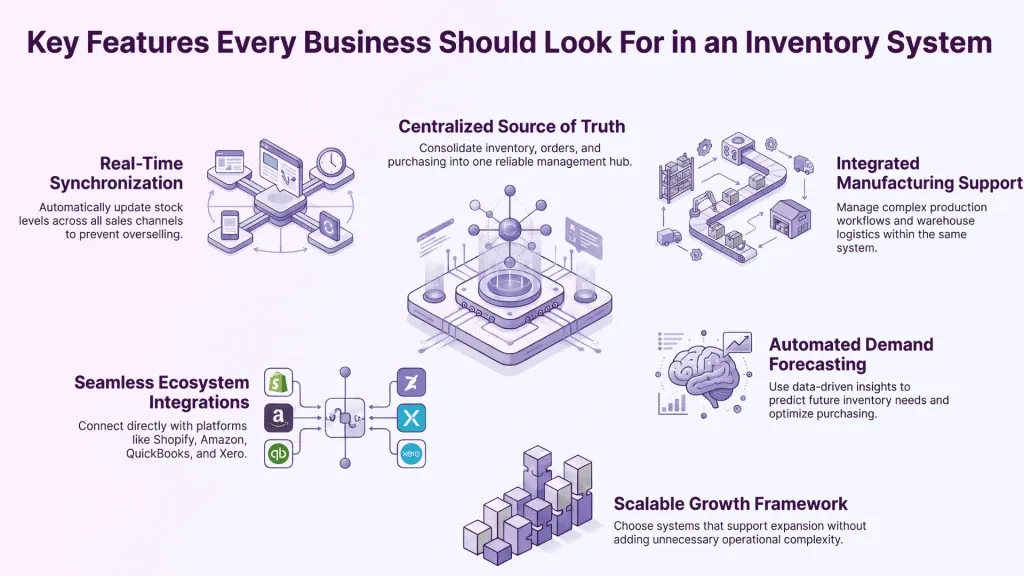
Key Features Every Business Should Look For
Not every inventory management software is built for the same type of business. A simple reseller does not need the same capabilities as a manufacturer or wholesale distributor.
Here are the key features to evaluate.
Real-Time Inventory Sync
Real-time inventory sync updates stock levels across all connected channels when inventory changes.
This is critical for businesses selling the same product on multiple platforms. Without it, your team may need to manually update inventory after every sale, return, or stock adjustment.
Look for software that supports automatic stock synchronization across Shopify, WooCommerce, Amazon, eBay, Walmart Marketplace, and wholesale orders.
Multi-Warehouse Management
Multi-warehouse management allows you to track inventory by location.
This matters if you store products in more than one warehouse, use a 3PL, or fulfill orders from different regions.
The software should show:
- Stock available by warehouse
- Stock transfers
- Reserved inventory
- Incoming inventory
- Location-specific fulfillment rules
This improves delivery speed and reduces fulfillment mistakes.
Order Management
Order management brings orders from multiple sales channels into one workflow.
Instead of switching between Shopify, Amazon, and wholesale emails, your team can process orders from one dashboard.
Strong order management features should support order status tracking, fulfillment workflows, split shipments, backorders, and returns.
Purchase Order Management
Purchase order management helps you reorder products before stock runs out.
Good software should allow teams to create purchase orders, track supplier lead times, receive inventory, and update stock automatically when goods arrive.
This is especially important for businesses with long lead times, seasonal demand, or imported products.
Demand Forecasting
Demand forecasting uses historical sales, seasonality, lead times, and inventory trends to estimate future demand.
This helps businesses avoid two expensive problems:
- Stockouts that cause lost sales
- Overstock that ties up cash
Forecasting is especially useful for fast-growing eCommerce brands, wholesalers, and manufacturers.
Manufacturing Support
If your business assembles, produces, or bundles products, basic inventory tracking may not be enough.
Manufacturing inventory software should support Bills of Materials, production workflows, made-to-order products, batch tracking, lot tracking, expiry date management, and component-level inventory control.
This helps teams understand how raw materials become finished goods.
Reporting and Analytics
Inventory reports help teams understand what is selling, what is slow-moving, and what needs attention.
Important reports include inventory valuation, inventory turnover, stock aging, reorder recommendations, product performance, and warehouse-level stock reports.
Clear analytics improve purchasing decisions and cash flow planning.
API and Integrations
Your inventory system should connect with the rest of your business stack.
Common integrations include:
- Shopify
- WooCommerce
- Amazon
- QuickBooks
- Xero
- 3PL providers
- Shipping tools
- ERP systems
- Custom APIs
The more connected your software is, the less manual work your team needs to manage.
Multi Channel Inventory Software Comparison Table
| Software | Best For | Key Strengths | Considerations |
| Qoblex | Growing eCommerce, wholesalers, and manufacturers | Inventory, orders, purchasing, manufacturing, forecasting, Shopify, Xero and QuickBooks integrations | Best fit for businesses ready to centralize operations |
| Cin7 | Larger product-based businesses | Strong inventory and order management features | Can be complex for smaller teams |
| Linnworks | Marketplace-heavy sellers | Marketplace automation and order routing | May require setup support |
| Zoho Inventory | Small businesses | Affordable inventory and order tools | Limited for advanced manufacturing |
| Extensiv | 3PL and warehouse operations | Warehouse and fulfillment capabilities | More focused on logistics-heavy teams |
| Finale Inventory | Inventory-heavy SMBs | Stock control and warehouse features | Interface may require training |
| Brightpearl | Retail operations | Retail operations and back-office automation | Better suited for larger teams |
| Sellbrite | Marketplace sellers | Simple multichannel listing and inventory sync | Less advanced for manufacturing or purchasing |
Best Multi Channel Inventory Management Software
The right software depends on your business model. A Shopify brand with one warehouse has different needs than a manufacturer managing components and finished goods.
Qoblex
Qoblex is built for growing businesses that need to simplify inventory operations across multiple channels.
It helps teams centralize inventory, manage orders, create purchase orders, track warehouses, forecast demand, and manage manufacturing workflows from one platform.
Qoblex integrates with Shopify, WooCommerce, QuickBooks, Xero, Amazon, and other business tools. This makes it a strong fit for companies that want inventory management software that connects operations and accounting without forcing teams into a complex ERP.
It is especially relevant for eCommerce brands, wholesalers, and manufacturers that need better inventory visibility and faster implementation.
Cin7
Cin7 is a strong option for larger businesses that need broad inventory and order management capabilities.
It supports complex product operations, multiple sales channels, and warehouse workflows. It can work well for businesses that have outgrown basic inventory tools and need more structure.
However, smaller teams should evaluate implementation complexity before choosing it.
Linnworks
Linnworks is often used by businesses selling across multiple marketplaces.
Its strengths include marketplace connectivity, order routing, and automation. It can be useful for companies that rely heavily on Amazon, eBay, and other marketplaces.
Businesses with manufacturing or deeper purchasing needs may need to evaluate whether it covers their full workflow.
Zoho Inventory
Zoho Inventory is a practical option for small businesses that need affordable inventory control.
It offers order management, basic inventory tracking, and integrations within the Zoho ecosystem. For early-stage businesses, it can be a useful starting point.
However, companies with advanced multi-warehouse, manufacturing, or forecasting needs may eventually require a more specialized platform.
Extensiv
Extensiv is well suited for logistics-heavy operations, 3PLs, and businesses with advanced warehouse requirements.
It focuses strongly on fulfillment and warehouse management. This makes it a good option for companies where logistics complexity is the main challenge.
For businesses looking for broader inventory planning and manufacturing support, fit should be evaluated carefully.
Finale Inventory
Finale Inventory is designed for businesses that need detailed inventory tracking and warehouse control.
It can support barcode scanning, stock movements, and inventory visibility. It is often relevant for product-based SMBs with operational complexity.
The main consideration is ensuring the workflows match your team’s daily process.
Brightpearl
Brightpearl focuses on retail operations and back-office automation.
It can work well for larger retail businesses that need inventory, orders, accounting workflows, and operational reporting. It is usually better suited for established teams with more complex processes.
Smaller businesses may find it more than they need.
Sellbrite
Sellbrite is useful for sellers that want simpler multichannel listing and inventory synchronization.
It helps manage products across channels like Amazon, eBay, and Walmart. It is a good fit for marketplace-focused businesses that want easier listing control.
It is less suitable for companies that need advanced purchasing, manufacturing, or warehouse workflows.
How to Choose the Right Software
Choosing multi channel inventory management software should start with your operation, not the feature list.
Use this buyer framework to narrow your options.
| Business Type | Priority Features | Recommended Focus |
| Small business | Simple inventory tracking, order sync, basic reports | Ease of use and affordability |
| Shopify store | Real-time sync, Shopify integration, fulfillment visibility | Stock synchronization and order management |
| Manufacturer | BOMs, production tracking, component inventory | Manufacturing support |
| Wholesaler | B2B orders, purchase orders, customer pricing | Purchasing and order management |
| Multi-warehouse business | Location-level inventory, transfers, routing | Warehouse management |
| Marketplace seller | Amazon, eBay, Walmart integrations | Channel connectivity |
Small Businesses
Small businesses should prioritize ease of use, simple setup, and core inventory control.
Avoid paying for complex ERP features before your team needs them. The first goal is to eliminate manual updates and improve inventory accuracy.
Shopify Stores
Shopify businesses should look for real-time inventory sync, product mapping, order management, and QuickBooks or Xero integration.
If you sell the same products on Amazon or wholesale, make sure the software can centralize stock across all channels.
Manufacturers
Manufacturers need more than inventory tracking. They need visibility into components, raw materials, finished goods, and production workflows.
Look for BOM support, manufacturing orders, batch tracking, and demand planning.
Wholesale Businesses
Wholesale businesses often manage larger orders, repeat buyers, payment terms, and purchase planning.
The right software should support B2B order workflows, purchasing, stock allocation, and customer-specific processes.
Multi-Warehouse Operations
If you manage multiple warehouses, prioritize location-level inventory visibility.
Your software should handle transfers, fulfillment rules, stock allocation, and warehouse-specific reporting.
Common Mistakes to Avoid
Many businesses choose inventory software too late or choose based on the wrong criteria.
Avoid these mistakes:
- Choosing software only because it has the lowest price
- Ignoring implementation and migration complexity
- Keeping inconsistent SKUs across sales channels
- Letting multiple systems update inventory independently
- Failing to define one source of truth
- Overlooking accounting integrations
- Buying ERP-level complexity before your team is ready
A good inventory system should simplify operations, not create another layer of confusion.
Implementation Checklist
Before switching to new inventory management software, prepare your data and workflow.
Use this checklist:
- Clean your product catalog and remove duplicate SKUs.
- Standardize product names, variants, and units of measure.
- Define your warehouses and fulfillment locations.
- Decide which system will be the source of truth.
- Map sales channels and accounting tools.
- Review supplier lead times and reorder points.
- Train your team before going live.
- Test orders, returns, stock transfers, and purchase orders.
Implementation quality matters as much as software choice. Clean data creates cleaner operations.
Frequently Asked Questions
What is multi channel inventory management software?
Multi channel inventory management software centralizes inventory tracking, stock synchronization, orders, purchasing, and warehouse management across multiple sales channels. It helps businesses manage inventory across Shopify, Amazon, WooCommerce, wholesale, and accounting tools from one system.
What is the difference between multichannel and omnichannel inventory?
Multichannel inventory means selling and managing stock across multiple channels. Omnichannel inventory goes further by creating a connected customer experience across channels. For example, a customer may buy online, pick up in store, or return through another channel.
Does Shopify include inventory management?
Yes, Shopify includes basic inventory management features. However, growing businesses often need more advanced capabilities such as multi-warehouse management, purchase orders, demand forecasting, manufacturing support, and deeper accounting integrations.
Can QuickBooks manage inventory across multiple channels?
QuickBooks can track inventory, but it is primarily accounting software. Businesses selling across multiple channels usually need dedicated inventory management software to manage real-time stock synchronization, warehouses, purchasing, and operational workflows.
What features should I prioritize?
Prioritize real-time inventory sync, order management, multi-warehouse tracking, purchase order management, demand forecasting, reporting, and integrations with your sales channels and accounting tools. Manufacturers should also prioritize BOMs and production tracking.
Is cloud inventory software secure?
Cloud inventory software can be secure when it uses strong access controls, encrypted connections, role-based permissions, and reliable infrastructure. Businesses should review security practices, user permissions, API access, and backup processes before choosing a platform.
How much does inventory management software cost?
Inventory management software pricing varies by features, users, order volume, integrations, and business complexity. Simple tools may be affordable for small businesses, while advanced platforms with forecasting, warehouses, and manufacturing support usually cost more.
Can I manage multiple warehouses?
Yes, many inventory management systems support multiple warehouses. Look for location-level inventory tracking, stock transfers, warehouse-specific reports, fulfillment routing, and real-time visibility across all storage locations.
Which software is best for manufacturing?
The best inventory software for manufacturing should support Bills of Materials, component tracking, production workflows, batch or lot tracking, and demand forecasting. Qoblex is a strong option for growing businesses that need both manufacturing and multichannel inventory support.
How long does implementation take?
Implementation time depends on data quality, number of SKUs, sales channels, warehouses, and integrations. A simple setup can be completed quickly, while complex operations may require more planning, product cleanup, testing, and team training.
Final Thoughts
The best multi channel inventory management software is not simply the tool with the longest feature list. It is the system that fits your business model, reduces manual work, improves inventory accuracy, and supports growth without adding unnecessary complexity.
For growing eCommerce businesses, wholesalers, and manufacturers, the goal is clear: create one reliable source of truth for inventory, orders, purchasing, warehouses, and forecasting.
Qoblex helps businesses simplify that process with centralized inventory management, real-time synchronization, manufacturing support, demand forecasting, and integrations with Shopify, WooCommerce, QuickBooks, Xero, Amazon, and more.
Start your 14-day free trial and see how Qoblex can simplify multichannel inventory management for your business.