



A guide for sellers running Amazon, Shopify, and wholesale at once, written from the operator’s side of the desk.
You sell the same product on Amazon, on your Shopify store, and to a couple of wholesale accounts. Your Amazon FBA restock dashboard tells you to send in 200 units. So you do. Three weeks later Amazon looks fine, but the same SKU is out of stock on Shopify, and a wholesale reorder you forgot was coming just cleaned out the shelf. The FBA number was not wrong. It just never knew about the other two channels.
That gap is the whole problem this page is about. When each channel forecasts only its own demand, you are buying inventory for a product from a fraction of its real demand. The fix is not a better Amazon tool. It is forecasting the product across every channel at once. This page stays tight on the cross-channel angle, so if you want the full primer on how demand forecasting works in the first place, our demand forecasting software guide covers it.
What is multichannel demand forecasting, and why does it matter for purchasing?
Multichannel demand forecasting builds one demand picture per product by reading sales history across all your channels: Amazon, Shopify, and wholesale together, rather than forecasting each channel in isolation. The result is a single reorder signal based on total product demand. Amazon’s native restock recommendations read only FBA velocity, so a seller on multiple channels who relies on them alone is making buying decisions from an incomplete demand picture.
The reason this matters is simple: a purchase order buys the product, not the channel. When you place a factory order or a supplier PO, you are asking one question. How many units of this product will sell across everywhere I sell it in the next N days? A per-channel forecast cannot answer that question. It answers a narrower one (“how many will sell on this one channel”) and leaves you to stitch the rest together in your head.
This is not a fringe scenario. Retailers selling on three or more channels generate over 140% more revenue than those on fewer channels, according to Anchor Group’s multichannel selling data. The more channels you run, the more a per-channel view distorts what you actually need to buy.
What per-channel forecasting gets wrong
Say Amazon forecasts its own demand and Shopify forecasts its own demand, each in a separate tool. On paper you could just add the two numbers. In practice that addition hides the interaction between them.
Stock is shared. A unit sold on Shopify is a unit no longer available for Amazon, and the other way around. If one channel spikes, it does not just raise that channel’s number, it drains the pool the other channels draw from. Two forecasts running in isolation each assume they own the inventory. They do not. The result is either double-counting your safety stock (holding too much) or discovering at the worst moment that a channel you were not watching ate the buffer.
Demand siloing is the name for this: each channel has its own view of the truth, and no single view is complete. Adding the silos back together after the fact is not the same as forecasting the product as one thing from the start.
What does a unified per-product forecast look like?
The clean version reads all of a product’s sales history, from every channel, as a single record. It forecasts that combined demand once, then sets one safety-stock buffer and one reorder point for the product. Safety stock in a cross-channel context is not “extra on Amazon plus extra on Shopify,” it is a single cushion sized against total demand variability. One forecast, one buffer, one buying decision.
That only works if there is one stock truth underneath it. If your channels each keep their own inventory count, you are back to silos. This is why cross-channel forecasting sits on top of multichannel inventory management: the single stock record is the foundation the forecast reads from.
What does Amazon’s native demand forecasting actually do, and where does it stop?
Amazon’s tools here are real and, for the right seller, good. It is worth being precise about what they do before saying where they stop, because the limitation is structural, not a defect.
What Amazon’s FBA restock recommendations see
Inside Seller Central, the FBA Inventory Dashboard gives you restock recommendations and forecasted demand. Amazon reads your FBA sales velocity, factors in your FBA capacity and inbound limits, and tells you when and how much to replenish into their fulfillment network. For a seller whose entire business runs through FBA, that is exactly the tool for the job, and it is included at no extra cost.
What Amazon’s FBA recommendations cannot see
The moment you sell anywhere else, the picture narrows. Amazon provides forecasting signals in Seller Central, but they are channel-limited: Amazon only, per SKU Compass’s Amazon forecasting guide. Those signals do not integrate demand from Shopify, WooCommerce, or your wholesale orders. Seller Central cannot see a channel it is not part of.
SKU Compass also notes that Amazon’s native tools work at SKU level without variation-specific reorder math, and that multichannel sellers or anyone managing 100 or more SKUs typically end up needing dedicated forecasting software. So the failure mode is predictable: if 40% of a product’s volume moves on Shopify and 60% on Amazon, an FBA restock number is built from 60% of the demand. Not because Amazon miscalculated, but because it is a single-channel tool making single-channel recommendations. We treat the broader Amazon operations picture on our Amazon inventory management guide, so this page will not restate all of it.
How does cross-channel demand forecasting work in practice?
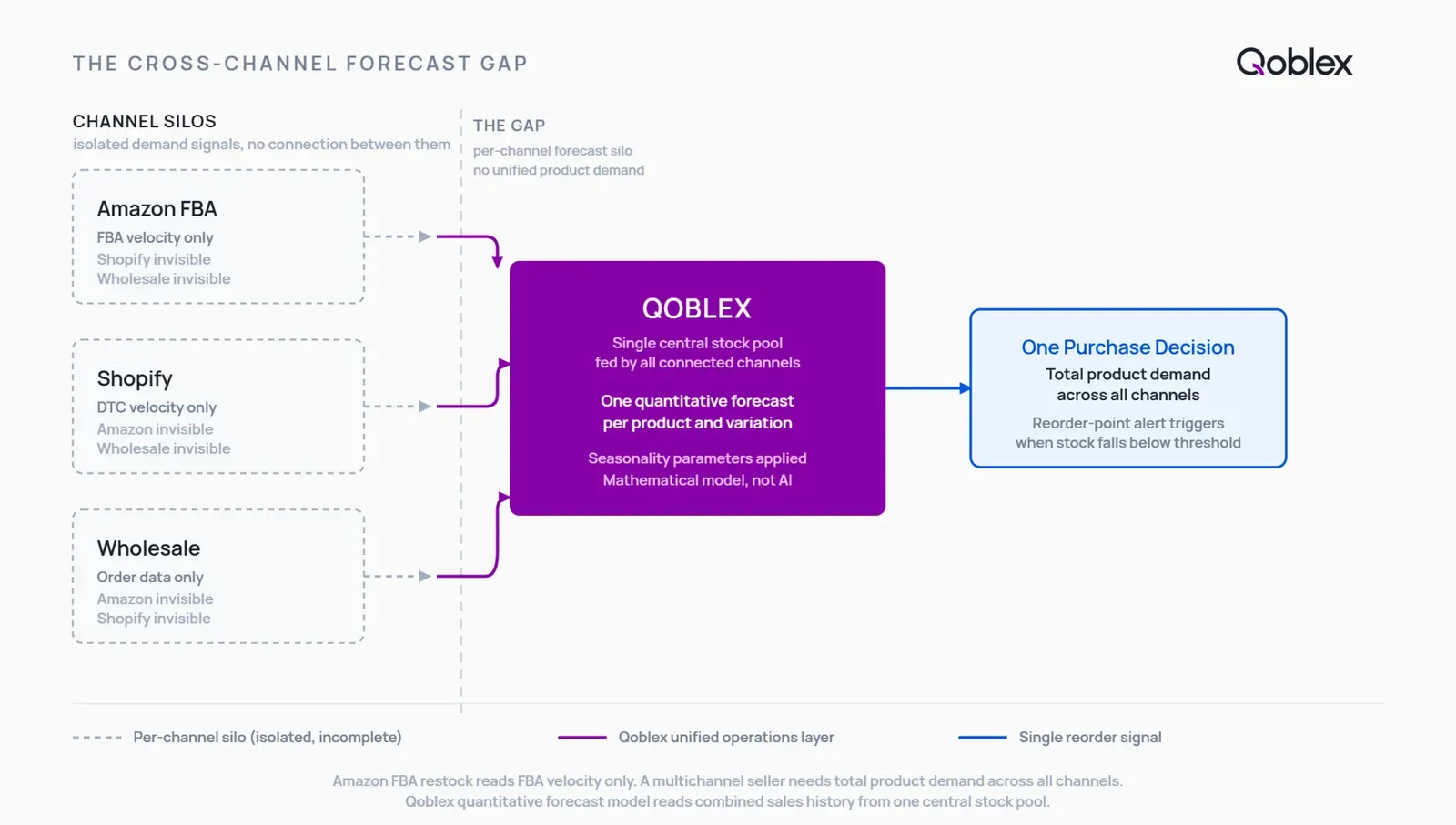
The mechanics come down to three moves: one stock record, one forecast, one reorder signal.
According to SKU Compass’s multi-channel inventory forecasting guide, most tools claiming “multi-channel” forecasting operate at Level 1 (separate per-channel forecasts); only a subset deliver Level 2 (one unified forecast per product with cross-channel allocation). That distinction is exactly what makes the difference at the purchasing step.
Quantitative forecasting: what it is and how it works
A quantitative demand forecast uses math, not opinion. A procedure looks back over a defined window of past sales, the lookback window, and fits a model to that history to project what demand will do next. Feed it a combined, cross-channel sales history and the projection reflects the whole product. Feed it one channel’s history and it can only ever describe that channel.
This is worth saying plainly because the category is thick with “AI” labels: a solid quantitative forecast is a statistical model reading real sales data, not a black box. You can reason about what it is doing.
How seasonality parameters improve forecast accuracy
Recent velocity alone is a weak basis for a seasonal product. If you sell garden furniture, last month’s numbers tell you almost nothing about what June looks like. A forecast that carries seasonality parameters lets you say “predict this summer from last summer” instead of extrapolating from a quiet spring. For products with a repeating annual pattern, that single adjustment is often the difference between a useful number and a misleading one.
From forecast to reorder: closing the purchasing loop
A forecast is only useful if it changes what you buy. The forecast informs your reorder points: the thresholds that, when stock falls below them, tell you it is time to act. From there the demand number and current stock position feed a purchasing decision and a supplier PO. The forecast does not place the order for you, it gives you the quantity to place. That is the loop: from combined history to a purchase order you can actually stand behind.
How Qoblex forecasts demand across channels
Now the tool. Qoblex includes a demand forecasting module built on a quantitative technique, not AI or machine learning. Its own description is precise: a mathematical procedure looks at a predefined number of past sales days and fits a mathematical model, which is then used to forecast future demand. It forecasts per product and per product variation, and it carries seasonality parameters.
Here is the honest connection to the cross-channel problem. Qoblex holds your inventory in a single central stock pool, fed by all of your connected channels. Because that stock record is shared across channels, the sales history the forecast reads reflects activity from all the channels feeding it, not one silo.
Does Qoblex forecast per product variation?
Yes. The forecast runs per product and per variation. That matters for multichannel sellers with size and color SKUs: the medium-black tee and the XL-white tee do not sell at the same rate, and a forecast that lumps them together buys the wrong mix. Variation-level forecasting keeps the buying decision at the resolution the demand actually has.
How does Qoblex handle seasonality and lookback parameters?
As on the module page, you can base a forecast on the equivalent period from a prior year rather than only the most recent window. If you want this summer’s plan built from last summer’s sales, you set that, instead of letting a slow spring drag the number down.
The forecast feeds reorder alerts, not automatic orders
Be clear on this so expectations match reality. Qoblex fires reorder-point alerts when stock falls below the threshold you set. It does not silently auto-create purchase orders. The alert tells you to act; you review the forecast, then raise the order through purchase order management. The decision stays with you, informed by a number built from all your channels.
Demand forecasting is a paid capability, not necessarily part of every plan. Base inventory management, reorder-point alerts, and purchase orders are available more broadly. For what sits on which plan, see qoblex.com/pricing.
How does cross-channel forecasting compare to Amazon FBA native restock?
| Capability | Amazon FBA Restock (Seller Central native) | Cross-channel demand forecasting (e.g. Qoblex) |
|---|---|---|
| Channel data read | Amazon FBA sales only | All connected channels (via single stock pool) |
| Forecast unit | Per FBA SKU | Per product across all channels |
| Variation-level forecasting | SKU-level, not variation-specific | Per product and per variation |
| Forecast method | Undisclosed proprietary algorithm | Quantitative/mathematical model |
| Seasonality handling | Not confirmed (no current sourced claim) | Yes, seasonality parameters included |
| Integrates Shopify demand | No | Yes (via connected channel sync) |
| Reorder signal type | FBA capacity-based restock recommendation | Reorder-point alerts informed by forecast |
| Plan availability | Included in Seller Central (no add-on cost) | Paid capability, not necessarily part of every plan |
When do you not need cross-channel forecasting software yet?
Not every seller needs this, and it is worth being straight about when you do not.
You sell on one channel only. If all your demand is on Amazon FBA and there is no Shopify, no WooCommerce, no wholesale, Amazon’s native restock signals are the right tool. They are built for exactly that. A cross-channel layer would add complexity for no return.
Your demand is stable and low-variation. A handful of SKUs with steady, predictable sales and no seasonal swings may not need a mathematical forecast at all. A plain reorder-point alert (“tell me when this drops below 50 units”) can carry you, and it is simpler and cheaper. Qoblex’s reorder-point alerts handle that at the base operations layer without the forecasting module.
You are early and still testing channels. If you just launched a second channel and volume is low enough that the right reorder quantity is obvious from a glance at recent sales, a formal forecasting tool is premature. Set reorder-point alerts and revisit when eyeballing it stops being reliable.
The signal that it is time: you are actively selling on two or more channels, you have already made at least one buying decision that went wrong because a channel you were not watching moved differently, and you have enough SKUs that keeping the math in your head no longer holds. That is the point where one forecast across every channel earns its place.
FAQ
What is multichannel demand forecasting?
Multichannel demand forecasting builds one demand picture per product by reading sales history across all your connected channels: Amazon, Shopify, and wholesale together, rather than forecasting each channel in isolation. The output is a single reorder signal based on total product demand, which is the correct input for a purchase order when you sell across multiple channels.
What is the difference between multichannel demand forecasting and single-channel forecasting?
Single-channel forecasting, like Amazon’s native FBA restock recommendations, reads demand from one channel only. A multichannel forecast reads all channel history for the same product and produces one demand total. For a seller on Amazon and Shopify, a single-channel forecast misses demand from the channel it does not read, so reorder quantities are wrong unless the two channels happen to behave identically.
Does Amazon Seller Central support multichannel demand forecasting?
No. Amazon’s native restock recommendations and forecasted demand signals in Seller Central read only FBA sales velocity and FBA capacity. They do not factor in demand from Shopify, WooCommerce, or other channels. For a seller active on multiple channels, Amazon’s native signals are a partial input, not a complete demand forecast.
What is cross-channel demand forecasting software?
Cross-channel demand forecasting software reads sales history from all your connected sales channels, computes one demand forecast per product, and translates that into reorder guidance. It sits as the operations layer above your storefronts and your accounting system, holding the single stock record all channels draw from.
Does Qoblex offer demand forecasting?
Yes. Qoblex includes a demand forecasting module that uses a quantitative (mathematical or statistical) model: a mathematical procedure reads a predefined number of past sales days and fits a model to forecast future demand, including seasonality parameters. It forecasts per product and per product variation. Demand forecasting is a paid capability, not necessarily part of every plan. See qoblex.com/pricing for plan detail.
Does Qoblex use AI for demand forecasting?
No. Qoblex’s demand forecasting uses a quantitative, mathematical technique, not AI or machine learning. The system applies a statistical model to historical sales data to project future demand. Qoblex describes it at qoblex.com/reporting as a “quantitative technique” and “mathematical procedure,” not an AI engine.
How does Qoblex demand forecasting handle seasonality?
Qoblex’s forecast module includes seasonality parameters. You can configure it to predict demand for a specific season by basing the forecast on the equivalent period from the prior year, rather than only the most recent sales velocity. This makes the forecast more accurate for products with predictable seasonal patterns.
Is demand forecasting included in all Qoblex plans?
No. Demand forecasting is a paid capability in Qoblex, not necessarily part of every plan. Base inventory management, reorder-point alerts, and purchase order management are available more broadly. See qoblex.com/pricing for current plan detail.