


Bundling strategies drive 10-30% of eCommerce revenue for businesses that implement them well. You likely have products that sell together naturally. Your order data shows the same items appearing in the same carts repeatedly. Yet turning that insight into actual bundled offers feels complicated once you factor in inventory tracking, pricing, and keeping everything synced across your sales channels.
Most product bundling guides stop at the marketing strategy. They explain why to bundle but gloss over how to actually manage bundles without creating inventory nightmares. This guide takes a different approach.
Here, you will learn exactly what product bundling is, explore seven bundle types with real product bundle examples, and follow a practical five-step process for how to bundle products that boost your average order value while keeping your inventory accurate. We will also cover the operational side that other guides miss: managing component-level stock, preventing oversells, and forecasting demand for bundled products.
Whether you sell on Shopify, WooCommerce, Amazon, or your own B2B wholesale portal, this guide gives you the complete picture.
What Is Product Bundling?
Product bundling is a sales and marketing strategy where multiple products are grouped together and sold as a single combined offering, typically at a price lower than purchasing each item separately.
Think of it as creating a “value pack” that gives customers a convenient way to buy related items while encouraging them to spend more per transaction. The product bundling strategy works across industries: software companies offering suite packages, cosmetics brands selling skincare sets, and wholesalers creating starter kits for retail buyers all use this approach.
Product bundling differs from simple discounting because the value comes from the combination itself, not just the lower price. Customers perceive bundles as curated solutions rather than random markdowns.
How Product Bundling Works in Practice
At its core, eCommerce bundling connects three elements: the products you group together, the pricing strategy you apply, and the inventory system that tracks everything behind the scenes.
When a customer purchases a bundle, your system needs to accomplish several tasks simultaneously. It must deduct the correct quantities of each component product from your available stock. It must update inventory counts across every sales channel where those products appear. And it must maintain accurate cost tracking for margin analysis.
For example, if you sell a “Coffee Lover’s Kit” containing a French press, a bag of beans, and a travel mug, each sale must reduce inventory for all three SKUs. If the French press runs out, the bundle becomes unavailable even though the beans and mug remain in stock.
This component-level complexity is why eCommerce bundling requires more than marketing creativity. It demands operational precision.
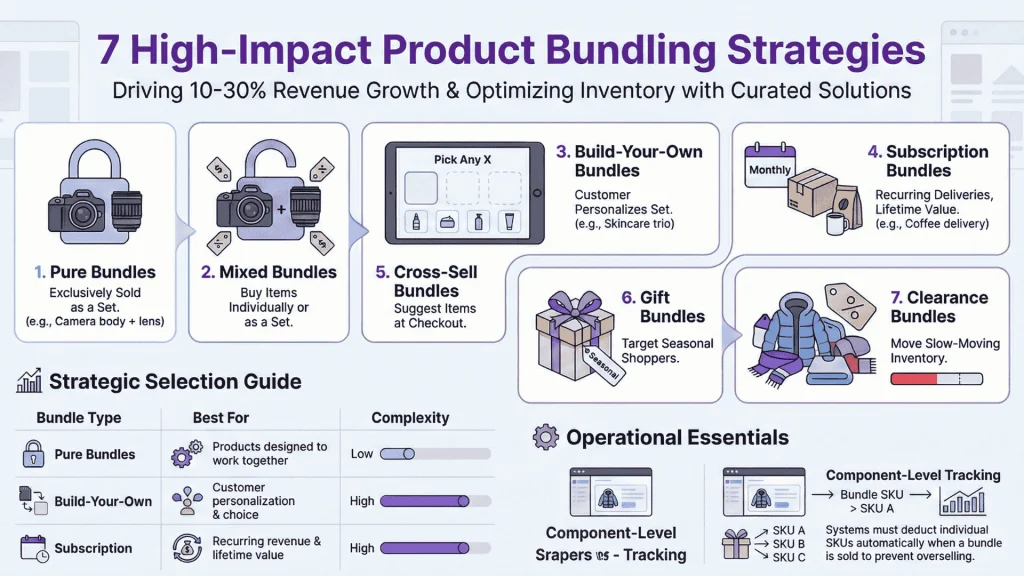
7 Types of Product Bundles (With Examples)
Not all bundles work the same way. The type you choose depends on your products, your customers, and your operational capacity to manage the bundle over time.
| Bundle Type | Best For | Complexity | Example |
| Pure Bundles | Products designed to work together | Low | Camera body + lens + memory card sold only as a set |
| Mixed Bundles | Flexible purchasing options | Medium | Skincare trio available as bundle or individual items |
| Cross-Sell Bundles | Increasing AOV at checkout | Medium | Phone case suggested when buying a smartphone |
| Build-Your-Own | Customer personalization | High | Choose any 5 protein bars from 12 flavors |
| Subscription Bundles | Recurring revenue | High | Monthly coffee delivery with rotating selections |
| Gift Set Bundles | Seasonal and occasion sales | Low | Holiday spa set with candle, lotion, and bath bombs |
| Clearance Bundles | Moving slow inventory | Low | End-of-season bundle pairing popular item with dead stock |
Pure Bundles
Pure bundles contain products sold exclusively as a set. Customers cannot purchase the individual components separately. This approach works best when the products genuinely complement each other and create more value together than apart.
A cookware brand might offer a “Starter Kitchen Set” with a skillet, saucepan, and utensil set available only as a bundle. The customer gets everything needed to begin cooking, and the brand controls the product experience.
The operational advantage of pure bundles is simplicity. You create a single SKU for the bundle and track it as one unit. However, you lose flexibility if customers want just one item from the set.
Mixed Bundles
Mixed bundles give customers a choice. They can buy the bundle at a discounted rate or purchase items individually at regular prices. This flexibility often converts hesitant buyers who want one specific product but might upgrade to the bundle when they see the savings.
A supplement company could sell a protein powder, shaker bottle, and sample pack as a $45 bundle while also offering each item separately at $25, $15, and $12 respectively. The bundle saves the customer $7 and increases the seller’s average order value.
For B2B wholesalers, mixed bundling works particularly well for starter kits. Retail buyers can purchase a curated assortment to test a new product line while retaining the option to reorder individual bestsellers.
Managing mixed bundles requires careful inventory tracking since the same products exist both independently and as bundle components.
Cross-Sell Bundles
Cross-sell bundling suggests complementary products at the point of purchase. Unlike pre-packaged bundles, these recommendations appear dynamically based on what the customer already intends to buy.
When someone adds running shoes to their cart, showing them moisture-wicking socks and insoles as a “Complete Your Run” bundle captures additional revenue from a customer already in buying mode.
The challenge with cross-sell bundles lies in the technology. Your eCommerce platform or inventory system must recognize product relationships and present relevant suggestions without overwhelming the checkout experience.
Build-Your-Own Bundles
Build-your-own bundles let customers create personalized combinations from a curated selection. This approach works particularly well for consumable products where taste preferences vary.
A tea company might offer “Pick Any 6” from their collection of 20 loose-leaf varieties. Customers feel empowered by the choice, and the business moves inventory across their entire catalog rather than just bestsellers.
From an inventory perspective, build-your-own bundles are the most complex. Every possible combination affects multiple SKUs, and your system must prevent customers from selecting out-of-stock items mid-configuration.
Subscription Bundles
Subscription bundles combine the product bundling strategy with recurring delivery. Customers sign up to receive a curated set of products at regular intervals, typically monthly or quarterly.
A pet supply company could offer a “Monthly Pup Box” with treats, toys, and grooming supplies delivered every four weeks. The predictable revenue helps with cash flow planning, and the recurring nature builds customer lifetime value.
Subscription bundles require sophisticated inventory forecasting since you are committing to future deliveries based on current stock projections.
Gift Set Bundles
Gift bundles package products around occasions or themes, making them easy choices for shoppers who want a complete present without assembling pieces themselves.
During the holiday season, a skincare brand might offer a “Winter Glow Set” with cleanser, serum, and moisturizer in festive packaging. The gift-ready presentation justifies a premium price while simplifying the buying decision.
Gift bundles often have seasonal demand spikes. Inventory planning must account for concentrated sales windows rather than steady year-round movement.
Clearance Bundles
Clearance bundles pair slow-moving inventory with popular products to move stagnant stock without deep discounting. Instead of marking down an unpopular item by 50%, you bundle it with a bestseller at a modest combined discount.
A fashion retailer might bundle last season’s scarves with current-season sweaters. Customers perceive they are getting a bonus item, and the business clears warehouse space while maintaining healthier margins than a pure clearance sale.
The key is ensuring the slow-moving item genuinely complements the popular one. Forced pairings feel like a trick and damage customer trust.
Benefits of Product Bundling for Growing Businesses
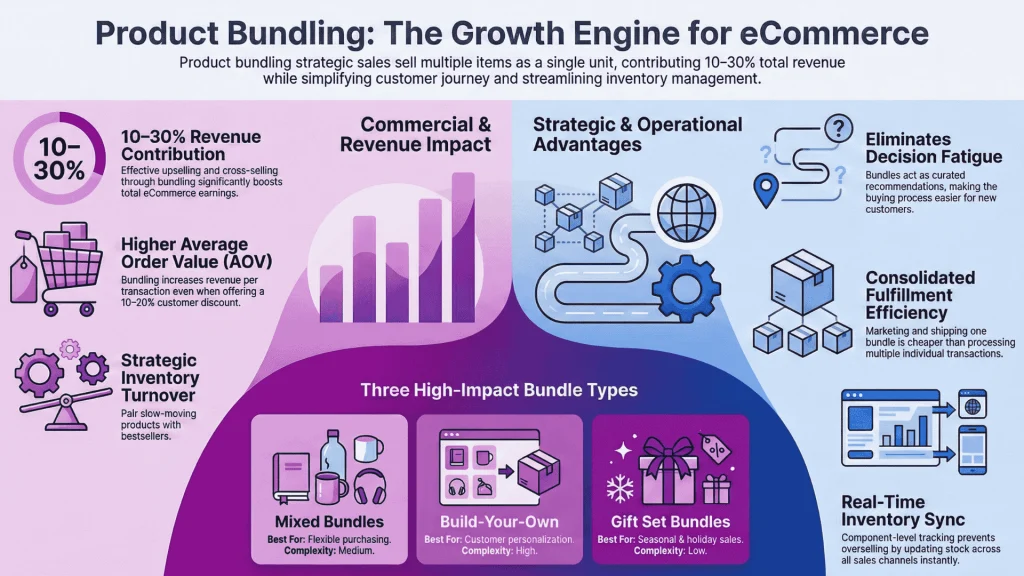
Product bundling delivers measurable advantages when executed properly. According to Forrester research, upselling and cross-selling strategies, including bundling, contribute 10-30% of eCommerce revenues for many businesses.
Increase Average Order Value
The most immediate benefit of bundling is higher transaction values. When customers buy multiple products in a single purchase, your revenue per order increases even if you offer a bundle discount.
Consider the math: selling a $30 product individually generates $30 in revenue. Bundling that product with two $15 items and offering a 10% discount creates a $54 transaction instead. Your margin percentage drops slightly, but total profit per customer increases.
This AOV lifts compounds over time. Higher order values mean better return on your customer acquisition costs, since each converted visitor generates more revenue.
Move Slow-Moving Inventory
Every business accumulates products that do not sell as expected. Rather than slashing prices and training customers to wait for discounts, bundling strategically moves stagnant inventory while maintaining perceived value.
By pairing slow movers with popular items, you give customers a reason to try products they might have overlooked. Some discover new favorites, leading to future individual purchases of what was once dead stock.
The inventory management benefit here is significant. Reducing slow-moving stock frees up warehouse space, lowers carrying costs, and improves your overall inventory turnover ratio.
Simplify Purchasing Decisions for Customers
Decision fatigue costs you sales. When customers face too many choices without clear guidance, they often leave without buying anything.
Bundles act as curated recommendations. Instead of asking customers to evaluate every possible combination, you present a pre-selected solution. “Everything you need to start brewing pour-over coffee” is easier to buy than navigating between 15 individual products.
This simplification particularly benefits new customers who lack the expertise to know what they need. A beginner photographer trusts the “Essential Portrait Kit” more than their own ability to choose the right lens and lighting equipment separately.
Reduce Marketing and Fulfillment Costs
Promoting one bundle is more efficient than marketing three individual products. Your advertising spend, email campaigns, and content creation efforts consolidate around a single offer rather than fragmenting across multiple SKUs.
Fulfillment efficiency improves as well. Picking, packing, and shipping one bundled order costs less than processing three separate transactions, even if the total product weight is identical. You also reduce packaging materials when items ship together.
For businesses managing multi-warehouse inventory, bundles can be pre-assembled at your distribution center, further streamlining the pick-and-pack process.
How to Create Profitable Product Bundles (5-Step Process)
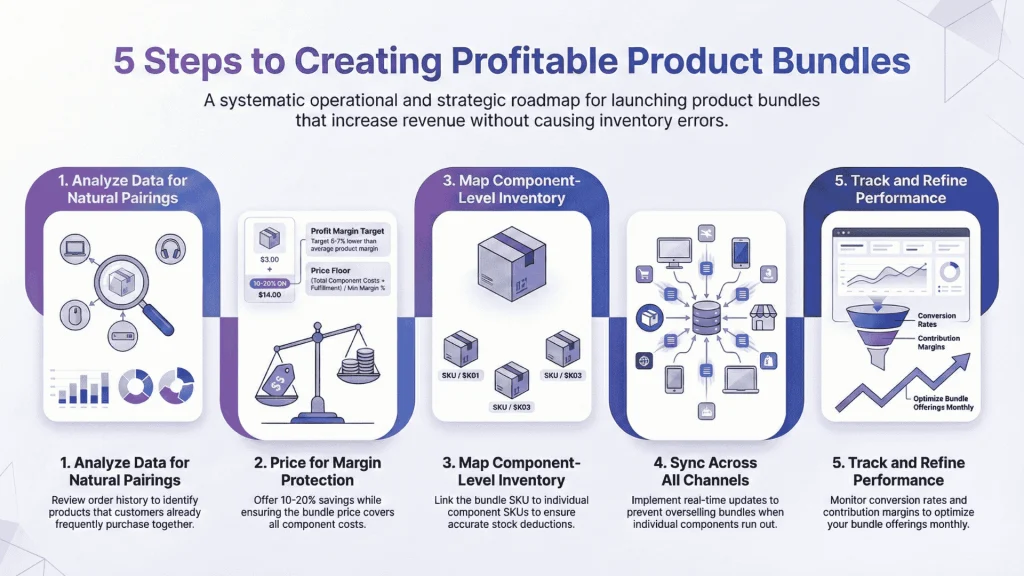
Understanding how to bundle products effectively requires a systematic approach. Follow these five steps to create bundles that perform well both commercially and operationally.
Analyze Sales Data to Find Natural Pairings
Start with what your customers already tell you through their purchasing behavior. Your sales data reveals which products frequently appear in the same orders, even without any bundling incentive.
Review your order history for product combinations that occur more often than random chance would suggest. If 40% of customers who buy your yoga mat also purchase a carrying strap, that pairing has proven demand.
Look beyond obvious complements. Sometimes data reveals unexpected connections, like customers who buy kitchen knives frequently also buying cutting boards from a specific material. These insights fuel bundle ideas that competitors miss.
Pro Tip: Examine not just what customers buy together, but when they buy. Products purchased within the same session indicate strong associations. Products bought weeks apart may indicate a replenishment pattern better suited for subscription bundles.
Calculate Bundle Pricing for Margin Protection
Your bundle pricing strategy requires balancing customer appeal with profitability. The discount must feel meaningful to buyers without eroding your margins below sustainable levels.
Start by calculating the total cost of goods for all bundle components, including landed costs if you import products. Then determine your minimum acceptable margin—typically not lower than your average margin minus 5-10 percentage points.
Example Bundle Pricing Calculation:
| Item | Individual Price | Cost | Margin |
| Product A | $40 | $16 | 60% |
| Product B | $25 | $10 | 60% |
| Product C | $15 | $6 | 60% |
| Individual Total | $80 | $32 | 60% |
| Bundle Price | $68 | $32 | 53% |
| Customer Savings | $12 (15%) | — | — |
In this example, a 15% customer discount reduces your margin by 7 percentage points. That trade-off works if the bundle significantly increases conversion rates or order frequency.
Set Up Bundles in Your Inventory System
Creating bundles in your product catalog requires the right inventory management infrastructure. Your system must understand that a bundle is composed of component products and track stock accordingly.
Look for software that supports composite variants or pack sizes—features that let you define bundles as combinations of existing SKUs. When configured correctly, selling one bundle unit automatically deducts the appropriate quantity of each component SKU from your available inventory.
Key configuration considerations:
- Component mapping: Link each bundle to its constituent products with correct quantities
- Cost rollup: Ensure the bundle’s cost of goods reflects all component costs plus any assembly labor
- Reorder points: Set alerts based on the component with the lowest stock relative to bundle demand
- Location assignment: Specify which warehouse holds assembled bundles versus individual components
Without proper system configuration, you risk selling bundles you cannot fulfill because a single component ran out while the bundle appeared available.
Sync Bundle Inventory Across Sales Channels
If you sell on multiple platforms, bundle inventory management becomes exponentially more complex. A sale on your Shopify store must instantly update availability on Amazon, your wholesale portal, and any other channel listing those products.
Real-time inventory sync prevents the nightmare scenario: selling the last unit of a bundle component on one channel while another channel simultaneously accepts an order for a bundle containing that component.
Pro Tip: Build buffer stock into your available inventory calculations when selling bundles across channels. If your warehouse shows 10 units of a component, listing 8 as available across all channels provides a cushion against sync delays.
Evaluate your inventory management software’s integration capabilities before launching bundles on multiple channels. Native integrations with Shopify, WooCommerce, and Amazon reduce sync delays and technical complexity compared to manual updates or disconnected systems.
Track Bundle Performance and Optimize
Launching a bundle is the beginning, not the end. Monitor performance metrics to understand what works and refine your approach over time.
Essential bundle metrics to track:
- Conversion rate: What percentage of visitors who view the bundle proceed to purchase?
- Contribution margin: After accounting for the discount, how much profit does each bundle sale generate?
- Component cannibalization: Are bundle sales replacing individual product sales, or generating incremental revenue?
- Inventory velocity: How quickly do bundle components move compared to their standalone sales rate?
Review these metrics monthly and adjust bundle composition or pricing based on results. A bundle with strong conversion but weak margins might need repricing. A bundle with great margins but low conversion might need better positioning or different product combinations.
Product Bundling and Inventory Management: What Most Guides Miss
Marketing-focused bundling guides often skip the operational realities that determine whether your bundles succeed or create fulfillment chaos. Here is what you need to know about the inventory side.
Managing Component-Level Stock for Bundles
Every bundle exists as both a sellable unit and a collection of individual SKUs. Your inventory system must track both perspectives simultaneously.
When a customer orders a bundle, the system needs to:
- Check availability of every component across relevant warehouse locations
- Reserve those components to prevent other orders from claiming them
- Deduct quantities from both the bundle and individual product stock counts
- Update availability across all connected sales channels
If your system only tracks bundles as standalone SKUs without component linkage, you will eventually sell bundles you cannot ship because you lack visibility into what actually comprises them.
Modern inventory management platforms handle this through composite variants or bill of materials (BOM) functionality. Composite variants let you define a bundle as a combination of different product variants sold as a single unit. Pack sizes handle scenarios where you sell multiples of the same item as one SKU. Both features ensure that bundle sales automatically cascade stock deductions to the underlying components.
Preventing Overselling Across Channels
Overselling happens when you accept orders for more inventory than you actually have. With bundles, overselling risk multiplies because the same components might appear in multiple bundles and as individual products across several sales channels.
Imagine you have 50 units of Product A. It sells individually, appears in Bundle X (which requires 2 units of A), and appears in Bundle Y (which requires 1 unit of A). Without coordinated inventory management, three different listings compete for the same 50 units without awareness of each other.
Preventing oversells requires:
- Centralized inventory truth: One system maintains accurate stock counts that all channels reference
- Real-time sync: Changes propagate within seconds, not hours
- Safety stock buffers: Deliberately list less than your actual available quantity
- Automatic disabling: Bundles become unavailable when any component drops below minimum threshold
The cost of an oversell—customer disappointment, refund processing, potential platform penalties, and reputation damage—exceeds the cost of occasionally showing bundles as unavailable when you could technically fulfill one more order.
Forecasting Demand for Bundled Products
Standard demand forecasting examines historical sales of individual products. Bundle forecasting adds complexity because you must predict not just bundle sales but how those sales interact with individual product demand.
If you forecast needing 200 units of Product B next month, and 30% of Product B sales typically come through bundles, you need to factor in several questions. Will you maintain current bundle offerings, or launch new ones containing Product B? Has any marketing activity changed the bundle-to-individual ratio? Are bundle components ordered from the same suppliers with the same lead times?
The most practical approach is forecasting at the component level first, then validating that your projected bundle sales fit within those component forecasts. If you expect to sell 100 bundles containing Product B, your component forecast for B must include at least 100 units allocated to bundle fulfillment.
Common Product Bundling Mistakes to Avoid
Even well-intentioned bundling strategies fail when businesses overlook these common pitfalls.
Ignoring Inventory Availability
Creating bundles without confirming component availability leads to frustrated customers and operational scrambling. Before launching any bundle, verify that you have sufficient stock of every component and that your replenishment pipeline can sustain ongoing bundle sales.
Warning: Never launch a bundle during a promotional campaign if any component is within 30 days of stocking out. The demand spike from promotion combined with the time required to reorder and receive inventory creates a high risk of overselling.
Also consider seasonal variations. A bundle that works well during slow months might deplete inventory too quickly during peak season if you have not adjusted reorder quantities.
Mispricing Bundles Below Profitable Margins
The temptation to offer aggressive bundle discounts can destroy profitability. A 20% discount that generates 50% more orders sounds great until you realize your margins no longer cover operating costs.
Before finalizing bundle pricing, calculate the minimum price that maintains acceptable profitability:
- Sum the cost of goods for all components
- Add any assembly or special packaging costs
- Add your per-order fulfillment cost allocation
- Divide by your minimum acceptable margin percentage to find your price floor
If the resulting price floor does not leave room for a discount that customers will notice, either reduce component costs or reconsider whether that particular bundle makes financial sense.
Creating Bundles Without Customer Data
Intuition about what products “should” go together often differs from what customers actually want. Bundles based purely on logic rather than data frequently underperform.
A classic mistake is bundling products that logically connect but appeal to different customer segments. A professional-grade camera lens bundled with a beginner’s instructional book targets two audiences with different needs—neither finds the combination compelling.
Always validate bundle concepts against purchase data before investing in marketing materials or pre-assembled inventory. If products rarely appear in the same customer orders, the bundle faces an uphill battle regardless of how sensible the pairing seems.
Frequently Asked Questions
What is an example of a product bundle?
A common product bundle example is a skincare set containing cleanser, toner, and moisturizer sold together at a lower price than buying each item separately. Fast food combo meals, software suites like Microsoft Office, and gaming console packages with extra controllers are all everyday bundle examples that consumers encounter.
Is product bundling the same as cross-selling?
Product bundling and cross-selling are related but distinct strategies. Bundling combines multiple products into a single SKU sold as one unit. Cross-selling recommends additional products at checkout while keeping each item as a separate purchase. Bundles are predetermined packages; cross-sells are dynamic suggestions based on what the customer already intends to buy.
How do you price a product bundle?
Price a product bundle by first calculating the total cost of all component products, then determining your target margin for the bundle. Most successful bundles offer customers 10-20% savings compared to individual purchases while maintaining a margin at least 5-7 percentage points lower than your average product margin. Test pricing with small customer segments before full rollout.
What software do I need for product bundling?
Effective product bundling requires inventory management software that supports composite products or kit assembly. Your system must link bundles to component SKUs, automatically adjust stock levels when bundles sell, and sync availability across all sales channels in real time. Many eCommerce platforms offer basic bundling apps, but businesses with complex inventory often need dedicated inventory management solutions that offer composite variants and pack sizes functionality.
Start Bundling Smarter, Not Harder
Product bundling offers a proven path to higher average order values, faster inventory turnover, and simplified customer purchasing decisions. The strategy works across industries, business sizes, and sales channels.
But successful bundling requires more than grouping products and applying a discount. You need clear insight into what your customers actually buy together, pricing that protects your margins while delivering genuine value, and inventory systems capable of managing component-level stock across your entire operation.
Here is how to get started:
- This week: Pull your sales data and identify two or three natural product pairings that already appear frequently in customer orders.
- Next week: Calculate pricing that offers meaningful savings without sacrificing profitability using the margin protection formula above.
- Within 30 days: Configure your inventory management system to track bundle components and sync availability across channels.
Then launch, measure, and refine.
The businesses that treat bundling as an ongoing operational discipline—not a one-time marketing tactic—are the ones that capture lasting benefits. With the right approach and the right systems supporting you, product bundling becomes a reliable engine for growth rather than a source of inventory headaches.
How Qoblex Makes Product Bundling Simple (and Keeps Your Inventory Accurate)
Most businesses understand the revenue potential of bundling. The hard part is managing bundles operationally—especially when you sell across multiple channels with hundreds of SKUs. Spreadsheets break down fast, and basic eCommerce tools were never designed to handle the component-level tracking that bundles demand.
Qoblex was built to solve exactly this kind of complexity. Here is how the platform handles every operational challenge we have covered in this guide, so you can focus on creating bundles that sell rather than wrestling with inventory errors.
Composite Variants and Pack Sizes: Bundles Built Into Your Catalog
Qoblex supports two purpose-built features for bundling: Composite Variants and Pack Sizes.
Composite Variants let you combine different product variants into a single sellable unit. When you create a “Coffee Lover’s Kit” with a French press, a bag of beans, and a travel mug, Qoblex treats the bundle as one item in your catalog while maintaining full visibility into its individual components. Each time a bundle sells, stock for every component updates automatically across your entire operation.
Pack Sizes handle a different bundling scenario: selling multiples of the same product as one unit. If you offer a 6-pack of your bestselling protein bars or a case of 12 candles for wholesale buyers, Pack Sizes track the relationship between the individual item and its grouped version. No manual math, no stock discrepancies.
Both features connect directly to your inventory counts, purchase orders, and sales channels, so the operational backbone of your bundles stays accurate from day one.
Real-Time Multichannel Sync: No More Overselling
The biggest risk with bundles is overselling a component that appears across multiple listings. Qoblex eliminates this by syncing inventory in real time with your connected sales channels—whether you sell on Shopify, WooCommerce, Amazon, or your own B2B wholesale portal.
When a customer purchases a bundle on your Shopify store, Qoblex instantly deducts each component’s stock and pushes updated availability to every other channel. If a component runs low, the bundle listing reflects that change before another platform can accept an order you cannot fulfill.
For businesses running multichannel operations, this real-time sync is the difference between smooth fulfillment and a wave of customer service tickets.
Multi-Warehouse Support: Bundles Across Locations
If you store inventory in multiple warehouses or use consignment locations, Qoblex tracks component availability at each location independently. You can see exactly how many bundles you could assemble from Warehouse A versus Warehouse B, transfer stock between locations to balance bundle capacity, and assign specific fulfillment locations to incoming orders.
This location-level granularity means your bundle availability reflects what you can actually ship, not just a total count sitting somewhere in your supply chain.
Low Stock Alerts and Demand Forecasting: Stay Ahead of Bundle Demand
Running out of a single component disables an entire bundle. Qoblex helps you avoid this with low stock alerts tied to each product variant, including those that serve as bundle components. Set your reorder points once, and the system notifies you before any component drops below the threshold you need to keep bundles available.
Qoblex’s demand forecasting goes further. The platform analyzes your sales patterns to predict how many units you will likely need, helping you place smarter purchase orders that account for both individual product demand and bundle-driven consumption. No more guessing how many extra units of Product B to order because it appears in three different bundles.
Bills of Materials for Assembled Bundles
Some bundles require actual assembly—combining raw materials or components into a finished product before shipping. Qoblex’s manufacturing module handles this through Bills of Materials (BOM), letting you define exactly what goes into each assembled bundle, including additional costs like labor and packaging.
When you create a Production Order for a batch of gift sets, Qoblex tracks the start-state components and end-state finished goods, alerts you if stock is insufficient to complete the run, and automatically reconciles production efficiency with your accounting system. Wastage is tracked, unused stock gets recommitted to inventory, and your costs stay accurate.
Accounting Integration: Bundle Margins You Can Trust
Accurate bundle pricing depends on knowing your true costs. Qoblex calculates Moving Average Costs (MAC) that factor in purchase prices and landed costs—shipping, duties, and fees included—even across multi-currency transactions.
When you sync Qoblex with Xero or QuickBooks, every bundle sale flows through to your accounting system with correct cost of goods sold, revenue allocation, and margin data. No manual journal entries, no spreadsheet reconciliation. You see exactly what each bundle earns after all costs are accounted for.
Reporting That Reveals Bundle Performance
Qoblex’s reporting suite lets you evaluate bundle success from multiple angles. Track bundle sales by product, by channel, by customer, or by time period. Compare how bundle revenue stacks up against individual product sales to detect cannibalization. Sort your top products by profit margin to see whether your bundles are pulling their weight.
The Low Stock Report and Incoming Stock Report work together to give you a forward-looking view: what needs reordering now, what is already on the way, and how your current stock supports upcoming bundle demand.
From Strategy to Execution in One Platform
The gap between a smart bundling strategy and a well-run bundling operation is inventory management. Qoblex closes that gap by giving you the tools to create bundles, track their components, sync availability across channels, forecast demand, and measure results—all from a single platform that connects to the sales channels and accounting tools you already use.
Ready to start bundling with confidence? Try Qoblex free for 14 days and see how inventory management built for bundles changes the way you sell.