



A guide written from an operator’s point of view: what the expiry date on your label actually commits you to, and where the day-to-day tracking gap really sits.
You printed “Best by 08/2027” on the bottle, the retailer wants at least a year of that remaining when the pallet lands, and somewhere on a shared drive there is a stability report and a Certificate of Analysis that prove the date is real. On a good day, all of that lines up. On a bad day, someone ships a lot that expires in four months to a buyer who rejects it, and nobody can find the COA for the batch that just got flagged.
That is the actual problem for most supplement brands. It is rarely the science. The lab did its job. The gap is operational: the expiry date and the documents that back it up live on paper and in email, not against the lot in the system that decides what ships. This page is a spoke of our broader guide to supplement and nutraceutical inventory software, and it goes deep on one decision most vendor pages skip or get wrong: whether you even have to date the product, and what changes the moment you do.
Under 21 CFR Part 111, dietary supplement expiration dating is voluntary, but any date placed on a label must be substantiated by stability data showing the product meets its label claims through that date. Inventory software closes the operational gap: it records the lot expiry date at receipt, surfaces near-expiring stock at pick time, and keeps the supporting COA or stability document attached to the lot record and retrievable on demand.
Is an expiration date required on a dietary supplement label?
Short answer: no. This surprises people, because it is the opposite of how prescription and over-the-counter drugs work.
What 21 CFR Part 111 actually says about shelf-life dating
The cGMP rule for dietary supplements, 21 CFR Part 111, does not require you to put an expiration or shelf-life date on the product. The regulation treats dating as optional, and it says so in its own recordkeeping language. Under 21 CFR 111.605, you must keep written records “for 1 year past the shelf life date, if shelf life dating is used, or 2 years beyond the date of distribution of the last batch” if it is not. That phrase, “if shelf life dating is used,” only makes sense because dating is a choice, not a mandate.
Why the FDA declined to mandate expiry dating for dietary supplements
When the FDA finalized the Part 111 rule in 2007, it deliberately chose not to require expiration dating. The reason was practical, not permissive: validated analytical methods do not exist for every dietary ingredient category, and botanicals in particular are hard to test consistently over time. The agency laid this out in the final-rule preamble at 72 FR 34752, at page 34856, and industry summaries such as this Trust Transparency analysis of expiration dating responsibility trace the same conclusion. The FDA could not defensibly demand a date it had no reliable way to hold everyone to.
What changes once you put an expiration date on the label: the substantiation obligation
Here is the part that matters operationally. The moment you print a shelf-life date, you take on a substantiation obligation. The FDA’s stated position is that “any expiration date that you place on a product label should be supported by data,” per the same Trust Transparency summary. In plain terms: if you date it, you need evidence, usually stability testing, showing the product still meets its label claims through that date. And under the 111.605 clock above, you are then holding batch records for a year past every date you assign.
One contrast worth drawing once and then setting aside: pharmaceutical drug dating is a different world. Drugs must carry an expiration date, established through stability testing, under 21 CFR 211.137. That is Part 211, for drugs. It does not apply to dietary supplements, and conflating the two is a common way pages on this topic go wrong.
This page describes the regulatory context for dietary supplement expiration dating at an orientation level. Supplement businesses should confirm their specific obligations with the FDA and a qualified regulatory advisor.
What is potency dating and how does it relate to shelf life for supplements?
If dating is voluntary but must be backed by data, the natural question is where the date comes from. It comes from stability testing, and the goal is usually potency, not just safety.
How stability testing determines the expiry date: real-time vs accelerated studies
Stability testing observes how a product changes over time under defined storage conditions: active-ingredient potency, microbial limits, moisture, appearance, and packaging integrity. Real-time studies store the product at its recommended conditions and test at intervals such as 3, 6, 12, 18, and 24 months. Accelerated studies use elevated temperature and humidity to project a shelf life faster, as this supplement shelf-life primer from NutraCap describes. The resulting data is what an expiry date leans on.
What potency overage means and why it is a formulation decision, not a software function
“Potency dating” reflects when a product is expected to still deliver its labeled potency, not merely when it becomes unsafe. Because some ingredients degrade over time, manufacturers often build in a potency overage: they formulate in more of an active than the label claims, so the product still meets the claim at the end of shelf life. That overage is a formulation and laboratory decision, made before the product ever reaches your inventory system. Inventory software records the expiry date that results from this work. It does not calculate overage, run the tests, or decide the date. Keep that boundary clear when you evaluate tools, because some vendor pages blur it.
Why some ingredients degrade faster and what that means for lot management
Different ingredients set different clocks. Some vitamins and many botanicals degrade faster and drive shorter shelf lives; more stable actives allow longer ones. For lot management, the practical takeaway is simple: expiry dates vary by product and sometimes by batch, so the date has to travel with the lot, not with the SKU.
What does 21 CFR Part 111 require for recordkeeping once you use shelf-life dating?
Choosing to date turns on a retention clock. Two codified sections carry the same conditional structure.
The conditional recordkeeping rule: 111.605 and the “if shelf-life dating is used” language
The recordkeeping rule, 21 CFR 111.605, requires written records to be kept for one year past the shelf-life date if dating is used, or two years beyond distribution of the last batch if it is not.
Reserve sample retention: 111.465 and the same conditional structure
Reserve samples follow the same logic under 21 CFR 111.465: retained for one year past the shelf-life date when dating is used, or two years from the last batch’s distribution when it is not.
How long must records be kept when an expiry date is in use?
One year past the shelf-life date you assigned to each batch. The operational consequence is that your batch records and your expiry dates are now linked. You cannot confidently retire a record until you know the dated shelf life of the batch it belongs to. That is a data problem long before it is a compliance problem, and it is exactly why the expiry date needs to sit on the lot record itself. For the structure of the batch records those dates attach to, see our companion guide on GMP batch records and traceability for supplement manufacturers.
How do supplement operators track expiry dates by lot across warehouse locations?
This is where the spreadsheet that got you started starts to strain. A spreadsheet is fine at recording a date. It is poor at making that date change what ships, especially once you have multiple lots of the same SKU, more than one location, or a 3PL in the mix.
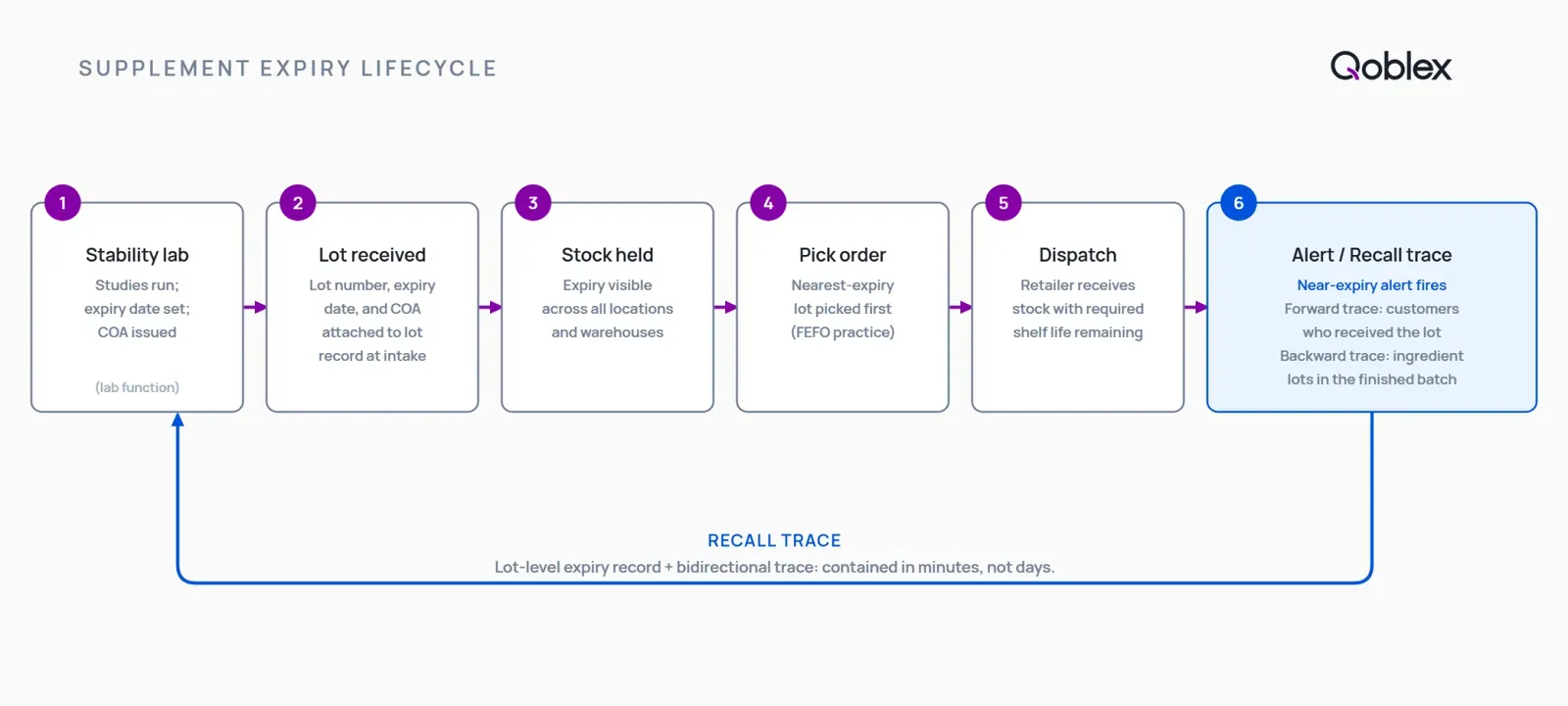
Record the date at receipt, at the lot level. The expiry date is a property of the lot, not the product. Two lots of the same SKU can expire months apart. Capturing the date when goods are received, against the specific lot, is the foundation everything else rests on.
Surface the nearest-expiring stock at pick time. This is FEFO in practice: First Expired, First Out. Instead of shipping whatever came in first, you ship whatever expires soonest, regardless of arrival order. For supplements this matters commercially as much as operationally. Industry guides note that a meaningful share of supplement inventory, on the order of 10 to 18 percent, gets written off to expiration, and that moving from arrival-order to expiry-order picking cuts that waste, per this supplement inventory management guide.
Meet the retailer’s shelf-life window. Retailers commonly require 12 to 18 months of remaining shelf life when they receive supplement stock, per the same inventory management guide. If you cannot see, at a glance, which lots still clear that bar, you find out at the receiving dock instead of in your own warehouse.
See expiry across every location. Once stock sits in more than one warehouse or at a 3PL, the date has to be visible everywhere, not trapped in one site’s notebook. Holding the lot expiry consistently across locations is the difference between rotating stock deliberately and discovering a short-dated pallet by accident. For the underlying discipline this depends on, see our lot control software guide.
Is your current setup handling supplement expiry tracking? A self-check
Use this table to identify the gaps before evaluating software.
| Capability | Why it matters for dated supplements |
|---|---|
| Records lot expiry date at receipt (lot-level, not just product-level) | Two lots of the same SKU can have different dates; product-level tracking misses the difference |
| Expiry date held and visible across all warehouse locations and 3PLs | Stock rotation and retailer compliance depend on a unified view, not per-site notebooks |
| Near-expiring lots surfaced at pick time (FEFO practice) | Reduces expired write-offs; meets retailer minimum remaining shelf-life requirements |
| COA and stability document attached to the lot record and retrievable on demand | Auditors, retail partners, and recall investigations ask for the COA by lot, not by product |
| Forward trace: which customers received a specific lot | Required when a potency or contamination problem surfaces |
| Backward trace: which ingredient lots went into a finished batch | Identifies root-cause scope before deciding whether to expand a recall |
| Record retention period triggered by the shelf-life date (per 21 CFR 111.605) | One year past the assigned date; batch records must stay linked to their expiry date |
How do COA and stability documents connect to lot records in an inventory system?
A Certificate of Analysis is the lab’s statement of what a lot actually is: identity, potency, contaminant screens, and the results behind the label claim. It is the document a retailer’s quality team, an auditor, or your own recall investigation will ask for by lot number. The problem is almost never that the COA does not exist. It is that finding the right one for the right lot, fast, is painful when it lives in an inbox.
What a COA carries and why attaching it to the lot record matters for traceability
The fix is to attach the COA and stability report to the lot record itself, so the document and the physical stock are one lookup apart. That is a document-management function, and it has a hard boundary: attaching a COA is not the same as producing one.
What inventory software does vs what a LIMS or QMS does with stability data
Inventory software stores and links the file. It does not author, verify, or certify it, and it does not perform the identity testing required under 21 CFR 111.75. That obligation, and the quality governance around it, stays with you and your QA function. A LIMS manages the lab data; a QMS manages quality governance. Inventory software manages where the resulting document lives relative to the stock.
Attaching COA documents to lot records: the operational workflow
Receive the COA from your testing laboratory or contract manufacturer. Attach it to the lot record in your inventory system at the point of goods receipt. From that point, any query by lot number returns both the stock status and the document. A recall investigation does not require a manual archive search; the COA is already linked.
How does lot-level expiry tracking connect to recall readiness?
When a potency failure, contamination, or label-claim problem surfaces, the lot record stops being paperwork and becomes the evidence trail. Two traces do the work.
Forward trace: which customers received a near-expiry or contaminated lot
Forward trace answers which customers received this lot, so you contact only the affected shipments. The attached COA documents what the batch was expected to meet at manufacture, strengthening the evidence trail.
Backward trace: which raw-material lots went into a finished batch with a potency problem
Backward trace answers which raw-material lots went into this finished batch, so you know whether the problem is one bad ingredient shipment or something wider. The point of doing this in a system rather than by hand is time: a trace that used to mean a day of reconstructing shipping records becomes a single query. If you want to pressure-test that capability before you ever need it, our GMP batch records and traceability guide walks through a mock recall.
What does Qoblex cover for supplement shelf-life and expiry tracking?
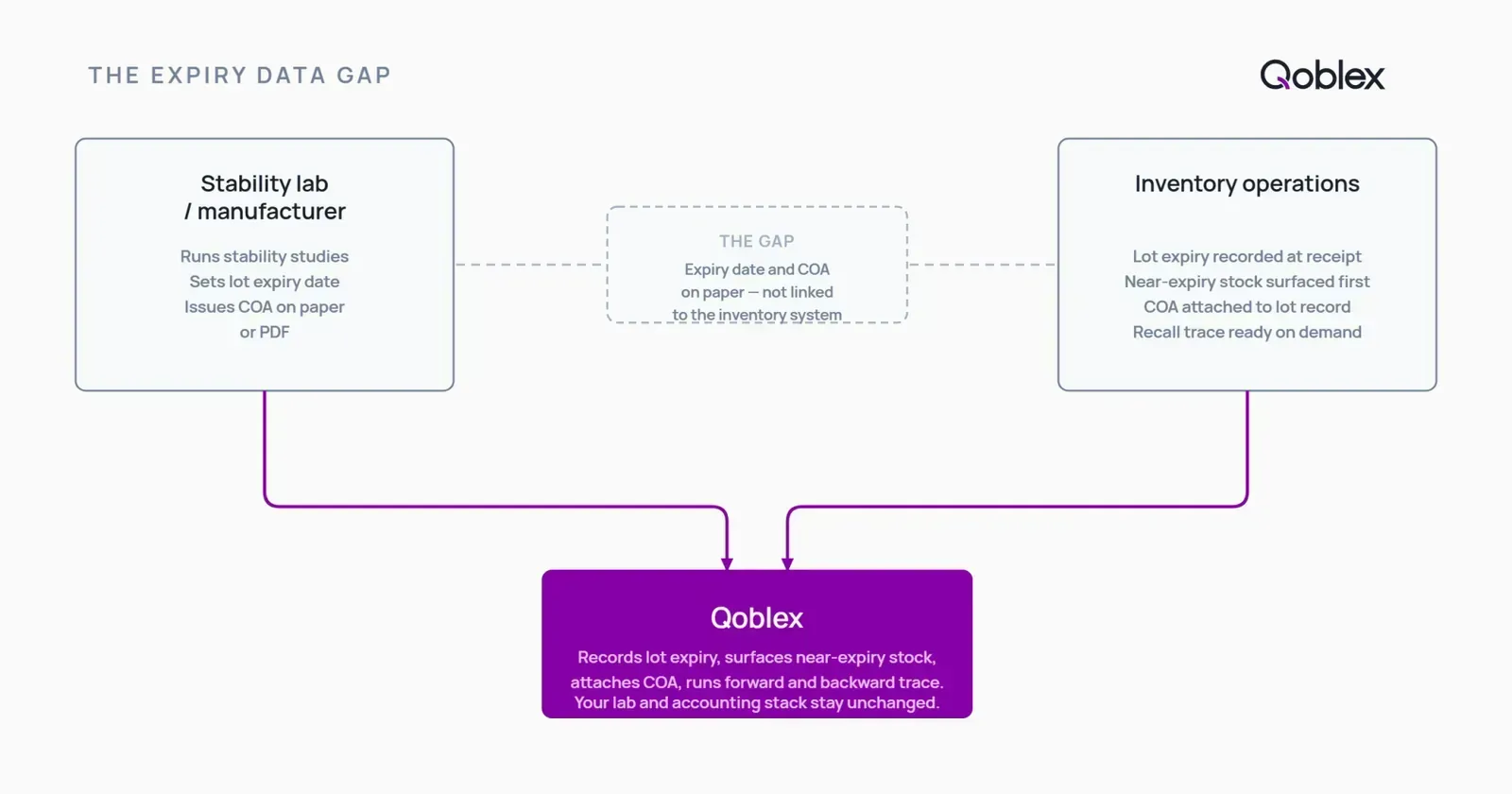
With the problem framed, here is where Qoblex fits, and where it does not.
Qoblex records the lot expiry date at receipt and holds it across all your locations, per Qoblex lot tracking. At pick time it surfaces near-expiring stock so the nearest-expiry lot moves first, the expiry-date-ordered picking described on our supplement inventory software guide. It lets you attach a COA or stability report to the lot record as a file, per the same guide, so the document is retrievable by lot on demand. And it provides forward trace (which customers received a lot) and backward trace (which raw-material lots went into a finished batch, through Qoblex manufacturing BOM traceability), so a recall query returns affected batches and recipients at once, per Qoblex lot tracking.
What it does not do matters just as much. Qoblex does not run stability testing, generate potency data, or author or certify Certificates of Analysis, and it is not a QMS or a LIMS, per our supplement inventory software guide. It does not calculate potency overage. It records the date and stores the documents that other functions produce. That is the honest scope.
It also stays in its lane in your stack. QuickBooks Online or Xero remains your financial book of record, and Shopify or Amazon remains your sales channel; Qoblex sits between them and handles the lot-level operations those tools were never built for. Lot, batch, serial, and expiry tracking is a paid add-on rather than part of the base plan; current structure is on the Qoblex pricing page.
Qoblex capability coverage for the expiry and shelf-life workflow
| Capability | Qoblex |
|---|---|
| Records lot expiry date at receipt and holds it across all locations | Yes, per Qoblex lot tracking |
| Near-expiring lot surfaced at pick time (expiry-date-ordered picking) | Yes, per supplement inventory guide |
| COA and stability document attachment to lot record | Yes, per supplement inventory guide |
| Forward trace (lot to customer shipment) | Yes, per Qoblex lot tracking |
| Backward trace (finished lot to raw-material inputs via BOM) | Yes, via Qoblex manufacturing |
| Recall trace: identify all affected batches and recipients in one query | Yes, per Qoblex lot tracking |
| Integration with QuickBooks Online and Xero (financial book of record) | Yes |
| Integration with Shopify and Amazon (sales channels) | Yes |
| Runs stability tests or generates potency data | No |
| Authors, verifies, or certifies Certificates of Analysis | No |
| QMS or LIMS functions (batch release, CAPA, deviation management) | No |
When you may not need dedicated shelf-life tracking software yet
No prize for buying software before the problem shows up. A few honest cases where you can wait:
-
A spreadsheet is genuinely keeping up. If you run one or a few SKUs, have only a handful of lots active at any time, work from a single location, and have not hit a retailer audit or a near-expiry incident, a spreadsheet is doing its job. The usual trigger to move is concrete: a retailer starts requiring electronic lot and expiry data, a short-dated lot reaches a customer, or a recall takes days to trace by hand.
-
Your real gap is stability testing, not tracking. If you do not yet have a stability program and are unsure what date to even put on the label, your next step is a laboratory relationship or a LIMS, not an inventory system. Inventory software records the date that testing produces; it cannot produce the date.
-
Your real gap is quality governance. If the pain is formal batch release sign-off, CAPA, deviation management, or documented QC workflows, that is QMS territory. Qoblex covers the inventory and traceability side of the house; a QMS covers quality governance. Plenty of supplement operations eventually need both, but they are different tools solving different problems.
Frequently asked questions
Is an expiration date required on dietary supplements under 21 CFR Part 111?
No. 21 CFR Part 111 does not mandate expiration dating for dietary supplements. The FDA declined to require it in the 2007 final rule because validated analytical methods do not exist for all dietary ingredient categories, including many botanicals (preamble at 72 FR 34752, 34856). However, if a manufacturer places any shelf-life date on the label, that date must be substantiated by data showing the product meets all label claims through that date. The obligation is triggered by the voluntary choice to date, not by the regulation itself.
What is potency dating for dietary supplements?
Potency dating is the practice of assigning a supplement expiry date that reflects when the product is expected to still deliver its labeled potency, not merely when it becomes unsafe. The date is determined by stability testing (real-time or accelerated studies) and may account for a potency overage formulated in at manufacture so label claims are met through the end of shelf life. Potency overage is a formulation decision made by the manufacturer or formulation lab; inventory software records the resulting expiry date but does not calculate overage amounts.
What does 21 CFR 111.605 say about supplement record retention when an expiration date is used?
21 CFR 111.605 states that records must be kept for one year past the shelf-life date if shelf-life dating is used, or two years beyond the date of distribution of the last batch if no shelf-life date is used. The “if shelf life dating is used” language confirms that dating is optional under the codified regulation. When you put an expiry date on the label, you accept the one-year-past-that-date retention obligation.
How is a supplement expiration date determined?
The expiry date is determined by stability testing conducted under defined storage conditions. Real-time studies store product at recommended conditions and test at intervals (3, 6, 12, 18, 24 months or more). Accelerated studies use elevated temperature and humidity to project shelf life faster. The resulting data must show the product meets all label claims (potency, microbial limits, appearance) through the stated date. Stability testing is a laboratory function; inventory software records the date the lab or manufacturer establishes, not the test data itself.
What is FEFO and how does it apply to supplement inventory?
FEFO (First Expired, First Out) is an inventory rotation practice that prioritizes picking the lots with the nearest expiry date before lots with later dates, regardless of when each lot arrived. For supplements, FEFO reduces the risk of expired stock reaching customers and helps meet retailer shelf-life requirements (typically 12 to 18 months remaining on receipt). It differs from FIFO (First In, First Out), which prioritizes arrival order and can leave older stock in place if a newer lot with a closer expiry date arrived later.
Can Qoblex attach a COA to a supplement lot record?
Yes. Qoblex can attach documents, including COA files and stability reports, to a lot record as file attachments. Qoblex does not author, verify, or certify a COA. The identity-testing obligation under 21 CFR 111.75 and the quality-governance obligations remain with the operator and their QA function. The COA is generated by the testing laboratory or the contract manufacturer; Qoblex stores and links it to the lot it belongs to.
Does Qoblex replace a LIMS or QMS for supplement manufacturers?
No. Qoblex is an inventory and traceability system. It records lot expiry dates, surfaces near-expiring stock, attaches COA documents to lot records, and provides forward and backward recall trace. It does not run laboratory tests, generate stability data, perform potency analysis, or execute QMS functions such as batch release approval, CAPA, or deviation management. A LIMS handles lab data; a QMS handles quality governance. Qoblex and those systems are complementary, not substitutes.
How does expiry date tracking connect to supplement recall readiness?
When a potency problem, contamination, or label-claim failure is identified, the lot-level expiry record becomes part of the evidence trail. Forward trace identifies every customer shipment that received the affected lot. Backward trace identifies which raw-material lots went into the finished batch. The combination of lot-level expiry tracking and bidirectional trace means a recall can be contained in minutes rather than reconstructed manually from shipping records. Cross-linking the COA to the lot record further documents what the product was expected to meet at the time of manufacture.
What is the difference between dietary supplement and pharmaceutical expiration dating requirements?
Pharmaceutical drug expiration dating is mandatory under 21 CFR 211.137, which requires that each drug product bear an expiration date established through stability testing under 21 CFR 211.166. Dietary supplements are governed by a separate regulation, 21 CFR Part 111, which does not mandate expiration dating. These two regulatory frameworks apply to different product categories. The mandatory pharmaceutical rules do not extend to dietary supplements.