



An FDA investigator is booked in, or a retailer has just made lot-level records a condition of the next purchase order, or a mock recall stalled halfway through. Whatever the trigger, the question is suddenly concrete: can you produce a complete batch record for any production run, on demand, with the ingredient lots, quantities, and certificates of analysis attached? For most supplement operations the formal quality documents exist in some form. What breaks under pressure is the thread underneath them, which supplier lot of which raw material went into which finished batch, and which customers received it. This page is a spoke of our supplement and nutraceutical inventory software hub, and it goes deep on that thread: the GMP batch records 21 CFR Part 111 asks for, and the inventory layer that supports them.
Under 21 CFR Part 111, supplement manufacturers must keep a written Master Manufacturing Record per formulation and a Batch Production Record per production run, capturing component lot numbers, quantities, and in-process results. Inventory software supports this by linking ingredient lot numbers to production orders and finished batches. The QC review, batch release, and sign-off functions belong in a quality management system, not in inventory software.
We are not going to re-explain what a batch record is or walk through paper versus digital workflows in general; that ground is covered on our guide to digital batch records. This page owns the supplement-specific angle: the MMR and BPR obligations under Part 111, identity testing per ingredient lot, COA management per lot, and where the inventory and traceability layer stops and a quality system starts.
What do 21 CFR Part 111 GMP batch records actually require?
US dietary supplements are made and held under the FDA’s current Good Manufacturing Practice rules for dietary supplements, 21 CFR Part 111. Part 111 does not tell you to buy software. It tells you to keep records, and to make them complete, contemporaneous, and retrievable. Two documents sit at the center of that obligation, and they are frequently confused.
What must a Master Manufacturing Record contain under Part 111?
The Master Manufacturing Record (MMR) is the written master for a formulation: the recipe and the process, written once per product and batch size. Under 21 CFR 111.210, it must include the product name and the quantity of each dietary ingredient per batch size, the complete list of components with their weights and measures, any intentional overage amounts, the theoretical yield at each step of production with acceptable minimum and maximum percentages, a description of the packaging and a representative label, and written manufacturing instructions. Those instructions have to cover process-control specifications, sampling procedures, verification actions, dual-person verification for manual weighing, safety precautions, and corrective-action protocols. It is a demanding document, and it is the reference every production run is measured against.
What must a Batch Production Record contain, and how is it different from the MMR?
If the MMR is the recipe, the Batch Production Record (BPR) is the receipt for a single run made from that recipe. Under 21 CFR 111.260, each BPR must record the batch, lot, or control number of the finished product, the equipment and processing lines used, cleaning and sanitizing dates, a unique identifier for each component and label used, the identity and weight or measure of each component, actual and theoretical yield percentages, monitoring results, testing and examination results, proof the finished product meets specifications, documentation of each manufacturing step with dates and the initials of the person who performed it, packaging and labeling reconciliation, the QC review and the approval or rejection decision, and any reprocessing documentation. The point that catches operators out is that the BPR has to be created as the work happens, not reconstructed afterward from memory or loose notes.
Most of what a BPR needs, which components, from which lots, in what quantities, on what date, resulting in which finished lot, is exactly the data an inventory system already captures when you receive stock and complete a production order. The formal QC review and sign-off is a quality function. The operational data underneath it is inventory data.
Why can you not rely on a supplier COA alone for identity verification under 21 CFR 111.75?
Because the rule does not let you. Under 21 CFR 111.75, you must conduct at least one appropriate test or examination to verify the identity of any dietary ingredient component for every lot received, before you use it in production. A supplier’s certificate of analysis (COA), on its own, does not satisfy that requirement. Permitted methods include appearance, organoleptic, physical, or chemical testing. This is an important boundary for what any inventory system can honestly claim: it can store the COA file against the lot record and give you a place to document that identity testing happened, but it does not perform the test, author the COA, or verify the result. That work stays with your quality function and your lab. Written specifications sit alongside this obligation, identity specifications for each component and finished-product specifications, and missing specifications are among the most frequently cited FDA observations for supplement manufacturers.
How long must batch production records be retained for dietary supplements?
Under 21 CFR 111.605, records must be kept for one year past the shelf-life date when shelf-life dating is used, or two years beyond the date of distribution of the last batch associated with those records when no shelf-life date is used. Electronic records must comply with 21 CFR Part 11, and all records must be readily available for FDA inspection throughout the retention period. That retrievability requirement is exactly what erodes in a spreadsheet once you have more than a handful of lots and runs.
This page describes the requirements of 21 CFR Part 111 at an orientation level, not as legal advice. Confirm your specific obligations with the FDA and a qualified regulatory advisor.
What is the difference between inventory traceability and a QMS for supplements?
Here is where a lot of software confusion comes from. A supplement operation running Part 111 records needs two distinct capabilities, and they are often assumed to be one.
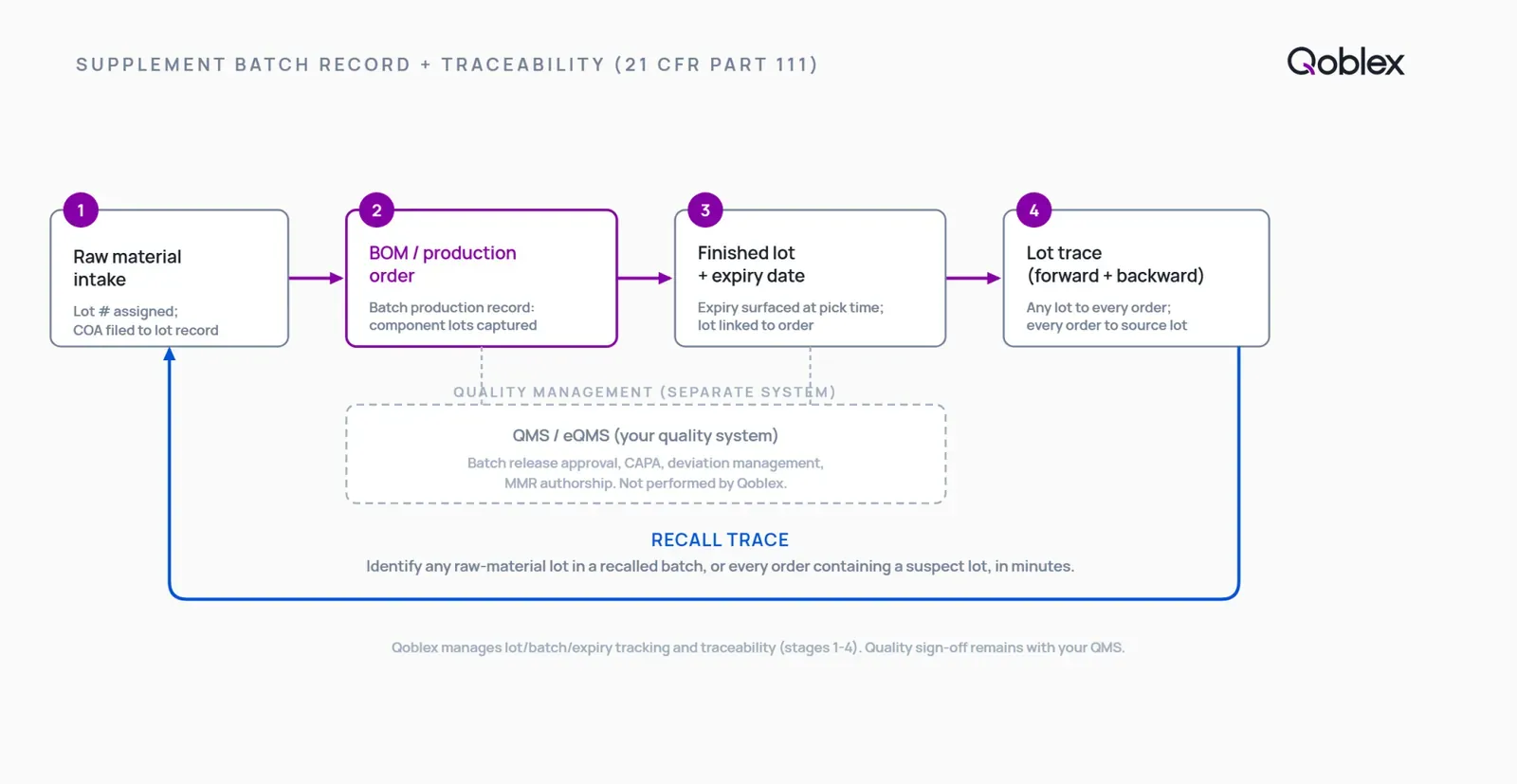
What inventory software does: lot tracking, BOM traceability, COA attachment
The inventory and traceability layer owns the physical facts. It assigns a lot or batch number the moment stock arrives against a purchase order, links those component lots to production orders and finished batches, stores the COA file against the lot record, holds expiry and location across sites, and produces a forward and backward trace when a lot is flagged. This is the operational spine of a BPR: the record of which materials, from which lots, went into which run.
What a QMS does: batch release approval, CAPA, deviation management, QC sign-off
The quality management system (QMS or eQMS) owns quality governance. It is where the MMR is authored and controlled, where the BPR is formally reviewed and signed off, where a batch is approved for release or rejected, and where deviations and corrective and preventive actions (CAPA) are managed. These are judgment and accountability functions, not inventory movements. A laboratory information management system (LIMS) sits alongside for analytical test data.
Why most supplement manufacturers need both, and why they are not substitutes
Part 111 effectively requires both kinds of capability, the physical traceability and the quality governance, so most supplement operations end up running both. They are complementary, not interchangeable. An inventory system that claims to also be your QMS is worth a hard second look, and a QMS that claims to also be your live inventory and lot-trace engine usually is too. The honest version is that each does one job well, and the two hand data back and forth.
How does lot-level traceability support GMP batch record data for supplement manufacturers?
With the split clear, here is what the inventory layer actually contributes to your records.
Linking ingredient lots to finished batches: BOM-linked production orders
The thread that ties a batch record together is lot linkage: knowing which ingredient lots went into which finished batch. When a production order draws components from specific received lots and assigns a batch to the finished goods, the finished lot carries its component lots with it. That linkage is what lets a recall pass through production instead of stopping at the finished-goods shelf, and it is the same data a BPR asks for under 111.260. If you manufacture from formulations, this is where a lot of lightweight tools quietly lose the thread. The underlying structure here is a BOM software capability applied to regulated production.
Attaching COA documents to lot records
A COA belongs to the lot it describes. Storing it as a file attached to that lot record means it travels with the material and is retrievable during an inspection or audit without hunting through email. To be exact about the boundary: attaching a document is not authoring, verifying, or certifying it. The identity-testing obligation under 21 CFR 111.75 and the QC decision on that COA remain with your quality function.
Forward and backward lot trace through production
When an ingredient lot or a finished lot is flagged, you need two directions at once. Forward: every customer or shipment that received a unit containing the lot. Backward: the supplier lot and receipt it came from. A traceability system built on lot control software returns both from a single query, plus what is still on hand and where. Some regulated products are tracked by unique unit rather than by lot; if that is you, serial number tracking software covers that model. Operators who also handle food-adjacent products under FSMA 204 traceability will recognize the same forward-and-backward pattern.
FEFO: surfacing near-expiry stock so pickers prioritize it
Supplement stock has a clock. First-expired-first-out (FEFO) is the practice of surfacing near-dated stock at pick time so it moves ahead of fresher stock, which cuts write-offs and keeps out-of-date product from shipping. It is operational best practice for perishable supplement inventory rather than a picking method named in Part 111. A system supports it by recording expiry at receipt and making near-dated stock visible across locations at pick time. That is expiry-date visibility feeding a practice, not an enforced guarantee that older stock can never be picked.
What happens during an FDA inspection if batch records are incomplete?
An investigator asks to see the records for a given batch and works through them against the MMR. The failure modes are predictable, and worth knowing before the visit rather than during it.
The most frequently cited Part 111 observations: what inspectors look for
Incomplete batch production records, missing or inadequate specifications, and gaps in component identity testing are consistently among the top 21 CFR Part 111 observations for supplement manufacturers. The common thread is not usually that the work was not done, it is that the record of it cannot be produced, or was assembled after the fact. A BPR with a missing component lot number, an unrecorded yield reconciliation, or a COA that cannot be located is the kind of gap that turns a routine inspection into a longer conversation.
How complete, retrievable records reduce inspection risk
The defense is boring and effective: capture the data as the work happens, keep it linked, and make it retrievable in seconds. When the component lots, quantities, COA files, and finished-batch assignments are recorded in one place at the time of production, producing a batch record on request is a query rather than a reconstruction. That does not make you compliant on its own, the quality review and sign-off still have to be real, but it removes the most common and most avoidable category of finding.
How do I run a mock recall for a supplement product using lot numbers?
A mock recall is the rehearsal that tells you whether your records actually hold together, run on a quiet day with a stopwatch instead of during a real event. Pick a lot number, ideally a raw-ingredient lot because it forces the harder path through production, and trace it in both directions. Backward to the supplier lot and receipt. Forward through every production run that consumed it, to every finished batch, to every customer shipment. Then confirm what is still on hand and where, and reconcile the quantities so nothing is unaccounted for. The mock recall workflow developed for food applies directly to supplements: the regulation differs, the trace is the same. If the drill runs to hours instead of minutes, the finding is that the records are not connected, and closing that gap is the entire point of running it before you need to.
How Qoblex supports GMP batch record data and lot traceability for supplement manufacturers
With the requirement clear, here is where Qoblex fits. It is the operational system between a spreadsheet and a bloated ERP: structured enough for a growing supplement brand, light enough to run without an IT team, and deliberately scoped to the traceability layer rather than the quality layer.
What Qoblex does: lot tracking, BOM-linked production orders, COA attachment, recall trace
Qoblex lot tracking captures lot, batch, and serial numbers and expiry dates from receipt through to sale, and holds those quantities across every warehouse, 3PL, and manufacturing site. Because Qoblex manufacturing ships bills of materials and production orders natively, a finished batch carries the component lots that went into it, so a production order captures the component lots, quantities, and movements that make up the operational data behind a Batch Production Record. When a lot is flagged, Qoblex traces it forward to the customers and shipments that received it and backward to the supplier lot it came from, and it can attach a COA document to the lot record as a file. Audit-ready lot and batch traceability reports come out on demand.
What Qoblex does not do: QMS, batch release, CAPA, LIMS, MMR/BPR authoring
The boundary is deliberate and worth stating plainly. Qoblex is an inventory and traceability system. It does not perform batch release approval, deviation management, CAPA, or independent QC sign-off, and it is not a LIMS for laboratory results. It does not author, verify, or certify Master Manufacturing Records, Batch Production Records, or Certificates of Analysis. It provides the physical-traceability data that feeds those records and supports audit-readiness; the quality governance stays with your QMS and your QA function.
How it connects to your existing accounting and ecommerce stack
Qoblex integrates two-way with QuickBooks Online and Xero and keeps them as your book of record, and it connects to Shopify, Amazon, and other sales channels so stock and orders stay in agreement without re-keying. You add traceability and operations; you do not switch accounting or retrain your bookkeeper.
Getting started: what the setup looks like
Bills of materials and production orders are part of the core manufacturing capability. Lot, batch, serial, and expiry tracking is a paid add-on rather than part of the base plan. Rather than quote plan details or figures that can change, see Qoblex pricing for what each tier includes and current costs.
When is a QMS or dedicated eBR system the right call instead of inventory software?
Being honest about who should not buy an inventory tool for this is how you buy the right thing. There are two clear cases.
If your primary gap is the formal batch record itself, authoring and controlling the MMR, reviewing and signing off the BPR, approving batch release, and running CAPA and deviation management, then the gap is a quality management system or a dedicated electronic batch record (eBR) system, not inventory software. Tools built around 21 CFR Part 111 quality governance exist for exactly this, and Qoblex neither competes with them nor claims to. If your gap is laboratory testing, in-process analytical results, and lab data management, that is a LIMS, and again Qoblex does not do it.
The common outcome is that a growing supplement manufacturer needs both: a QMS or eBR system for quality governance and an inventory system for physical traceability. They are complementary, not substitutes. Qoblex fills the inventory and traceability side, keeps your accounting and sales channels as they are, and leaves the quality decisions where they belong.
FAQ: GMP batch records and traceability for supplement manufacturers
What must a Master Manufacturing Record contain under 21 CFR Part 111? Under 21 CFR 111.210, a written MMR is required per formulation and batch size. It must include the product name and dietary ingredient quantities per batch size, the complete component list with weights and measures, any intentional overage amounts, the theoretical yield at each production step with acceptable minimum and maximum percentages, a description of the packaging and a representative label, and written manufacturing instructions covering process-control specifications, sampling procedures, verification actions, dual-person verification for manual weighing, safety precautions, and corrective-action protocols.
What must a Batch Production Record contain, and how does it differ from the MMR? The MMR is the written master for a formulation, the recipe and process, written once. The BPR is the record of a single production run made from that master. Under 21 CFR 111.260, the BPR must include the finished-product batch, lot, or control number, equipment and processing lines used, cleaning and sanitizing dates, a unique identifier for each component and label, the identity and weight or measure of each component, actual and theoretical yield percentages, monitoring and testing results, proof the finished product meets specifications, each manufacturing step documented with dates and performer initials, packaging and labeling reconciliation, the QC review and approval or rejection decision, and any reprocessing documentation. It must be created contemporaneously, not reconstructed later.
Does inventory software need to track lot numbers per batch to satisfy Part 111? Part 111 imposes recordkeeping obligations, not software requirements: the records must exist and be retrievable. Inventory software that captures ingredient lot numbers at receipt and links them to production runs and finished batches provides the operational data that feeds a BPR. The formal QC review, batch release, and sign-off belong in a quality management system. The inventory layer and the QMS layer are complementary, not substitutes.
Can I rely on a supplier COA alone for identity verification under Part 111? No. Under 21 CFR 111.75, you must conduct at least one appropriate test or examination to verify the identity of any dietary ingredient component for every lot received, before use in production. A supplier COA does not, on its own, satisfy this. Permitted methods include appearance, organoleptic, physical, or chemical testing. An inventory system can store the COA file against the lot record and document that testing occurred; it does not perform the test or verify the result.
How long must batch production records be kept for dietary supplements? Under 21 CFR 111.605, records must be kept for one year past the shelf-life date when shelf-life dating is used, or two years beyond the date of distribution of the last batch when no shelf-life date is used. Electronic records must comply with 21 CFR Part 11, and all records must be readily available for FDA inspection.
Can inventory software support GMP batch records, or do I need a dedicated QMS or eBR system? Inventory software handles the physical-traceability layer: lot assignments, component lot linkage to production orders, COA file attachment, forward and backward recall trace, and audit-ready movement history. A QMS or eBR system handles quality governance: formal MMR and BPR authoring, QC sign-off, batch release approval, CAPA, and deviation management. Part 111 effectively requires both kinds of capability. Qoblex covers the inventory and traceability layer; it does not replace a QMS or eBR system.
How do I attach a COA to a lot record in my inventory system? In Qoblex, a COA document can be attached to a lot record as a file, so it travels with the material and is retrievable during an audit. Qoblex does not author, verify, or certify the COA. The identity-testing obligation under 21 CFR 111.75 and the QC governance remain with the operator and their QA function.
Does Qoblex support GMP lot tracking and batch record data for supplement manufacturers? Qoblex tracks lot, batch, serial, and expiry from receipt through to sale, links ingredient lots to finished batches via BOM-linked production orders, attaches COA files to lot records, and produces forward and backward recall trace in a single query. Production orders capture the component lots, quantities, and movements that constitute the operational data behind a Batch Production Record. Qoblex is an inventory and traceability system; it does not perform batch release approval, CAPA, deviation management, or QC sign-off, and it does not author MMRs or BPRs.