


You formulate, blend, encapsulate, bottle, or pack dietary supplements. For a while, a spreadsheet and the stock fields in your accounting software kept up. Supplement operators usually outgrow that setup not because volume exploded, but because of identity. Which supplier lot of an ingredient went into which finished batch? What is the expiry date on the stock you are about to ship, and is there older stock you should move first? Where is the certificate of analysis for the lot a customer just asked about? A spreadsheet has no memory of any of that. It records a number, but it does not hold the thread that connects a raw-material lot to a finished bottle to the customer who received it.
That is the point where general inventory tools stop being enough. Supplement and nutraceutical inventory has requirements that most software was never built for: lot and batch identity, expiry date visibility, certificate-of-analysis records per lot, production batch records aligned with GMP recordkeeping, and a recall trace that runs through your bill of materials. This page is a map of what a supplement inventory system actually needs to do, what the FDA’s recordkeeping rules ask for at an orientation level, who genuinely needs this kind of software (and who does not yet), and where a tool like Qoblex fits. It is written for the supplement brand, nutraceutical maker, and contract manufacturer.
Supplement and nutraceutical inventory software manages the requirements specific to regulated supplement operations: lot and batch tracking, expiry date visibility, recall traceability, and BOM-linked production batch records that support 21 CFR Part 111 GMP recordkeeping. It sits between a spreadsheet and a full ERP, keeping accounting platforms as book of record while adding the physical traceability and compliance-ready history that accounting tools and ecommerce platforms do not provide.
What makes inventory management for supplement and nutraceutical brands different from other industries?
Most inventory software counts units and tells you when to reorder. That is enough for a business selling identical, shelf-stable widgets. Supplements are not that. Two bottles of the same product are not interchangeable if one expires in three months and the other in two years, and if one was made from an ingredient lot that later gets flagged, you need to know exactly which finished units contain it and where they went. The difference between supplement inventory software and general inventory software is that supplement software tracks identity, dates, and lineage at the lot level, not just quantity on a shelf.
The reason that matters is regulatory as much as operational. Dietary supplements made or sold in the US fall under the FDA’s current Good Manufacturing Practice rules for dietary supplements, 21 CFR Part 111. Part 111 does not ask you to buy software. It asks you to keep records: a written recipe and process for each product, a record of each production run, the identity of every ingredient lot, and a history you can retrieve when the FDA, a retailer, or a customer asks. Those are recordkeeping obligations, and recordkeeping is where software earns its place. It does not make you compliant; it makes the records you are already required to keep faster to produce and harder to lose.
A Batch Production Record is not the same as a Master Manufacturing Record
These two terms come up constantly, and they are worth separating. A Master Manufacturing Record is the written master for a product: the formula, the specifications, and the step-by-step process, written once per formulation. A Batch Production Record is the record of a single production run made from that master, capturing what actually happened: the specific ingredient lots used, quantities, in-process checks, and who did the work. One is the recipe; the other is the receipt for a given batch. Part 111 requires both (sections 111.255 to 111.260, Subpart I), and the batch record has to be complete at the time of production, not reconstructed afterward. Incomplete batch production records are among the most frequently cited FDA observations for supplement manufacturers.
What does 21 CFR Part 111 actually require? (the GMP recordkeeping baseline)
Here is the plain version, framed operationally rather than as legal advice. The point is not to alarm you. The rule exists, these are the records it asks for, and here is how an inventory system supports them.
Master Manufacturing Records and Batch Production Records: what they are and why software helps
The Master Manufacturing Record fixes the formulation and process; the Batch Production Record documents each run against it. Software helps with the batch record specifically, because most of what a batch record needs (which component lots were consumed, in what quantities, on what date, resulting in which finished lot) is exactly the data an inventory system already captures when you receive stock and complete a production order. The formal review and sign-off of that record is a quality function, but the operational data underneath it is inventory data.
Component identity testing per lot: why blind COA acceptance is not enough
Part 111 requires that every lot of every dietary ingredient be tested or examined for identity before use in production (21 CFR 111.75). Accepting a supplier’s certificate of analysis without your own identity verification does not, on its own, satisfy that requirement. This is an important boundary for what inventory software can and cannot claim to do. An inventory system can store the supplier COA against the lot record and give you a place to record that identity testing happened. It does not perform the test, author the COA, or verify the result. That work belongs to your quality function and your lab.
Component and finished-product specifications
The rule also requires written specifications: identity specifications for each component and specifications for the finished product (21 CFR 111.70). Missing specifications are another of the top FDA citations. Specifications live in your quality documentation; the inventory system’s job is to hold the lot-level records that let you show a given batch was made from components you received, identified, and tracked.
Lot-linked traceability: connecting ingredient lots to finished batches
The thread that ties all of this together is lot linkage: knowing which ingredient lots went into which finished batch, and which customers received units from that batch. Part 111 expects records to be complete, legible, and readily retrievable across the product lifecycle. That retrievability is precisely what falls apart in a spreadsheet the moment you have more than a handful of lots and runs.
QC independence and batch release: what belongs in a QMS, not inventory software
One clear line to draw. The decision to release a batch, the review of a deviation, the corrective and preventive action (CAPA) process, and independent QC sign-off are quality-management functions. They belong in a quality management system (QMS or eQMS), not in inventory software. Part 111 effectively requires both kinds of capability: the physical traceability and the quality governance. An inventory layer covers the first. It does not replace the second, and any tool that claims to be both is worth a hard second look.
This page describes the operational requirements of 21 CFR Part 111 at an orientation level. Supplement businesses should confirm their specific compliance obligations with the FDA and a qualified regulatory advisor.
What should supplement inventory software actually do? (the capability checklist)
Here is the working checklist. Each item is a genuine requirement for a lot-tracked supplement operation, and each links to a page with more depth where one exists.
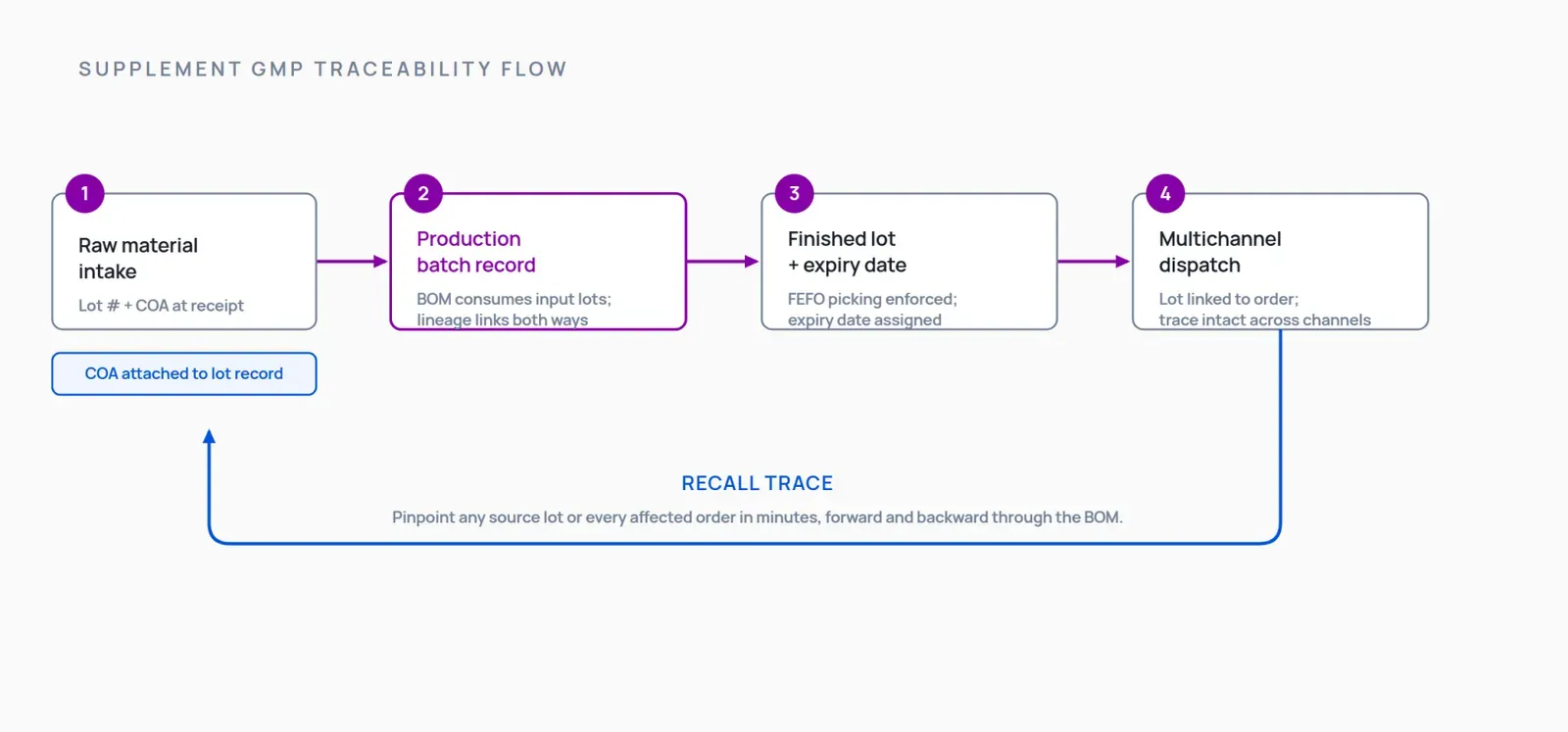
1. Lot and batch tracking: assign and trace every component and finished unit. The system should capture a lot or batch number the moment stock arrives against a purchase order, and assign a batch to each production run, so every unit is tied to its origin from the start. In supplements, “which supplier lot is this?” is not only a recall question; it is the record behind your identity-testing obligation before production even begins. This is the supplement expression of lot control software. Some regulated products are tracked by unique serial number rather than by lot; if that is you, see serial number tracking software.
2. Expiry date visibility so near-dated stock moves first. Expiry should be recorded at receipt, held across every location, and surfaced at pick time so near-dated stock is prioritized ahead of fresher stock. This practice is often called FEFO, First Expired First Out, and it is operational best practice for perishable supplement inventory rather than a picking method named in Part 111. Done well, it cuts write-offs and keeps out-of-date product from shipping.
3. Recall trace: isolate an affected lot in minutes, not hours. When an ingredient lot or a finished lot is flagged, you need a forward trace to every customer or shipment that received it, a backward trace to the supplier lot it came from, and a read of what is still on hand and where. A software trace should take minutes; a manual reconstruction can take hours or days. Running it as a mock recall before you ever need it is how you find out whether your records hold together. See food recall readiness for the mock-recall workflow, which applies directly to supplements.
4. BOM traceability: connecting raw-material lots to finished production batches. The link between component lots and finished batches is what lets a recall pass through production instead of stopping at the finished-goods shelf. When you know exactly which raw materials went into which finished goods, an ingredient problem traces forward to every affected batch. This is where a lot of lightweight tools lose the thread. It connects to BOM software for small manufacturers and manufacturing inventory software. Supplement traceability is closely related to food traceability software, which covers the end-to-end trace in detail.
5. Production orders with batch-level component assignment. You should be able to select component batches for a production order, assign a batch to the completed products, and track runs through draft, in-progress, and completed states, with production reconciliation and wastage recorded. This is the operational spine of a batch production record. See Qoblex manufacturing and production planning software for the deeper workflow.
6. Multi-location stock across warehouses, 3PLs, and production sites. Growth almost always adds a second location before it adds anything else. You need lot and expiry quantities visible across every warehouse, contract manufacturer, and third-party logistics site at once, so near-dated stock and affected lots are never hidden in a location you cannot see.
7. Purchasing and supplier management: purchase orders, COA attachment, landed cost. Purchase orders should tie to the lots they bring in, with landed cost and freight tracked so your batch cost is real, multi-currency where you buy internationally, and results synced back to your accounting platform. This is also where you can attach a supplier’s certificate of analysis to the lot record as a file. Attaching a document is not the same as authoring, verifying, or certifying it; the COA obligation stays with your quality function.
8. COGS and margin reporting per production batch. Real margin per batch, not just invoice price, means seeing the landed cost of every component that went into a run against what the finished product sells for. That is the number that tells you whether a formulation is actually worth making.
Those eight are the core. A tool that stores a lot number in a text field but cannot tie it to identity records, production runs, and shipments is a label, not a traceability system.
The integration gap: why your accounting or ecommerce platform is not enough
Most operators who need this already have a stack that works: accounting in QuickBooks Online or Xero, orders through Shopify, Amazon, or a wholesale channel. Those tools are good at their jobs. The gap is that none of them was built to hold lot identity, expiry dates, and the physical trace, so the traceability layer has to sit alongside them.
QuickBooks Online: handles your books, not your lots or batch records
QuickBooks Online does not natively track lot or batch numbers or record expiry dates. That is not a criticism; it is an accounting platform doing accounting well. But the trail of which ingredient lot went into which finished batch, and which customer received it, is not something it holds. That trail is what lot control software adds. See the detail on lot tracking for QuickBooks Online.
Xero: no native lot, batch, or expiry tracking, even with Inventory Plus
Xero does not natively track lot or batch numbers or record expiry dates. Even the Xero Inventory Plus add-on, which is US-only and USD-only, adds no lot, batch, or expiry capability, so the traceability gap is the same whether you are on core Xero or the paid add-on. See the detail on lot and expiry tracking for Xero.
Shopify and Amazon: order channels with no lot identity or trace
Shopify and Amazon treat every unit of a listing as identical. There is no native lot or batch identity and no expiry date field. Your storefront knows how many units you have; it does not know which lot they belong to or when they expire, which is exactly the information a supplement recall or audit turns on. See the detail on lot and expiry tracking for Shopify.
How to add supplement traceability without replacing your accounting platform
The good news is that adding traceability does not mean ripping out what works. The better middle path is to keep QuickBooks Online or Xero as your book of record, keep Shopify or Amazon as your storefront, and add a dedicated inventory operations layer between them that owns lots, batches, expiry dates, locations, purchasing, and manufacturing traceability, then syncs the financial results back. That is the same pattern our food and beverage inventory software hub describes, applied to supplements.
How Qoblex works as the inventory layer for supplement and nutraceutical brands
With the requirement clear, here is where Qoblex fits. It is the operational system between a spreadsheet and a bloated ERP: structured enough to support a growing supplement brand, light enough to run without an IT team.
What Qoblex does: lot tracking, expiry visibility, recall trace, BOM traceability, production batch records
Qoblex lot tracking captures lot, batch, and serial numbers and expiry dates from receipt through to sale, holds those quantities across every location, and lets you trace a flagged lot forward to the customers and shipments that received it and backward to the supplier lot it came from. Because Qoblex manufacturing ships bills of materials and production orders natively, a finished batch carries the component lots that went into it, so a recall trace passes cleanly through production. Production orders capture the component lots, quantities, and movements that make up the operational data behind a batch production record.
What Qoblex does not do: QMS, QC sign-off, CAPA, LIMS, COA authoring
Qoblex is an inventory and traceability system, not a quality management system. It does not perform batch release approval, deviation management, CAPA, or independent QC sign-off, and it is not a LIMS for laboratory results. On certificates of analysis, the distinction matters: Qoblex can attach a COA document to a lot record as a file, but it does not author, verify, or certify it. The identity-testing obligation (21 CFR 111.75) and the quality governance stay with you and your QA function. Many supplement operations run a QMS for quality governance alongside an inventory layer for physical traceability, and the two are complementary rather than substitutes.
How it connects to your existing accounting and ecommerce stack
Qoblex integrates two-way with QuickBooks Online and Xero and keeps them as your book of record, and it connects to Shopify, Amazon, and other sales channels so stock and orders stay in agreement without re-keying. You add traceability and operations; you do not switch accounting or retrain your bookkeeper.
Getting started: what the setup looks like
Bills of materials and production orders are part of the core manufacturing capability. Lot, batch, serial, and expiry tracking is a paid add-on rather than part of the base plan. Rather than quote figures that can change, see Qoblex pricing for what is included and current costs.
Who supplement inventory software is for, and who it is not for
Being honest about who should not buy this is how you buy the right tool. Here is the straight version, and there are four cases worth naming.
The supplement and nutraceutical businesses that benefit most
This kind of software earns its place for growth-stage supplement brands, nutraceutical makers, and contract manufacturers whose stock carries a shelf life, whose customers or retailers expect lot and expiry records, or who manufacture from formulations and need to trace an ingredient lot into a finished batch. Broadly, it is for operators for whom a recall, an FDA inspection, or a retailer audit is a real possibility rather than a hypothetical.
When a spreadsheet or your accounting software is genuinely sufficient for now
A spreadsheet or your accounting software’s stock fields may be genuinely sufficient if you sell a single product with no lot-number or expiry requirement from a customer or regulator, have no retailer audit or recall history, and are at a stage where the manual overhead is still manageable. Spreadsheets got a lot of good supplement businesses off the ground, and there is no prize for buying software before you need it. The moment to look is specific: a customer or auditor asks you to trace a lot and you cannot produce it from a report, or a retailer makes lot and expiry data a condition of doing business.
When a full supplement ERP is the right call instead
At the other end, a full supplement ERP (Wherefour, BatchMaster, and Brahmin Solutions are examples, named to draw honest category boundaries, not to attack) may be the better fit if you are a mid-market contract manufacturer with EDI obligations, complex multi-plant manufacturing, catch-weight and formula-scaling requirements, or integrated regulatory submissions. Those are bigger, more expensive, slower-to-implement systems, and for a large enough operation they are the right call. Qoblex fills the middle: more capable than an accounting add-on, far lighter and less expensive than an ERP.
When a dedicated QMS or a LIMS is what you actually need
If your primary gap is batch release approval, CAPA, deviation management, QC sign-off, or documented GMP audit workflows, the gap is a quality management system, not inventory software. If the gap is laboratory testing, analytical results, and in-process QC test recording, that is a LIMS. Qoblex fills the inventory and traceability side and does not replace either. Many supplement operations run a QMS or LIMS for quality and lab work and an inventory layer for physical traceability.
How to choose supplement inventory software: a practical checklist
If you are evaluating options (Qoblex or otherwise), here is how to cut through a vendor demo.
Must-have capabilities for a lot-tracked supplement operation
Start from the eight capabilities above. The non-negotiables are: lot and batch assignment at receiving, expiry recording surfaced at pick time so near-dated stock moves first, forward and backward trace in a single query, recall isolation in minutes, BOM traceability from ingredient lot to finished batch if you manufacture, multi-location visibility, COA document attachment to lot records, and production orders that capture the component lots behind a batch record.
Questions to ask any software vendor before you commit
A few questions separate real traceability from a lot-number field. Can you trace a lot in both directions in one query? Does the trace pass through the bill of materials to raw-ingredient lots? Does expiry surface at pick time, or is it only stored? Can I attach a COA file to a lot record? Is what I am seeing inventory traceability, or is the vendor implying it is a QMS? What is included versus a paid add-on, and at which tier? How long does implementation take, and is there a contract?
Integration requirements: accounting, ecommerce, and 3PL connections
The integrations that matter are the ones that stop you re-keying: your accounting platform (QuickBooks Online or Xero) so financial results flow back, and your sales channels (Shopify, Amazon, wholesale B2B) so stock and orders agree. If a tool cannot connect to the systems you already run, the operations layer becomes another silo.
Supplement inventory capability checklist
This table is for self-qualification, not a competitor scorecard. It shows what a full-featured supplement inventory system covers and how Qoblex maps to each requirement.
| Capability | Why it matters for supplement operations | Qoblex |
|---|---|---|
| Lot and batch number assignment and tracking | Ties every component and unit to its origin; the basis of identity records and any trace | Yes |
| Expiry date recording and near-dated stock visibility | Perishable supplement stock has a clock; you need to see it across locations | Yes |
| Expiry-date-ordered picking to prioritize near-dated stock | Near-dated stock moves first, cutting write-offs and expired shipments | Yes |
| Forward trace (lot to customer or shipment) | Find every customer who received a flagged lot | Yes |
| Backward trace (lot to supplier) | Find the supplier lot behind a problem | Yes |
| Recall isolation (minutes, not hours) | Turns a recall from a lost week into a routine query | Yes |
| BOM traceability (raw-material lot to finished batch) | Connect ingredient lots to finished batches so a recall passes through production | Yes |
| Production orders with batch-level component assignment | Capture the component lots and quantities behind a batch record | Yes |
| Batch production record data (component lots, quantities, movements) | Provide the operational data that feeds a Batch Production Record | Yes |
| COA document attachment to lot records | Store the supplier COA against the lot (authoring and verification stay with QA) | Yes |
| Multi-warehouse and 3PL stock visibility | One view of lots and expiry across sites, contract manufacturers, and 3PLs | Yes |
| Purchase orders with lot receipt and landed cost | Real batch cost; anchor the backward trace to the supplier and PO | Yes |
| COGS and margin reporting per production batch | Real margin per batch, not just invoice price | Yes |
| Integration with QuickBooks Online and Xero | Keep your book of record; add operations on top | Yes |
| Multichannel: Shopify, Amazon, wholesale B2B | Sell across channels while stock and orders stay in agreement | Yes |
FAQ
What is supplement inventory software? Supplement inventory software manages the requirements specific to regulated supplement operations: lot and batch tracking, expiry date visibility, recall trace, and BOM-linked production batch records that support GMP recordkeeping. It sits between a spreadsheet and a full ERP or QMS, keeping your accounting platform as book of record while adding physical traceability.
What does 21 CFR Part 111 require from an inventory system? Part 111 requires a Master Manufacturing Record per formulation and a Batch Production Record per production run capturing component lot numbers, quantities, in-process results, and operator information (21 CFR 111.255 to 111.260), and it requires records be complete, legible, and readily retrievable. Inventory software supports these by linking lot numbers to movements and production batches. The QC review and batch release functions belong in a QMS.
Does my accounting software handle supplement lot tracking? Neither QuickBooks Online nor Xero, including Xero Inventory Plus (which is US-only and adds no lot, batch, or expiry capability), provides native lot or batch tracking, expiry recording, or BOM traceability. A dedicated inventory operations layer adds these while keeping accounting as your book of record.
What is the difference between supplement inventory software and a QMS? Inventory software tracks physical operations: lot movements, expiry, production batches, recall trace, and COGS. A QMS (eQMS) handles quality governance: batch release approval, CAPA, deviation management, and QC sign-off. 21 CFR Part 111 requires both kinds of capability. Qoblex covers the inventory and traceability side, not the QMS side. Many supplement operations run both.
What is a Batch Production Record (BPR) and does inventory software generate it? A Batch Production Record is a per-run record aligned with the Master Manufacturing Record that captures component lot numbers, quantities, in-process results, and operator information (21 CFR 111.255 to 111.260). Inventory software that tracks lot-level components in production orders provides the operational data that feeds a BPR. The formal batch record review and sign-off is a QC or QMS function.
Does Qoblex replace a QMS for supplement manufacturers? No. Qoblex handles inventory operations and traceability: lot tracking, expiry visibility, recall trace, BOM-linked production, and audit-ready history. It does not perform batch release approval, CAPA, deviation management, or independent QC sign-off. A QMS handles those functions; Qoblex and a QMS are complementary, not substitutes.
How does recall trace work in supplement inventory software? When an ingredient or finished lot is flagged, the system runs a forward trace to every customer or shipment that received it and a backward trace to the supplier lot it came from, plus a read of what is still on hand and where. A software trace takes minutes; a manual reconstruction can take hours or days.
Can Qoblex attach COA documents to supplier lot records? Yes, Qoblex can attach documents, including COA files, to lot records as file attachments. It does not author, verify, or certify Certificates of Analysis. The regulatory COA obligation, including identity testing under 21 CFR 111.75 and QC governance, rests with the operator and their QA function.
How much does supplement inventory software cost? For Qoblex, bills of materials and production orders are part of the core manufacturing capability. Lot, batch, serial, and expiry tracking is a paid add-on rather than part of the base plan. See Qoblex pricing for current figures.