



Every mispicked order costs your business money. Every unnecessary step your pickers take adds up. And when you’re fulfilling orders across Shopify, Amazon, and wholesale channels simultaneously, inefficient warehouse picking can quickly become the bottleneck that limits your growth.
Warehouse picking accounts for up to 55% of total warehouse operating costs, making it the single most expensive activity in your fulfillment operation. Yet for many growing ecommerce businesses and wholesalers, picking remains an afterthought rather than a strategic process that deserves optimization.
This guide covers the warehouse picking strategies that work for different business types, the technology that makes a difference, and practical steps to reduce errors, speed up fulfillment, and lower your cost per order.
What Is Warehouse Picking?
Warehouse picking is the process of locating and retrieving products from storage locations within a warehouse or fulfillment center to fulfill customer orders. It is one of the most labor-intensive warehouse operations, typically accounting for 50-55% of total warehouse operating costs.
The picking process typically follows these steps:
- Receiving the order information (pick list or pick ticket)
- Traveling to the storage location
- Identifying and retrieving the correct item(s)
- Verifying the pick (scanning, visual confirmation)
- Transporting items to the packing station for pick and pack completion
While this sounds straightforward, the complexity multiplies quickly when you’re handling hundreds of SKUs, processing orders from multiple sales channels, and trying to maintain accuracy under time pressure.
The Role of Picking in Order Fulfillment
Picking sits at the heart of the order fulfillment workflow. It follows receiving and putaway, and precedes packing and shipping. But its impact extends far beyond its position in the sequence.
A well-executed picking process ensures:
- Order accuracy: The right products reach the right customers
- Fast cycle times: Orders move from “placed” to “shipped” quickly
- Inventory integrity: Stock counts remain accurate as items leave storage
- Labor efficiency: Workers spend time productively, not wandering or searching
When picking breaks down, everything downstream suffers. Mispicks lead to returns, refunds, and disappointed customers. Slow picking creates shipping delays. Inaccurate picks throw off your inventory counts, leading to overselling and stockouts.
Pro Tip: If you sell across multiple channels (Shopify, Amazon, wholesale), ensure your picking system pulls from a single, real-time inventory source. Channel-specific stock counts are the fastest path to overselling and fulfillment chaos.
Why Picking Efficiency Directly Impacts Your Bottom Line
The financial impact of picking efficiency is significant and measurable. Consider these numbers:
| Cost Factor | Impact of Poor Picking |
| Labor costs | 50-55% of warehouse operating expenses |
| Mispick cost | $10-$50 per incorrect order (return processing, reshipping, customer service) |
| Travel time | 50%+ of picker time often spent walking, not picking |
| Order delays | Lost customers and negative reviews |
For a business shipping 500 orders per day, even a 2% error rate means 10 mispicked orders daily. At $25 average cost per error, that’s $250 per day—over $90,000 annually—lost to picking mistakes alone.
The good news: picking optimization delivers measurable results quickly. The right strategy, combined with appropriate technology, can reduce errors to below 0.5% and significantly increase throughput without adding headcount.
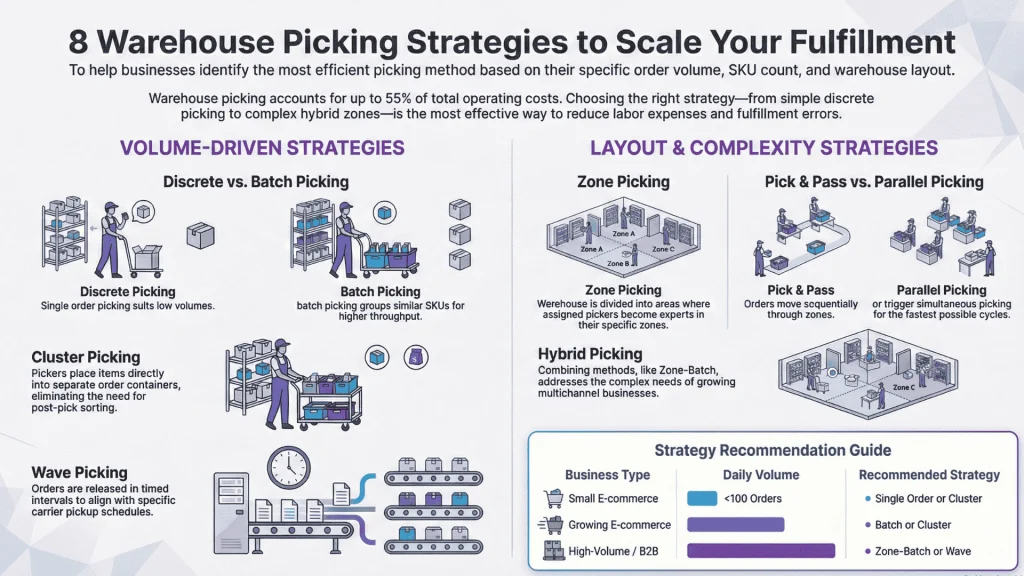
8 Warehouse Picking Strategies Explained
Not all picking methods work for every business. Your ideal approach depends on your order volume, SKU count, warehouse layout, and the nature of your orders.
Here are the eight most common warehouse picking strategies:
- Single Order Picking (Discrete Picking)
- Batch Picking
- Zone Picking
- Wave Picking
- Cluster Picking
- Pick and Pass
- Parallel Picking
- Hybrid Picking Strategies
Below, we explain each method with guidance on when it works best.
Single Order Picking (Discrete Picking)
Single order picking is the most straightforward method: one picker handles one order at a time, collecting all items before moving to the next order.
How it works: A picker receives a pick list for a single order, travels through the warehouse collecting each item, then delivers the complete order to the pick and pack station.
Best for:
- Small operations with low daily order volume (under 100 orders)
- High-value or fragile items requiring careful handling
- Complex orders with special instructions
- Businesses just starting to formalize their picking process
Pros: Simple to implement, easy to train, minimal chance of order mixing
Cons: Highly inefficient for larger volumes due to excessive travel time
Batch Picking
Batch picking groups multiple orders together, allowing a picker to collect the same SKU for several orders in a single trip to that location.
How it works: The system identifies common items across multiple orders. A picker collects quantities for all orders in the batch, then sorts items into individual orders at a consolidation station.
Best for:
- Operations with many orders containing similar or identical items
- Ecommerce businesses with popular “hero” products
- Order volumes of 100-500+ daily
- Warehouses where travel time is a significant factor
Pros: Dramatically reduces travel time, increases picks per hour
Cons: Requires sorting step, higher risk of mixing orders without proper systems
Example: A cosmetics brand selling skincare bundles finds that 60% of orders include their bestselling moisturizer. Batch picking lets one picker grab moisturizer quantities for 20 orders in a single trip to that bin location.
Zone Picking
Zone picking divides the warehouse into distinct areas, with dedicated pickers assigned to each zone.
How it works: Each picker only works within their assigned zone. Orders requiring items from multiple zones either pass from zone to zone (pick and pass) or are consolidated after parallel picking.
Best for:
- Large warehouses with distinct product categories
- Operations with specialized storage requirements (refrigerated, hazmat, high-security)
- Businesses with high SKU counts spread across significant floor space
Pros: Pickers become experts in their zones, reduced travel, enables parallel processing
Cons: Requires coordination between zones, potential bottlenecks if zones have uneven workloads
Pro Tip: Assign your fastest pickers to high-velocity zones. Balance zone workloads by SKU velocity, not physical space—a small forward pick area with fast-movers may need more picker coverage than a large reserve storage zone.
Wave Picking
Wave picking schedules order releases in timed intervals (waves) throughout the day, typically aligned with carrier pickup times or shipping priorities.
How it works: Instead of picking orders as they arrive, the system groups orders into waves based on shipping method, destination, or priority. All orders in a wave are picked within a defined time window.
Best for:
- Operations with multiple daily carrier pickups
- Businesses needing to prioritize expedited orders
- Warehouses coordinating picking with other operations (receiving, replenishment, cycle counting)
Pros: Better resource planning, alignment with shipping schedules
Cons: Less responsive to real-time order changes, requires scheduling systems
Cluster Picking
Cluster picking allows a picker to work on multiple orders simultaneously, placing items directly into separate containers (totes, bins, or bags) as they pick.
How it works: A picker moves through the warehouse with a cart holding multiple order containers. As they pick each item, they place it directly into the correct container, eliminating the need for post-pick sorting.
Best for:
- Ecommerce fulfillment with many small orders
- Businesses where orders typically contain 1-5 items
- Operations using pick carts or mobile shelving units
Pros: Combines batch efficiency with order separation, reduces sorting time
Cons: Limited by cart capacity, requires clear container labeling
Example: A fashion retailer processing 300 daily orders averaging 2 items each uses cluster picking with 12-slot carts. Each picker completes 12 orders per warehouse pass, tripling throughput compared to discrete picking.
Pick and Pass
Pick and pass is a zone-based method where orders physically move from zone to zone, accumulating items along the way.
How it works: An order starts in Zone 1, collects required items, then passes to Zone 2, continuing until complete. The finished order arrives at packing ready to ship.
Best for:
- High-volume operations with consistent order composition
- Warehouses with conveyor systems between zones
- Businesses where orders span multiple product categories
Pros: Orders complete as they move, no consolidation needed, natural quality checkpoints
Cons: Slowest zone determines throughput, less flexible for variable order sizes
Parallel Picking
Parallel picking has multiple zones working on the same orders simultaneously, with items consolidated afterward.
How it works: An order with items in Zones A, B, and C triggers picking in all three zones at once. Items are then brought together at a consolidation point.
Best for:
- Time-sensitive fulfillment operations
- Large orders spanning many warehouse areas
- Operations with sophisticated WMS and conveyor systems
Pros: Fastest possible order completion, maximizes picker utilization
Cons: Requires robust consolidation systems, higher complexity
Hybrid Picking Strategies
As businesses grow, most adopt hybrid approaches combining elements of multiple strategies to match their evolving needs.
Common combinations:
- Zone-Batch: Pickers work in zones but batch pick within their area
- Wave-Zone: Orders are released in waves, with zone picking within each wave
- Cluster-Zone: Zone pickers use cluster carts to handle multiple orders
Best for:
- Businesses outgrowing single-strategy approaches
- Operations with varied order profiles
- Companies selling across multiple channels with different fulfillment requirements
Example: A food and beverage distributor uses wave picking for B2B wholesale orders and cluster picking for DTC ecommerce—all from the same warehouse with shared inventory.
How to Choose the Right Picking Strategy for Your Business
Selecting the optimal picking strategy isn’t about finding the “best” method—it’s about finding the best fit for your specific situation. Here’s a framework to guide your decision.
Key Factors to Consider
Order volume: How many orders do you ship daily? Low volumes (under 100) often work fine with discrete picking. Higher volumes demand batch, zone, or hybrid approaches.
Order composition: Do most orders contain one item or many? Single-item orders favor cluster picking. Multi-item orders may benefit from zone-based methods.
SKU count: A small catalog (under 500 SKUs) allows simpler strategies. Large catalogs (5,000+ SKUs) often require zone picking to manage complexity.
Warehouse layout: Your physical space matters. Long, narrow warehouses may benefit from zone picking. Compact spaces might work better with batch picking.
Sales channel mix: Selling on Shopify, Amazon, and to wholesale accounts? You may need different picking approaches for each channel’s typical order profile.
Picking Strategy by Business Type and Order Profile
| Business Type | Typical Order Profile | Recommended Strategy |
| Small ecommerce (under 100 orders/day) | 1-3 items per order | Single order or cluster picking |
| Growing ecommerce (100-500 orders/day) | 1-5 items, many repeats | Batch or cluster picking |
| High-volume ecommerce (500+ orders/day) | Variable | Zone-batch hybrid |
| B2B wholesale | Large orders, full cases | Wave picking with zone structure |
| Multichannel (DTC + wholesale) | Mixed profiles | Hybrid with channel-specific waves |
| Subscription boxes | Standardized contents | Batch picking optimized for kitting |
When to Combine Multiple Strategies
Consider hybrid approaches when:
- Your order profiles vary significantly by channel or customer type
- You’ve hit efficiency limits with a single strategy
- Peak seasons require different approaches than baseline operations
- You’re adding warehouse space or reorganizing your layout
The transition point typically comes when travel time exceeds 50% of picker activity or when error rates climb above 1%. Both signals indicate your current strategy isn’t keeping pace with operations.
Technology and Equipment That Improve Warehouse Picking
The right technology can transform picking efficiency. But for growing businesses, the goal isn’t to implement every available solution—it’s to invest in tools that deliver measurable ROI at your current scale.
Warehouse Management Systems (WMS)
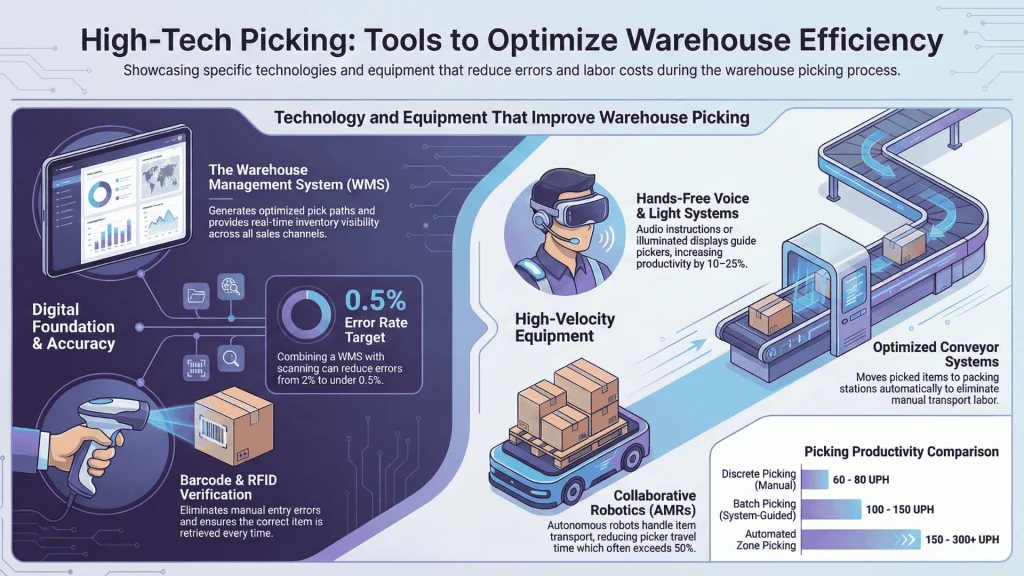
A warehouse management system is the foundation of efficient picking. Modern WMS platforms generate optimized pick lists, direct pickers through efficient routes, and provide real-time inventory visibility across all storage locations.
Key WMS picking features:
- Automated pick list generation based on order priority
- Optimized pick paths that minimize travel time
- Real-time inventory updates as items are picked
- Integration with sales channels (Shopify, WooCommerce, Amazon) for seamless order flow
- Bin location tracking for precise picker direction
- Replenishment alerts when forward pick areas run low
For multichannel sellers, a WMS that connects directly to your sales platforms eliminates manual order entry and ensures inventory accuracy across all channels.
Barcode Scanning and RFID
Barcode scanning is the most cost-effective way to verify picks and maintain inventory accuracy. Pickers scan items as they’re picked, confirming the right product and updating counts instantly.
Implementation options:
- Handheld RF scanners: Durable, purpose-built devices for warehouse use
- Smartphone apps: Lower cost option for smaller operations
- Wearable scanners: Ring or wrist-mounted for hands-free operation
RFID technology offers faster scanning without line-of-sight requirements but comes at higher cost. It’s typically justified for high-value inventory or bulk scanning operations.
Voice Picking Systems
Voice-directed picking uses audio instructions delivered through a headset, keeping pickers’ hands and eyes free. The system speaks the pick location and quantity; the picker confirms verbally.
Benefits:
- Hands-free operation increases pick speed
- Reduced training time (no screen navigation)
- Works well in challenging environments (cold storage, low light)
Voice picking typically delivers 10-25% productivity gains but requires investment in headsets and software integration.
Pick-to-Light Technology
Pick-to-light systems use illuminated displays at storage locations to guide pickers visually.
How it works: Lights illuminate at locations containing items needed for the current order. The picker takes the indicated quantity and presses a button to confirm.
Best for:
- High-velocity pick zones and forward pick areas
- Small parts with many SKUs in close proximity
- Operations prioritizing speed and accuracy equally
Installation costs make pick-to-light most viable for forward pick areas with high pick density rather than warehouse-wide deployment.
Automation and Robotics
Warehouse automation ranges from simple conveyor systems to fully autonomous mobile robots (AMRs).
Practical options for growing businesses:
- Conveyor systems: Move picked items to packing without manual transport
- Automated carousels: Bring items to the picker (goods-to-person)
- Collaborative robots: Transport carts or totes alongside pickers
- AMRs: Autonomous robots that navigate the warehouse independently
Most growing businesses start with a WMS, add barcode scanning, and evaluate automation as volumes justify the investment.
Looking for picking optimization without the complexity? Qoblex connects your inventory, orders, and fulfillment in one platform—with real-time visibility across Shopify, WooCommerce, Amazon, and B2B channels.
Measuring Picking Performance: Essential KPIs
You can’t improve what you don’t measure. These four metrics provide a complete picture of picking performance and help identify improvement opportunities.
Pick Accuracy Rate
Pick accuracy measures the percentage of orders picked correctly without errors.
Formula:
Pick Accuracy = (Total Orders Picked Correctly / Total Orders Picked) x 100
Benchmark: Target 99.5% or higher. World-class operations achieve 99.9%+.
What affects it: Training quality, pick verification methods, inventory accuracy, warehouse organization
Units Per Hour (UPH)
Units per hour measures picker productivity—how many individual items a picker retrieves in 60 minutes.
Formula:
UPH = Total Units Picked / Hours Worked
Benchmarks vary by method:
- Discrete picking: 60-80 UPH
- Batch picking: 100-150 UPH
- Zone picking with automation: 150-300+ UPH
Track UPH by picker, shift, and zone to identify training opportunities and process bottlenecks.
Order Cycle Time
Order cycle time measures how long it takes from order receipt to shipment readiness.
Formula:
Order Cycle Time = Ship-Ready Timestamp – Order Received Timestamp
What it tells you: Cycle time reveals bottlenecks across your entire fulfillment process, not just picking. If cycle time is high but picking UPH is good, look at packing, shipping label generation, or order release processes.
Cost Per Pick
Cost per pick quantifies the direct expense of each item picked—essential for understanding profitability and setting pricing.
Formula:
Cost Per Pick = Total Picking Labor Cost / Total Units Picked
What to include: Picker wages, supervision, equipment depreciation, warehouse space allocation for picking areas
Tracking cost per pick helps you evaluate technology investments. If automation reduces cost per pick by $0.05 and you pick 100,000 units monthly, that’s $5,000 in monthly savings to weigh against implementation costs.
Common Warehouse Picking Challenges and How to Solve Them
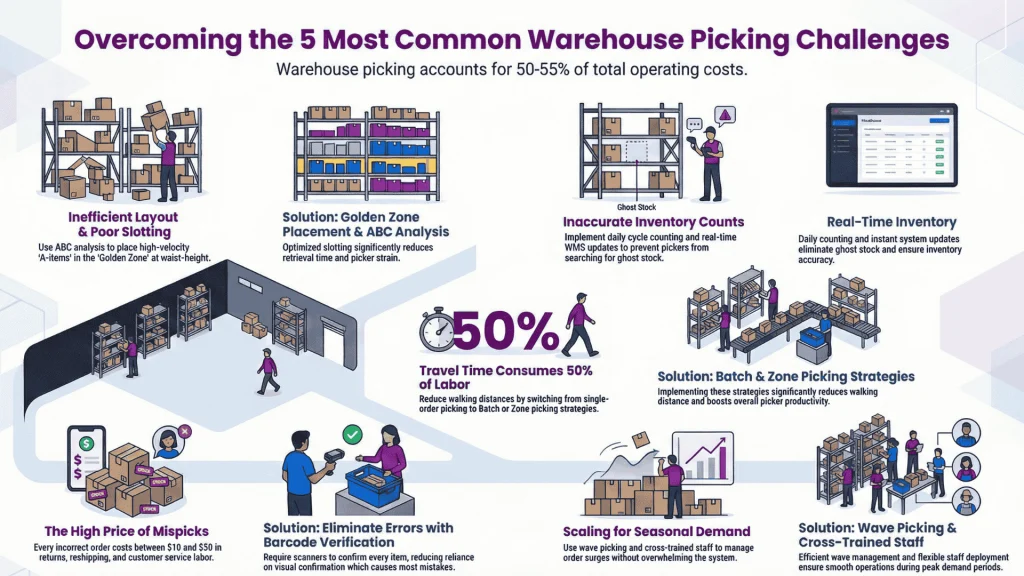
Every warehouse operation faces picking challenges. Here’s how to address the most common issues.
Inaccurate Inventory Counts
When your system says you have 50 units but the bin holds only 35, pickers waste time searching for items that don’t exist—and orders ship incomplete.
Solutions:
- Implement cycle counting programs (count a portion of inventory daily)
- Require barcode scanning at receiving and putaway
- Use a WMS that updates inventory in real time across all channels
- Set low-stock alerts to catch discrepancies before stockouts
Inventory accuracy below 97% will cause significant picking problems. Target 99%+ for smooth operations.
Inefficient Warehouse Layout
Poor slotting—where products are stored—forces pickers to travel excessive distances and creates congestion.
Solutions:
- Place fast-moving items in easily accessible locations (waist-height, near packing)
- Group frequently ordered-together items in adjacent bins
- Create dedicated forward pick areas for high-velocity SKUs
- Review and adjust slotting quarterly based on velocity data
- Ensure adequate aisle width for picker traffic flow
High Labor Costs
Labor is your largest picking expense. Reducing labor cost per order directly improves profitability.
Solutions:
- Implement batch or zone picking to reduce travel time
- Invest in route optimization through your WMS
- Cross-train pickers to balance workloads across zones
- Consider piece-rate incentives tied to accuracy and productivity
- Evaluate partial automation for highest-volume tasks
Seasonal Demand Fluctuations
Peak seasons can overwhelm picking operations designed for average volumes.
Solutions:
- Use demand forecasting to anticipate peaks and staff accordingly
- Pre-pick predictable orders (subscription, forecast-based) before the rush
- Implement wave picking to manage order flow during peaks
- Cross-train non-picking staff to assist during high-volume periods
- Consider temporary storage expansion for peak inventory
Picking Errors and Mispicks
Every mispick costs money and damages customer relationships. Understanding error types helps target solutions.
Common error types:
- Wrong item: Picker takes similar-looking product
- Wrong quantity: Short picks or overpicks
- Wrong location: Item taken from incorrect bin
- Missed item: Order ships incomplete
Solutions:
- Implement barcode verification at pick
- Use distinct packaging or labeling for similar SKUs
- Improve bin organization and labeling
- Add photo verification for high-error SKUs
- Review error patterns to identify systemic issues
Warehouse Picking Best Practices for Growing Businesses
These practices help growing ecommerce businesses and wholesalers build picking operations that scale.
Optimize Your Warehouse Layout for Picking
Your physical layout directly impacts picking efficiency. Apply these principles:
- ABC analysis: Classify inventory by velocity. A-items (top 20% of SKUs driving 80% of picks) belong in prime locations.
- Golden zone placement: Position A-items at waist-to-shoulder height where they’re fastest to access.
- Logical flow: Arrange pick paths to minimize backtracking. Pickers should move in one direction through the warehouse.
- Clear labeling: Every bin needs a clearly visible, unique identifier that matches your WMS.
Pro Tip: Run ABC analysis monthly during growth phases. A product that was a slow-mover six months ago might now be a bestseller deserving prime placement. Your WMS should make this data easily accessible.
Implement Real-Time Inventory Visibility
Accurate, real-time inventory data is non-negotiable for efficient picking.
What real-time visibility enables:
- Pickers always know exactly where items are located
- Stock levels update instantly as items are picked
- Overselling prevention across all sales channels
- Accurate available-to-promise for customer-facing inventory displays
Centralized inventory management that syncs across your warehouse, ecommerce platforms, and accounting system eliminates the data gaps that cause picking problems.
Train Your Team Continuously
Picking seems simple, but technique matters. Ongoing training improves both speed and accuracy.
Training priorities:
- Proper use of all equipment (scanners, carts, WMS interface)
- Understanding pick list information and location codes
- Quality standards and verification procedures
- Safety practices for lifting, ladder use, and equipment operation
- New procedures when strategies or layouts change
Document standard operating procedures and update them as processes evolve.
Leverage Technology Without Overcomplicating
Not every technology makes sense for every operation. Match investments to your actual needs.
Start with foundations:
- A WMS that integrates with your sales channels
- Barcode scanning for pick verification
- Organized bin locations with clear labeling
Add based on ROI:
- Voice picking when hands-free operation would boost productivity
- Pick-to-light for high-density forward pick areas
- Automation when volume justifies capital investment
Avoid implementing technology for its own sake. Each addition should solve a measurable problem or deliver quantifiable improvement in your picking optimization efforts.
Frequently Asked Questions About Warehouse Picking
What is the most efficient warehouse picking method?
The most efficient method depends on your operation. For high-volume ecommerce with many similar orders, batch picking typically offers the best efficiency gains by reducing travel time. Zone picking works best for large warehouses with diverse products. Growing businesses often achieve optimal results with hybrid approaches—such as zone-batch picking—that combine the benefits of multiple strategies.
How do I reduce picking errors in my warehouse?
Reducing picking errors requires a multi-layered approach. Start with barcode scanning to verify every pick against the order. Ensure your inventory counts are accurate through regular cycle counting. Organize bins clearly with distinct labels and consider separating similar-looking products. Train pickers on quality standards and review error data to identify patterns.
What technology do I need to improve warehouse picking?
At minimum, you need a warehouse management system (WMS) that generates pick lists and tracks inventory in real time, plus barcode scanners for pick verification. These two tools address the most common picking problems: inefficient routes and picking errors. Additional technology—voice picking, pick-to-light, automation—should be evaluated based on ROI for your specific volume.
How does picking connect to inventory management?
Picking and inventory management are inseparable. Every item picked reduces available inventory. If these updates don’t happen in real time across all your sales channels, you’ll face overselling, stockouts, and inaccurate inventory counts that make picking harder. A centralized inventory management system ensures stock levels update instantly everywhere—your WMS, Shopify store, Amazon listings, and wholesale portal.
What is pick and pack in warehouse operations?
Pick and pack refers to the combined process of retrieving items from storage (picking) and preparing them for shipment (packing). These are typically sequential steps—the picker collects items and delivers them to a packing station for verification and shipment preparation. Some smaller operations combine these roles, with the same person handling both pick and pack for each order.
How long should it take to pick an order?
Pick time varies based on order size, warehouse layout, and picking method. Single-item orders in an optimized warehouse typically take 1-3 minutes. Multi-item orders may take 5-15 minutes depending on complexity. Track your order cycle time and units per hour (UPH) to establish baselines, then work to improve through better slotting, optimized pick paths, and appropriate technology.
Key Takeaways
Before you go, here’s what to remember about warehouse picking:
- Picking is your biggest cost lever. At 50-55% of warehouse operating expenses, even small efficiency gains translate to significant savings.
- Match strategy to your operation. There’s no universal “best” picking method—the right choice depends on your order volume, SKU count, and channel mix.
- Start with the basics. A solid WMS with real-time inventory visibility and barcode scanning solves most picking problems before you need advanced technology.
- Measure to improve. Track pick accuracy, units per hour, cycle time, and cost per pick to identify and address bottlenecks.
- Plan for growth. Build picking processes that can scale with your business, not systems you’ll outgrow in six months.
Streamline Your Picking Process with the Right Tools
Efficient warehouse picking isn’t about working harder—it’s about working smarter. The right strategy eliminates unnecessary travel. Accurate inventory data ensures pickers find what they need. Proper verification catches errors before they become expensive problems.
For growing ecommerce businesses and wholesalers, picking optimization often delivers the fastest ROI of any operational improvement. Reducing pick time by seconds per order adds up to hours saved daily. Cutting error rates from 2% to 0.5% eliminates thousands of dollars in annual costs.
Start by measuring your current performance: pick accuracy, units per hour, and order cycle time. Identify your biggest bottleneck and address that first. As your business grows, evolve your approach, adding technology and complexity only when the numbers justify it.
Ready to simplify your warehouse operations? Qoblex brings your inventory, orders, and fulfillment together in one platform—with real-time visibility across every sales channel. Start your 14-day free trial and see how streamlined picking transforms your fulfillment.