


Understanding how efficiently your business uses its available resources can make the difference between sustainable growth and operational bottlenecks. Capacity utilization is one of the most critical metrics for manufacturers, distributors, and any business managing physical production or inventory operations.
Whether you’re running a small manufacturing operation or managing multiple warehouses, knowing your capacity utilization rate helps you make smarter decisions about expansion, staffing, equipment purchases, and inventory levels. This comprehensive guide breaks down everything you need to know about capacity utilization and how to leverage it for better business outcomes.
Understanding Capacity Utilization – The Basics
Capacity utilization measures the extent to which a business uses its productive capacity. In simple terms, it compares your actual output against the maximum output your operations could theoretically achieve with existing resources.
Think of capacity utilization as a measure of efficiency. If your manufacturing facility can produce 10,000 units per month at full capacity but currently produces 7,500 units, you’re operating at 75% capacity utilization. This percentage tells a powerful story about your operational efficiency, resource allocation, and growth potential.
Capacity utilization applies across various business contexts:
- Manufacturing operations track production line capacity and equipment usage to maximize throughput
- Warehouses and distribution centers measure storage space utilization and order fulfillment capacity
- Service businesses monitor staff productivity and billable hours against available work capacity
- Retailers analyze inventory turnover capacity and sales floor utilization
- Food production facilities balance production capacity with strict quality control and cleaning requirements
Regardless of your industry, understanding this metric helps you identify opportunities to optimize operations without unnecessary capital expenditure.
The concept extends beyond just physical production. It encompasses equipment usage, labor hours, warehouse space, and any finite resource that constrains your business output. High capacity utilization generally indicates efficient operations, while consistently low utilization suggests you may have excess capacity that’s driving up your fixed costs per unit.
For growing businesses, capacity utilization provides early warning signals. When your utilization rate consistently approaches 85-90%, it’s time to consider expansion. Conversely, sustained low utilization might indicate market challenges, inefficient processes, or opportunities to reduce overhead.
The Capacity Utilization Formula Explained
The capacity utilization formula is straightforward, making it accessible for businesses of all sizes. The basic formula is:
Capacity Utilization Rate = (Actual Output / Maximum Possible Output) × 100
Let's break down each component:
Actual Output represents what your business actually produces during a specific period. This could be units manufactured, orders fulfilled, products stored, or hours of service delivered. The key is measuring real production against a consistent timeframe.
Maximum Possible Output is the theoretical maximum your operations could achieve with current resources operating at full capacity. This assumes optimal conditions with minimal downtime, full staffing, and efficient processes. It's not about working equipment or people to exhaustion but rather the sustainable maximum output under ideal circumstances.
The multiplication by 100 converts the decimal result into a percentage, making it easier to understand and communicate. A capacity utilization rate of 0.75 becomes 75%, which clearly shows you're using three-quarters of your available capacity.
Some businesses refine this formula to account for planned downtime, maintenance windows, or seasonal variations. The adjusted formula might look like:
Adjusted Capacity Utilization = (Actual Output / Effective Capacity) × 100
Where effective capacity removes scheduled maintenance, changeovers, or other planned non-production periods from the maximum possible output. This provides a more realistic picture of operational efficiency.
Understanding the difference between design capacity, effective capacity, and actual output is crucial. Design capacity is the theoretical maximum under perfect conditions. Effective capacity accounts for real-world constraints like maintenance and setup time. Actual output is what you truly achieve. These distinctions help you set realistic targets and identify specific improvement opportunities.
How to Calculate Capacity Utilization Rate (Step-by-Step)
Calculating your capacity utilization rate requires gathering accurate data and applying the formula systematically. Here's a practical approach:
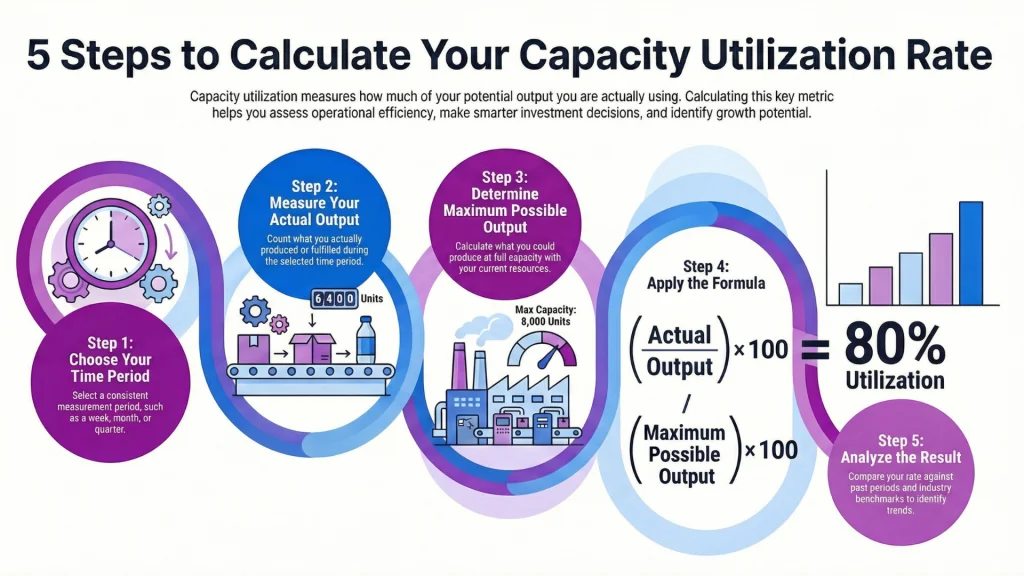
Step 1: Determine Your Time Period
Choose a consistent measurement period. Monthly calculations work well for most businesses, though weekly or quarterly periods may suit specific operations. The key is consistency across measurements to enable meaningful comparisons.
Step 2: Measure Actual Output
Count what you actually produced during the period. For manufacturers, this means units produced. For warehouses, it could be orders fulfilled or items stored. For service businesses, track billable hours or completed projects. Ensure you're measuring output, not input or effort.
Step 3: Calculate Maximum Possible Output
Determine what you could have produced if operating at full capacity. Consider your equipment capabilities, available labor hours, and operational constraints. If your production line can make 50 units per hour and operates 160 hours per month, your maximum possible output is 8,000 units.
Step 4: Apply the Formula
Divide actual output by maximum possible output and multiply by 100. If you produced 6,400 units with a maximum capacity of 8,000 units: (6,400 / 8,000) × 100 = 80% capacity utilization.
Step 5: Analyze and Context
Review your result within the context of your industry and business goals. An 80% capacity utilization rate might be excellent for one industry but concerning in another. Compare against previous periods to identify trends.
Here's a practical example for an eCommerce business using Qoblex for inventory management:
| Metric | Value |
| Available Warehouse Space | 50,000 sq ft |
| Space Currently Utilized | 42,500 sq ft |
| Capacity Utilization Rate | (42,500 / 50,000) × 100 = 85% |
This 85% utilization rate suggests the warehouse is operating efficiently while maintaining some buffer for demand fluctuations. The business can make informed decisions about whether to expand warehouse capacity or optimize existing space usage.
For multi-location operations, calculate capacity utilization for each facility separately, then aggregate for an overall picture. This granular approach reveals which locations operate efficiently and which need attention.
Why Capacity Utilization Matters for Your Business
Capacity utilization directly impacts your bottom line and strategic planning. Understanding this metric provides multiple business advantages that extend far beyond simple efficiency tracking.
Cost Management and Profitability
Fixed costs remain constant regardless of production volume. When capacity utilization is low, these fixed costs spread across fewer units, increasing your per-unit cost. Higher capacity utilization distributes fixed costs more effectively, improving profit margins without additional capital investment. This relationship between utilization and unit costs is fundamental to manufacturing economics.
Investment Decisions
Before purchasing new equipment or expanding facilities, examine your current capacity utilization. If you're consistently operating below 80% capacity, you likely don't need more resources. Instead, focus on filling existing capacity through better demand forecasting, marketing initiatives, or operational improvements. This prevents costly overinvestment in underutilized assets.
Operational Efficiency Insights
Capacity utilization reveals operational bottlenecks and inefficiencies. If certain production lines or warehouse sections consistently show low utilization, investigate why. Perhaps you have scheduling issues, maintenance problems, or demand misalignment. These insights drive targeted improvements rather than broad, unfocused initiatives.
Cash Flow Optimization
Higher capacity utilization improves cash flow by maximizing revenue from existing assets. Rather than tying up capital in new equipment or facilities, you generate more revenue from current resources. This preserves cash for other business needs like inventory investment, marketing, or working capital.
Competitive Positioning
Businesses operating at optimal capacity utilization can offer competitive pricing while maintaining healthy margins. Lower per-unit costs from efficient capacity use translate to pricing flexibility, enabling you to compete more effectively without sacrificing profitability.
Forecasting and Planning
Tracking capacity utilization over time reveals seasonal patterns and growth trends. This historical data improves demand forecasting and helps you plan capacity expansion proactively. You can anticipate when current capacity will become constraining and prepare accordingly, avoiding last-minute scrambles or lost sales opportunities.
For businesses using integrated inventory management systems like Qoblex, capacity utilization metrics combine with real-time inventory levels, order forecasts, and production schedules. This integration enables proactive capacity planning rather than reactive problem-solving.
Ideal Capacity Utilization Rate by Industry
The optimal capacity utilization rate varies significantly across industries. Understanding industry benchmarks helps you set realistic targets and evaluate your performance contextually.
| Industry | Typical Optimal Range | Key Considerations |
| Manufacturing | 80-85% | Allows for maintenance and demand flexibility |
| Warehousing & Distribution | 85-90% | Needs buffer for peak seasons and receiving |
| Food & Beverage Production | 75-80% | Requires frequent cleaning and changeovers |
| Chemical Manufacturing | 85-90% | High fixed costs favor higher utilization |
| Automotive Manufacturing | 80-85% | Model changes and retooling affect capacity |
| Consumer Goods | 80-85% | Seasonal demand creates variation |
| Pharmaceuticals | 70-80% | Stringent quality control and validation |
Why Not 100% Capacity?
Operating at 100% capacity utilization sounds ideal but creates significant risks. Equipment needs maintenance, workers need breaks, and unexpected demand spikes require buffer capacity. Sustained operation at maximum capacity leads to:
- Increased equipment breakdowns from lack of preventive maintenance and continuous stress on machinery
- Quality issues from rushed production schedules and insufficient time for proper inspections
- Worker burnout and safety incidents resulting from excessive overtime and fatigue
- Lost opportunities to accommodate rush orders, urgent customer requests, or unexpected demand spikes
- Higher defect rates and customer complaints due to compromised quality control processes
- Supply chain vulnerabilities with no buffer to absorb supplier delays or material shortages
Most successful businesses target 80-85% capacity utilization as the sweet spot. This range maximizes efficiency while maintaining operational flexibility and quality standards.
Economic Indicators
The Federal Reserve tracks capacity utilization as an economic indicator across U.S. manufacturing. Historical data shows the national average typically ranges between 75-80%, with variations reflecting economic cycles. During recessions, capacity utilization drops as demand weakens. In strong economies, it rises as businesses increase production to meet demand.
For your specific business, benchmark against direct competitors when possible. Industry associations often publish capacity utilization statistics that provide useful comparison points. However, focus primarily on your own trends rather than fixating on external benchmarks. Improvement over time matters more than matching an arbitrary industry average.
Factors That Impact Capacity Utilization
Multiple variables influence your capacity utilization rate. Understanding these factors helps you identify improvement opportunities and anticipate changes.
Demand Fluctuations
Customer demand directly impacts capacity utilization. Seasonal businesses experience predictable cycles, while others face more volatile demand patterns. Effective demand forecasting helps you align capacity with anticipated needs, avoiding both excess capacity during slow periods and capacity constraints during peak seasons.
Supply Chain Constraints
You can't produce without raw materials. Supply chain disruptions, delayed shipments, or inventory shortages force production slowdowns even when you have available capacity. Strong supplier relationships and safety stock strategies help maintain consistent capacity utilization despite supply chain variability.
Maintenance and Downtime
Planned maintenance is necessary but reduces available capacity. Unplanned breakdowns create even more significant disruptions. Preventive maintenance programs reduce unplanned downtime while scheduling planned maintenance during naturally slower periods minimizes utilization impact.
Labor Availability and Skills
Capacity depends on having appropriately skilled workers available. Labor shortages, high turnover, or insufficient training constrain your ability to utilize available equipment and space. Workforce planning should align with capacity targets to ensure you can actually achieve desired utilization rates.
Process Efficiency
Inefficient processes waste capacity. Long changeover times between products, quality issues requiring rework, or poor workflow design all reduce effective capacity utilization. Lean manufacturing principles and continuous improvement initiatives address these efficiency gaps.
Market Conditions
Economic downturns reduce demand, lowering capacity utilization across entire industries. Conversely, economic expansion increases demand and capacity utilization. While you can't control macroeconomic conditions, understanding these cycles helps you plan capacity investments strategically.
Technology and Equipment Age
Newer equipment typically operates more reliably and efficiently than aging machinery. As equipment ages, breakdowns increase and throughput may decline. Regular equipment assessment and strategic replacement planning maintain optimal capacity utilization.
Inventory Management Practices
For warehouse and distribution operations, inventory management directly affects space utilization. Poor inventory practices like excess stock, slow-moving items, or disorganized storage waste valuable capacity. Modern inventory management systems like Qoblex optimize stock levels and warehouse layout, maximizing space utilization while maintaining service levels.
Understanding which factors most significantly impact your capacity utilization enables targeted improvements. Rather than broadly trying to increase utilization, focus on the specific constraints limiting your operations.
How to Improve Your Capacity Utilization Rate
Improving capacity utilization doesn't always require major capital investments. Strategic operational improvements often deliver significant gains with minimal cost.
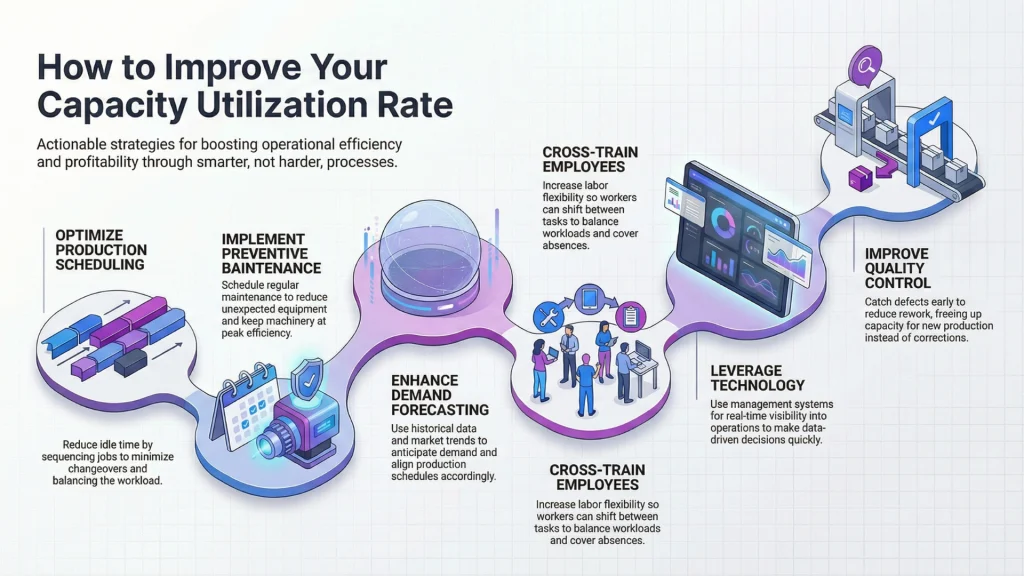
Optimize Production Scheduling
Better scheduling reduces idle time and maximizes equipment usage. Sequence jobs to minimize changeover time, schedule maintenance during naturally slower periods, and balance workload across all available resources. Advanced planning systems help you identify scheduling inefficiencies and optimize production flow.
Implement Preventive Maintenance
Planned maintenance is less disruptive than unexpected breakdowns. A structured preventive maintenance program reduces unplanned downtime while keeping equipment operating at peak efficiency. Track maintenance history to identify recurring issues and address root causes.
Enhance Demand Forecasting
Accurate demand forecasts enable better capacity planning. When you can anticipate demand patterns, you schedule production to match, maintaining higher utilization during peak periods and avoiding excess capacity during slow periods. Combine historical sales data, market trends, and seasonal patterns for more reliable forecasts.
Reduce Changeover Times
For businesses producing multiple products, changeover time between production runs wastes capacity. Apply Single-Minute Exchange of Die (SMED) principles to streamline changeovers. Standardize procedures, pre-stage materials, and train operators to minimize transition time.
Balance Production Lines
Identify bottlenecks constraining overall throughput. Even if most of your operation runs efficiently, a single bottleneck limits total capacity utilization. Balance production lines by adding capacity to bottleneck operations or redistributing work to underutilized resources.
Improve Quality Control
Defects and rework waste productive capacity. Strong quality control systems catch issues early, reducing the need to reproduce items. This frees up capacity for new production rather than correcting mistakes.
Cross-Train Employees
Labor flexibility improves capacity utilization by enabling workers to shift between tasks as needed. Cross-training ensures you can maintain production even when specific employees are unavailable and helps balance workload across your team.
Optimize Inventory Levels
For warehouse operations, right-sizing inventory improves space utilization. Eliminate slow-moving stock, negotiate better terms with suppliers to reduce safety stock requirements, and implement just-in-time principles where appropriate. Inventory management software provides visibility into stock movement patterns, helping you optimize inventory levels.
Leverage Technology and Automation
Modern inventory and operations management systems provide real-time visibility into capacity utilization. Platforms like Qoblex integrate inventory tracking, order management, and demand forecasting, enabling data-driven decisions that optimize capacity usage. Real-time dashboards reveal utilization patterns, helping you identify improvement opportunities quickly.
Consider Flexible Capacity Strategies
When permanent capacity expansion isn't justified, explore flexible alternatives. Contract manufacturing, third-party logistics providers, or temporary labor can provide surge capacity during peak periods without the fixed costs of permanent expansion.
Small improvements across multiple factors often deliver better results than dramatic changes in a single area. Take a systematic approach, measuring the impact of each initiative and building on successful improvements.
Capacity Utilization in Manufacturing and Inventory Management
Manufacturing and inventory management operations particularly benefit from careful capacity utilization monitoring. The relationship between production capacity and inventory levels creates complex optimization challenges.
Production-Inventory Balance
Manufacturers must balance production capacity utilization against inventory holding costs. Running at very high capacity utilization to minimize per-unit costs can lead to excess inventory if production exceeds demand. Conversely, producing strictly to order maximizes inventory efficiency but may underutilize production capacity.
The optimal strategy depends on your specific situation. Products with long shelf lives and stable demand may justify higher production utilization even if it creates modest inventory buildup. Perishable goods or products with volatile demand require tighter production-demand alignment, accepting somewhat lower capacity utilization to avoid obsolete inventory.
Multi-Warehouse Operations
Businesses operating multiple warehouses face additional complexity. Each warehouse has distinct capacity utilization characteristics based on location, customer base, and inventory mix. Integrated inventory management systems help optimize stock distribution across locations, balancing space utilization while maintaining service levels.
For example, a business using Qoblex can track capacity utilization across multiple warehouses in real-time. If one warehouse approaches full capacity while another has excess space, the system facilitates informed decisions about stock transfers, future receiving locations, or rebalancing inventory distribution.
Made-to-Order vs. Made-to-Stock
Your production strategy significantly impacts capacity utilization patterns. Made-to-order operations typically show more variable capacity utilization, fluctuating with order timing. Made-to-stock operations can maintain steadier utilization by producing to forecast rather than responding to individual orders.
Hybrid approaches balance these extremes. Produce core products to stock while handling customized items as made-to-order. This maintains base-level capacity utilization while preserving flexibility for customer-specific requirements.
Seasonal Planning
Many businesses face predictable seasonal demand patterns. Effective seasonal planning smooths capacity utilization across the year rather than creating extreme peaks and valleys. Key strategies include:
- Build inventory during off-peak seasons to prepare for high-demand periods, distributing production more evenly throughout the year
- Introduce counter-seasonal products that naturally peak during your slow periods, balancing overall demand
- Schedule major projects strategically by planning maintenance, equipment upgrades, and facility improvements during traditionally slow periods
- Implement flexible staffing models using temporary workers, overtime, or contract labor that scales up and down with seasonal needs
- Negotiate flexible supplier agreements that allow order quantity adjustments based on actual seasonal demand patterns
- Leverage demand forecasting to anticipate seasonal peaks and prepare capacity adjustments weeks or months in advance
This approach maintains steadier capacity utilization while avoiding the costs and risks of extreme variability.
Integration Benefits
Modern inventory management platforms integrate capacity tracking with broader operations management. This integration provides several advantages:
Real-time visibility into how inventory levels affect warehouse capacity utilization helps you make informed receiving and shipping decisions. When warehouse space is constrained, you can prioritize fast-moving items or high-value products.
Demand forecasting integration enables proactive capacity planning. When forecasts indicate upcoming demand increases, you can schedule production or arrange additional capacity before constraints emerge.
Order management integration reveals how order patterns affect capacity utilization. If certain products or customers create capacity challenges, you can adjust inventory positioning, pricing, or production scheduling accordingly.
Multi-location visibility enables optimization across your entire network rather than managing each facility in isolation. This network perspective often reveals opportunities to improve aggregate capacity utilization even if individual locations seem optimized.
Common Mistakes to Avoid When Measuring Capacity Utilization
Even experienced operations managers make mistakes when calculating and interpreting capacity utilization. Avoiding these common pitfalls leads to more accurate measurements and better decisions.
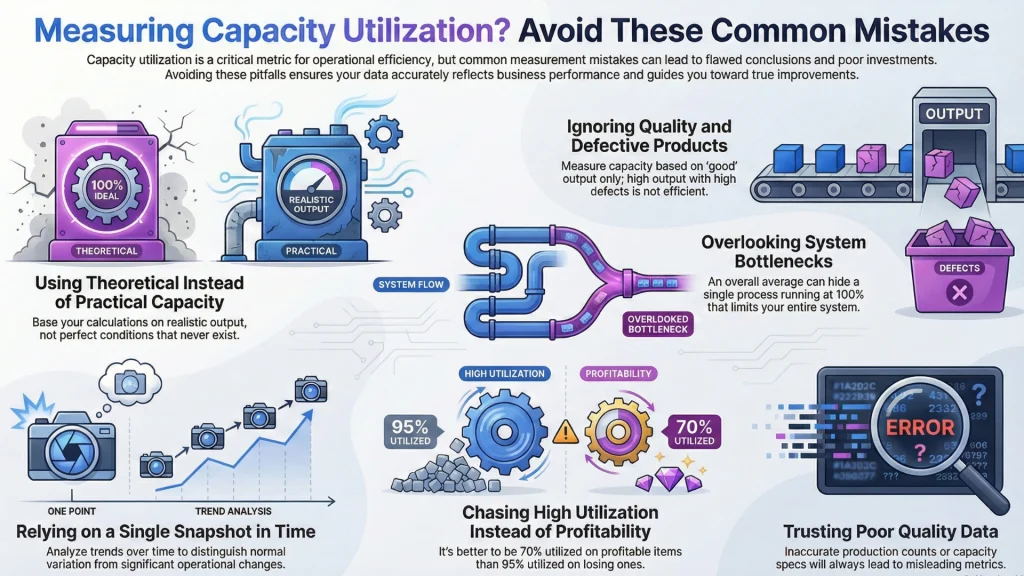
Using Theoretical Instead of Practical Capacity
Don't base capacity calculations on perfect conditions that never exist. If your equipment can theoretically produce 100 units per hour but realistically achieves 85 units when accounting for normal changeovers and variability, use 85 as your practical capacity. Unrealistic capacity assumptions make your utilization rates appear artificially low and can lead to poor investment decisions.
Ignoring Quality Considerations
High capacity utilization means nothing if you're producing defective products. Always measure capacity based on good output, not total output. A facility running at 90% capacity utilization but generating 20% defects is actually achieving only 72% effective capacity utilization.
Failing to Account for Product Mix
Not all products consume capacity equally. A simple average capacity utilization may mask significant variation across product lines. Some products may fully utilize capacity while others barely touch it. Analyze capacity utilization by product family or production line to get actionable insights.
Overlooking Bottlenecks
Overall capacity utilization can look reasonable while specific bottleneck operations run at 100% capacity, constraining total output. Identify and monitor bottleneck utilization separately since these operations limit your entire system's capacity.
Short-Term Focus
A single month's capacity utilization tells you little. Track trends over time to distinguish normal variation from meaningful changes. Seasonal businesses especially need multi-year perspective to separate seasonal patterns from underlying trends.
Neglecting External Factors
Don't assess capacity utilization in isolation. Consider market demand, competitive dynamics, and economic conditions. Low capacity utilization during a recession reflects market reality, not operational failure. Conversely, high utilization during a boom may mask inefficiencies that will become problematic when demand normalizes.
Overemphasizing Utilization Over Profitability
High capacity utilization isn't valuable if you're producing unprofitable products or building excess inventory. Always connect capacity utilization to financial outcomes. It's better to run at 70% utilization producing profitable products than 95% utilization on money-losing items.
Inconsistent Measurement
Use consistent definitions and measurement approaches across time periods and locations. Changing how you calculate capacity makes trend analysis impossible and prevents meaningful comparisons.
Ignoring Support Functions
Manufacturing capacity doesn't exist in isolation. Constraints in receiving, shipping, quality control, or maintenance affect overall capacity utilization. Take a systems perspective rather than focusing narrowly on production floor utilization.
Data Quality Issues
Capacity utilization is only as good as your underlying data. Inaccurate production counts, incorrect capacity specifications, or incomplete records lead to misleading metrics. Invest in reliable data collection systems and validate data quality regularly.
Avoiding these mistakes requires discipline and systems thinking. Look beyond simple metrics to understand the full operational picture.
Frequently Asked Questions About Capacity Utilization
What is a good capacity utilization rate?
For most manufacturers and distributors, 80-85% capacity utilization represents the optimal range. This level maximizes efficiency and cost-effectiveness while maintaining operational flexibility for maintenance, demand surges, and quality control. Rates consistently below 70% suggest excess capacity, while sustained operation above 90% risks quality problems, equipment breakdowns, and inability to handle unexpected demand.
How does capacity utilization affect pricing?
Higher capacity utilization spreads fixed costs across more units, reducing per-unit costs and potentially enabling lower prices while maintaining margins. Conversely, low capacity utilization increases per-unit costs, forcing higher prices or compressed margins. This relationship makes capacity utilization a key factor in competitive pricing strategy.
Should I always try to maximize capacity utilization?
No. While higher utilization generally improves economics, pushing utilization too high creates problems. Target the optimal range for your industry rather than maximum utilization. Leave buffer capacity for maintenance, quality control, and demand variability. Sustainable, profitable operation matters more than maximizing a single metric.
How often should I measure capacity utilization?
Monthly measurement works well for most businesses, providing regular feedback without excessive administrative burden. Weekly or daily tracking may benefit operations with high variability or rapid change, while quarterly measurement suffices for slower-moving businesses with stable operations. Consistency matters more than frequency—choose a schedule and stick with it.
What's the difference between capacity utilization and efficiency?
Capacity utilization measures how much of your available capacity you use, while efficiency measures how well you use it. You might operate at high capacity utilization but low efficiency if your processes waste time and resources. Both metrics matter—you want high utilization of efficiently operated capacity.
Can capacity utilization be too low?
Yes. Consistently low capacity utilization indicates excess capacity relative to demand. This situation increases per-unit costs since fixed expenses spread across fewer units. Very low utilization suggests you may need to reduce capacity, increase demand through sales and marketing, or explore new markets and products to fill available capacity.
How does inventory management affect capacity utilization?
For warehouse operations, inventory levels directly determine space capacity utilization. Poor inventory management with excess stock or slow-moving items wastes space capacity. In manufacturing, inventory levels affect production scheduling and capacity utilization—too little inventory creates production delays while excess inventory may enable higher utilization through longer production runs.
Does capacity utilization differ between industries?
Significantly. Capital-intensive industries like chemical manufacturing typically target higher utilization to justify large fixed investments. Industries with frequent changeovers or stringent quality requirements may accept lower utilization. Service businesses measure capacity differently than manufacturers. Always benchmark against similar businesses in your specific industry.
What tools help track capacity utilization?
Comprehensive inventory and operations management systems provide the best visibility. Platforms like Qoblex integrate inventory tracking, order management, and warehouse utilization, automatically calculating capacity metrics and providing real-time dashboards. This eliminates manual tracking and provides more accurate, timely data for decision-making.
How do I calculate capacity utilization for multiple shifts?
Multiply single-shift capacity by the number of shifts actually operated. If your facility can produce 1,000 units per shift and you run two shifts per day, your daily maximum capacity is 2,000 units. Calculate utilization based on actual output versus this multi-shift capacity. If you produced 1,600 units across two shifts, your capacity utilization is (1,600 / 2,000) × 100 = 80%.
Optimize Your Operations with Smart Inventory Management
Understanding and improving capacity utilization represents just one aspect of operational excellence. The most successful businesses take an integrated approach, connecting capacity management with inventory optimization, demand forecasting, and order fulfillment.
Modern inventory management systems provide the visibility and tools needed to optimize capacity utilization across your operations. Real-time data eliminates guesswork, enabling confident decisions about expansion, staffing, and resource allocation.
Qoblex simplifies capacity management for manufacturers and distributors by integrating inventory tracking, multi-warehouse management, and demand forecasting in a single platform. Track stock levels across locations, forecast demand accurately, and optimize warehouse space utilization while maintaining the flexibility to handle unexpected changes.
The platform's comprehensive reporting provides clear visibility into capacity utilization trends, helping you identify opportunities before they become problems. Whether you're managing a single location or coordinating across multiple warehouses, Qoblex gives you the insights needed to maximize efficiency and profitability.
Ready to optimize your inventory and warehouse operations? Start your free 14-day trial today—no credit card required. See how better inventory management translates directly to improved capacity utilization and operational efficiency.
Visit www.qoblex.com to learn more about how integrated inventory management supports better capacity planning and operational excellence for growing businesses.