



A guide written from the operator’s side of the table: which Cin7 Omni alternative actually fits the way your business runs, whether you need enterprise weight or a right-sized platform.
The best Cin7 Omni alternatives in 2026 are Brightpearl by Sage, NetSuite, Xorosoft, Qoblex, Unleashed, and Katana. Cin7 Omni is the enterprise tier built for high-volume multichannel operations that need native EDI, 700+ integrations, and 3PL connectivity, priced by custom quote. If your operation needs multichannel inventory, order management, and accounting sync without that enterprise layer, a right-sized alternative is likely the better fit.
If you have been through a Cin7 Omni evaluation, you already know the shape of the conversation. A sales call, a discovery questionnaire about your channels and warehouses, a mention of EDI and 3PL connections, and then a custom quote rather than a price on a page. That process is reasonable for the operation Omni is built for. It is also how a lot of growing businesses end up looking at a platform that is heavier than the job in front of them. This guide is meant to help you tell the difference.
Cin7 Core or Cin7 Omni: which one were you actually quoted?
This is the first thing to get straight, because Cin7 sells two separate products and it is easy to land on the wrong shortlist.
Cin7 Core (the product formerly called DEAR Inventory) is the small-to-mid-business tier with published pricing you can read straight off the Cin7 pricing page (Standard, Pro, and Advanced tiers). If that is what you are evaluating, our guide to the best Cin7 Core alternatives covers that shortlist in full, and this page is not the one you want.
Cin7 Omni is the enterprise tier. It is quote-based rather than published-price, and it carries native EDI, a much larger integration catalog, multi-entity support, and 3PL connectivity for high-volume multichannel operations. This guide covers Omni specifically.
The two share a company and a name, but they are different platforms with different buyers. Getting the routing right saves you from comparing an SMB tool against an enterprise one and wondering why the numbers do not line up.
What does Cin7 Omni include that Core doesn’t?
The 2023 rebrand is where the naming came from: the original Cin7 product became Cin7 Omni, and DEAR Inventory became Cin7 Core (Cin7 announced this in its newsroom). So if you remember “the old Cin7,” that lineage now lives in Omni.
On capability, Cin7 describes Omni as its platform for larger multichannel operations, with native EDI so you connect to big-box retailers without buying a separate third-party EDI service, 700+ integrations versus Core’s set of popular platform connectors, multi-entity management so you can run multiple brands or legal entities from one account, 3PL connectivity, and contract manufacturing with flexible cost configuration. That is a genuine enterprise feature set, and it is the reason the pricing is custom rather than listed.
On cost: Cin7 Omni does not publish a price. The Cin7 pricing page lists Core’s tiers openly and shows Omni as “contact us for pricing,” a custom quote sized to your order volume and user count. So the honest answer to “what does Omni cost” is that you have to ask, and the quote depends on your operation.
Who actually needs Cin7 Omni (and who doesn’t)?
The short version: Omni is built for scale and complexity. If you are trading through big-box retail with EDI requirements, running several entities, or coordinating outsourced warehousing through 3PLs, Omni’s weight is doing real work for you.
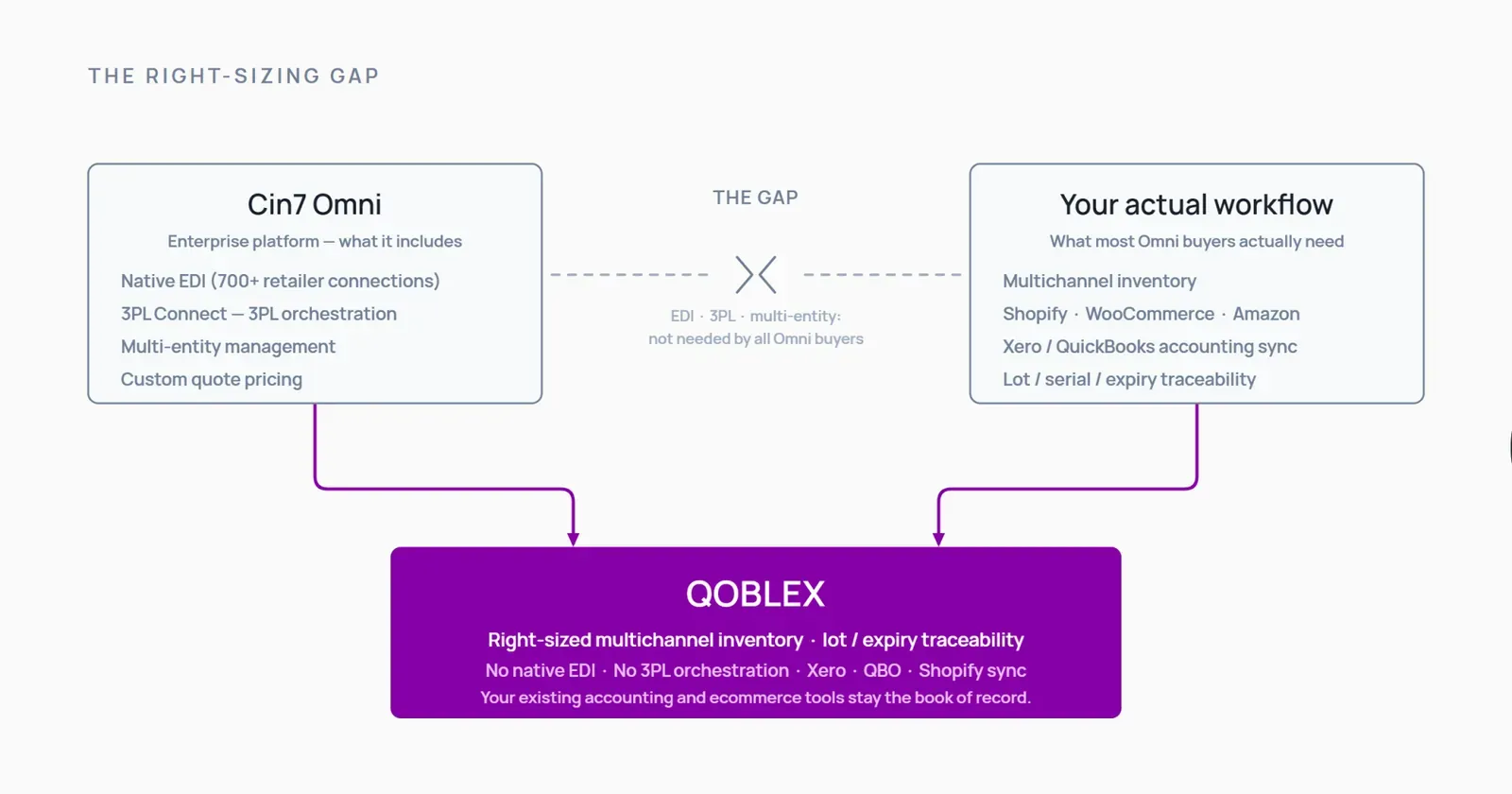
If your operation is multichannel inventory, purchasing, order management, and keeping your accounting and storefronts in agreement, without EDI, without 3PL orchestration, and without multiple legal entities, then a lot of what you are paying for in Omni is capability you will not switch on. That is not a knock on Omni. It is just a mismatch, and mismatches are expensive in both money and implementation time.
What to look for in a Cin7 Omni alternative
Before you compare tools, get honest about which of Omni’s capabilities you actually use or genuinely plan to use in the next year. The decision usually comes down to a few questions.
Do you need native EDI? EDI matters if your customers are large retailers who require electronic data interchange for purchase orders, invoices, and shipping notices. If you sell direct-to-consumer and through marketplaces, you probably do not need it, and building your shortlist around it will steer you toward heavier platforms than the job requires.
Do you connect to 3PL providers? If outsourced warehouses handle your fulfillment and you need tight two-way integration with them, that narrows the field to platforms with real 3PL orchestration. If you run your own stock across your own locations, it does not.
Do you run multiple entities? Multi-brand or multi-legal-entity operations with intercompany transactions need a platform designed for that. A single trading entity does not.
What does your accounting and ecommerce stack look like? Most growing operators want multichannel inventory that syncs cleanly with Xero or QuickBooks and with Shopify, WooCommerce, or Amazon, so those tools stay the book of record. That requirement is common to almost every buyer on this list, so it is table stakes rather than a differentiator.
Answer those four honestly and your shortlist mostly sorts itself: enterprise EDI/3PL/multi-entity needs point to Brightpearl or NetSuite, and everything else points to a right-sized platform.
The 6 best Cin7 Omni alternatives in 2026: at a glance
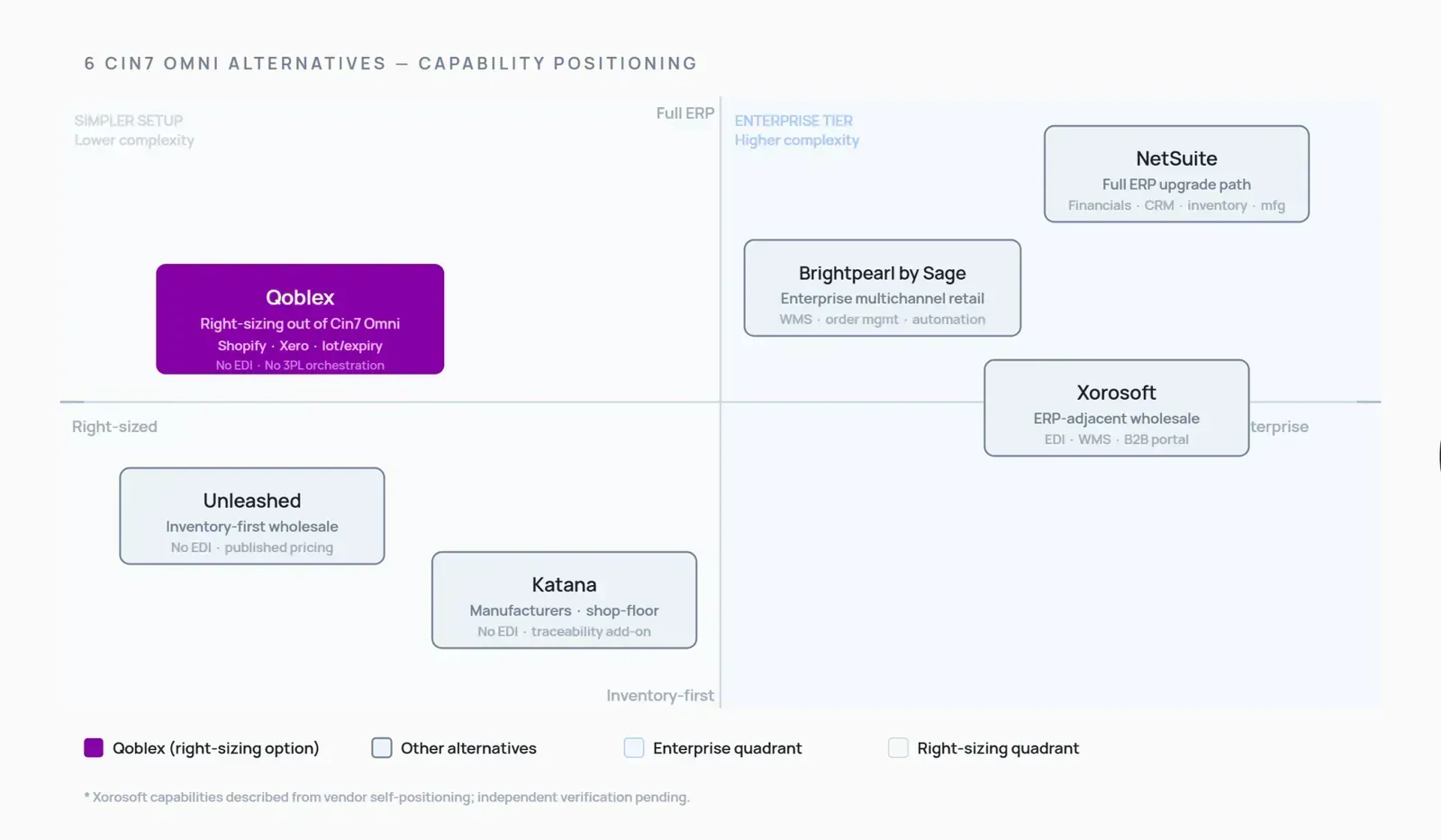
The table below is capability-led, not price-led. The real decision here is fit, not cost, so pricing appears only as a model descriptor. Where a competitor’s specific capability has not been independently verified, the cell says so rather than inventing a spec.
| Tool | Primary use case | Native EDI | 3PL integration | Xero / QBO / Shopify sync | Lot / expiry traceability | Pricing model |
|---|---|---|---|---|---|---|
| Brightpearl by Sage | Enterprise multichannel retail/wholesale | Retail-oriented platform; confirm current EDI scope with Brightpearl | Retail operations platform; confirm 3PL scope with Brightpearl | Integrates with major accounting and ecommerce platforms | WMS includes serial, lot, and expiry tracking | Custom quote, see pricing |
| NetSuite | Full ERP (financials, CRM, inventory, manufacturing) | ERP-level, via configuration/partners | ERP-level, via configuration/partners | Native GL; connects to ecommerce via SuiteApps | Advanced inventory module | Custom quote, quote-only |
| Xorosoft | Multichannel wholesale and light distribution | Vendor positions EDI connectivity; confirm depth | Vendor positions 3PL via WMS; confirm depth | Vendor states accounting and ecommerce connectivity | Lot-tracking depth not independently confirmed | Published tiers, see pricing |
| Qoblex | Right-sizing out of Cin7 Omni for multichannel inventory + traceability | Not offered | Not offered (no 3PL orchestration) | Native Shopify, WooCommerce, Amazon, Xero, QuickBooks | Lot / serial / expiry and FEFO (paid add-on) | Structure on qoblex.com/pricing |
| Unleashed | Inventory-first wholesale and distribution | Not offered | Via integrations, not native orchestration | Native Shopify; Xero and QuickBooks | Batch and expiry tracking | Published tiered subscription, see pricing |
| Katana | Product manufacturers needing multichannel inventory | Not offered | Via integrations | Shopify, Xero, QuickBooks | Via Full Traceability add-on | Published tiers plus add-on, see pricing |
Detailed reviews: which Cin7 Omni alternative is right for your operation?
1. Brightpearl by Sage: best for high-volume multichannel retailers needing an enterprise platform
If you genuinely need an Omni-class platform, Brightpearl by Sage is the closest same-tier peer on this list. It is a retail operations platform built for higher-volume merchants, covering multichannel order management, inventory, retail fulfillment automation, and financials. Sage completed its acquisition of Brightpearl in 2022, which is why the correct name is Brightpearl by Sage.
Brightpearl’s warehouse management includes serial, lot, and expiry date tracking, so traceability is not a gap for the enterprise retail buyer. Pricing is custom quote only; Brightpearl does not publish figures and builds a bespoke setup per customer, so contact them for current pricing rather than trusting a third-party number. One thing to plan for: Brightpearl’s own pricing page states customers go live in 90 to 120 days on average, so this is an implementation with real lead time, not a same-week switch.
Brightpearl is not a right-sizing option. It is the honest choice when your operation is genuinely enterprise-scale retail and you want a platform sized to match.
2. NetSuite: best for businesses ready for a full ERP
NetSuite is the one option on this list that is more platform than Cin7 Omni, not less. It is a full ERP: unified financials, CRM, inventory, and manufacturing in one system. If you have outgrown Omni’s scope and you are consolidating multiple systems into a single ERP of record, NetSuite is the upgrade path rather than a lateral move.
That power comes with ERP-grade cost, implementation, and administration. NetSuite is quote-only with no published pricing; third-party analyses estimate a base around $999/mo plus roughly $129 to $199 per user per month (erpresearch.com), but treat that strictly as a third-party estimate because actual pricing is a custom quote. Choose NetSuite when the requirement is a whole business system, not just better inventory and order management.
3. Xorosoft: best for multichannel wholesale and light distribution
Xorosoft positions itself as an ERP-adjacent platform for multichannel wholesale and distribution, and it comes up repeatedly in this comparison space. On its own site it describes cloud ERP, real-time inventory, warehouse management, an accounting suite, ecommerce and EDI connectivity, a B2B portal, and 3PL support through its WMS integrations, with published subscription tiers.
We are describing Xorosoft from its own positioning here rather than from independent verification. If Xorosoft is on your shortlist, confirm the specifics that matter to you, especially EDI depth, 3PL integration, and lot-tracking capability, directly with them before committing, because those cells have not been independently verified for this guide.
4. Qoblex: best for right-sizing out of Cin7 Omni
Here is the honest placement: Qoblex sits at number four on this list, not number one, because it is not an Omni replacement for every buyer. It is the right choice for a specific and common situation: you were quoted Cin7 Omni for multichannel inventory, purchasing, accounting and storefront sync, and lot or expiry traceability, but your operation does not require native EDI, 3PL orchestration, or multi-entity management.
For that operator, Qoblex closes the inventory and traceability gap while your existing accounting and ecommerce tools stay your book of record. It offers native multichannel inventory across Shopify, WooCommerce, and Amazon, with Xero and QuickBooks accounting sync, so multichannel inventory management stays in one place without forcing a platform migration on your accounting. It includes lot, serial, and expiry tracking with FEFO picking as a paid add-on rather than a base-plan feature, and it ships Bills of Materials (BOM) and production orders for businesses that assemble or manufacture. Setup is self-serve with a 14-day free trial and no mandatory annual contract. For current tiers and the traceability add-on, see qoblex.com/pricing.
Now the scope boundary, stated plainly because it is what earns the trust: Qoblex does not offer native EDI, and it does not do 3PL orchestration or multi-entity management. If your business trades through big-box retailers who require EDI, or runs fulfillment through 3PLs you need to orchestrate, or operates multiple entities with intercompany transactions, Qoblex is not the tool for that, and Cin7 Omni, Brightpearl, or NetSuite are the honest answers. Qoblex is for the operator whose real workflow lives below that line.
5. Unleashed: best for inventory-first wholesale and distribution
Unleashed is a solid mid-tier option for wholesale and distribution operators who want strong multichannel inventory and B2B order management without enterprise overhead. It is inventory-first, with native Shopify sync and Xero and QuickBooks accounting integration, and it uses a published tiered subscription (see unleashedsoftware.com for current tiers).
Set expectations correctly: Unleashed does not offer native EDI and is not an Omni-tier platform. If EDI or 3PL orchestration is a hard requirement, it is not the fit. If your priority is clean multichannel inventory and wholesale order handling, it is a credible right-sized choice.
6. Katana: best for product manufacturers needing multichannel inventory
If Omni came up because you make what you sell, Katana is worth a look. It is manufacturing-first, with stronger shop-floor and production workflow than most inventory platforms, alongside multichannel inventory and Shopify, Xero, and QuickBooks connections. Pricing is a published Core tier plus add-ons (see katanamrp.com); notably, lot, batch, serial, and expiry tracking sits behind a separate Full Traceability add-on rather than the base plan, so factor that in if traceability is central to your operation.
Katana is weaker than Qoblex on accounting-sync depth and treats traceability as an add-on, so the manufacturer choosing between them should weigh shop-floor depth against accounting and traceability fit. For a fuller head-to-head, see our Katana alternatives guide.
How to choose: which Cin7 Omni alternative fits your operation?
Map your operation to the shortlist and the choice gets straightforward.
If you need enterprise EDI, 3PL orchestration, or multi-entity management, stay in the enterprise tier: Brightpearl by Sage for high-volume multichannel retail, or NetSuite if you are consolidating your whole business into a single ERP.
If your priority is right-sized multichannel inventory with clean accounting and storefront sync and no EDI, look at Qoblex when lot and expiry traceability matters, or Unleashed when the emphasis is wholesale and distribution inventory.
If you manufacture, weigh Katana for shop-floor depth against Qoblex for accounting-sync and traceability fit.
And if you are genuinely a wholesale-and-distribution operator sizing an ERP-adjacent platform, Xorosoft is worth adding to that same-tier comparison, with the verification caveats above.
The wrong move is choosing the heaviest platform “to be safe.” Capability you do not use still costs money to license and time to implement, and it makes the system harder for your team to run.
When Cin7 Omni is genuinely the right call
Omni earns its complexity for the operation it is built for. The question this guide helps you answer is whether your actual workflow requires that complexity. For a real set of buyers, it does, and the honest answer is to stay.
Choose or keep Cin7 Omni if you manage high-volume multichannel operations selling into big-box retailers who require EDI. Omni’s native EDI connections mean you do not stand up a separate third-party EDI service, and that is a genuine operational advantage.
Choose Omni if you run a multi-entity operation, several brands or legal entities, and need unified inventory and order management with intercompany visibility across all of them. Omni’s multi-entity support is built for exactly that.
Choose Omni if you rely on 3PL providers for warehousing and need tight, two-way 3PL integration. Its 3PL connectivity is purpose-built, and stitching that together on a lighter platform is not worth the effort.
And if you have already implemented Cin7 Omni and it is serving your workflow, the switching cost is real. A platform that fits is worth keeping. Do not switch for the sake of switching.
FAQ: Cin7 Omni alternatives
What is the difference between Cin7 Core and Cin7 Omni? They are two separate products from the same company. Cin7 Core (formerly DEAR Inventory) is the small-to-mid-business tier with published pricing. Cin7 Omni is the enterprise tier: custom quote, native EDI, 700+ integrations, multi-entity management, and 3PL connectivity for high-volume multichannel operations.
Is Cin7 Omni priced publicly? No. The Cin7 pricing page lists Core’s tiers openly but shows Omni as a custom quote sized to your order volume and users.
Does Cin7 Omni include native EDI? Yes. Cin7 describes Omni as including native EDI, so you connect to large retailers without a separate third-party EDI service. It is one of Omni’s primary enterprise differentiators.
Which Cin7 Omni alternative is best for large multichannel retailers? Brightpearl by Sage. It is a retail operations platform built for higher-volume multichannel merchants and is the closest same-tier peer to Omni on this list.
Which Cin7 Omni alternative is best for businesses that don’t need EDI? It depends on your priority: Qoblex if lot and expiry traceability matters, Unleashed for wholesale and distribution inventory, or Katana if you manufacture. All three are right-sized for operations that do not require EDI or 3PL orchestration.
Is Qoblex a replacement for Cin7 Omni? Not for every buyer. Qoblex does not offer native EDI or 3PL orchestration. It is a right-sizing option for operators who need multichannel inventory, accounting and storefront sync, and traceability, but whose workflow does not require Omni’s enterprise layer.
What does Brightpearl by Sage cost compared to Cin7 Omni? Both are custom quote. Brightpearl does not publish pricing and neither does Omni, so contact each vendor for a figure sized to your operation rather than relying on third-party estimates.
When should I choose NetSuite over Cin7 Omni? When you need a full ERP, unified financials, CRM, inventory, and manufacturing in one system, rather than best-in-class inventory and order management. NetSuite is the upgrade path beyond Omni’s scope, not a lateral alternative.
Is Cin7 Omni good for small business? Omni is built for enterprise complexity. A small business with a simpler workflow is usually better served by Cin7 Core or a right-sized alternative, and pays less to run something that fits.
Are there Cin7 Omni alternatives with a free trial? Yes. Qoblex offers a 14-day free trial with no credit card required, and Katana offers a free plan for a small SKU count. Brightpearl and NetSuite are demo and quote only.
Conclusion: your next step
Route yourself by what your operation actually does. If you need EDI, 3PL orchestration, or multi-entity management, compare Brightpearl by Sage and NetSuite and expect an enterprise implementation. If your real need is right-sized multichannel inventory with clean accounting and storefront sync, and traceability that turns on when you need it, take a closer look at Qoblex or Unleashed. And if you landed here evaluating the SMB tier by mistake, our best Cin7 Core alternatives guide is the shortlist you want. The goal is not the biggest platform. It is the one sized to the way your business actually runs.