


Across Black Friday 2024 and 2025, Adobe Analytics found US online shoppers buying earlier and Cyber Monday staying the biggest US online day, which Adobe Digital Insights called the last call in 2024, while among Klaviyo brands in 2025 those offering the smallest discounts grew fastest. In our reading, each lesson becomes one stock decision: hold a Buffer in Qoblex from before Thanksgiving week, then lower it for Cyber Monday.
Thanksgiving falls on Thursday 26 November 2026, Black Friday on 27 November and Cyber Monday on 30 November. Keeping stock in agreement across several online stores comes up often on our demo calls, so we read two seasons of published figures from the stock side. The figures are the sources’ findings and the stock decisions are our reading; sales-side ideas are in our holiday sales tips.
What worked on Black Friday in 2024 and 2025, and what does each lesson mean for stock?
Seven lessons from the 2024 and 2025 Black Friday seasons are supported by published figures, and in our reading each one leads to a single stock decision a small brand makes in November 2026, set out in the table below.
Adobe Analytics and Adobe Digital Insights report US online sales, Salesforce publishes modelled estimates, global and US, and Shopify reports the gross merchandise volume of its merchants worldwide. The NRF survey, run with Prosper Insights & Analytics, counts people rather than dollars, and Klaviyo’s 2025 figures come from a same-site cohort of 10,000 Klaviyo brands. So no figure here is set against another source’s as if both measured one thing.
| Lesson | What the 2024 and 2025 figures say (source, year, scope) | The stock decision for November 2026 (our reading) | Where it lives in Qoblex |
|---|---|---|---|
| 1. Deals started earlier | Adobe Analytics, 2025, US online: Black Friday $11.8 billion, up 9.1%. NRF, 2024, shopper survey: 38% of shoppers took advantage of sales the week before Thanksgiving weekend. | Buffer set and count finished by 18 November. | Buffer, variant Inventory tab |
| 2. Cyber Monday stayed the biggest online day and the last call | Adobe Analytics, 2025, US online: $14.25 billion, up 7.1%. Adobe Digital Insights, 2024: "last call". Salesforce, 2024, modelled, global and US: Black Friday strongest. | Hold stock back all weekend, lower the Buffer on Monday. | Buffer |
| 3. Phones carried most online shopping | Adobe Analytics, 2025, US online: Thanksgiving mobile share 61.6%; 82.2% of buy now pay later purchases on smartphones. | Overselling off on hero variants by 26 November. | Continue selling when out of stock |
| 4. AI-referred shoppers converted, from a small base | Adobe Analytics, 2025, US retail sites: AI traffic up 760%, "the base of users remains modest"; Adobe blog: converted 31% more. Salesforce, 2025, modelled, global: AI and agents influenced 20% of orders, its own broad measure. | Hero variants' figures checked on 25 November. | Stock on Hand: Total Buffer Quantity, Total Available Quantity |
| 5. Moderate discounts and repeat buyers | Klaviyo, 2025, 10,000 Klaviyo brands: smallest discounters +14%; repeat-customer revenue +13.5%. Adobe, 2024, US online: demand up 1.029% per 1% price decrease. | Offer fixed first, Buffer sized from it. | Buffer |
| 6. Beauty, apparel and fitness lead on Shopify | Shopify, 2025 and 2024, merchants worldwide, GMV: cosmetics, clothing tops and pants, activewear, fitness and nutrition. Klaviyo, 2025: Health & Beauty +14%, Apparel +11%. | Top lines buffered in one pass per location. | Stocktake CSV BufferQuantity |
| 7. The weekend is not one spike | Klaviyo, 2025, 10,000 brands: Cyber Sunday fastest growing; Cyber Monday +11%, Black Friday +10%. Adobe Analytics, 2025, US online: Black Friday 9.1%, Cyber Monday 7.1%. | Old orders that will never ship cleared before a mid-weekend delivery. | Awaiting Stock orders |
When does a small brand’s Black Friday stock need to be ready?
In our reading, a small brand’s Black Friday stock needs to be counted and its Buffer set before Thanksgiving week, because Adobe Analytics reported that Black Friday growth outpaced Cyber Monday growth in both 2024 and 2025 as shoppers embraced early deals, and NRF found that 38% of shoppers took advantage of sales in the week before the 2024 Thanksgiving holiday weekend.
Lesson 1: deals started earlier
Shoppers bought earlier in both seasons, by Adobe’s count of US online sales. Adobe Analytics counted $11.8 billion of US online spending on Black Friday 2025, up 9.1%, the second season in a row in which Black Friday growth outpaced Cyber Monday, “as shoppers embraced early, competitive deals.” The 2024 NRF and Prosper Insights & Analytics survey found that 38% of shoppers took advantage of sales specifically during the week before the Thanksgiving holiday weekend.
We read that as a deadline, because a Buffer set on the Wednesday night protects nothing sold the week before. So the team buffers its hero variants and finishes the count around Wednesday 18 November, and supplier lead times have to allow for that.
Lesson 2: Cyber Monday stayed the biggest online day, and the last call
Cyber Monday stayed the biggest online shopping day in Adobe’s US data in 2024 and 2025. Adobe Analytics counted $14.25 billion of US online spending on Cyber Monday 2025, up 7.1%, the biggest online shopping day of all time. Reviewing Cyber Week 2024, Adobe Digital Insights called Cyber Monday “last call” for shoppers, a remark about 2024 rather than a forecast. Salesforce’s 2024 release named Black Friday the strongest shopping day of the week, on its own modelled global and US estimates.
In our reading, a brand that sells its best-seller out by Sunday has none left for the day Adobe ranks first. So the team holds part of it behind a Buffer through the weekend and lowers the Buffer on Monday, as the example below shows.
What do phones, buy now pay later and AI answers change about the stock a store shows?
In our reading, phones, buy now pay later and AI answers change one thing about stock for a small brand: more orders arrive at any hour from shoppers who never talk to anyone, so the store’s stock figure has to be right before the rush, not corrected during it.
Lesson 3: phones carried the orders and buy now pay later is almost all phone
Phones carried most of US online shopping on Thanksgiving 2025, by Adobe’s count. Adobe Analytics found that mobile share crossed 60% for the first time that day, at 61.6%, and reported that smartphones drove 82.2% of US online buy now pay later purchases over the 2025 season.
In our reading, an order placed at midnight lands with nobody awake to check it, so before 26 November the team sets Continue selling when out of stock to No on hero variants that sell only from real stock. Left on, the setting makes Qoblex allocate every order for the product in full, so orders show Ready To Ship with no stock behind them. These hero variants should not oversell in the store either, because the store shows sold out only when it stops selling at zero. While the Continue selling when sold out checkbox in the store’s integration settings is ticked, the setting syncs in the same direction as product information, so the team switches overselling off in the store as well: otherwise a store still set to oversell keeps taking orders once Available reaches zero, and its next product update switches the setting back on in Qoblex. Orders already allocated have to be deallocated and allocated again, as our guide to Ready To Ship orders without stock explains.
Lesson 4: AI-referred shoppers arrived and converted
AI-referred shoppers grew fast in 2025 and converted well, from a small base. Adobe Analytics counted AI traffic to US retail sites up 760% from 1 November to 1 December 2025, noting that the base of users remains modest, and Adobe’s blog found AI referrals converting 31% more than other traffic sources in 2025. Salesforce’s 2025 modelled estimates say AI and agents influenced 20% of global orders, its own broad measure covering personalized product recommendations and conversational customer service.
No source says AI shoppers cause stock-outs, so our decision is a precaution. A shopper sent by an AI answer lands on one product page, often a best-seller’s, and that page should show only what is really there, so on 25 November the team checks Total Buffer Quantity against Total Available Quantity on the Stock on Hand report for those hero variants.
How does a Buffer protect Black Friday stock across the five days of Cyber Week 2026?
In Qoblex, a small brand protects its Black Friday stock by setting a Buffer for each variant at each location on the variant’s Inventory tab, because Available, which is In stock minus Allocated minus Buffer, is the number Qoblex sends to Shopify and WooCommerce.
Only users with access to adjustments can edit the Buffer, which cannot be negative. Shipping an order uses up its own allocation, so In stock and Allocated fall together and Available moves only with new orders and Buffer changes.
Let’s assume a brand’s best-selling serum has carried a Buffer of 60 at its one warehouse since Wednesday 18 November, and once the early-deal week’s orders have shipped it holds 300 units on the evening of Wednesday 25 November. Each order is for one unit.
- Wednesday 25 November. The team checks the Inventory tab: In stock 300, Allocated 0 and Buffer 60, unchanged since the 18th, so Available is 300 minus 0 minus 60, which is 240, the number Qoblex sends to Shopify and WooCommerce.
- Thursday 26 November (Thanksgiving). Shoppers place 80 orders, so Available falls from 240 to 160 while the Buffer stays at 60.
- Friday 27 November (Black Friday). Shoppers place 100 orders, so Available falls from 160 to 60.
- Saturday 28 and Sunday 29 November. Shoppers place 30 orders a day, so Available is 60 on Saturday morning, 30 on Sunday morning and 0 on Sunday night, and the store shows sold out while 60 units sit in the Buffer.
- Monday 30 November (Cyber Monday). With the 240 orders shipped, In stock is 60, Allocated 0, Buffer 60 and Available 0. The team lowers the Buffer from 60 to 20, so Available becomes 60 minus 0 minus 20, which is 40. Shoppers place 40 orders, and the 20 units left are the Buffer.
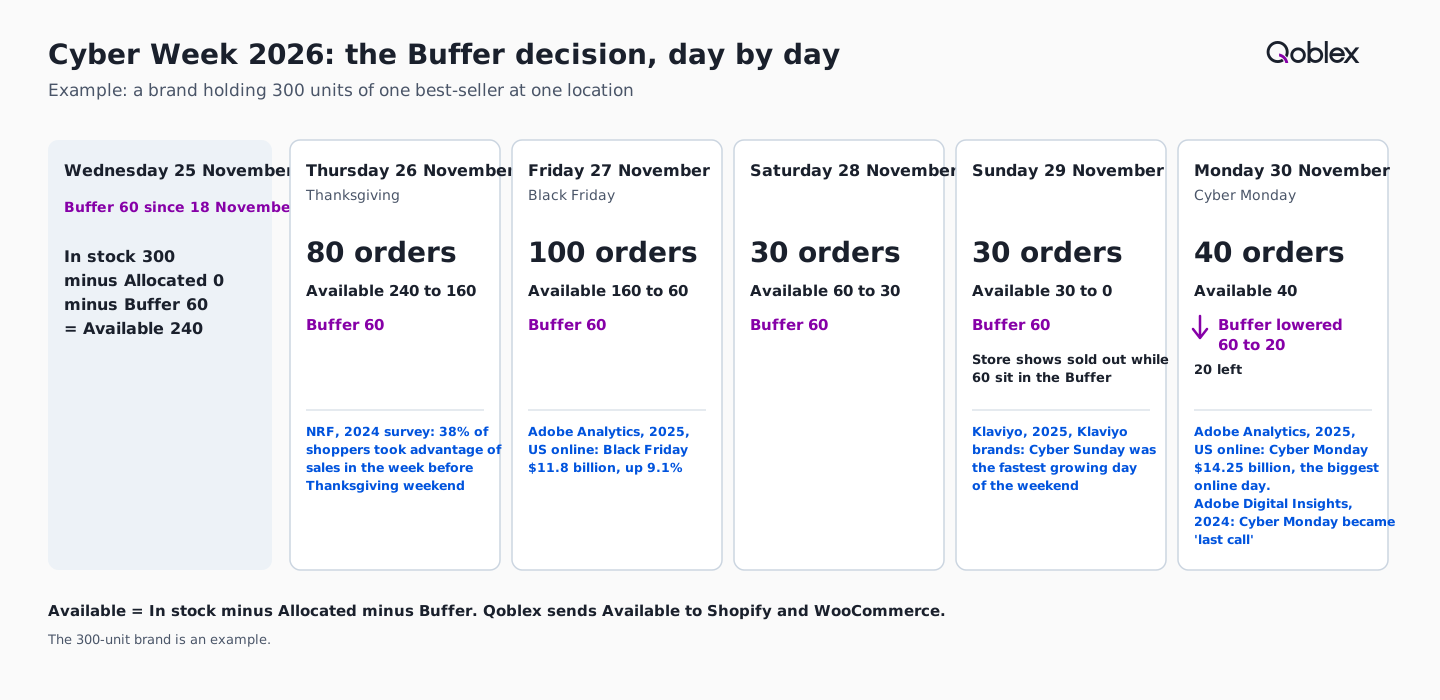
The five days add up: 240 + 40 + 20 = 300. In our reading, the brand holds back because Adobe Digital Insights called Cyber Monday the last call in 2024, because one miscount in a pick should not oversell the last units, and because the 20 left are a cushion. The sizes are its own judgement, not a rule or a market figure, and its last Cyber Week should move them.
How deep should the discount go, and which lines need the most stock protection?
Klaviyo’s 2025 data found that brands offering the smallest discounts grew fastest across Black Friday Cyber Monday, so in our reading a small brand settles the offer first and sizes the Buffer from it, and protects the lines the strongest categories point to.
Lesson 5: moderate discounts and repeat buyers
The smallest discounters grew fastest in Klaviyo’s 2025 cohort. Klaviyo’s figures for a same-site cohort of 10,000 Klaviyo brands show growth of +14% for those offering the smallest discounts, and repeat-customer revenue up 13.5% as those customers responded to loyalty tactics like early access rather than blanket discounts. Adobe’s 2024 season recap reads the other way on price: in US online data, for every 1% decrease in price, demand increased by 1.029% compared to the 2023 season.
The two measure different populations. In our reading, a moderate offer moves units over several days rather than clearing the shelf on Friday, so the team sizes the Buffer once the offer is fixed.
Lesson 6: beauty, apparel and fitness lead on Shopify
Beauty, apparel and fitness led Shopify’s categories in 2024 and 2025. Shopify’s 2025 data, from the GMV of its merchants worldwide, named cosmetics, clothing tops and pants, activewear, and fitness and nutrition as the hottest categories, the same set as in 2024. Across Klaviyo’s 2025 cohort, Health & Beauty sales rose 14% and Apparel 11%.
In our reading, a brand in those categories buffers its top lines in one pass per location with the stocktake CSV, filling the BufferQuantity column and leaving a cell blank to keep a buffer unchanged. Uploading needs the Authorize Adjustments permission and writes the buffers at once. BufferQuantity is ignored for bundles, since a bundle’s stock is read from its parts, so a gift set is protected through its parts.
Lesson 7: the weekend is not one spike
The 2025 weekend was not one spike, and two sources disagree on which end grew faster. Klaviyo’s 2025 cohort found Cyber Sunday the fastest growing day, with Cyber Monday’s 11% growth beating Black Friday’s 10%, while Adobe Analytics had Black Friday up 9.1% against Cyber Monday up 7.1% in US online sales.
In our reading, the point is that a delivery can land mid-weekend. Qoblex allocates received stock to Awaiting Stock orders oldest first, orders linked to the purchase order first, so only what is left reaches the store, and the team closes or cancels old orders that will never ship before receiving.
Where do the 2024 and 2025 figures disagree?
The 2024 and 2025 figures disagree on which day of Cyber Week was strongest, on whether Black Friday or Cyber Monday grew faster in 2025, and on how much discounting paid, because each measures a different population with a different method.
Lessons 2 and 7 set out the first two: Adobe’s US online dollars against Salesforce’s modelled estimates, and Adobe’s US market against the same Klaviyo brands measured year on year. On discounts, Klaviyo found that consumer spending across its 2025 cohort rose 11% even as discounts fell 10%, a different question from Adobe’s 2024 price figure. We pick none; the brand’s own last Cyber Week is the tiebreak.
When is a Buffer more than a small brand needs?
A small brand that sells from one store and one location, counts its stock every week and rarely holds more than a few days of cover may need nothing beyond the stock count in Shopify or its own store, because there is no second number to keep in agreement.
Shopify and WooCommerce handle that brand’s stock well, and staying put is right. The decisions here matter when stock sits in more than one place, when the books are in Xero or QuickBooks Online, when several stores are updated by hand, or when orders are allocated against stock that has not arrived. A made-to-order brand has no finished stock to buffer, and a brand with no November history has nothing to size a Buffer from.
Three questions settle it. What has to be checked by hand before anyone trusts the store’s number? Where does someone have to remember that part of the hero serum is already spoken for? Which decisions need a meeting instead of a number?
Frequently asked questions
What worked on Black Friday 2024 and 2025 for small brands?
Adobe Analytics found US online shoppers buying earlier, with Cyber Monday still the biggest US online day. Among 10,000 Klaviyo brands in 2025, the smallest discounters grew fastest. Shopify’s 2025 data for merchants worldwide named cosmetics, clothing and fitness among the hottest categories. In our reading, each becomes one stock decision.
Is Cyber Monday still the biggest online shopping day?
In Adobe Analytics’ US online data, yes: Cyber Monday 2025 brought $14.25 billion, up 7.1%, the biggest online shopping day of all time. Salesforce’s 2024 release called Black Friday the strongest day of the week, on its own modelled global and US estimates.
Did smaller discounts work better in 2025?
Klaviyo found that across a same-site cohort of 10,000 Klaviyo brands in 2025, those offering the smallest discounts grew fastest, +14%. Adobe’s 2024 recap of US online sales found demand rose 1.029% per 1% price decrease. In our reading, settle the offer, then size the Buffer.
How much stock should a small brand hold back as a Buffer for Black Friday?
The amount is the brand’s own judgement. In our example, a brand holding 300 units has kept a Buffer of 60 since 18 November, so Available is 240 on Wednesday 25 November. On Cyber Monday, 30 November, the team lowers the Buffer to 20, and Available becomes 40.
Do AI answers send many shoppers to small online brands?
Adobe Analytics counted AI traffic to US retail sites up 760% from 1 November to 1 December 2025, noting the base of users remains modest. Adobe’s blog found AI referrals converted 31% more than other traffic. Salesforce’s 2025 modelled estimates say AI and agents influenced 20% of global Cyber Week orders, a broader measure covering personalized product recommendations and conversational customer service.
What happens to the stock a store shows when a delivery arrives during Cyber Week?
Qoblex allocates received stock to Awaiting Stock orders oldest first, orders linked to the purchase order first, and only what is left raises Available, the number Qoblex sends to Shopify or WooCommerce. Old orders that will never ship can take a whole delivery, so close or cancel them before receiving.
Why do orders show Ready To Ship when the stock has run out?
A product set to Continue selling when out of stock is always fully allocated in Qoblex, so its orders show Ready To Ship with no stock behind them. Turning the setting off does not fix orders already allocated: deallocate them and allocate them again, ideally before Thanksgiving week begins.