



It usually starts with an email you did not expect. A supplier writes to say a fragrance lot they shipped you three months ago has been flagged for an allergen that should not have been there. Or a third-party lab result comes back on a colorant. Or, in the version nobody wants, a customer reports a reaction and the report reaches your desk as a serious adverse event. Whatever the trigger, the same two questions arrive with it: which of our finished products contain that ingredient, and which customers received them?
If the traceability chain was maintained at the time you made those products, you have a fast answer. If it was not, you are about to spend days reconstructing it from delivery notes, production sheets, and shipping records that were never designed to be read backward. This guide is about building that chain so the answer stays fast, and about running the trace when the moment comes. None of this is meant to alarm. Most cosmetics brands never face a mandatory recall. But the same chain that makes a recall containable is also the audit trail that earns the trust of retailers and buyers who ask, reasonably, how you would handle one.
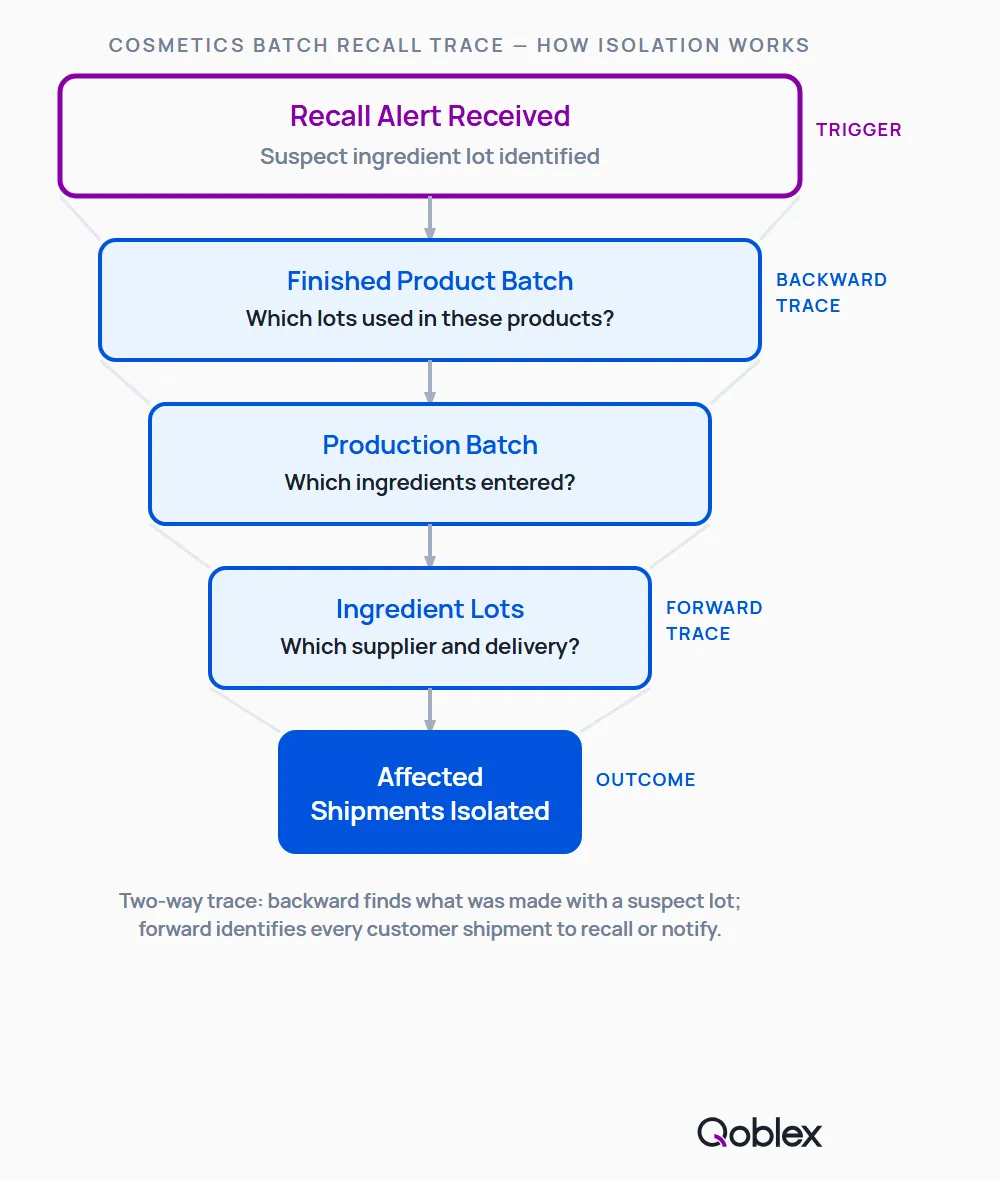
Cosmetics batch traceability links every ingredient lot received from a supplier to the production batch it entered, and traces that production batch forward to every finished-goods batch and every customer shipment. That two-way chain is what makes a recall containable in minutes rather than days: a backward trace finds which production batches used a suspect ingredient lot, and a forward trace identifies every customer who received units from those batches. Qoblex holds this operational traceability layer and surfaces recall reports on demand.
What does cosmetics batch traceability actually mean? (the four-stage chain)
Strip away the regulatory language and traceability is a chain of four linked records. Each stage answers a plain question and connects to the next, so a query at one end reaches all the way to the other. When people say a brand “has traceability,” they mean these four records exist, they are linked, and someone can read them in either direction without rebuilding anything by hand. Get the chain right and a recall becomes a lookup; get it wrong at any single stage and the whole thing breaks at the weakest link, usually the one you did not think mattered until you needed it.
Stage 1: Ingredient lot receipt: where does the traceability chain start?
Every delivery of a raw material, active ingredient, fragrance compound, colorant, or preservative gets an internal lot number the moment it arrives. That receiving record captures the supplier name, the supplier’s own lot or batch reference, the quantity received, the date, and any certificate of analysis attached to the shipment. This is the anchor point. If you do not assign and record a lot at receiving, nothing downstream can be traced, because there is no identifier to trace back to.
Fragrance and colorant lots deserve particular attention here, because they are among the most frequent triggers for cosmetics recalls (banned allergens turning up in fragrance compounds, non-approved colorants). Tracking them as distinct inputs, rather than folding them into a generic “raw materials” bucket, is what lets you isolate a problem to a single lot later instead of every batch that used any fragrance at all.
One boundary worth stating early: the inventory system captures and stores this receiving data. Whether the lot passes incoming verification and is cleared for use is a decision your quality function makes. The software records what arrived; it does not approve it.
Stage 2: Production batch record: how do ingredient lots link to output batches?
When you run a production batch, the record that ties everything together is the Batch Manufacturing Record, or BMR. This is the core traceability document: it links every ingredient lot you consumed to the finished-goods batch you produced. A complete BMR carries a unique production batch number, the date of manufacture, the quantity of each ingredient lot used (cross-referenced by its internal lot number from Stage 1), and the output batch or batches assigned.
The BMR is what makes the chain bi-directional. Read it one way and you go backward from a finished batch to every ingredient lot that went into it; read it the other way and you go forward from a single ingredient lot to every finished batch that used it. That second direction is the one a recall depends on, and it only exists if the link was captured at production time. You cannot reconstruct it credibly after the fact. This is where a bill of materials earns its place: when production runs on a BOM and production orders, the consumption of specific ingredient lots is recorded against the output batch as part of making it, not as separate paperwork afterward. The inventory system captures the operational data (which lots, which quantities, which output batch); the formal review and quality release of that record, the sign-off that says the batch is good to sell, is a quality function, not an inventory one.
Stage 3: Finished goods batch: what is the unit that reaches the customer?
The finished product gets its own finished-goods batch or lot number. In practice this is usually the number printed on the consumer packaging, because EU Regulation 1223/2009 requires a batch number on the label so a product can be positively identified through the supply chain, especially in a recall. That finished-goods batch links back to the production BMR, one-to-one or many-to-one depending on how you split a production run.
At this stage the QC status is recorded (on hold, or approved and released), and if labels, closures, or other packaging components are themselves a plausible recall trigger for your products, those packaging lots can be tracked here too. As before, the system holds the batch record; the release decision belongs to quality.
Stage 4: Distribution record: how does a batch link to the customer?
The last link connects the finished-goods batch to the people who received it. Every shipment is recorded against a specific batch number: which customer or distributor, which order, what quantity, on what date. This forward record is the difference between a targeted recall and a blanket one. With it, you contact only the accounts that received an affected batch. Without it, you cannot prove who did or did not get the product, and a market-wide withdrawal becomes the only defensible option.
Distributors carry their own version of this obligation: under EU Regulation 1223/2009, distributors keep batch identification records for three years from the date the batch was made available. If you sell through distribution, that record needs to exist somewhere in the chain, whether it is yours or theirs.
How do you run a cosmetics recall trace? (backward and forward trace)
Here is the section you come back to when it is not a drill. A recall trace is two moves: a backward trace that finds what you made with a suspect ingredient, and a forward trace that finds who has it. Both are lookups against the chain you built above. When good traceability is in place, the result is a targeted field correction rather than a full market withdrawal, which is the whole point.
Backward trace: from suspect ingredient lot to production batches
You start with one input: the suspect ingredient lot number. It comes from a supplier notification, an internal QC flag, or an adverse event report. The action is a single query against the batch records: find every production batch that consumed that lot number. The output is a list of production batch numbers.
That is the backward trace, and it answers one question: what did we make with this ingredient? In a well-maintained system the lookup takes seconds. Done by hand across paper BMRs or spreadsheet tabs, the same question can eat days, and every hour spent reconstructing is an hour the affected product stays in the market.
This is the capability Qoblex describes as “Recalls Made Easy”: identify the affected batches instantly, then see who received them, without scrambling or guessing. Qoblex sits at the inventory and traceability layer, holding the ingredient-lot to production-batch links so this lookup returns an answer rather than a research project. The workflow is what matters, though; the tool is one way to run it.
Forward trace: from production batches to finished goods to customers
The forward trace picks up the list of production batches from step one. First query: which finished-goods batches came from those production batches? Second query: which customer shipments included units from those finished-goods batches? The output is a targeted list of accounts, orders, and quantities. That list is the scope of your recall.
The forward trace answers the question that decides how big the event is: who has stock we need to retrieve or notify? With the list in hand, you quarantine any remaining on-hand stock from the affected batches so it cannot ship, and you document the full trail, from ingredient lot to BMR to finished batch to shipments. That trail is both your action list and your evidence that the recall was handled properly.
What does a mock recall drill involve for a cosmetics brand?
The only way to know the trace works is to run it before it is real. A mock recall is straightforward: pick a finished-goods batch at random, trace it backward to every ingredient lot it used, trace it forward to every customer shipment that received it, and time the exercise. If it takes more than two hours, the record chain has gaps, and those gaps are exactly what a real recall would expose at the worst possible moment. Run this drill once a year, and after any major change to your systems or process. It turns recall readiness from something you claim in a supplier questionnaire into something you have actually demonstrated. The workflow maps directly onto cosmetics; the pattern is worth borrowing from our write-up on recall readiness and mock recall.
What does EU 1223/2009 require for cosmetics batch traceability? (regulatory context)
Two frameworks shape traceability for most cosmetics brands, one European and one American. What follows is orientation, not legal advice: confirm your specific obligations with the relevant authority and a qualified regulatory advisor, because the details depend on your role in the supply chain and where you sell.
On the EU side, Regulation 1223/2009 sets out a few load-bearing requirements. Article 19 requires a batch number on every label so a product can be identified throughout the supply chain, which is the label-side half of the traceability chain described above. Article 10 requires the Responsible Person to maintain the Product Information File for ten years after the last batch is placed on the market, and Article 7 requires distributors to keep batch identification records for three years. Alongside the regulation, ISO 22716, the harmonized good manufacturing practice standard for cosmetics, describes the traceability chain at each stage, from raw materials through to customer delivery. ISO 22716 describes the chain; it does not require any particular piece of inventory software, and software cannot make a business “ISO 22716 certified.” Certification is an assessment of your operation, not your tools.
On the US side, MoCRA (the Modernization of Cosmetics Regulation Act, signed into law in December 2022) sets record and reporting duties. It requires serious adverse events to be reported to the FDA within 15 business days of receiving the information, with follow-up medical information received within a year submitted within 15 business days as well. For record retention, the same source describes six years for large businesses and three years for small businesses (defined as those with average gross annual US cosmetics sales under 1 million dollars over the prior three years). MoCRA also directs the FDA to establish good manufacturing practice requirements by rulemaking, and that rule is the vehicle likely to carry more specific traceability expectations; confirm its current published status with the FDA and a qualified regulatory advisor before treating any GMP requirement as final and in force.
What belongs in traceability software vs. what belongs in a QMS?
This is the distinction that saves buyers from two expensive mistakes: expecting an inventory system to do a quality system’s job, or skipping the quality system because the inventory system “already handles compliance.” Neither is true, and the line is clean once you see it.
An inventory and traceability system does the operational work of the chain. That means assigning lots at receiving, keeping BOM-linked production batch records that show which ingredient lots went into which finished batch, assigning finished-goods batch numbers, holding distribution records that connect batch to customer, running forward and backward traces, managing expiry and first-expired-first-out rotation, generating recall reports, storing an attached document such as a certificate of analysis against a lot record, and giving you visibility across locations. This is the layer Qoblex operates in.
A quality management system does something different. Batch release approval and QC sign-off, deviation management, corrective and preventive action (CAPA), preparation of the Cosmetic Product Safety Report (CPSR), safety assessments, adverse event reporting to the FDA or EU authorities, ingredient specification governance, and independent laboratory result management all live in a dedicated QMS or eQMS. These are decisions and approvals about quality, not records of physical movement.
To put it plainly: Qoblex is an inventory and traceability system, not a quality management system. It does not perform batch release approval, deviation management, CAPA, or independent QC sign-off. It does not prepare the CPSR, perform safety assessments, or submit regulatory notifications or adverse event reports to regulators. It can attach a certificate of analysis to a lot record as a file, but it does not author, verify, or certify it. If you need those quality-governance functions, and a growing cosmetics brand eventually will, they belong in a system built for them, running alongside your inventory layer rather than inside it.
Does every cosmetics brand need dedicated traceability software?
Not every brand needs this on day one. It is worth being honest about that rather than pretending the software is mandatory from your first product, because in a few situations a manual approach still holds.
The first is the very early-stage brand: fewer than ten SKUs, one supplier per ingredient, a single location, no retail customers yet. At that scale a manual BMR spreadsheet and a paper lot log can genuinely maintain the chain. The cost is your time, not money. The catch is that a spreadsheet-based chain tends to break the moment you add a second product line or supplier, and it breaks quietly, so you often do not notice until you try to run a trace.
The second is the pure reseller. If you buy only finished goods from a co-manufacturer and resell them, with no internal production, and the co-manufacturer holds the full BMR and provides finished-goods lot numbers on delivery, then the traceability obligation above the distribution-record level sits with them. You still need to know which customers received which batches, but you are not maintaining a production chain you do not have.
The third is the brand with very limited distribution, where all products sit on-shelf at a single retailer and that retailer holds the distribution records. In that narrow case, the distribution-record part of the obligation may already be satisfied by the retailer’s system.
The honest note to end on: growing brands outgrow all three conditions faster than they expect. A second product, a second retailer, a first wholesale account, and suddenly the manual chain that felt sufficient is the thing slowing down a trace. To see where this fits alongside the rest of the operation, our cosmetics inventory management software overview is the place to start, and the cosmetics expiry and PAO management guide covers the shelf-life side of the same records. The traceability mechanics here are close cousins of the GMP batch records supplements teams keep, and they rest on the same foundation of solid lot control software.
Frequently asked questions about cosmetics batch traceability
What is cosmetics batch traceability and why does it matter?
Cosmetics batch traceability is the documented chain linking every ingredient lot received from a supplier to the production batch it entered, and that production batch to every finished-goods unit shipped to customers. It matters because when a quality or safety event occurs, the trace is what determines whether a recall is targeted to a handful of affected customers or becomes a blanket market withdrawal.
What records does EU Regulation 1223/2009 require for batch traceability?
Article 19 requires a batch number on every cosmetics label to enable identification throughout the supply chain. The Responsible Person must maintain the Product Information File for ten years after the last batch is placed on the market (Article 10). Distributors must keep batch identification records for three years from when the batch was made available (Article 7). Confirm your specific obligations with a qualified regulatory advisor.
How does a backward trace work in a cosmetics recall?
A backward trace starts with the flagged ingredient lot number and queries the batch records (the BMR) for every production batch that consumed it. The output is a list of production batches. A forward trace from those batches then identifies all finished-goods batches and all customer shipments. Done in a well-maintained inventory system, both traces take minutes.
Is Qoblex a QMS (quality management system) for cosmetics?
No. Qoblex is an inventory and traceability system. It does not perform batch release approval, deviation management, CAPA, or QC sign-off. It does not prepare the CPSR or report adverse events to regulators. It holds the operational traceability chain; quality-governance functions require a dedicated QMS.
What does a mock recall drill involve for a cosmetics brand?
Pick a finished-goods batch, trace it backward to every ingredient lot it used, then trace it forward to every customer shipment. Time the exercise. If it takes more than two hours, the record chain has gaps that a real recall would expose. Running it annually verifies the traceability chain holds.
What does MoCRA require for cosmetics batch record-keeping?
MoCRA requires reporting serious adverse events to the FDA within 15 business days. Record retention is six years for large businesses and three years for small businesses with average gross annual US cosmetics sales under 1 million dollars over the prior three years. Confirm current requirements with the FDA and a qualified regulatory advisor.
Can Qoblex attach a certificate of analysis (COA) to a cosmetics lot record?
Qoblex can attach a COA document to a lot record as a file. It does not author, verify, or certify the COA. That function belongs to the quality team and any testing laboratory involved.