


Here is the drill. A quality manager picks a lot number off a finished-goods label, starts a timer, and tries to answer three questions with records alone: which supplier batch did this come from, which customers received it, and how much is still on our shelves right now. That is a mock recall. It is not a crisis and it is not theatre. It is a rehearsal, the same way a fire drill is a rehearsal, run so that the answer is already known before anyone actually needs it. And it ends one of two ways. Either the trace comes together in a few minutes from a report, or it turns into an afternoon of cross-checking spreadsheets, packing slips, and email. The drill exists to tell you which of those you are, on a quiet day, when the stakes are only a stopwatch.
Food recall readiness means your operation can trace an affected lot backward to the supplier batch it came from and forward to every customer who received it, in minutes rather than hours. A mock recall is a timed drill that proves it. For food manufacturers and distributors, it tests whether your lot records, expiry data, and stock movements are complete enough to isolate and account for every affected unit in a real event.
This page is the operational playbook: what a mock recall verifies, how to run one step by step, what your records have to contain for the result to mean anything, and where the gap usually is. If you want the broader picture of how end-to-end tracing works and what FSMA 204 requires in full, that lives on our food traceability software page. This one goes deep on the drill.
What is food recall readiness?
Recall readiness is a records question wearing an operations costume. You are ready when the history of every lot is written down in a form you can query, not reconstructed from memory. The test of that readiness is the mock recall, and the measure of it is time-to-trace: how long it takes to go from a flagged lot number to a complete, defensible list of where that product came from and where it went.
Can you trace a lot in minutes? That is the one question that defines recall readiness.
Everything else is detail. If you can enter a lot number and get back the supplier receipt on one side and every customer shipment on the other, plus what is still on hand and where, you are ready. If producing that answer means opening files and matching dates by hand, you have a written plan but not a working one, and the two are not the same thing. A recall does not wait for you to assemble records; the clock is already running when the call comes.
Recall vs. market withdrawal: what is the operational distinction that matters?
These two terms get used interchangeably, and they should not be. The FDA draws a clear line. A recall is the removal or correction of a marketed product that the FDA considers to be in violation of the laws it administers, and against which the agency would initiate legal action such as seizure. A market withdrawal is the removal or correction of a product for a minor violation that would not be subject to legal action, or that involves no violation at all, for example routine stock rotation or a minor labeling correction. You can read the FDA’s own framing in its industry guidance on recalls, market withdrawals, and safety alerts.
Both can require you to trace affected lots. The difference is the regulatory stakes and the urgency, and a mock recall is usually built around a recall scenario because that is the harder case to get right. A recall can also be voluntary, meaning the company initiates it, or, less commonly, mandatory, meaning the FDA orders it under its recall authority. Most food recalls are voluntary. In every version, the operational demand is identical: trace the lot, both directions, fast.
One-up, one-down: the minimum, not the finish line
The baseline traceability standard is one-up, one-down, also called one step back, one step forward. It means you know exactly where a lot came from, one step back to your direct supplier, and exactly where it went, one step forward to your direct customer. That is the regulatory minimum in most settings. A full trace goes further. For a manufacturer, the affected material rarely leaves as it arrived; it goes through a recipe into finished batches. A real trace has to run through the bill of materials to connect a raw-ingredient lot to every finished batch that contains it, and only then forward to customers. One-up, one-down is where you start. Whole-chain trace through the bill of materials is where a manufacturer actually has to finish.
Why do mock recalls matter, and what do they actually test?
A recall plan is a document. Recall readiness is a capability. The plan tells you who to call and what to write down; the drill tells you whether the underlying records can produce the trace the plan assumes. Plenty of operations have a polished plan in a binder and discover, the first time they run a real drill, that the data the plan depends on lives in three systems and one person’s head.
What does FSMA 204 require for recall readiness, and what is the 24-hour trace requirement?
There is a common misreading worth clearing up: the FDA does not, as a general rule, require food manufacturers to run mock-recall drills. What it requires is that the records the drill validates actually exist and can be produced. Under the FSMA Section 204 Food Traceability Rule, companies that manufacture, process, pack, or hold foods on the Food Traceability List must maintain traceability records and make them available to the FDA within 24 hours of a request. The compliance date is July 20, 2028, extended from an earlier January 2026 date. That is a preparation window, not an alarm, and it is exactly the window a mock recall is for. We keep the full FSMA 204 treatment, including the Key Data Elements (KDEs) and Critical Tracking Events (CTEs), on the food traceability software page rather than repeating it here.
Food-safety certification is where the drill itself becomes a requirement. Food-safety certification schemes commonly require a mock recall on a regular cycle as a condition of certification, so certified operations run one at least annually whether or not a regulation compels it. If you sell into retail or foodservice, that certification, and the drill behind it, is frequently a condition of doing business rather than an optional badge.
Why is a written recall plan not the same as a functioning one?
The drill is the difference. A plan can be complete and still fail in practice because a supplier lot was recorded on paper, an expiry date lived only on the physical label, or a wholesale shipment was invoiced but never linked to the lot it contained. None of those gaps show up when you read the plan. All of them show up the moment you run the trace against a clock. That is the whole value of doing it before you need it.
What does a credible mock recall have to prove? Five verification checkpoints.
A drill is only meaningful if it verifies specific things, not just that someone can eventually find an answer. The next section breaks down the five checkpoints a credible drill has to clear.
The five things a mock recall must verify
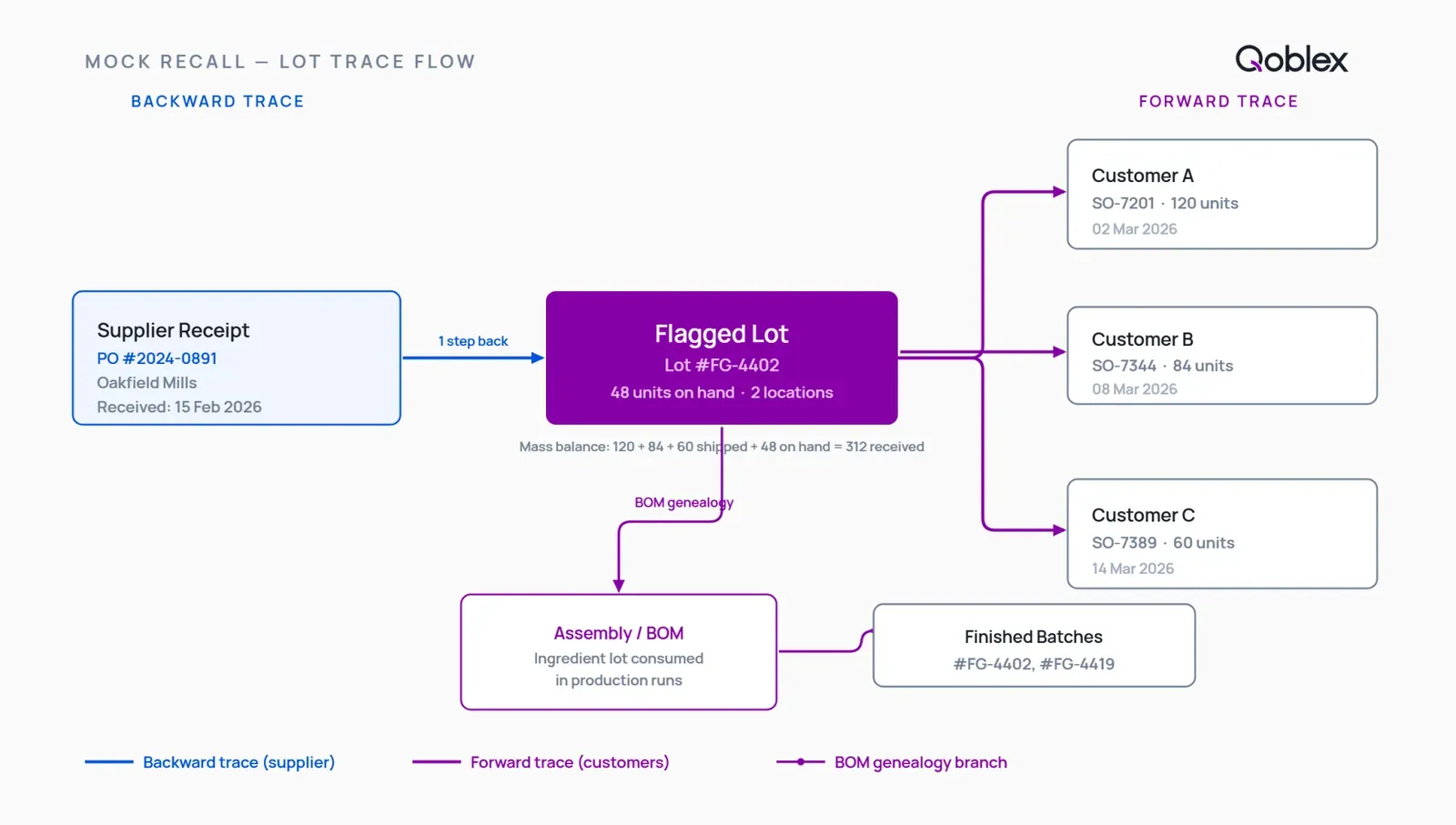
1. Backward trace: from the affected lot to the supplier batch and receipt. Start at the flagged lot and walk backward. Which supplier delivery did this come from, on which inbound receipt or purchase order, and on what date? For a purchased raw material this is the one-step-back leg, and it is the anchor for everything else. If you cannot tie the lot to a specific receipt, the backward trace has already failed.
2. Forward trace: from the affected lot to every customer shipment. Now walk the other way. Every outbound shipment that included any unit of the affected lot, to which customer, in what quantity, on which date. This is the list you would actually act on in a real event, so it has to be complete. A forward trace that misses one wholesale pallet is worse than useless, because it reads as complete when it is not.
3. On-hand quantity and location: what to isolate right now. Before anything ships or gets pulled, you need to know what is still under your control: how many units of the lot are on hand, and in which locations, warehouses, or 3PLs. This is the inventory you can hold immediately, and it is often the fastest way to contain a problem.
4. BOM genealogy: which finished batches contain the ingredient lot. (This step applies to manufacturers who produce finished goods from ingredient lots; a distributor can skip it.) If the flagged material is a raw ingredient, the forward trace does not run directly to customers. It runs through the recipe first. You need to identify every production run, every finished batch, that consumed the ingredient lot, and only then trace those finished batches forward. Miss the genealogy and you either recall too much, at real cost, or too little, which is the failure that matters.
5. Mass balance: every unit accounted for, no gaps. The reconciliation check. The quantity received of the affected lot should equal what shipped, plus what is on hand, plus any documented waste or samples. If the numbers do not close, there is product you cannot account for, and that gap is precisely what a drill exists to expose while it is still only a drill.
How do you run a mock food recall step by step?
The eight steps below are the logical sequence of a timed drill. Time indications are framed as benchmarks, not promises; what a good drill measures is your own time-to-trace against your own last drill.
Step 1: Choose a trigger scenario and select a test lot. Pick a realistic scenario, for example a supplier notifies you of a contaminated ingredient lot, and select an actual lot number from your records to trace. Note the start time. Choosing a raw-ingredient lot rather than a finished good makes the drill harder and more honest, because it forces the BOM leg.
Step 2: Freeze and apply a hold on the affected inventory. Place a hold on the lot so no more of it ships while the trace runs. In a real event this is containment; in a drill it proves you can stop the flow of affected product quickly and cleanly without halting everything else.
Step 3: Backward trace. Identify the supplier lot and inbound receipt. Trace the lot back to the supplier delivery and the receipt or purchase order it arrived on. Record the supplier, the receipt date, and the quantity received. This is your one-step-back leg.
Step 4: Forward trace. List every customer shipment of the affected lot. Produce the complete list of outbound shipments containing the lot: customer, quantity, date, reference. For a distributor this is the core deliverable. Confirm the list is exhaustive, not just the shipments someone remembers.
Step 5: BOM trace. Identify finished batches that contain the ingredient lot (manufacturers only). If the lot is a raw ingredient, trace it through the bill of materials to every finished production batch that used it, then run the forward trace on those finished batches. This is where manufacturers most often find that a purely quantity-based system cannot answer the question.
Step 6: On-hand reconciliation. Confirm quantity on hand and location. Confirm how much of the affected lot, or of the finished batches, remains on hand and where. Combine it with the forward-trace totals and the received quantity to run the mass-balance check. If it does not close, note the discrepancy; that is a finding.
Step 7: Document the trace, the time taken, and any gaps found. Capture the full trace, both directions, the on-hand position, the elapsed time from Step 1, and every gap or manual workaround the drill required. The elapsed time is your time-to-trace, and it is the number you compare drill over drill.
Step 8: Review and remediate. Fix what the drill exposed. A drill that finds nothing to fix usually means it was run too easily. Take the gaps, a missing expiry date, an unlinked shipment, a lot recorded only on paper, and close them, so the next drill, and the real event, is faster. Then schedule the next drill.
How often you run one depends on your obligations, but for certified operations at least annually is the common cadence, and running a smaller drill more frequently is a reasonable way to keep records honest between formal audits.
What records must a food manufacturer keep for a mock recall to be meaningful?
A mock recall is only as good as the data underneath it. You can run the cleanest procedure in the world and still fail if the records were never captured in a queryable form in the first place.
What is the minimum record set for a food recall trace?
For the drill to produce a real answer, four things have to be recorded at the lot level, not the SKU level: the lot or batch number on every unit from receipt onward, the supplier receipt or purchase order each lot arrived on, the expiry or best-before date for perishable stock, and the link between each lot and the outbound shipments it left on. For manufacturers, add the production records that tie ingredient lots to finished batches. This lot-level history is the foundation the whole trace stands on; it is the food-and-beverage expression of lot control software. Expiry data matters here too, because the same records that drive a recall trace also drive first-expired-first-out picking that keeps near-dated stock moving.
FSMA 204 formalizes these requirements for covered foods through its Key Data Elements (KDEs) and Critical Tracking Events (CTEs): specific data fields that must be captured at each point where food changes hands or is transformed. A mock recall is, in practice, a test of whether your records satisfy that standard for the lots you produce. The full KDE/CTE breakdown lives on our food traceability software page; this section is about having the underlying records in place.
Can QuickBooks Online or Xero support a food recall trace?
This is where most operators discover the gap. If your books live in QuickBooks Online or Xero and your orders come through Shopify or WooCommerce, none of those systems tracks a lot number, records an expiry date, or holds the stock-movement history a trace needs. QuickBooks Online and Xero are accounting platforms; they are excellent at the ledger and were never built to follow a batch of raw ingredient through a production run to the customer who bought the finished case. Lot number and expiry date tracking in QuickBooks is a feature of Desktop Enterprise, not QuickBooks Online. Xero’s Inventory Plus add-on, which is US-only and USD-only as of mid-2026, adds no lot, batch, or expiry tracking. These platforms should stay your book of record; the missing piece is the inventory layer that records what they do not.
Why do spreadsheets fail in a food recall?
A spreadsheet or a storefront can store a lot number in a field. What it cannot do is tie that number to every movement, so the trace becomes a manual join across systems, done under time pressure, with each hand-off a place to lose a shipment. That is the single most common reason a drill runs to hours instead of minutes: the data exists, but it was never connected. Connecting it is the entire job of a traceability layer.
How does Qoblex help with food recall readiness, and how fast can it trace an affected lot?
Qoblex is the inventory operations layer that sits between those accounting and ecommerce platforms and closes exactly this gap, while QuickBooks Online, Xero, Shopify, or WooCommerce stay your book of record. It records the lot number, expiry date, supplier receipt, and location at every stage, receiving, production, picking, dispatch, so the movement history is built as work happens rather than reconstructed under a clock.
What does a Qoblex recall report include?
In a drill or a real event, the operator enters the affected lot number and Qoblex returns the trace in both directions in one report: backward to the supplier lot, receipt, and purchase order it came from, and forward to every customer shipment it left on, with quantities and dates. The same report shows the on-hand quantity and location, so the containment picture and the notification list come out of one query rather than several.
How does Qoblex trace an ingredient lot through a bill of materials in a recall?
For manufacturers, this is the part accounting tools and spreadsheets cannot do at all. Because Qoblex ships lightweight manufacturing with a bill of materials on every tier, it records which ingredient lots went into which production runs. So a trace on a raw-ingredient lot follows the genealogy forward to every finished batch that consumed it, and then forward again to the customers who received those finished goods. That is the whole-chain trace the drill’s fourth checkpoint demands, produced from records, not detective work.
Can Qoblex run a mock recall while the warehouse keeps operating?
You can run the trace and place a hold on affected inventory while the warehouse keeps receiving, picking, and shipping everything else. A drill does not have to stop the business to be meaningful; that is part of what makes running one routine rather than an event.
Plan and pricing details are on the Qoblex pricing page.
When is your current setup enough, and when is it not?
A mock recall is only as useful as the records behind it, and not every business has records that need one yet. It would be dishonest to pretend otherwise.
The operator whose spreadsheet still covers them. If you sell a single non-perishable SKU with no lot-number requirement, no expiry constraint, and no retailer or regulator asking for lot-level records, there is nothing to drill. The spreadsheet that covers your operation today is fine, and spreadsheets have gotten a lot of good food businesses off the ground. There is no prize for buying software before the operation asks for it.
When a HACCP or recall-plan tool is what you need instead. If your real gap is the written program, a recall-plan template, a HACCP plan builder, or a supplier audit questionnaire, rather than the inventory records the plan runs on, then a food-safety management platform such as FoodReady, FoodDocs, or SafetyChain is built for that and Qoblex is not. Many operations run both, because the two solve different problems. The drill this page is about tests your inventory records, not your written program.
The gap inventory software closes that plan tools cannot. A traceability layer earns its place specifically when you need to trace a lot to all affected customers within a business day, you carry perishable stock with expiry or best-before constraints, you sell to retailers or distributors who require lot tracing as a condition of business, or you are preparing for FSMA 204 records, certification, or a retailer audit. If one or more of those describe you, the manual workaround has quietly become the risk, and a drill is how you find out before the real thing does. If none of them do, keep the spreadsheet.
FAQ
What is food recall readiness? Food recall readiness is the ability to trace an affected lot backward to its supplier origin and forward to every customer shipment quickly enough to isolate the product before more of it reaches consumers. It is tested through mock-recall drills, which measure your time-to-trace against a realistic scenario.
What is a mock recall in food manufacturing? A mock recall is a timed simulation of a real recall. The operation picks a lot number, traces it backward to the supplier and forward to every customer who received it, reconciles the quantity on hand, and documents the trace, all against a clock. It is the only reliable way to know whether your traceability records hold up before you actually need them.
Are mock recalls required by law for food manufacturers? Generally, no: the FDA does not mandate mock-recall drills by regulation for most food manufacturers. What it does require, under FSMA 204, is that covered businesses can produce traceability records within 24 hours of a request. Separately, food-safety certification schemes commonly require a mock recall as a condition of certification, so certified operations run one regularly regardless of the regulation.
What is the difference between a recall and a market withdrawal? A recall is the removal or correction of a product the FDA considers in violation of the laws it administers, against which the agency would initiate legal action such as seizure. A market withdrawal is removal for a minor violation that would not trigger legal action, or no violation at all, such as routine stock rotation or a minor labeling correction. Both may require tracing affected lots; the regulatory stakes differ. See the FDA industry guidance on recalls.
How long should a food recall trace take? FSMA 204 requires covered businesses to provide traceability records to the FDA within 24 hours of a request, so that is the outer bound to plan against. In practice, certification benchmarks expect a complete forward-and-backward trace much faster, and software-enabled operations typically complete it in minutes. A trace that runs to hours usually signals that records are incomplete or not queryable.
What is one-up, one-down traceability? One-up, one-down, also called one step back, one step forward, is the minimum bidirectional standard: you know exactly where your raw materials came from, one step back to your direct supplier, and exactly where your finished products went, one step forward to your direct customer. FSMA 204 and most certification schemes require at least this. A full trace goes further, through the bill of materials, to connect ingredient lots to finished batches.
Can QuickBooks Online or Xero support a food recall trace? Neither QuickBooks Online nor Xero tracks lot numbers, records expiry dates, or holds the stock-movement history a recall trace requires; both are accounting platforms. Lot and expiry tracking in QuickBooks is a Desktop Enterprise feature, not available in QuickBooks Online. Xero’s Inventory Plus add-on, US-only as of mid-2026, adds no lot or expiry capability either. That missing inventory layer is the gap a tool like Qoblex closes, while keeping QuickBooks Online or Xero as your book of record.
How does Qoblex help with food recall readiness? Qoblex records lot numbers, expiry dates, supplier receipts, and stock movements at every stage, from receiving through dispatch. When a lot is flagged, the operator queries it and gets the complete backward and forward trace in minutes, including on-hand quantity and location and, for manufacturers, the finished batches the ingredient lot fed into via the bill of materials. The same report serves a mock drill, an auditor request, or a real event. Qoblex is the inventory layer that makes the trace possible, not a recall-plan tool or HACCP platform.