


A practical guide, written from the operator’s side of the bench, to what cosmetics inventory software actually needs to do and who genuinely needs it.
There is a moment most cosmetics and personal care brands recognize. A retailer emails asking for the certificate of analysis on the lot they just received. A production run needs a fragrance component, and someone has to work out which supplier lot it came from before the batch record makes sense. A pallet of stock is near-dated and no one is quite sure whether it should ship before the fresher run sitting in another location. Each question is small. Answered from a spreadsheet, each one takes a phone call, a scroll, and a bit of memory. The spreadsheet did its job while the business was small. The problem is not the spreadsheet. The problem is that the questions have quietly changed from “how many do we have” to “which one is this, and where did it go.”
Cosmetics inventory management software handles the requirements that standard stock tools skip: lot and batch tracking, expiry date and PAO management, FEFO-driven picking, BOM traceability from ingredient to finished product, and a recall trace that identifies affected batches in minutes. It sits between a spreadsheet and a full ERP, adding the operational identity layer that accounting platforms and ecommerce storefronts do not provide. Qoblex is the operations layer built for this gap.
This page is a map, not a pitch. It walks through what makes cosmetics inventory different, what the software genuinely needs to do, where a tool like Qoblex fits, and, just as importantly, where it does not.
What makes cosmetics inventory different from general inventory management?
General inventory software counts units. It is good at that. It tells you that you have 240 units of a foundation shade and that you sold 30 yesterday. For a lot of businesses, that is enough.
Cosmetics inventory is different because two units of the same shade are not always interchangeable. One might expire in 90 days and the other in 18 months. One might have been made from a fragrance lot that a supplier later flags for a restricted allergen, and the other from a clean lot. The count is identical. The identity is not. That is the shift: from tracking quantity to tracking identity, dates, and lineage at the lot level. Lot tracking, for a cosmetics brand, means every unit carries the record of which batch it belongs to, when it was made, when it expires, and which ingredient lots went into it. Once a customer, a retailer, or a regulator can ask “which lot is this,” basic stock counts stop being enough.
The regulatory layer that general inventory software ignores
Two live frameworks shape why this matters, and it is worth being clear that what follows is orientation, not compliance advice. Confirm your specific obligations with the relevant authority and a qualified regulatory advisor.
In the EU, Regulation (EC) No 1223/2009 (as consulted August 2026) requires a batch number on the label of every cosmetic product so that a specific batch can be identified and traced if a recall is needed. The Responsible Person must keep the Product Information File for ten years after the last batch of the product was placed on the market (as consulted August 2026), and distributors are expected to be able to identify the businesses they supplied and were supplied by, with batch identification records kept for three years.
In the US, the Modernization of Cosmetics Regulation Act (MoCRA), signed in December 2022, added a duty to report serious adverse events to the FDA within 15 business days and to retain the related records (as summarized in this legal briefing consulted August 2026). Retention periods reported for those records are six years for larger businesses and three years for smaller businesses, defined by average gross annual US cosmetics sales below a set threshold over the prior three years.
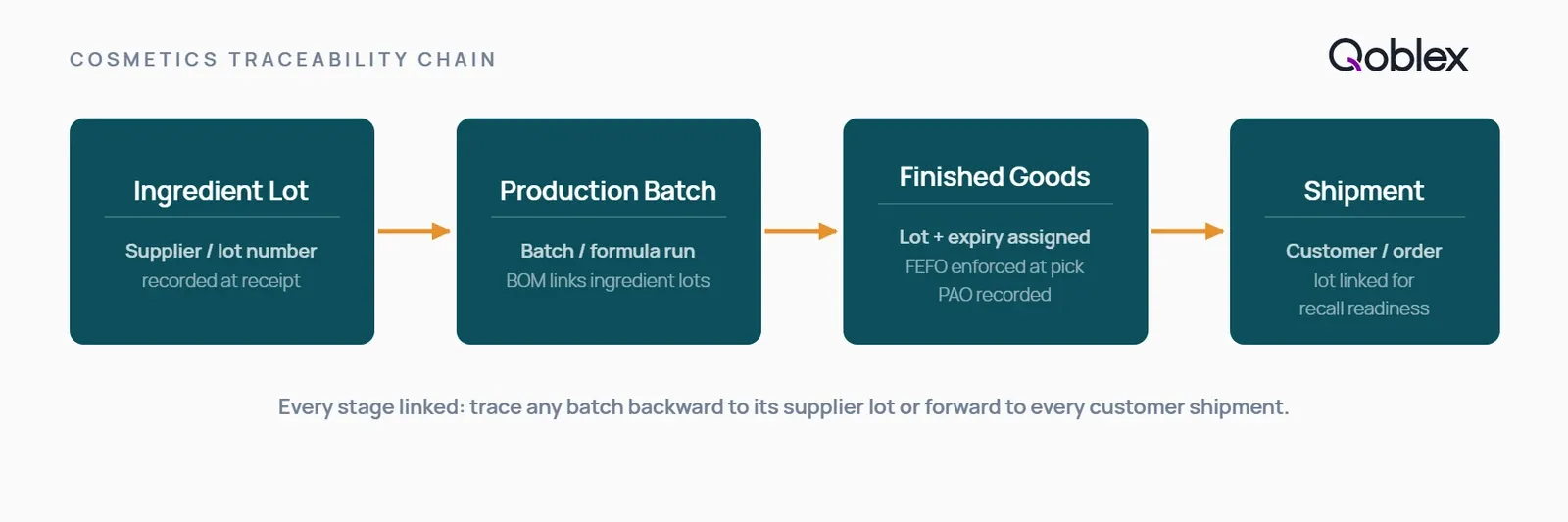
Underpinning both is ISO 22716, the internationally harmonized good-manufacturing-practice standard for cosmetics (as consulted August 2026), which describes a traceability chain running from raw-material receipt through production to customer shipment. ISO 22716 is a standard for how you operate, not a specification for a particular piece of software. It does not require you to buy any named product. What it does mean, in practice, is that if your operation cannot follow a finished unit back to its ingredient lots and forward to its customers, the traceability chain has a gap in it.
An ecommerce storefront and an accounting platform were built to sell products and keep the books, and they do that well. They were not built to hold the identity record a cosmetics operation is accountable for.
PAO and minimum durability date: the expiry split that matters for inventory
Here is the distinction that trips up most inventory setups. Cosmetics do not all carry the same kind of date. Products with a shelf life of 30 months or less must show a minimum durability date, the familiar “best before” date marked with the hourglass symbol (as consulted August 2026). Products with a shelf life over 30 months are exempt from that date and instead carry a period-after-opening symbol, the open-jar mark with a figure such as “12M,” meaning the product is intended to be used within twelve months of first opening.
For inventory, that means you are managing two different expiry concepts. Short-shelf-life products have a fixed calendar date you can rotate stock against directly. The larger long-shelf-life group has no fixed expiry date on the label at all, only a period after opening, which is a consumer instruction rather than a warehouse date. Handling that second group well usually means recording the manufacture date and the manufacturer’s internal shelf-life period, then using that as a proxy date for rotation. The cosmetics expiry and PAO tracking spoke covers this in detail. The one thing not to do is treat a period after opening as if it were an expiry date. They are different measures for different products.
What should cosmetics inventory software actually do? (the capability checklist)
This is a working map of what a lot-tracked cosmetics operation needs from its system, not a feature list to admire.
How does lot tracking work for cosmetics manufacturers?
The system should capture the lot or batch number when stock is received against a purchase order, assign a batch to each production run, and tie every finished unit back to its origin. In cosmetics this is not only a recall mechanism. It is the record that connects a finished product batch to the ingredient chain behind it, which is what makes every later question answerable. This is the foundation the rest of the checklist sits on, and it is worth reading alongside general lot control software practice.
How do I manage expiry dates and PAO for cosmetics inventory?
Record the expiry date, or the manufacture date as a proxy for the period-after-opening group, at receiving. Surface near-dated stock at pick time. Enforce FEFO picking, first-expired-first-out, so the older or shorter-dated stock ships before the fresher stock. FEFO is an operational best practice for date-sensitive goods rather than a rule imposed by any single named regulation, but it is the difference between catching near-dated stock and writing it off. Alerts before the write-off, not after, are the point. The cosmetics expiry and PAO tracking spoke goes deeper.
How does batch recall traceability work for cosmetics brands?
When a fragrance lot is flagged for a restricted allergen or a colorant lot is recalled by its supplier, two questions need answers fast: which finished-good batches used that lot, and which customers received them. A backward trace runs from the flagged ingredient lot to the production batches that consumed it. A forward trace runs from those batches to the customer shipments that carried them. Done in software, that is a single query. Done by hand from spreadsheets, it can take days, which is exactly the time you do not have. The cosmetics batch traceability spoke covers the mechanics, and the recall readiness guide from the food side shows the same pattern under pressure.
Can I link raw material lots to finished product batches in cosmetics inventory software?
The link between component lots (fragrance, colorant, base ingredients, preservatives) and the finished product batch is what lets a recall trace pass cleanly through production. Without it, the trace stops at the factory door. A bill of materials that records which ingredient lots went into which production batch is what carries traceability across that gap. The cosmetics batch traceability spoke works through a full ingredient-to-finished-batch example.
Can I manage cosmetics stock across multiple warehouses?
Lot and expiry quantities should be visible across every warehouse, third-party logistics location, and production site at once. Near-dated stock hidden in a location the system cannot see is stock you will write off by surprise. One picture of what is where, and how close it is to its date, is the requirement.
Can I attach certificates of analysis to lot records?
Lot assignment should happen at receiving, against the purchase order the goods arrived on. Where the system supports it, the certificate of analysis for that lot can be attached to the lot record, so the document lives with the stock rather than in an email thread. A boundary matters here: an inventory system stores the certificate of analysis as an attached file. It does not author it, verify it, or certify it. That work belongs to the quality function.
Where Qoblex fits in the cosmetics operations stack
With the problem laid out, this is where Qoblex sits. It is the operations layer between your accounting platform and a full ERP. It integrates two-way with QuickBooks Online and Xero so those stay your book of record, and it connects to sales channels such as Shopify so orders and stock stay in step. On the physical side, Qoblex (as consulted August 2026) assigns lots and batches at receiving, records expiry and surfaces it for first-expired-first-out picking, runs forward and backward traces, connects ingredient lots to finished batches through bill-of-materials traceability, and keeps an audit-ready history of every batch and movement. Its recall workflow is built to identify affected batches and see who received them.
If your accounting platform is where you keep score, Qoblex is where you keep track. The batch, lot, serial, and expiry tracking capability is a paid add-on rather than part of the base plan; the current structure and pricing are on qoblex.com/pricing. The same lot and expiry gaps in the accounting tools are covered directly in the QuickBooks Online lot and expiry tracking and Xero lot and expiry tracking breakdowns.
What Qoblex is not (the honest boundary)
Qoblex is an inventory and traceability system. It is not a quality management system. It does not perform batch release approval, deviation management, corrective and preventive action, or independent quality-control sign-off. It does not prepare the Cosmetic Product Safety Report required under EU Regulation 1223/2009, perform safety assessments, submit regulatory notifications, or report adverse events to regulators. For ISO 22716 purposes, those quality-governance functions belong in a dedicated quality management system. An inventory layer covers the physical traceability; it does not replace quality management, and it is worth being plain about that rather than blurring the line.
It is also not a labeling system. It does not generate the batch number labels or period-after-opening symbols that go on packaging. That remains a separate system or a manual step.
When Qoblex is not the right fit (honest scoping)
Software should earn its place. There are operations where a tool like Qoblex, on its own, is genuinely not the right answer, and it is more useful to say so than to pretend otherwise.
Products that are also regulated as drugs. Items that straddle cosmetic and drug classification, such as US sunscreens, anti-dandruff shampoos, or whitening toothpaste, face pharmaceutical regulatory requirements that go beyond what an inventory system handles. Those product lines need a dedicated pharmaceutical or OTC-drug compliance system.
Enterprise brands with an integrated quality management system. A large manufacturer running a formal quality management system such as SAP QM, MasterControl, or Veeva Vault, and needing deep two-way integration between that system and inventory, is better served by an ERP or a purpose-built quality-to-inventory integration. Qoblex is not a quality management system and does not offer that deep out-of-box integration.
Companies that genuinely need a full ERP. If the real requirement is across-the-board ERP scope, full financial consolidation, advanced CRM, HR, and complex multi-entity manufacturing planning at enterprise scale, a full ERP is the better investment. Qoblex deliberately occupies the space between a spreadsheet and a full ERP, not the far end of it.
Very early-stage brands. A founder making product at home with a handful of SKUs, one location, and no compliance-driven customer can still run a well-kept spreadsheet. At that scale, software adds overhead before it adds value. When the identity questions start arriving faster than the spreadsheet can answer them, that is the signal it is time to look. If your operation is closer to supplements than cosmetics, the supplement inventory software hub and the GMP batch records guide cover the parallel case.
Frequently asked questions
Does EU Regulation 1223/2009 require cosmetics brands to use inventory software?
No. The regulation requires batch identification records and a Product Information File retained for ten years, but it does not mandate any specific software. Inventory software makes those record-keeping obligations faster to fulfill and harder to lose, which is a practical benefit rather than a legal requirement. Confirm your specific obligations with a qualified regulatory advisor.
What is the difference between a PAO date and a minimum durability date in cosmetics?
A minimum durability date (the hourglass “best before” symbol) applies to cosmetics with a shelf life of 30 months or less and is a fixed calendar date set at manufacture. A period after opening (the open-jar symbol, for example “12M”) applies to products with a shelf life over 30 months and indicates how long the product is intended to be used after first opening. For inventory purposes, only the minimum-durability group carries a fixed expiry date that directly drives FEFO rotation.
What does MoCRA require for cosmetics recordkeeping?
MoCRA, signed in December 2022, introduced a requirement to report serious adverse events to the FDA within 15 business days of receiving the information, along with record retention obligations reported as six years for larger businesses and three years for smaller ones defined by a US cosmetics sales threshold. This is orientation-level information; confirm current requirements with the FDA and a qualified advisor.
Can Qoblex replace a quality management system (QMS) for cosmetics?
No. Qoblex is an inventory and traceability system, not a quality management system. It does not perform batch release approval, deviation management, corrective and preventive action, or independent quality-control sign-off. It handles the physical traceability layer: lot assignment, expiry visibility, bill-of-materials trace, and recall identification. Quality management functions require a dedicated quality management system.
How does cosmetics batch recall traceability work in practice?
When an ingredient lot is flagged, a backward trace identifies which production batches consumed it by matching the ingredient lot number in the batch records. A forward trace then identifies which finished-good batches came from those production batches, and which customer shipments included them. Done in software, this trace takes minutes. Reconstructed by hand from spreadsheets, it can take days.
Does cosmetics inventory software track PAO dates?
It can, indirectly. For the majority of cosmetics products (shelf life over 30 months, period-after-opening only), the practical approach is to record the manufacture date at receiving and store the manufacturer’s maximum shelf-life period internally, then use that as a proxy expiry date for FEFO rotation. The consumer-facing period-after-opening symbol is product data, not the same thing as an inventory expiry date.
Is Qoblex suitable for OTC drug products or dual-registered cosmetics?
No. Products regulated as both cosmetics and drugs, such as US SPF sunscreens or anti-dandruff shampoos, face pharmaceutical regulatory requirements that exceed what an inventory traceability system handles. Those product lines need a dedicated pharmaceutical compliance or quality management system.