


Quick answer: A dietary supplement recall under FD&C Act section 423 requires identifying every affected lot and customer within hours, not days. The fastest way to do that is lot-level traceability that links raw material receipt to production to shipment. Given a flagged ingredient lot, a forward trace surfaces every finished-good lot that used it and every customer order that received them. A mock recall drill verifies you can execute that trace before FDA asks.
A practical guide, written from an operator’s point of view, to tracing an affected supplement lot fast enough to satisfy an FDA recall request and to rehearsing that trace before the request ever arrives.
Here is the moment this page is about. A supplier emails you, or a third-party lab flags a result, and one raw material lot you received months ago is now suspect: a contaminant, a mislabeled ingredient, an out-of-spec potency reading. The question lands on your desk immediately. Which finished-good lots did that ingredient go into? Which customers received those lots? And can you answer both in an afternoon, or will it take three days of cross-referencing spreadsheets, packing slips, and someone’s memory of which batch ran that week?
For a long time, the spreadsheet answer was reasonable. When you had one product, one supplier, and a handful of wholesale accounts, a tab per batch and a shared drive of COAs got the job done. That is how most supplement brands start, and it works right up until the volume, the SKU count, and the number of ingredient suppliers grow past what one person can hold in their head. The breaking point is usually not a real recall. It is the first time someone asks you to prove, on a clock, that you know where a lot went.
That clock is no longer hypothetical. Since 2011, FDA has been able to order a mandatory recall of a dietary supplement, so recall readiness has quietly shifted from a nice-to-have to an operational baseline. This guide walks through the regulatory triggers, the records 21 CFR Part 111 expects you to keep, what a forward and backward lot trace actually involves, and how to rehearse the whole thing in a mock recall drill. It leans on Qoblex as one example of the operational layer that makes the trace fast, but the workflow matters more than the tool.
One note before the detail: the regulatory framing below is orientation-level, not legal advice. Confirm your specific obligations with the FDA and a qualified regulatory advisor.
What gives FDA the authority to order a supplement recall?
Dietary supplements are regulated as a category of food. Section 201(ff) of the Federal Food, Drug, and Cosmetic Act defines them that way, which is why the food-safety recall machinery reaches them. The specific authority is FD&C Act section 423 (21 U.S.C. 350l), added by section 206 of the Food Safety Modernization Act (Public Law 111-353, signed January 4, 2011). Before FSMA, FDA could pressure a company toward a recall but could not compel one. Now it can.
The bar is high, and it is worth stating precisely so you frame the risk correctly rather than fearfully. FDA may order a mandatory recall only when there is a reasonable probability that a product is adulterated under section 402 or misbranded under section 403(w), and that its use or exposure will cause serious adverse health consequences or death, a threshold the guidance abbreviates as SAHCODHA. Most supplement issues never reach that bar. But when one does, the recordkeeping you already have decides how the next 48 hours go.
One boundary matters here because it is easy to get wrong. FSMA’s Food Traceability Rule (section 204, 21 CFR Part 1.1300 and following) applies to foods on the Food Traceability List, and dietary supplements are not on that list. If you also run a food business, the food recall readiness guide covers that separate FSMA 204 world. For supplements, the framework is 21 CFR Part 111, the cGMP rule promulgated under the Dietary Supplement Health and Education Act of 1994 (DSHEA) and the FD&C Act. Do not apply FSMA 204 obligations to a supplement line.
Voluntary vs. mandatory recall: how FDA escalates
FDA cannot skip straight to a mandatory order. The mandatory recall guidance is explicit that the agency must first give the responsible party an opportunity to conduct a voluntary recall. Only if the company declines or fails to act adequately does the escalation begin, and only the FDA Commissioner can issue the actual mandatory order. In practice this means the overwhelming majority of supplement recalls are voluntary, company-initiated actions. Readiness is what lets you run that voluntary recall quickly and credibly, which is usually what keeps it voluntary.
Recalls are also classified by severity (21 CFR 7.3): Class I for a reasonable probability of serious harm or death, Class II for temporary or medically reversible harm, and Class III for situations unlikely to cause harm. The class does not change the trace you have to run. Whether the issue is a genuine contamination or a label error, you still need to know which lots shipped where.
When adverse event reports trigger a recall investigation
Recalls do not only start with a supplier email. They often start with a consumer. Under FD&C Act section 761, added by the Dietary Supplement and Nonprescription Drug Consumer Protection Act (Public Law 109-462, signed December 22, 2006), the manufacturer, packer, or distributor whose name appears on a supplement label sold in the US must report serious adverse events to FDA within 15 business days of receiving them. A serious adverse event is defined as one resulting in death, a life-threatening experience, inpatient hospitalization, a persistent or significant disability or incapacity, a congenital anomaly or birth defect, or one requiring medical or surgical intervention to prevent such an outcome. New medical information about that event received within a year must also be reported within 15 business days.
The operational point is the link. When a serious adverse event report comes in, the first internal question is: which lot did that consumer’s product come from, and where else did that lot go? A report is a signal that starts a backward trace, and how fast you can run it determines whether an isolated event stays isolated.
What does 21 CFR Part 111 require you to document for recall readiness?
Part 111 is the cGMP rule for supplements, and two of its subparts sit directly on the recall path. The exact subpart letters matter, because they get miscited often. Product complaints live in Subpart O; returned supplements live in Subpart N. (Subpart P, sections 111.605 to 111.610, is records and recordkeeping generally.)
Neither subpart tells you to buy software. What they do is require written procedures and per-item records, and both records only work if they carry a lot or batch number as the linking key. If your complaint log and your return log reference lot numbers that tie back to production, you can run a trace. If they do not, the regulation is technically satisfied while the trace is practically impossible. That gap is what recall readiness is really about.
The manufacturing records those traces traverse, the master manufacturing record and the batch production record, have their own structure under Part 111. That is a topic in its own right, covered in the GMP batch records guide. Here it is enough to know that a complete forward trace walks through those production records to connect a raw material lot to the finished-good lots that consumed it.
Product complaints (Subpart O): what the regulation requires
Subpart O (sections 111.553 to 111.570) requires written procedures for handling complaints, review of every product complaint to decide whether it points to a possible failure to meet specifications (including any risk of illness or injury), investigation of qualifying complaints by quality control, and a written record of each complaint. That record must capture the supplement’s name and description, the batch, lot, or control number if available, the date received and the complainant’s contact details if available, the nature of the complaint, any reply sent, and the investigation findings and follow-up actions. The batch or lot number is the field that makes a complaint traceable rather than anecdotal.
Returned supplements (Subpart N): what the regulation requires
Subpart N (sections 111.503 to 111.535) governs returned dietary supplements. It requires written procedures, and it requires that returned product be identified and quarantined until quality control personnel conduct a material review and make a disposition decision: release, reprocess, or destroy. Section 111.535 lists the records to keep, including the written procedures, the material review and disposition decisions, any test or examination results, and documentation of any reevaluation when product is reprocessed. Again, the practical requirement underneath the paperwork is that a returned unit can be tied back to its original batch, so a return can seed a trace instead of sitting in a quarantine bin as a mystery.
What does a supplement lot trace actually look like? (Forward and backward)
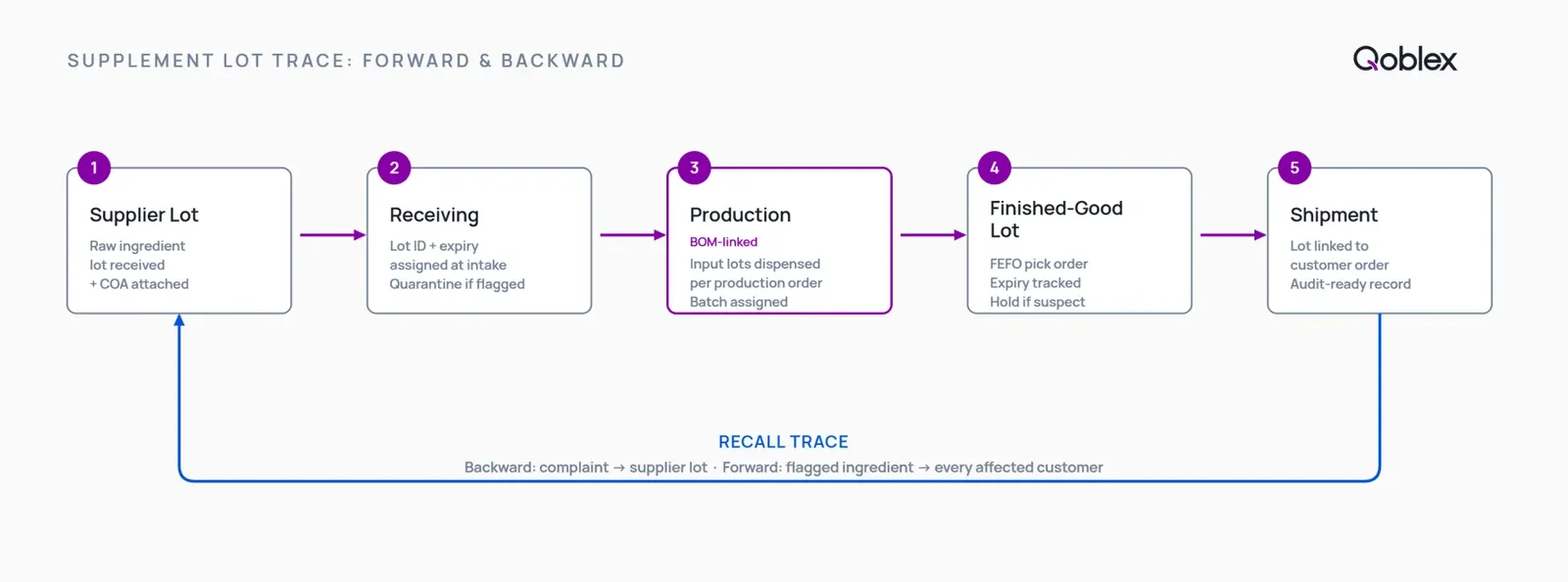
A lot trace runs in two directions, and a real recall usually needs both. The forward trace answers “where did it go.” The backward trace answers “where did it come from.” The chain they run along is the same: a raw material lot is received from a supplier, dispensed into a production order against a bill of materials, assigned to a finished-good lot when production completes, and shipped to customers. The advanced lot tracking guide describes both directions in detail.
The reason speed matters is arithmetic. In a mandatory-recall scenario the clock is external and it does not pause while you reconstruct records by hand. A trace that takes three days on paper is three days of product still moving, still on shelves, still being consumed. The same trace running in minutes narrows the affected scope while you can still act on it.
A trace is only trustworthy if it reconciles. Mass balance is the check: the quantity of an affected lot you received should equal what shipped, plus what remains on hand, plus what was scrapped or returned. If those numbers do not add up, a lot went somewhere your records do not show, and that gap is exactly what an FDA investigator will find.
Forward trace: from flagged ingredient lot to customer shipment
Start with the suspect raw material lot. Which production orders dispensed it? For each of those, which finished-good lots did the bill of materials produce? And for each finished-good lot, which customer orders shipped it, in what quantity, on what date? The output is a defined list of affected finished-good lots and the customers who received them. That list is the audit package: it is what you hand an investigator and what drives your customer notifications.
Backward trace: from customer complaint to supplier lot
The backward trace runs the chain in reverse. A customer reports an issue, or a serious adverse event report names a product. You take the lot number off that unit, find the finished-good lot, walk back through the production order to the raw material lots consumed, and land on the supplier and their lot. That is how you learn whether a single complaint is isolated or the first visible edge of a bad ingredient lot that also went into a dozen other finished-good lots. Expiry tracking intersects here too: first-expiry-first-out picking means near-dated lots ship before newer ones, which keeps your on-hand stock younger and your recall surface smaller.
How does a mock recall drill work for supplement manufacturers?
A mock recall drill is a timed rehearsal. You pick a real scenario, run the actual trace against your real records, and measure how long it takes and where it breaks, all without an actual recall in progress. cGMP auditors and retail partners increasingly expect to see mock recall records, because a drill is the only honest proof that your traceability works under pressure. Running at least one drill a year gives you a documented rehearsal record, and a practical target is completing lot accountability within about two hours of the signal.
The scenarios worth rehearsing map to how real recalls start: a supplier recalls an ingredient lot, an allergen is mislabeled, a contamination result comes back, or a packaging or potency defect surfaces. Score each drill on the things that actually cost time in a real event: time to define the affected scope, time to complete the forward trace, time to complete the backward trace, whether mass balance reconciles, whether you can place and enforce a hold, and whether your customer communications are ready. The common failure patterns are consistent: weak lot linkage between dispensing and production orders, no forward trace out of work-in-progress, and shipment records that never captured a lot number.
Step by step: running a supplement mock recall drill
- Define a plausible scenario and select a test lot, ideally one with a messy history (multiple production runs, several customers).
- Run the backward trace from a finished-good lot to the supplier lot, and time it.
- Run the forward trace from a raw material lot to every affected finished-good lot and customer shipment, and time it.
- Reconcile mass balance: shipped, plus on hand, plus scrapped or returned, should equal what you received.
- Apply the holds and stop-ship controls you would use in a real event, so you test enforcement, not just identification.
- Document the findings and the timings, because the record is what an auditor asks for.
- Identify the gaps and assign corrective actions with owners and dates.
What to look for when evaluating your traceability system
The drill usually exposes the tooling. A few honest questions: can the system run a lot trace in minutes, or does it need IT and a day? Are lot numbers captured at every stage, receiving, dispensing, production, packaging, and shipment? Does it link finished-good lots to the specific raw material lots consumed, or only record them separately? Does it surface near-dated stock so first-expiry-first-out picking is the default? And can you export an audit-ready trace report without rebuilding it by hand? If the answer to most of these is no, that is the signal you have outgrown the manual approach.
How Qoblex supports supplement recall readiness
This is the point in the workflow where dedicated lot traceability earns its place, so here is where Qoblex fits. Qoblex logs every batch, serial, and inventory movement against the lot, which is the foundation both traces rely on. Given a flagged ingredient lot, it can instantly identify affected batches and see who received them, the forward trace in practice. The trace runs through BOM-linked production orders: you select input batches for a production order and assign a batch to the completed finished goods, so the link from raw material lot to finished-good lot is captured at production time rather than reconstructed later. The forward and backward trace directions are both supported, and the same trace can be run as a mock recall drill rehearsal.
Expiry handling reduces the recall surface before any recall happens. Qoblex tracks expiry dates and prioritizes near-dated stock across locations, a first-expiry-first-out behavior that keeps older lots moving out first. And the movement history is kept as audit-ready traceability, so the export you need for an FDA inspection or a retailer audit already exists.
Two boundaries keep this honest. First, Qoblex does not replace your accounting system. Xero or QuickBooks Online stays your book of record; Qoblex is the operational inventory and traceability layer alongside it. Second, Qoblex is not a QMS or a LIMS. It stores and attaches documents and results against lots, but it does not author or certify Certificates of Analysis, run batch-release approvals, manage CAPA or deviations, or generate stability and potency test data. It logs and links; your quality system decides. Lot, batch, serial, and expiry tracking is a paid add-on rather than part of the base plan, with current structure on the pricing page.
When you may not need dedicated traceability software yet
Not every supplement operation needs this, and it is worth being straight about that. If you sell a single finished-good SKU built from one or two stable suppliers, ship low volume mostly direct to consumers, and can genuinely reconstruct a forward trace by hand in under an hour, a well-kept spreadsheet and a disciplined COA folder are enough. The regulation cares that you can trace, not that you bought a platform.
The same is true if a contract manufacturer holds your production. When a CMO owns the raw material receipt, dispensing, and batch records, much of the traceability burden sits with them, and a brand-only operator may need little more than clean records of what they received and shipped. Ask your CMO exactly which trace they can produce and how fast, then decide what you still need to own.
The signal that you have outgrown the manual approach is not a single event. It is accumulation: three or more rotating ingredient suppliers, six or more SKUs or multiple formulations, distribution across DTC and retail and marketplaces and wholesale, your own production or several CMOs, a first auditor or retailer request for a mock recall, or a forward trace that now takes days. When several of those are true at once, the spreadsheet is no longer failing at data entry. It is failing at speed, and speed is the whole point of recall readiness.
| Signal | Manual or spreadsheet adequate | Dedicated traceability software needed |
|---|---|---|
| Raw material suppliers | 1 to 2, stable | 3 or more, rotating |
| Finished-good SKUs | 1 to 5, single formulation | 6 or more, or multiple formulations |
| Distribution channels | Direct to consumer only | Multi-channel (DTC, retail, marketplace, wholesale) |
| Co-manufacturing or 3PL | None (you are the CMO’s customer) | Yes (you run production or use several CMOs) |
| Recall drill history | Never performed | Auditor or retailer has requested a mock recall |
| Expiry / first-expiry-first-out | Not a daily concern | Near-dated lots create return or write-off risk |
| Forward trace time | Under an hour by hand | Takes days or needs IT involvement |
Frequently asked questions
What triggers an FDA mandatory recall of a dietary supplement?
Under FD&C Act section 423 (added by FSMA section 206), FDA may order a mandatory recall when there is a reasonable probability that a supplement is adulterated (section 402) or misbranded (section 403(w)) and that its use will cause serious adverse health consequences or death. FDA must first offer the responsible party a chance to run a voluntary recall, and only the Commissioner can issue the mandatory order.
What is the difference between Subpart N and Subpart O of 21 CFR Part 111?
Subpart N (sections 111.503 to 111.535) covers returned dietary supplements: written procedures, quarantine, and a material review and disposition decision by quality control. Subpart O (sections 111.553 to 111.570) covers product complaints: written procedures, review of all complaints, investigation of qualifying ones, and a written record per complaint. Subpart P is general records and recordkeeping.
Does FSMA Section 204 (Food Traceability Rule) apply to dietary supplements?
No. FSMA Section 204 applies to foods on the Food Traceability List, and dietary supplements are not on that list. Supplements are regulated under 21 CFR Part 111 (cGMP) and FD&C Act section 423 for mandatory recall authority.
What is a mock recall drill and how often should I run one?
A mock recall drill is a timed rehearsal of your lot-trace and recall response using a real scenario run against real production records, described in the advanced lot tracking guide. Running at least one drill a year gives you a documented rehearsal record. The drill measures how quickly you can define the affected scope, complete forward and backward traces, reconcile mass balance, and apply holds.
How long should a supplement lot trace take?
A practical target is completing lot accountability within about two hours of a recall signal. A trace that takes a full day in a drill will be slower and costlier in a real event. The usual bottleneck is weak lot linkage between raw material dispensing and production orders, or shipment records that never captured a lot number.
What records do I need to complete a forward trace in a supplement recall?
You need the raw material lot receipt (supplier, lot ID, quantity, date), the production dispensing records linking that lot to specific production orders, the BOM-linked finished-good lot assignments from those orders, and the customer shipment records (order, customer, lot shipped, quantity, date). Every stage has to carry the lot number as a linking key.
What is serious adverse event reporting for dietary supplements and which law requires it?
FD&C Act section 761, added by the Dietary Supplement and Nonprescription Drug Consumer Protection Act (Public Law 109-462, 2006), requires the manufacturer, packer, or distributor named on a supplement label to report serious adverse events to FDA within 15 business days. A serious adverse event includes death, a life-threatening experience, inpatient hospitalization, persistent disability, a congenital anomaly, or one requiring medical or surgical intervention to prevent such an outcome.
Does Qoblex replace my accounting software or QMS?
No. Qoblex is the operational inventory and traceability layer that sits alongside your accounting software (Xero, QuickBooks Online) and any QMS or LIMS you run. It handles lot tracking, production-order BOM linkage, and shipment history. It does not replace accounting as your book of record, and it does not perform QMS functions such as batch-release approval, CAPA, or COA authoring.