


FSMA Section 204 requires food businesses that manufacture, process, pack, or hold foods on the FDA’s Food Traceability List to capture Key Data Elements (KDEs) at defined Critical Tracking Events (CTEs) and provide them to the FDA within 24 hours of a request. The current compliance date is July 20, 2028. If your foods are not on the list, or you qualify for an exemption, the rule’s additional recordkeeping requirements do not apply to you.
If you run a food business, FSMA 204 shows up as two practical questions before it is anything else: does this apply to me, and if it does, what do I actually have to write down? Most of what is published about the rule answers neither. It is either the FDA’s own regulatory language, which is precise and hard to act on, or vendor copy that treats the deadline as an emergency. This page is meant to sit between the two. It walks through whether your foods are covered, which events you have to keep records at, exactly which data fields belong to each event, and how all of that maps onto the lot numbers a lot of food operators already track. Qoblex comes up, but only after the regulatory picture is clear, because the picture is the part that decides everything else.
What is FSMA 204 and who does it apply to?
FSMA 204 is the traceability section of the Food Safety Modernization Act. The rule it created is formally the Food Traceability Rule (21 CFR Part 1, Subpart S), and its purpose is narrow and specific: for certain higher-risk foods, it requires businesses along the supply chain to keep enough standardized records that the FDA can trace an affected product back to its source and forward to where it went, quickly, during a foodborne-illness investigation.
It applies to persons who manufacture, process, pack, or hold foods that appear on the FDA’s Food Traceability List. That covers a wide slice of the food supply chain: growers, processors, manufacturers, distributors, and holders. It is not limited to any one link. What matters is whether the food you handle is on the list, and whether an exemption applies to your operation. If both of those land the wrong way, you are covered.
The current compliance date is July 20, 2028. That date has moved. The original date was January 20, 2026, and it was pushed back: the FDA proposed a 30-month extension in a Federal Register notice in August 2025, and Congress subsequently directed the FDA not to enforce the rule before July 20, 2028 through the Continuing Appropriations Act of 2026, which the law firm Barley Snyder documented in late 2025. The substance of the rule did not change; what changed is the runway. Treat it as a preparation window, not a fire alarm. The businesses that come out of it best are the ones that use the time to make lot-level records normal, not the ones that scramble in the last quarter.
What foods are on the FDA’s Food Traceability List (FTL)?
The Food Traceability List is the FDA’s list of foods for which the additional records are required. It is organized into commodity categories, and the current list runs to roughly fifteen of them. In broad strokes it covers fresh leafy greens, fresh herbs, melons, peppers, sprouts, tomatoes, cucumbers, tropical tree fruits, certain fresh-cut and ready-to-eat produce, soft and semi-soft cheeses, shell eggs, nut butters, ready-to-eat deli salads, and a range of seafood including finfish, crustaceans, and molluscan shellfish. The FDA’s Food Traceability List page is the authoritative source, and it is the one to check against your own products rather than any summary, including this one.
One nuance catches people out. The rule also reaches foods that contain a listed food as an ingredient, where that ingredient remains in the same form (for example, unchanged raw material) in the finished product. So a manufacturer who does not sell a listed food directly can still be covered because a listed ingredient is inside what they make. If you produce anything with a listed ingredient, check that ingredient against the list, not just your finished SKU.
When does FSMA 204 not apply to your business?
This is the honest part of the page, and it is worth reading slowly, because for a lot of smaller food businesses the answer is that the rule’s additional recordkeeping requirements do not currently apply at all. If any of the descriptions below fit your operation, you may not be covered. The exemptions below are drawn from the FDA’s rule; the exact wording and conditions matter, so confirm your own situation against the FDA before you rely on any of them.
- You do not handle any food on the FTL. This is the simplest case. No listed food, and no listed ingredient in the same form, means no additional FSMA 204 recordkeeping requirement. Most food businesses fall here.
- You are a small retail food establishment or restaurant. Retail food establishments and restaurants with $250,000 or less in average annual food sales (a three-year rolling average, inflation-adjusted) are exempt. This threshold is specific to retailers and restaurants: a food manufacturer or distributor does not qualify on sales size alone, so do not assume it covers you if you produce or distribute a listed food.
- You are a very small farm or raw-commodity producer. Farms, and producers of raw agricultural commodities other than produce or shell eggs, with an average annual sales value of $25,000 or less (a three-year rolling average, inflation-adjusted) are exempt.
- Your process includes a kill step. Foods that go through a processing step that eliminates the relevant pathogens can be exempt from the additional records for those foods. The scope here is specific to the food and the process, so this is one to confirm directly with the FDA for your situation rather than assume.
- You sell direct to consumers as a farm, under specific conditions. Certain direct farm-to-consumer sales are exempt.
- You are a transporter who does not take ownership of the product. Carriers moving food without holding it as their own are generally outside the additional requirements.
There is an honest observation to close on, and it is not a pivot back to a pitch. Even if the rule does not bind you today, lot-level recordkeeping is increasingly expected outside the regulation: by retailers deciding who to stock, by distributors setting supplier terms, and by certification schemes as a condition of the certificate. That is a separate, commercial reason to build the habit, and it is a real one. But it is not FSMA 204, and it would be wrong to blur the two. If you are exempt, you are exempt.
What are the Critical Tracking Events (CTEs) under FSMA 204?
A Critical Tracking Event is a point in the supply chain where the rule says you have to keep records, because it is a moment where food is created, combined, or changes hands. The rule defines seven of them, and no single business hits all seven. Which ones apply to you depends on what you do: a farm and a manufacturer keep records at different events.
The seven CTEs are Harvesting, Cooling, Initial Packing, First Land-Based Receiving (the seafood-specific event where catch first comes ashore), Shipping, Receiving, and Transformation. In plain terms: Harvesting, Cooling, and Initial Packing sit at the growing end and belong to farms and packers; First Land-Based Receiving is the seafood equivalent; Shipping and Receiving apply to essentially everyone who moves listed food between businesses; and Transformation belongs to manufacturers and processors who turn listed inputs into something new. The full definitions and the per-event data lists that follow are cross-sourced from the TrueCommerce KDE and CTE guide and the inecta FSMA 204 compliance guide, both checked July 2026.
The Transformation CTE: what food manufacturers must record
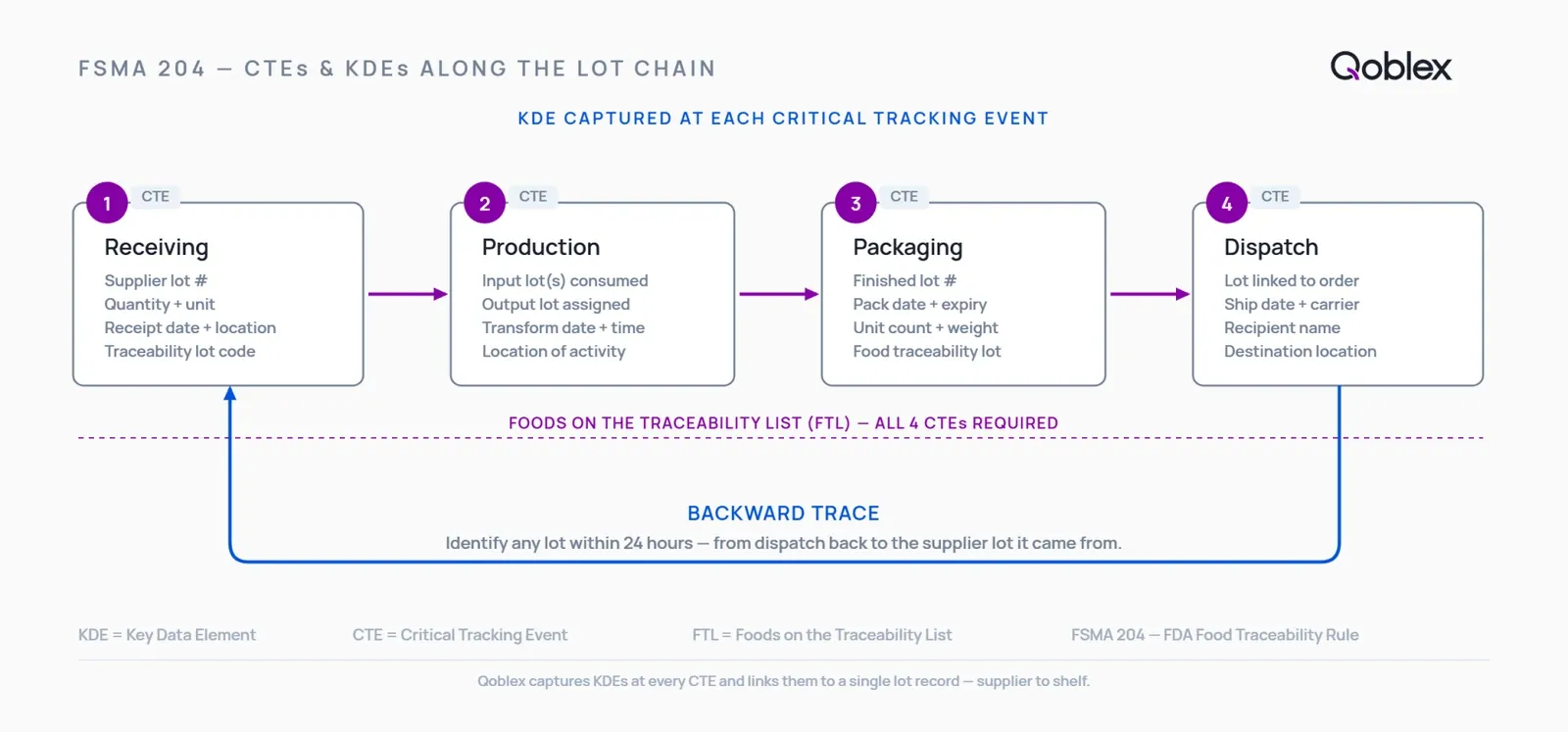
For a manufacturer, Transformation is the event that matters most, and it is the one that trips up systems built only to count stock. Transformation is what happens when you take one or more listed inputs and make something new: you combine ingredient lots according to a recipe and produce a finished batch. The rule requires that you link the Traceability Lot Codes of the inputs to a new Traceability Lot Code you assign to the output, and record the product descriptions and quantities on both sides, the location, the date, and a reference document.
That is a very specific demand: the finished batch has to point back to the exact input lots that went into it. And it maps almost one-to-one onto what a bill of materials does. When you run a production order against a recipe, you are selecting which ingredient lots go in and assigning a batch to what comes out. That is the Transformation record, expressed as an operational workflow rather than a compliance form. It is the reason a manufacturer’s traceability question is not really “can I store a lot number” but “can I link the input lots to the output batch,” and it is the single most useful thing to get right before 2028. Qoblex’s manufacturing captures exactly this link, and the mapping is worth understanding on its own terms before any tool enters the picture: it is not that a system makes you compliant, it is that the record the rule wants and the record a production order already produces are the same record.
What are the Key Data Elements (KDEs) you must capture at each CTE?
A Key Data Element is a specific field the rule requires at a given event. The lot code, the product description, the quantity, the location, the date, the reference document: each CTE has its own list, and the table below is the practical reference. It is drawn from the inecta compliance guide and the TrueCommerce KDE and CTE guide, both checked July 2026. It carries no product cells; it is a regulatory reference, not a comparison.
| CTE | Typically applies to | New TLC generated? | Key KDEs to capture |
|---|---|---|---|
| Harvesting | Farms growing FTL crops | No | Growing area, harvest date, quantity, commodity or variety |
| Cooling | Pre-packing cooling operations | No | Cooling location, date, quantity, farm location |
| Initial Packing | First packing of a raw agricultural commodity | Yes (TLC generated) | TLC, packing location, harvest source, packing date, quantity |
| First Land-Based Receiving | Seafood received from a fishing vessel | Yes (TLC generated) | TLC, species, landing date, harvest date range, locations |
| Shipping | Any shipper of FTL food | Carries existing TLC | TLC, product description, quantity, ship-from and ship-to locations, date, reference document |
| Receiving | Any receiver of FTL food | Carries existing TLC | TLC, product description, quantity, source, receiving location, date, reference document |
| Transformation | Manufacturers processing FTL ingredients | Yes (new TLC plus input TLCs linked) | New TLC, input TLCs, product descriptions in and out, quantities in and out, location, date, reference document |
The term that runs through every row is the Traceability Lot Code. The TLC is the FDA’s regulatory name for the lot or batch number that is assigned to a food and carried with it as it moves. If you already assign lot numbers to incoming stock and batch numbers to production runs, the TLC is not a new thing you have to invent; it is the regulatory label for a number you are probably already using. What the rule adds is the discipline of assigning it at the right event and carrying it through unbroken.
On retention: the records have to be kept for at least two years, and, when the FDA asks, provided within 24 hours in an electronic, sortable, and searchable format (or within a reasonable alternative timeframe if electronic records are genuinely not practicable for your operation), per the inecta guide. Two years and 24 hours are the two numbers to remember.
What is a Traceability Plan and does your business need one?
Alongside the event records, covered businesses have to establish a written Traceability Plan: a document describing how you identify the foods on the FTL in your operation, how you assign and link Traceability Lot Codes, who is responsible, and how the records are kept, per the inecta guide. It is worth being clear that this is not the same as a recall plan. A recall plan is about what you do in an event; the Traceability Plan is documentation of the recordkeeping system itself. It is a short but required piece of the picture.
How does FSMA 204 lot tracking map to what you may already do?
Here is the reassuring part for operators who already take lots seriously. A lot of food businesses track lot and batch numbers today, for internal quality control or because a retailer asked for it, well before any regulation required it. The KDEs the rule wants at Receiving and Shipping (the lot code, the product description, the quantity, the location, the date, and the reference document) are largely the same fields a good lot tracking setup already captures. If you record what you received, from whom, on what receipt, with which lot and expiry, and you record what you shipped, to whom, with which lot, you are already most of the way there for those two events.
The genuinely new element for manufacturers is the Transformation link: connecting the input ingredient lots to the finished batch lot explicitly, rather than just counting quantities in and out. A quantity-only system knows you used 40 kg of an ingredient; it does not necessarily know which lot of that ingredient went into which finished batch. FSMA 204 wants the second thing. So the practical question is less “do I track lots” and more “does my system carry the lot identity through transformation.”
This is where a tool like Qoblex fits, and it fits after the problem, not before it. Qoblex is the inventory operations layer that sits between your accounting and sales platforms, while QuickBooks Online, Xero, Shopify, or WooCommerce stay your book of record. It records lot numbers, expiry dates, supplier receipts, and stock movements at receiving; it links ingredient lots to finished production batches through the bill of materials and production orders at transformation; and it captures the lot references on shipments at dispatch. That is the data the Receiving, Transformation, and Shipping CTEs ask for, produced as a byproduct of normal work rather than as a separate compliance chore.
One honest caveat belongs right here. Capturing the underlying data is not the same as certifying compliance. Qoblex records the KDEs; whether your records fully satisfy the FDA’s specific format and completeness requirements for your particular operation is a judgment for your compliance team or FDA guidance, not something any software declares on your behalf. No inventory tool is “FSMA-certified,” and any that claims to be is overreaching. What software can honestly do is make the record exist and be queryable. On the sortable-and-searchable requirement specifically: Qoblex produces lot trace and stock-movement reports, which is the practical form a queryable record takes, though the formal sufficiency of that output for your operation is again a compliance judgment.
How do you produce traceability records to the FDA within 24 hours?
The 24-hour clock is the part that turns recordkeeping from a filing habit into an operational capability. When the FDA requests records during an investigation, you have 24 hours to provide them (or a reasonable alternative timeframe where electronic records are not practicable), and the format has to be electronic, sortable, and searchable, per the inecta guide. Read practically, that rules out records that live only on paper, or in a form that has to be reassembled by hand across several places under time pressure.
The practical answer is a report you can run, not a reconstruction project you have to start. If your lot history is captured as work happens, producing the record is a query: enter the lot, get the trace. If it is scattered, the 24 hours is spent hunting rather than answering. This is the same capability a mock recall drill tests, and running one is the cheapest way to find out which situation you are actually in before the real request arrives.
When is your existing setup enough, and when is it not?
Not every food business needs traceability software to meet FSMA 204, and it would be dishonest to suggest otherwise.
If your foods are not on the FTL, or you fall under one of the exemptions above, the regulation may not currently require you to add anything at all. The spreadsheet or storefront that covers your operation today is fine, and spreadsheets have carried a lot of good food businesses a long way. There is no prize for buying software ahead of the need.
Spreadsheets can technically hold lot numbers and dates. What they struggle with is the 24-hour part: producing a complete, sortable, searchable electronic record on demand, under pressure, when the data is spread across a sheet, a set of packing slips, and an inbox. The data can all be there and still not be a record in the sense the rule means.
QuickBooks Online and Xero will not close that gap either, and it is not a knock on them. They are accounting platforms, excellent at the ledger, and they do not natively track lot numbers, record expiry dates, or hold the stock-movement history a traceability record needs. They should stay your book of record; the missing piece is the inventory layer that captures what they were never built to capture.
Qoblex is that layer for operations that have crossed the line: you handle FTL foods above the exemption thresholds, you carry perishable stock with expiry constraints, you transform listed ingredients into finished batches, or a retailer or auditor is asking for lot-level records as a condition of business. If one or more of those describe you, the manual workaround has quietly become the risk, and the record needs to be a query rather than a project. If none of them do, keep the spreadsheet, and revisit when the operation asks. Plan and pricing details are on the Qoblex pricing page.
FAQ
What is FSMA Section 204? FSMA Section 204 is the FDA Food Traceability Rule (21 CFR Part 1, Subpart S). It requires businesses that manufacture, process, pack, or hold foods on the Food Traceability List to maintain records of Key Data Elements at Critical Tracking Events and provide them to the FDA within 24 hours of a request. The current compliance date is July 20, 2028.
What is the current FSMA 204 compliance date? July 20, 2028. The original date was January 20, 2026. The FDA proposed a 30-month extension (Federal Register document 2025-14967, August 2025), and Congress directed the FDA not to enforce the rule before July 20, 2028 through the Continuing Appropriations Act of 2026 (November 2025). The substantive requirements of the rule are unchanged.
Which foods are on the Food Traceability List? The FTL covers roughly fifteen commodity categories, including leafy greens, fresh herbs, melons, peppers, sprouts, tropical tree fruits, tomatoes, cucumbers, soft cheeses, shell eggs, nut butters, ready-to-eat deli salads, finfish, crustaceans, and molluscan shellfish. The FDA’s Food Traceability List page is the authoritative source. The rule also applies to foods that contain a listed ingredient in the same form.
Who is exempt from FSMA 204? Exemptions include: small retail food establishments and restaurants with $250,000 or less in average annual food sales; farms and producers of raw agricultural commodities with $25,000 or less in average annual sales; food that undergoes a kill step eliminating the relevant hazard; certain direct farm-to-consumer sales; transporters that do not take ownership of the food; and any food not on the FTL. These thresholds apply to specific business types (the $250,000 figure is for retailers and restaurants, not manufacturers or distributors), so confirm your own situation against the FDA.
What are Key Data Elements (KDEs) and Critical Tracking Events (CTEs)? A CTE is a supply chain event where traceability records must be maintained, such as harvesting, initial packing, receiving, shipping, or transformation. A KDE is a specific data field required at a given CTE, such as the lot code, product description, quantity, location, date, and reference document. Each CTE has its own list of required KDEs.
What is a Traceability Lot Code (TLC)? The TLC is the FDA’s regulatory term for the lot or batch number that is assigned to a food and carried with it as it moves through the supply chain. If you already assign lot numbers to incoming stock and batch numbers to production runs, the TLC is the regulatory name for the same concept.
How does the Transformation CTE work for food manufacturers? The Transformation CTE requires linking the lot codes (TLCs) of each input ingredient to a new TLC assigned to the finished product, along with product descriptions and quantities on both sides, the transformation location, the date, and a reference document. This is the bill-of-materials concept: ingredient lots linked to the finished batch they went into.
How long must FSMA 204 records be kept? Records must be maintained for at least two years and be available to the FDA within 24 hours of a request in an electronic, sortable, and searchable format, or within a reasonable alternative timeframe if electronic records are not practicable for your operation.
Does Qoblex help with FSMA 204 recordkeeping? Qoblex records lot numbers, expiry dates, supplier receipts, and stock movements at receiving; links ingredient lots to finished production batches via the bill of materials and production orders; and captures shipment records at dispatch. That is the data the Receiving, Transformation, and Shipping CTEs require. Qoblex is not FSMA-certified; it captures the underlying KDE data as part of normal operations, and whether your records satisfy the FDA’s requirements for your operation is a compliance judgment.