


Here is where the trace usually breaks. A supplier delivery arrives on a Tuesday, and someone writes the lot code on the box or leaves it on the packing slip. On Thursday that ingredient goes into a production run with three other lots, and the finished batch gets a new number that no record connects back to what went in. A month later those cases ship to a dozen customers, invoiced cleanly, with nothing tying the shipment to the batch inside it. Three separate records, each fine on its own, none of them joined. Then a supplier flags a bad ingredient lot, and the question lands: which of our finished batches contain it, who did we ship them to, and how much is still on our shelves? The answer is somewhere in those three records. Getting to it means an afternoon of matching dates by hand.
That is the seam problem. Your accounting platform is good at accounting and your storefront is good at selling, but the chain from a supplier receipt to a customer shipment runs through three handoffs, and the trace is only as strong as the weakest join between them. This page walks all three seams: where each one breaks, why, and what it takes to keep the chain whole from the loading dock to the shelf.
Supplier-to-shelf food traceability is the unbroken chain of lot records that follows product from a supplier delivery, through production, to every customer shipment. It has to hold at three seams: lot capture at receiving, a production link that connects raw-material lots to finished batches through the bill of materials, and dispatch records that log which lots left on which order. Only when all three hold can you run a forward trace (lot to every customer) and a backward trace (lot to its supplier receipt) that accounts for every unit.
What does supplier-to-shelf food traceability mean?
Supplier to shelf is the full journey of a food product told as one continuous record. It moves through three linked stages: a supplier receipt when raw material arrives, a production transformation when ingredients become finished goods, and a customer dispatch when those goods leave your facility. Traceability means every one of those movements is written down at the lot level, so the history of any unit can be reconstructed from records rather than memory.
What is forward trace versus backward trace?
A backward trace starts at a lot and walks toward its origin: from a finished case back to the production run that made it, and from there back to the supplier delivery and inbound purchase order the ingredients came from. A forward trace runs the other way: from a supplier lot or a finished batch out to every customer shipment that received it. You need both, because trouble can start at either end. A supplier flags a contaminated ingredient and you trace forward to find who has it; a customer reports a problem and you trace backward to find where it came from.
What is internal traceability, and why is it the critical bridge?
Between the inbound receipt and the outbound shipment sits the step that most systems lose: internal traceability, the record of what happens inside your own four walls. Mixing, cooking, packaging, rework. This is the bridge that connects an incoming raw-material lot to the outgoing finished-goods batch it became part of, and industry guidance treats it as the critical link that ties finished products back to specific supplier lots. A good batch record captures the ingredient and packaging lot codes that went in, the production time, the line, and the recipe version. Without that record, the forward and backward traces meet a wall at production and cannot cross it.
Where does the traceability chain break?
The chain does not usually break because a business is careless. It breaks at the seams, the handoffs where one record is supposed to connect to the next and quietly does not. There are three of them, and they fail in different ways.
The receiving seam: when a supplier’s lot code does not make it into your system
The first join is at the loading dock. A supplier ships product with its own lot code, in its own format, and that code has to land in your system, attached to the specific receipt and purchase order it arrived on. When it does not, the trace has no anchor. The lot code lives on a packing slip in a folder, or in a text field that no report can query, or in the format the supplier used rather than the one your intake expects, so the match has to be made by hand later. Traceability breaks at receiving when the supplier’s lot identity does not cleanly enter your records at the moment of intake.
The production seam: the Transformation CTE and the parent-to-output link
This is where the chain most often fails, and it is worth being precise about why. In production, several raw-material lots go in and a new finished batch comes out with its own number. The trace survives only if a record links the parent raw-material lots to that output batch. Many systems store a lot number in a field but never make that parent-to-output connection, so the chain breaks at the transformation step: you know what you received and you know what you made, but nothing tells you which received lots are inside which made batch. Once that link is missing, no amount of clean receiving or dispatch records can rebuild the trace across production. This is also where lot and batch tracking for food and beverage manufacturers earns its keep.
The dispatch seam: shipments that leave without lot records
The last join is at the door. A finished batch ships to a customer, the order is invoiced, and the record captures the customer, the quantity, and the date, but not which lot numbers were in the box. When dispatch is not linked to lots, a forward trace runs cleanly up to the point of shipment and then stops. You can see that a customer bought a hundred cases; you cannot see which batch those cases came from. In a recall, that is the difference between notifying the three customers who received the affected lot and notifying everyone who ever bought the product.
What does FSMA 204 require at each handoff?
The regulatory framework names these seams directly, which is useful even if the rule does not apply to your specific products. The FDA’s Food Traceability Rule, FSMA Section 204, is built around Critical Tracking Events (CTEs), the specific points in the supply chain where traceability records must be captured, and Key Data Elements (KDEs), the data fields recorded at each event. The CTE and KDE structure maps almost exactly onto the three seams above.
CTEs and KDEs: what records the rule requires at receiving, transforming, and shipping
Of the events the rule defines, three matter most to a food manufacturer, and they are the same three handoffs. At Receiving, you record the KDEs for a food arriving at your facility, including its lot code. At Transforming, the production event, you link the input lots to the new output lot, which is precisely the parent-to-output connection the production seam needs. At Shipping, you record which lots left, to whom, and when. FSMA 204 also expects covered businesses to produce these records for the FDA within 24 hours of a request, which is less about speed for its own sake and more about whether the records exist in a form you can query at all. The full treatment of the rule, its Food Traceability List, and every KDE lives on our food traceability software guide rather than being repeated here.
A note on timing, because it shapes how urgently to treat this. The compliance date is July 20, 2028, extended from an earlier January 2026 date. That is a preparation window, not an alarm. It is time to put the recordkeeping in place before it is required, which is exactly the work this page is about.
One-up, one-down: the minimum, not the finish line
The baseline traceability standard is one-up, one-down, also called one step back, one step forward: you know where a lot came from, one step back to your direct supplier, and where it went, one step forward to your direct customer. FSMA 204 and the major GFSI schemes (SQF, BRCGS, FSSC 22000) share that minimum expectation, typically with full lot accountability behind it. But one-up, one-down is the regulatory minimum, not the finish line. For a manufacturer, the affected material rarely leaves the way it arrived; it goes through a recipe into finished batches. A real trace has to run through the bill of materials to connect a raw-ingredient lot to every finished batch that contains it, and only then forward to customers. One-up, one-down is where you start. Whole-chain trace through production is where a manufacturer has to finish.
How does one system keep the chain unbroken?
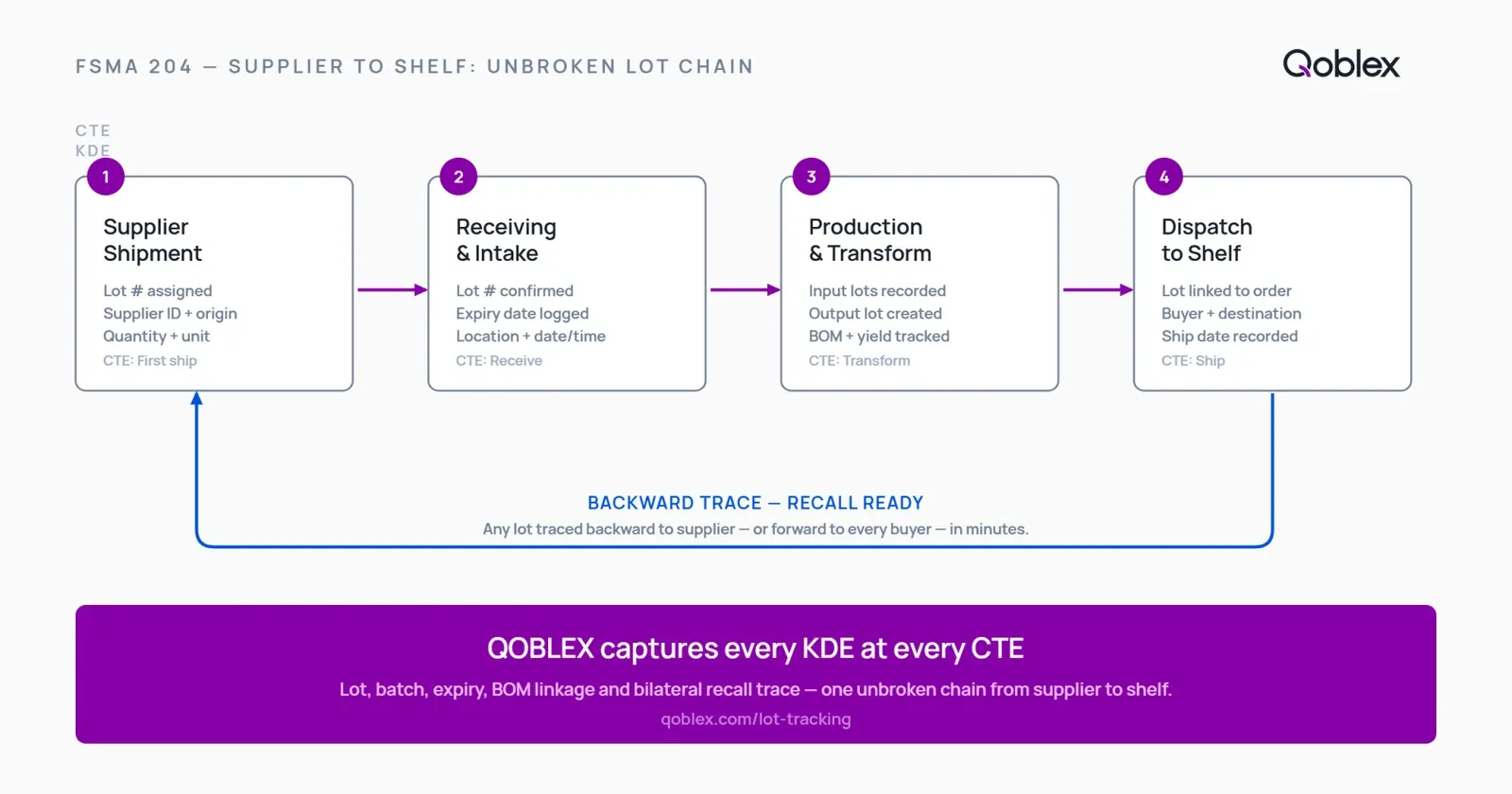
The seams break because the records live in different places. The fix is to hold all three in one system, so the join between them is made as work happens rather than reconstructed afterward. Here is the same chain, walked as a solved workflow.
Seam 1: lot capture at receiving
When stock arrives against a purchase order, the lot or batch number and the expiry date are captured at the point of receipt, tied to the supplier and the inbound PO. From that moment the lot has an anchor in your records, in your format, queryable. The receiving seam holds because the supplier’s lot identity enters the system at intake rather than sitting on a packing slip for someone to reconcile later.
Seam 2: BOM production linkage, parent lot to finished batch
This is the seam that usually fails, and it is the one Qoblex is built to close. Qoblex connects inputs to outputs through traceable bills of materials, so you know exactly which raw materials went into which finished goods. For batch-tracked components, you select the input batches when you create a production order, and the completed products are assigned their own batch. The parent-to-output link is recorded as part of making the batch, not added afterward, which is what carries the trace across production instead of stopping at it.
Seam 3: dispatch, recording which lots shipped on which order
When finished goods leave, the outbound order records which lot numbers went out, to which customer, in what quantity, on what date. Because the lot history is tracked from receipt through to sale, the dispatch record connects to the same lot identity captured at receiving and carried through production. The forward trace no longer stops at the door.
The result: forward and backward trace end to end
With all three seams holding in one system, the trace runs both directions from any point. Enter a finished-goods lot and walk backward through the batch that made it to the supplier receipt and PO it came from. Enter a supplier lot and walk forward through every finished batch that consumed it to every customer shipment that carried it. When a lot is flagged, you can identify the affected batches, see who received them, and read off what is still on hand from records rather than detective work. The same lot records also show what is nearing expiry across all locations so you can prioritize what to sell, which is the first-expired-first-out picking discipline perishable stock depends on.
The point is not the software for its own sake. It is that the chain stays whole because the three records were never separate to begin with. Qoblex is the operational layer that holds the seams together while your accounting platform and your storefront stay your books of record.
When is a lighter setup enough?
Not every food business needs full supplier-to-shelf traceability yet, and it would be dishonest to pretend otherwise. If you resell a single ingredient with no production transformation, carry nothing with a shelf life, and have no customer or regulator asking for lot or expiry records, a well-kept spreadsheet may genuinely cover you for now. The chain only has three seams to hold when there is actually a transformation in the middle; without one, there is far less to join. If that is your operation, keep the setup that works and revisit it when a production step, a perishable line, or a retailer’s lot requirement enters the picture.
Frequently asked questions
What is the difference between forward trace and backward trace in food traceability? Forward trace starts at a lot and follows it to every customer shipment that received it. Backward trace starts at a lot and walks back to the supplier receipt it came from. Both directions are required under FSMA 204 and GFSI schemes; a system that can only do one direction is incomplete.
What are Critical Tracking Events under FSMA 204? FSMA 204 defines Critical Tracking Events (CTEs) as the specific handoffs where traceability records must be captured. For food manufacturers the three most relevant are Receiving (when a listed food arrives), Transforming (production, when ingredients are converted into finished goods), and Shipping (when finished goods leave your facility). Each CTE requires specific Key Data Elements including lot codes, quantities, dates, and locations.
What is one-up, one-down traceability and is it enough for food manufacturers? One-up, one-down means you know where a lot came from, one step back to your direct supplier, and where it went, one step forward to your direct customer. That is the regulatory minimum under FSMA 204 and GFSI schemes. For food manufacturers it is not enough on its own: an ingredient lot has to be traced through the bill of materials to every finished batch it became part of, and only then forward to customers. BOM-level trace is what closes the gap.
What is the FSMA 204 compliance date? The compliance date is July 20, 2028, extended from an earlier January 2026 date. The practical read for an operator is that this is a preparation window rather than an immediate deadline, time to put the recordkeeping in place before it is required.
What records does a dispatch lot trace require? At dispatch, a complete lot trace records which lot numbers were in the shipment, the outbound order reference, the customer, the quantity of each lot shipped, and the ship date. These are the Shipping CTE data elements under FSMA 204. Without this link, a forward trace from any lot cannot reach the customer who received it.
How do I link a raw-material lot to a finished batch in Qoblex? Qoblex links raw-material lots to finished batches through the bill of materials and production orders. For batch-tracked components, you select the input batches when creating a production order; when the order completes, the finished product is assigned its own batch, and the bill of materials records which inputs went into it. That is the parent-to-output link the Transformation CTE requires.
Does Qoblex include lot tracking on all plans? Lot and batch tracking is a paid add-on in Qoblex, not included on every base plan. Current plan details and what is included at each tier are on the Qoblex pricing page.