



Every misplaced pallet, mislabeled bin, and delayed shipment costs you money. If your warehouse feels more like an obstacle course than a well-oiled machine, you are not alone. Growing businesses often inherit chaotic systems that worked when order volumes were low but now create bottlenecks that frustrate customers and drain profits.
The good news is that transforming your warehouse does not require a massive budget or a complete overhaul. Many of the most effective warehouse ideas can be implemented in days, not months, and deliver measurable returns almost immediately. Whether you are managing inventory for a single Shopify store or juggling stock across multiple sales channels, the strategies in this guide will help you reduce errors, speed up fulfillment, and position your operation for scalable growth.
This article covers 25 actionable warehouse organization ideas organized into these key areas:
- Quick wins you can implement this week with minimal investment
- Layout and space optimization strategies to maximize every square foot
- Inventory management techniques for multichannel sellers
- Technology and automation tools to scale operations efficiently
- Specialized guidance for businesses that manufacture and sell
- Ongoing maintenance practices for continuous improvement
What is warehouse organization? Warehouse organization refers to the systematic arrangement of inventory, equipment, workflows, and physical space to maximize operational efficiency, minimize errors, and reduce costs. It encompasses everything from shelf labeling to software systems that track inventory movement.
Why Warehouse Organization Directly Impacts Your Bottom Line
Before diving into specific warehouse improvement ideas, it is worth understanding why organization matters beyond simply keeping things tidy. A disorganized warehouse creates invisible costs that compound over time, while a well-organized operation becomes a competitive advantage.
The Hidden Costs of a Disorganized Warehouse
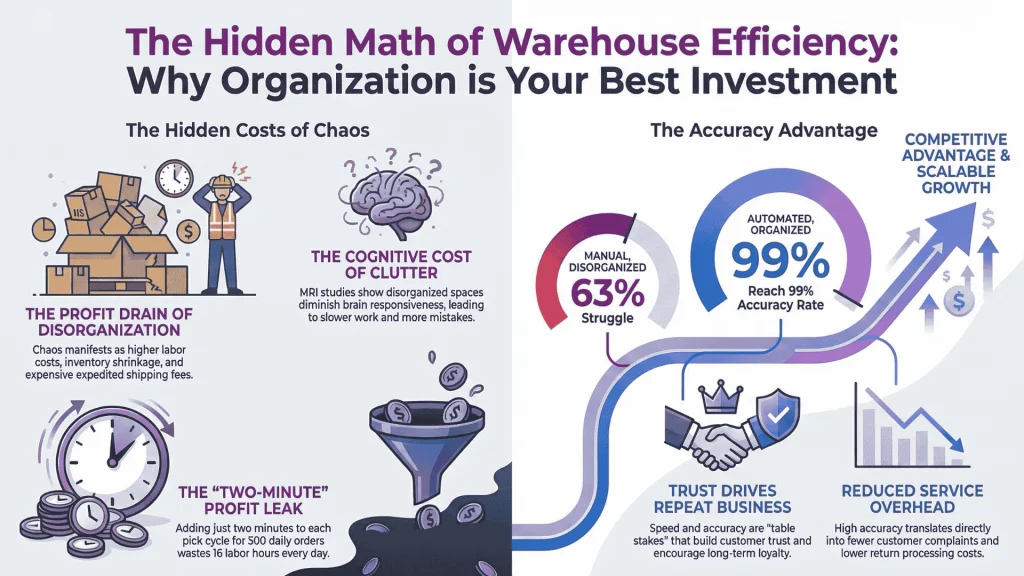
Disorganization rarely shows up as a single line item on your P&L statement. Instead, it manifests in ways that quietly drain your profits:
- Higher labor costs when employees spend extra time searching for products instead of fulfilling orders
- Inventory shrinkage when items get lost, damaged, or expire before they can be sold
- Expedited shipping fees when orders miss their deadlines due to picking delays
- Customer service overhead handling complaints about wrong items or late deliveries
- Opportunity costs when stockouts force customers to shop elsewhere
Research from the Princeton Neuroscience Institute demonstrates that visual clutter overburdens the brain and reduces the ability to concentrate. In a warehouse context, this means workers in messy environments make more mistakes, work more slowly, and tire faster. Studies using functional MRI imaging have confirmed that disorganized spaces diminish brain responsiveness and performance.
For a mid-sized operation shipping 500 orders per day, even small inefficiencies add up quickly. If poor organization adds just two minutes to each pick-and-pack cycle, you are losing over 16 hours of labor daily. Multiply that by your hourly rate, and the cost of disorganization becomes starkly clear.
How Organization Drives Customer Satisfaction and Repeat Business
Speed and accuracy are table stakes for eCommerce success. When your warehouse runs efficiently, orders ship faster, tracking information updates promptly, and customers receive exactly what they ordered. This reliability builds trust and encourages repeat purchases.
Automated and well-organized warehouses can achieve inventory accuracy rates of 99% or higher, compared to the industry average of around 63% for manual operations. That accuracy gap translates directly into fewer customer complaints, lower return rates, and reduced customer service costs.
Quick-Win Warehouse Ideas You Can Implement This Week
Not every warehouse improvement requires major investment. These quick-win ideas deliver immediate results with minimal disruption to your current operations.
Create a Labeling System That Eliminates Guesswork
Clear, consistent labels are the foundation of warehouse organization. Every shelf, bin, and storage location should have a label that includes a unique location code, the product name or SKU, and visual identifiers when helpful.
Invest in durable label materials that can withstand your environment. Thermal labels work well for most warehouses, while laminated or plastic labels are better for cold storage or high-humidity areas. Replace worn or damaged labels immediately since faded labels cause picking errors that cost far more than new label stock.
Pro tip: Include barcodes on your location labels. Even if you scan manually today, barcode-ready labels make future automation much easier.
Establish Clear Bin Locations and Pick Lists
Every product in your warehouse needs a defined home. When items have designated bin locations, employees spend less time searching and more time fulfilling orders.
Generate pick lists that organize items by location rather than by order. This approach, sometimes called batch picking, reduces travel time because workers move through the warehouse systematically instead of zigzagging between distant locations for each order.
Set Up Low Stock Alerts to Prevent Stockouts
Stockouts damage customer relationships and force you into expensive emergency reorders. Proactive alerts help you reorder before inventory runs dry.
For each SKU, calculate a reorder point based on your average daily sales and supplier lead time. When stock on hand drops below that threshold, your system should notify your purchasing team automatically. This simple automation prevents the feast-or-famine cycle that plagues many growing businesses.
Post Navigation Signage and Warehouse Maps
Signage serves two purposes: it helps experienced staff work faster, and it enables new or temporary workers to become productive immediately.
Install clear signage at aisle ends, zone transitions, and key workstations. Post warehouse maps at entry points and in break areas. For larger facilities, consider color-coding zones to make navigation intuitive.
| Quick-Win Idea | Time to Implement | Expected Impact |
| Labeling system | 1-2 days | 15-20% faster picking |
| Bin locations and pick lists | 2-3 days | 25% reduction in search time |
| Low stock alerts | 1 day | 90% fewer stockouts |
| Navigation signage | 1 day | 50% faster new employee ramp-up |
Layout and Space Optimization Ideas
Your warehouse layout determines how efficiently products flow from receiving to shipping. These warehouse layout ideas help you maximize every square foot and achieve true warehouse optimization.
Design Your Floor Plan for Logical Process Flow
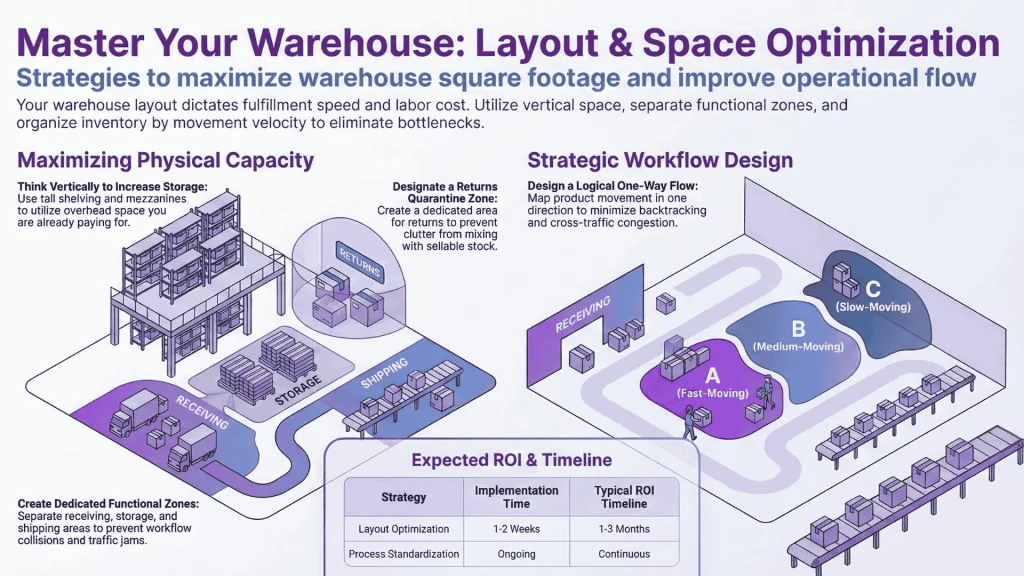
The best warehouse layouts create a logical progression from receiving through storage to picking, packing, and shipping. Products should move in roughly one direction through your facility, minimizing backtracking and cross-traffic.
Map your current flow by drawing a line showing how a typical product moves from arrival to departure. If that line crosses itself multiple times, your layout may be creating unnecessary travel time and congestion.
Think Vertically to Maximize Storage Capacity
Most warehouses underutilize vertical space. If your shelving stops well below the ceiling, you are paying for square footage you are not using.
Vertical storage solutions range from simple tall shelving units to sophisticated automated storage and retrieval systems. For most SMBs, adjustable pallet racking that accommodates different product heights offers the best balance of capacity and flexibility. Even adding a mezzanine level for lightweight, slow-moving inventory can dramatically increase your storage capacity without expanding your footprint.
Organize Products Using ABC Velocity Analysis
Not all products deserve the same real estate. ABC analysis categorizes inventory by movement velocity, placing your fastest-moving items in the most accessible locations.
- A items (your top 20% of SKUs by order frequency) belong in prime picking locations at waist height and near the packing station.
- B items (the next 30%) go in easily accessible but less premium spots.
- C and D items (slower movers) can occupy harder-to-reach locations since they are picked less frequently.
This approach reduces average travel time per pick and puts your team’s energy where it matters most.
Create Dedicated Zones for Receiving, Storage, and Shipping
Physical separation between functions prevents bottlenecks and reduces errors. Your receiving area should have space to inspect and process incoming shipments without blocking storage aisles. Your shipping zone needs room for packing, staging completed orders, and organizing by carrier or delivery route.
When these zones overlap, inbound and outbound processes interfere with each other. A shipment waiting to be put away blocks a picker, who blocks a packer, who delays a delivery. Dedicated zones keep each process moving independently.
Designate a Returns Processing Area
Returns are a fact of eCommerce life. Without a dedicated processing area, returned items clutter your main warehouse and create confusion about what is available to sell.
Create a quarantine zone where returns land first. Establish a clear workflow for inspecting returned items, updating inventory status, and either restocking or disposing of each unit. This discipline keeps your available inventory accurate and your main warehouse organized.
Inventory Management Ideas for Multichannel Sellers
Selling across multiple channels, whether Shopify, Amazon, WooCommerce, or B2B, creates unique organizational challenges. These warehouse storage ideas address the complexity of multichannel inventory management and eCommerce fulfillment.
Centralize Inventory Across All Sales Channels
Maintaining separate inventory counts for each channel is a recipe for overselling and stockouts. A centralized inventory system provides one source of truth that syncs across all your sales platforms.
When a customer buys on Amazon, your Shopify and WooCommerce stores should reflect the updated stock level within seconds. This real-time synchronization prevents the nightmare scenario of selling the same item twice because your channels were not talking to each other.
Use Demand Forecasting to Optimize Stock Levels
Demand forecasting transforms inventory management from reactive to proactive. Instead of waiting until stock runs low, forecasting tools analyze sales history, seasonality, and trends to predict future demand.
Accurate forecasting helps you order the right quantities at the right time, reducing both stockouts and the carrying costs of excess inventory. For seasonal products or items with long lead times, forecasting is especially valuable because it gives you weeks or months of advance warning.
Implement Real-Time Stock Synchronization
Real-time sync goes beyond periodic inventory updates. Every sale, return, adjustment, and receipt should update your stock levels instantly across all locations and sales channels.
This visibility matters most during high-volume periods like holiday sales or flash promotions. When stock is syncing in real time, you can confidently run promotions knowing you will not oversell, and you can quickly redirect inventory if one channel is outperforming another.
Track Moving Average Costs for Accurate Pricing
Moving Average Cost (MAC) provides a more accurate picture of your true inventory value than first-in-first-out or last-in-first-out accounting. MAC recalculates your average cost per unit each time you receive new inventory, smoothing out price fluctuations from different purchase orders.
Accurate costing supports better pricing decisions and ensures your profit margins reflect reality. It also simplifies inventory valuation for accounting and tax purposes.
Technology and Automation Ideas to Scale Operations
Technology amplifies the impact of every other warehouse improvement. These ideas help you build a foundation for scalable, efficient operations and faster order fulfillment.
Adopt a Warehouse Management System (WMS)
A warehouse management system is the central nervous system of modern warehouse operations. It tracks inventory locations, guides picking and packing, and provides the data you need to continuously improve.
For growing businesses, a cloud-based WMS offers flexibility without massive upfront investment. When evaluating options, look for these essential features:
- Real-time inventory tracking across multiple locations
- Integration with your existing sales channels (Shopify, Amazon, WooCommerce)
- Mobile app support for on-the-floor operations
- Automated pick list generation and route optimization
- Reporting and analytics for performance monitoring
Key Insight: The right WMS pays for itself quickly. Businesses that implement inventory management software typically see inventory accuracy improve from 63% to over 99%, reducing costly errors and stockouts.
Connect Inventory to Your Accounting Software
When inventory and accounting systems do not talk to each other, someone has to manually transfer data between them. This manual work takes time and introduces errors.
Integrating your inventory management with accounting software like Xero or QuickBooks automates the flow of financial data. Purchase orders, invoices, and inventory valuations sync automatically, reducing double-entry and keeping your books accurate.
Use Mobile Apps for Stock Takes and Adjustments
Mobile devices put inventory management in the hands of warehouse staff, right where the work happens. Instead of recording counts on paper and entering them later, workers can scan barcodes and update inventory in real time.
Mobile apps also enable more frequent cycle counts, since the barrier to conducting a count drops dramatically. A worker can count a section of shelving during a slow period, scan the results, and move on without paperwork or data entry delays.
Automate Reorder Points and Purchase Orders
Manual reordering relies on someone remembering to check stock levels and place orders before products run out. Automated reorder points remove human memory from the equation.
When stock drops below the threshold you set, the system can generate a purchase order automatically or at least alert your team. This automation ensures you never miss a reorder because someone was on vacation or distracted by other priorities.
Generate Pick Lists for Faster Order Fulfillment
Optimized pick lists turn order fulfillment into a systematic process rather than a chaotic scramble. The best pick lists organize items by location, batch similar orders together, and provide clear instructions for each pick.
Some systems can even optimize pick routes based on your warehouse layout, further reducing travel time. This optimization becomes more valuable as your order volume grows.
Ideas for Businesses That Manufacture and Sell
If you manufacture products or assemble kits, your warehouse needs to handle raw materials, work-in-progress, and finished goods. These ideas address the unique challenges of manufacturing inventory.
Integrate Bill of Materials with Inventory Tracking
A Bill of Materials (BOM) lists every component required to produce a finished product. When your BOM integrates with inventory tracking, the system automatically knows whether you have enough components to complete a production run.
This visibility prevents the frustration of discovering mid-production that you are short on a critical component. It also enables more accurate demand forecasting by linking finished goods orders to component requirements.
Set Up Production Order Workflows
Production orders formalize the manufacturing process and create accountability at each stage. A production order specifies what to make, how many to make, and which components to use.
When production completes, the system automatically deducts component inventory and adds finished goods. This automation keeps inventory accurate without manual adjustments.
Track Component Stock for Uninterrupted Manufacturing
Running out of components halts production, wastes labor, and delays customer orders. Separate reorder points for components, independent from finished goods, ensure your production team always has the materials they need.
Consider your component lead times when setting these thresholds. A part that takes six weeks to arrive needs a higher reorder point than one you can get overnight.
Maintenance and Continuous Improvement Ideas
Organization is not a one-time project. These ongoing practices keep your warehouse operating at peak efficiency.
Schedule Regular Cycle Counts Instead of Annual Stocktakes
Annual physical inventory counts are disruptive, time-consuming, and often inaccurate because they try to count everything at once. Cycle counting distributes this work throughout the year.
Each day or week, count a small section of your warehouse. Over time, you verify every location without the chaos of a full physical inventory. Cycle counting also catches discrepancies faster, while the causes are still fresh and correctable.
Keep Aisles Clear for Safety and Efficiency
Cluttered aisles slow down picking, create safety hazards, and signal to employees that organization is not a priority. Establish a zero-tolerance policy for obstructions in main travel paths.
Optimize aisle widths for your equipment. Forklifts need more clearance than pallet jacks, which need more than hand carts. Too narrow creates congestion, while too wide wastes valuable storage space.
Train Employees on Organization Best Practices
The best systems fail without employee buy-in. Regular training reinforces the importance of organization and ensures everyone knows current procedures.
New employee orientation should include a thorough warehouse tour with emphasis on organizational systems. Ongoing training can address seasonal changes, new products, or process improvements.
Monitor Performance Metrics and Adjust
What gets measured gets improved. Track these key metrics to identify problems and measure the impact of improvements:
- Picking accuracy: Percentage of orders picked correctly the first time
- Order cycle time: Average time from order placement to shipment
- Inventory turnover: How quickly you sell and replace stock
- Fulfillment rate: Percentage of orders shipped complete and on time
- Inventory accuracy: Match between system records and physical counts
Review metrics regularly with your team. When everyone sees the numbers, improvement becomes a shared goal rather than a management mandate.
| Improvement Category | Time Investment | Typical ROI Timeline |
| Quick wins (labeling, signage) | 1-3 days | Immediate |
| Layout optimization | 1-2 weeks | 1-3 months |
| Software implementation | 2-4 weeks | 3-6 months |
| Process standardization | Ongoing | Continuous |
Frequently Asked Questions About Warehouse Organization
How do I organize a small warehouse with limited space?
Small warehouses benefit most from vertical storage and smart slotting. Use tall shelving units to maximize cubic footage, and place your fastest-moving products at the most accessible heights. Consider narrow-aisle configurations and vertical lift modules if ceiling height allows. Even small spaces can be highly efficient with thoughtful organization.
What is the best way to organize inventory in a warehouse?
The most effective approach combines ABC velocity analysis with logical zoning. Group your fastest-moving items in easily accessible locations near your packing station. Create dedicated zones for receiving, storage, and shipping to prevent workflow collisions. Label every location clearly and maintain accurate digital records of where each product lives.
How can warehouse organization reduce shipping errors?
Organized warehouses reduce errors through clear labeling, systematic pick processes, and barcode verification. When every product has a defined location and pick lists are generated automatically, workers spend less time searching and guessing. Adding barcode scanning at the packing station catches the remaining errors before packages leave your facility.
What software do I need to organize my warehouse?
At minimum, you need inventory management software that tracks stock levels and locations. As you grow, consider a warehouse management system that adds features like pick optimization, barcode scanning, and multi-location support. Integration with your sales channels and accounting software multiplies the value by eliminating manual data transfer.
Start Organizing Your Warehouse for Scalable Growth
Every warehouse idea in this guide shares a common thread: they make your operation more efficient today while building the foundation for tomorrow’s growth. Whether you start with simple labeling improvements or implement a comprehensive warehouse management system, the key is to begin.
The 25 strategies covered in this guide fall into clear categories you can tackle systematically:
- Quick wins that deliver results in days with minimal cost
- Layout changes that maximize your existing space
- Inventory practices that prevent stockouts and overselling
- Technology investments that scale with your business
- Manufacturing workflows for businesses that produce and sell
- Ongoing maintenance that sustains your improvements
Start with the quick wins that deliver immediate results. Use those early successes to build momentum and demonstrate ROI. Then tackle larger structural improvements with confidence, knowing that organization pays for itself through reduced errors, faster fulfillment, and happier customers.
The gap between a chaotic warehouse and an efficient one is not just about tidiness. It is about transforming your operation from a cost center into a competitive advantage. The businesses that invest in warehouse organization now will be the ones best positioned to scale profitably as order volumes grow.
Your warehouse does not have to be perfect overnight. It just has to be better than it was yesterday. Pick one idea from this guide, implement it this week, and build from there.