



A guide written from the point of view of a B2B wholesale operator in Australia and APAC who has outgrown a batch-driven workflow and wants to know what actually changes when you switch.
The best EMERGE App alternatives for wholesale and distribution teams in 2026 are Qoblex, Unleashed, Cin7 Core, inFlow Inventory, Zoho Inventory, Odoo, and Katana. EMERGE App suits B2B trading businesses at a straightforward scale. Teams that need continuous real-time multichannel sync across Amazon and Shopify, enforced lot and expiry traceability, or broader marketplace coverage typically move to a platform built for that depth.
There is a specific moment a growing wholesale business hits. You started on EMERGE App because it did the core job well: purchase orders in, sales orders out, quotations, invoicing, a running view of stock. For an import/export or trading team, that is most of the work, and EMERGE handles it at a fair per-user price. Then a channel scaled. You added Amazon, kept Shopify busy, and the timing of when your stock numbers agree with reality started to matter more than it used to. That is the point where teams look at what else is out there.
This page is for that operator. Not “EMERGE is bad”, because it is not. It is a look at seven credible alternatives and, honestly, when EMERGE is still the right seat to stay in.
Why do B2B wholesale teams look for EMERGE App alternatives?
What is EMERGE App designed for?
EMERGE App is a Singapore-built inventory and order management tool with an Australia landing page and a following across the AU and APAC market. Its centre of gravity is B2B trading: purchasing, sales orders, quotations, multi-currency, multi-warehouse, and invoicing in one place. For an import/export or wholesale distribution business, that covers the daily grind well.
Its integration set is broader than it is sometimes given credit for. EMERGE connects to Shopify, WooCommerce, Xero, QuickBooks Online Advanced, ShipStation, and Stripe, and it has dedicated Amazon and eBay integrations. It also publishes a public Open API in beta covering product info, sales orders, product inventory, and webhooks. If you have read elsewhere that EMERGE lacks Amazon or lacks an API, that is out of date.
Where do wholesale teams typically hit the ceiling with EMERGE App?
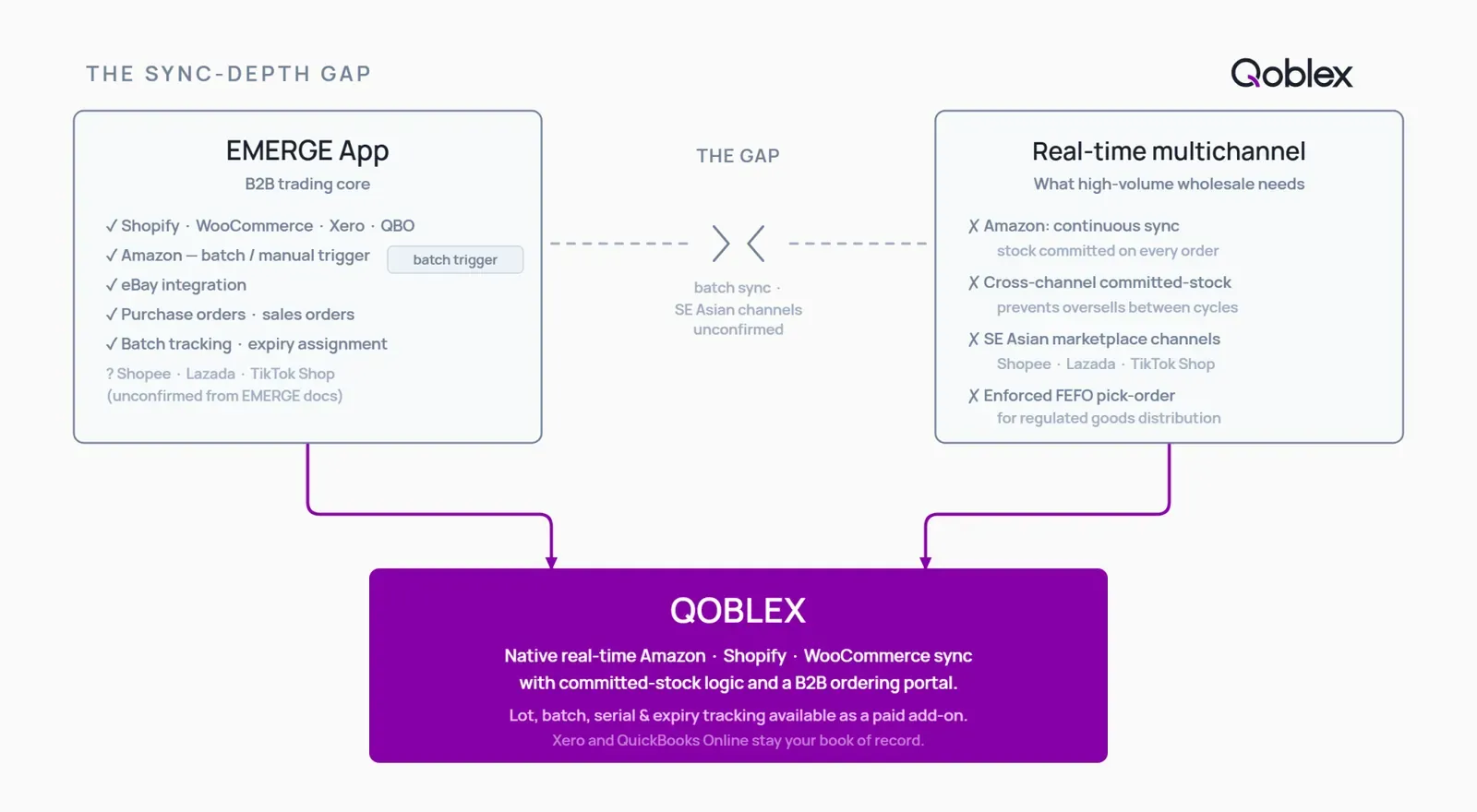
The ceiling is not a missing feature. It is sync depth, and it shows up as your channels and order volume grow.
EMERGE’s Amazon integration imports products and orders into EMERGE as sales orders, and the sync is triggered by a manual “Import data list” action processed in the background. Per EMERGE’s own help documentation, after you trigger it the system “needs some time to get data from Amazon” (EMERGE Amazon connection guide). That is a batch model. It is perfectly workable at a predictable order pace. It gets uncomfortable when you are running flash sales, concurrent drops across Shopify and Amazon at once, or thin stock on fast movers, because between import cycles your channels can each believe they still have units that another channel already sold.
Two other things come up for growing teams:
- Southeast Asian marketplace coverage. Shopee, Lazada, and TikTok Shop integrations are not confirmed from EMERGE’s own documentation at the time of writing. For a Singapore-origin tool this is worth checking directly with EMERGE if those channels are central to you.
- Traceability depth. EMERGE has a Batching module with expiry date assignment per batch. Whether it enforces first-expired-first-out (FEFO) pick order at the warehouse level, which regulated food and health distribution often requires, is not something we could confirm from first-party documentation. If that matters to you, verify it directly with EMERGE.
None of these makes EMERGE the wrong tool. They are the signals that tell you which of the alternatives below is worth a trial.
What should you look for in an EMERGE App alternative?
Before shortlisting, get clear on which of these you actually need. It saves you from buying complexity you will never use.
Real-time multichannel sync, not batch
If you sell on Amazon and Shopify at the same time, the question is whether stock updates continuously as orders land, or on a trigger. Continuous sync with committed-stock logic (units are reserved the moment an order comes in, so the other channel sees the reduced number immediately) is what prevents oversells during busy periods. Batch import is fine when your pace is predictable; continuous sync is what you want when it is not.
Xero and QuickBooks integration (critical for AU/NZ operators)
For AU and NZ operators especially, Xero is often the book of record, and your inventory tool should feed it cleanly rather than becoming a second ledger you have to reconcile. QuickBooks Online is the equivalent for many others. Confirm the integration is native and covers the direction you need (invoices, bills, inventory value), not just a contact sync.
Lot, batch, serial, and expiry tracking with enforced FEFO
If you distribute food, health, cosmetics, or anything with a shelf life or a recall obligation, you want more than an expiry field. You want the system to pick the right batch in the right order and give you the genealogy to trace a lot if something goes wrong. Ask specifically about enforced FEFO, not just expiry date storage.
B2B ordering and wholesale pricing
Wholesale runs on customer-specific price lists, credit terms, and a way for buyers to reorder without emailing you. A self-service B2B ordering portal turns that from an inbox into a workflow.
The 7 best EMERGE App alternatives in 2026
Here is how the shortlist compares on the capabilities that matter to a wholesale team. EMERGE App is shown as the reference point you are coming from, not as a ranked entry. Where a cell is not confirmed from a dated first-party source, it is marked so you can verify it with the vendor before you decide.
| Tool | Xero + QBO | Amazon sync (and type) | Lot / batch / expiry | B2B ordering portal | BOM / production | Best for |
|---|---|---|---|---|---|---|
| EMERGE App (reference) | Yes (Xero, QBO Advanced) | Yes, batch / manual trigger (source) | Yes, batch + expiry; FEFO enforcement unconfirmed | EMERGE Cart | Basic (verify depth) | B2B trading and import/export at a steady pace |
| Qoblex | Yes, native (Xero AU/NZ, QBO) | Yes, real-time native | Yes, paid add-on (see pricing) | Yes, native | Yes, all tiers | Real-time multichannel B2B wholesale on Xero/Shopify/Amazon |
| Unleashed | Yes, native Xero (AU listing) | Yes, native paid add-on | Yes, batch + serial | Via B2B store add-on | Yes, assembly / BOM | AU/NZ product businesses and light manufacturers |
| Cin7 Core | Yes | Yes, native multichannel | Yes, all tiers (source); FEFO via Advanced WMS | Yes (B2B portal) | Basic | Multichannel retail and wholesale at higher volume |
| inFlow Inventory | QBO yes; Xero verify with vendor | Yes, native | Lot/expiry in beta, verify current status | Yes, B2B showroom | Assembly | Small wholesale teams wanting a simple B2B portal |
| Zoho Inventory | QBO yes; Xero via Zoho Books, verify | Yes | Yes, lot tracking | Limited | Basic | Businesses already inside the Zoho ecosystem |
| Odoo | Via modules, verify AU setup | Via modules | Via modules | Yes, module | Yes, MRP module | Teams wanting a modular open-source ERP approach |
| Katana | Xero yes; verify Amazon | Verify with vendor | Yes, Full Traceability paid add-on (source) | Limited | Yes, strong MRP | Wholesale teams with a real manufacturing need |
Detailed reviews: the 7 alternatives
1. Qoblex, best for real-time multichannel B2B wholesale on Xero, Shopify, and Amazon
Qoblex sits in the same place EMERGE does, the operational middle between spreadsheets and a full ERP, but its multichannel layer is built for continuous sync rather than batch import. It connects natively and in real time to Amazon, Shopify, and WooCommerce, with a B2B ordering platform and Xero and QuickBooks Online integration. Committed-stock logic reserves units as orders arrive, which is what keeps two busy channels from selling the same unit twice.
For AU and NZ teams, Qoblex is listed on the Xero App Store in both AU and NZ, so it fits the same accounting stack EMERGE customers usually run. Lot, batch, serial, and expiry tracking is available as a paid add-on rather than part of the base plan, so you only pay for traceability if you need it (structure only here, current figures on the Qoblex pricing page). Bill of materials and production orders are included on all tiers, and billing is monthly with no long-term contract.
Pick Qoblex if you have hit EMERGE’s batch-sync ceiling, sell across Shopify and Amazon at the same time, and want your inventory feeding Xero or QBO cleanly.
2. Unleashed, best for AU/NZ product businesses and light manufacturers
Unleashed is Auckland-built and deeply embedded in the AU and NZ Xero ecosystem, with a native Xero integration listed on the AU App Store. It supports batch and serial tracking and assembly/BOM workflows, and Shopify sync is native and real-time; Amazon is available as a native paid add-on supporting multiple stores. If you are an AU/NZ manufacturer or product business that wants strong production and traceability alongside your wholesale side, Unleashed is a natural fit. See the full Unleashed comparison guide for a deeper look.
3. Cin7 Core, best for multichannel retail and wholesale at higher volume
Cin7 Core carries batch and expiry tracking on all tiers, with enforced FEFO available through the Advanced WMS module on higher tiers (source). It handles native multichannel selling and both Xero and QBO. It is a heavier, more configurable platform than EMERGE, which is the point if you are scaling retail and wholesale together, and probably overkill if you are a lean trading team. Compare it in the Cin7 alternatives guide.
4. inFlow Inventory, best for small wholesale teams wanting a simple B2B portal
inFlow pairs approachable inventory management with a genuinely nice B2B showroom: a branded catalog with real-time availability your customers can order from directly. Shopify and Amazon integrations are native, and QuickBooks Online is supported; confirm the Xero connection directly with inFlow. Lot and expiry tracking was in beta at our last check, so confirm its current status before you rely on it for compliance. More detail in the inFlow comparison guide.
5. Zoho Inventory, best for businesses already in the Zoho ecosystem
If you already run Zoho Books, CRM, or the wider suite, Zoho Inventory is the low-friction choice: multichannel selling, lot tracking, and basic assembly, all inside a stack you know. Xero is typically reached via Zoho Books rather than a direct connector, so verify that path if Xero is your ledger. See the Zoho Inventory comparison guide.
6. Odoo, best for teams wanting a modular open-source ERP approach
Odoo is a different animal: an open-source, modular ERP where inventory, purchasing, manufacturing, and a B2B portal are apps you assemble. That flexibility is real, and so is the implementation effort. It suits teams with the appetite (or the partner) to configure and maintain it. Check current module capabilities and AU deployment options in Odoo’s own documentation before committing.
7. Katana, best for wholesale teams with a real manufacturing need
Katana leads with strong MRP and production scheduling, so it is the pick when making is as central as selling. Shopify is native and it integrates with Xero. Lot, serial, and expiry tracking requires the Full Traceability paid add-on rather than the base plan; verify its Amazon integration with Katana directly.
How does EMERGE App’s multichannel sync differ from alternatives?
This is the section that matters most if channels are why you are here, so it is worth slowing down on.
How does EMERGE App’s Amazon sync actually work?
EMERGE genuinely integrates with Amazon. It imports your Amazon products and orders into EMERGE as sales orders, and you kick that off with an “Import data list” action that runs in the background; EMERGE’s own guide notes the system “needs some time to get data from Amazon” (EMERGE Amazon connection guide). This is a batch, pull-when-you-ask model. Nothing wrong with it. It means your stock and orders reconcile on the cadence you trigger rather than the instant each transaction happens.
What does continuous real-time sync look like across Amazon and Shopify at once?
Now picture a Friday flash sale running on Shopify while Amazon keeps ticking. With continuous sync and committed-stock logic, the moment a Shopify order lands, the unit is reserved and the available count on Amazon drops with it, and the reverse. There is no window where both channels think a scarce unit is still for sale. That is the practical difference for a high-volume multichannel seller: fewer oversells, fewer apology emails, less manual reconciliation. If your volumes are predictable and you are not running concurrent drops, a batch trigger may cover you fine. If they are not, the gap between import cycles is exactly where the pain lives.
Does EMERGE App integrate with Shopee, Lazada, or TikTok Shop?
If Shopee, Lazada, or TikTok Shop are core channels, note that native integrations for them are not confirmed from EMERGE’s own documentation at the time of writing. This is an absence in the documentation we found, not a statement from EMERGE that they are unsupported, so verify directly with EMERGE before assuming either way.
How does Qoblex handle the sync layer?
Qoblex’s answer to this is native, real-time sync across Amazon, Shopify, and WooCommerce with committed-stock netting and a B2B ordering portal, feeding Xero or QuickBooks Online as your ledger. It is a multichannel inventory management layer built for teams whose channel count and order pace have outgrown a manual import step, without pushing you into full ERP territory.
How do you pick the right EMERGE App alternative for your business?
You do not need to weigh all seven. Match your situation to one path.
- B2B trading only, steady pace. If purchase orders, sales orders, and quotations are 90% of your day and your channel volume is predictable, you may not need to switch at all. Read the next section honestly.
- Real-time multichannel growth. Selling across Shopify and Amazon with unpredictable spikes points to Qoblex, Cin7 Core, or Unleashed, depending on how much production and configuration you want.
- Lot-tracked regulated products. If enforced FEFO and lot genealogy are compliance requirements, prioritise tools that confirm enforced FEFO: Cin7 Core (Advanced WMS) or a Qoblex traceability add-on, and verify the depth against your specific obligation.
- Manufacturing at the core. If you make as much as you sell, Katana or Unleashed lead on production.
When is EMERGE App genuinely the right choice?
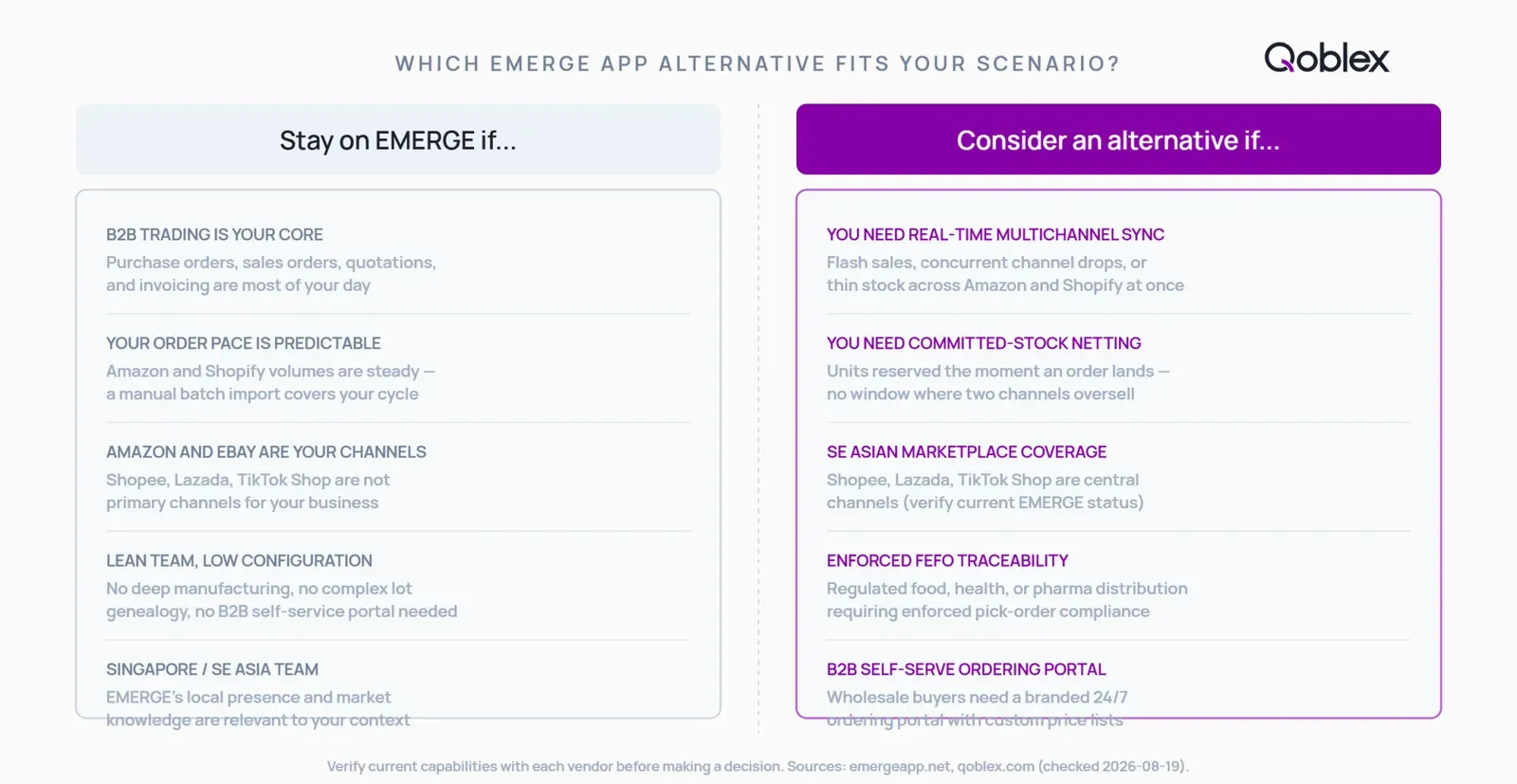
It would be dishonest to pretend everyone should switch. EMERGE is the right seat to stay in when:
- You are primarily an import/export or B2B trading business. You live in purchase orders, sales orders, quotations, and invoicing, and EMERGE is purpose-built for exactly that workflow at a competitive per-user price. That is a real strength, not a consolation.
- Your multichannel footprint is comfortable in batch mode. You sell on Amazon and Shopify, but your volumes and stock movement are predictable enough that a manual import covers you. You are not running concurrent flash sales where a between-cycle discrepancy would cause oversells.
- Your marketplace exposure is mainly Amazon and eBay. EMERGE has confirmed integrations for both, which covers the major English-speaking channels well. If Shopee, Lazada, or TikTok Shop are primary for you, check with EMERGE first.
- Your traceability needs are straightforward. EMERGE tracks batches and expiry dates, and many food and health businesses at smaller scale find that sufficient. If you are in a regulated industry that requires enforced FEFO pick order at the warehouse level, confirm that depth directly with EMERGE before you decide either way.
- You want a lean, low-configuration system. EMERGE’s focused feature set and per-user pricing suit a small trading team that does not need deep manufacturing, lot-level recall genealogy, or a self-service B2B ordering portal.
- Your team is in Singapore or Southeast Asia, where EMERGE’s local presence and market knowledge are genuinely useful.
If several of these describe you, the honest answer is: stay, and revisit when a channel or a compliance requirement changes the picture.
FAQ
What is EMERGE App used for? EMERGE App is a B2B inventory and order management tool for trading, import/export, and wholesale businesses. It handles purchasing, sales orders, quotations, multi-currency, and multi-warehouse inventory, with integrations for Shopify, Amazon, eBay, WooCommerce, Xero, QuickBooks Online Advanced, ShipStation, and Stripe.
How much does EMERGE App cost? EMERGE uses a per-user model with a Free Forever plan for very small operations and paid tiers that get cheaper on longer billing terms. For current, definitive figures, check the EMERGE pricing page directly. For Qoblex, see the Qoblex pricing page.
Does EMERGE App integrate with Amazon? Yes. EMERGE App has an Amazon integration that imports your Amazon products and orders into EMERGE as sales orders. The sync is triggered manually (you click “Import data list”) and processed in the background rather than pushed continuously in real time (EMERGE Amazon connection guide). For high-volume sellers who need stock committed and updated on every transaction across channels, that batch-versus-real-time distinction is the thing to weigh. Qoblex’s Amazon sync is native and real-time.
Which EMERGE App alternative is best for Australian businesses? Qoblex and Unleashed are the two strongest AU-market fits. Qoblex is on the Xero App Store in AU and NZ with real-time multichannel sync and no contract; Unleashed is Auckland-built with a strong AU/NZ Xero presence.
Is there an EMERGE App alternative with lot and expiry tracking? Yes. Qoblex offers lot, batch, serial, and expiry tracking as a paid add-on (see pricing), Cin7 Core includes batch and expiry on all tiers, and Unleashed offers batch and serial tracking. EMERGE itself also has batch and expiry tracking; for enforced FEFO pick-order compliance, verify the depth directly with each vendor.
Which EMERGE alternatives have a B2B customer ordering portal? Qoblex includes a native B2B ecommerce ordering platform, and inFlow offers a branded B2B showroom with real-time availability. Cin7 Core and Odoo also have portal options.
Can I migrate from EMERGE App without losing my data? Yes, with a bit of planning. Export your products, customers, and open orders to CSV, map your SKUs into the new tool, and reconcile open purchase and sales orders before you cut over. Run the alternative in parallel for a short period so you can verify the numbers agree before you switch off EMERGE.
What integrations does EMERGE App have? Confirmed integrations include Shopify, Stripe, Xero, QuickBooks Online Advanced, WooCommerce, ShipStation, Amazon, and eBay. EMERGE also publishes a public Open API in beta for custom integrations.
Is EMERGE App good for food and health product businesses that need expiry tracking? EMERGE has a Batching module with expiry date assignment. Whether it enforces FEFO pick order at the warehouse level, which regulated food and health distribution often requires, is not confirmed from first-party documentation. Verify that depth directly with EMERGE against your specific compliance requirement.
Your next step
If you are staying on EMERGE, stay with confidence: it does the trading job well. If a channel, a spike, or a compliance requirement is the reason you started reading, shortlist one or two of the tools above and trial them in parallel against your real order flow. Watch one thing in particular: does your stock stay true across channels during your busiest hour, without anyone checking it by hand? That answer, more than any feature list, tells you whether you have outgrown batch sync.