



In the US, Adobe Analytics counted more than $44 billion of online spend over Cyber Week 2025, up almost 8%, and Black Friday grew faster than Cyber Monday for the second year running. Salesforce put US Cyber Week order volumes up just 1%. For a small Shopify brand, that means sizing the order from its own sales last year, landing stock before Thanksgiving week, and holding some back.
It is early November, and the peak purchase order has to go now. Scaling last year’s order by a headline growth figure is tempting, but the figures say more about timing and price than units.
Which Black Friday and Cyber Monday statistics are worth reading if you buy stock?
A small Shopify brand buying stock needs only a dozen of the Black Friday and Cyber Monday statistics for 2024 and 2025, and each comes from a source that measures something different: Adobe counts US online dollars, Salesforce models global and US digital sales, Shopify reports merchants’ sales worldwide, and NRF counts shoppers rather than dollars.
Adobe Analytics covers US online sales only, and Salesforce’s figures are modelled estimates. Shopify says its 2025 figures are based on gross merchandise volume (GMV) by Shopify merchants around the world, and the National Retail Federation (NRF) runs its survey of shoppers with Prosper Insights & Analytics. Klaviyo reports on the brands that use Klaviyo, and ShipMatrix’s on-time data for US parcel carriers reaches the public through trade press.
Black Friday fell on 29 November 2024 and 28 November 2025 and falls on Friday 27 November 2026; Cyber Monday fell on 2 December 2024 and 1 December 2025 and falls on Monday 30 November 2026. The NRF’s 2024 weekend release noted an overall shorter window for holiday shopping that year. No figure should sit beside another source’s as if they measured the same thing.
What do the Black Friday and Cyber Monday statistics change in a small Shopify brand’s stock plan?
Read for stock, the 2024 and 2025 statistics change three decisions for a small Shopify brand: how much to buy, when the stock has to land, and how much to hold back, and the table below turns twelve sourced figures into each of them.
The first two columns give each source’s figure and scope; the third is our inference, which no source stated.
| Figure | Source and year | What it changes in stock planning (our inference) |
|---|---|---|
| Cyber Week (Thanksgiving to Cyber Monday) brought in $44.2 billion online, up 7.7% (2024: $41.1 billion, up 8.2%) | Adobe Analytics, 2025 and 2024, US online | How much: growth is single digit; start from the brand's own last Cyber Week |
| Black Friday $11.8 billion, up 9.1%, outpacing Cyber Monday (up 7.1%) for the second year in a row | Adobe Analytics, 2025, US online | When: in place for Thanksgiving week, not Cyber Monday |
| Early discounts led many shoppers to buy earlier, with Cyber Monday becoming "last call"; Cyber Monday 2025 was still the biggest online shopping day at $14.25 billion | Adobe Digital Insights, 2024 and Adobe Analytics, 2025, US online | Hold back: keep some of a top seller for the last day |
| 38% of shoppers took advantage of sales in the week before the Thanksgiving holiday weekend | NRF and Prosper Insights & Analytics, 2024, US survey of people | When: land stock at least a week before Thanksgiving week |
| A record 202.9 million shoppers over the five-day weekend; a record 32.6 million in-store shoppers on the Sunday after Thanksgiving | NRF and Prosper Insights & Analytics, 2025, US survey of people (not dollars) | When, for brands with stockists: shop reorders may not spike on Friday |
| Shopify merchants made $14.6 billion over Black Friday Cyber Monday weekend, up 27% (24% at constant currency); 2024: $11.5 billion, up 24% | Shopify, 2025 and 2024, GMV of Shopify merchants worldwide | How much: dollars, not units; a sense check only |
| Hottest product categories: cosmetics, clothing tops and pants, activewear, fitness and nutrition | Shopify, 2025 (the same five led in 2024), merchants worldwide | Hold back: weight the reserve toward these lines |
| Cyber Week average selling price up 6%; order volumes up 2% globally and 1% in the US; global sales $336.6 billion, up 7% | Salesforce, 2025, global modelled estimate | How much: more of the dollar growth came from price than from units; plan in units |
| Consumer spending rose 11% even as discounts fell 10%; brands offering the smallest discounts saw the highest growth (+14%) | Klaviyo, 2025, brands using Klaviyo | How much: settle the offer, then the quantity |
| Cosmetics $8.4 billion online over the season, up 9.3% | Adobe Analytics, 2025, US online, 1 November to 31 December | How much: a category's direction, not a product's multiplier |
| 1 in 7 returns happened between 26 and 31 December | Adobe Analytics, 2025, US online | Hold back: returns are not stock until checked in |
| USPS met on-time delivery standards 94.1% of the time in December 2025, against 90.4% in 2024; UPS had the highest on-time rate of the large carriers, 97.2% against 96.5% a year earlier | ShipMatrix data as reported by FreightWaves, 2025 and Digital Commerce 360, 2024, US carriers | When: allow carriers more days; 2025's recovery is no promise |
How much should a small brand buy?
The market grew by single digits in US online dollars, and in Salesforce’s 2025 Cyber Week data the average selling price rose 6% while US order volumes rose 1%, so in our reading more of the dollar growth came from price than from units. Klaviyo’s 2025 data tied growth to smaller discounts. None of it justifies far more units, so the base is the brand’s own last year, counted in units.
When does the stock have to land?
Adobe’s US online data shows Black Friday outgrowing Cyber Monday two years running, and the NRF’s 2024 survey found many shoppers buying in the week before Thanksgiving weekend, so stock that lands in time for Cyber Monday is late. ShipMatrix’s data, as reported in the trade press, show US carriers’ December on-time rates falling in 2024 and recovering in 2025, so one good year is no promise and the stock plan should allow carriers a few extra days.
What should a brand hold back?
Adobe Digital Insights called Cyber Monday 2024 the “last call”, so a brand that sells out on Friday turns its last-day buyers away, and a stock-out costs most in Shopify’s busiest categories. Returns cluster in late December in Adobe’s 2025 US data, too late to count as peak stock.
How does last year’s Cyber Week turn into this year’s purchase order?
A brand that sold 40 units a week of its hero product last autumn and 130 units in last year’s Black Friday week works out this year’s purchase order by counting back from 27 November 2026 through its supplier’s lead time, adding the units last year’s Cyber Week sold, and then a holdback.
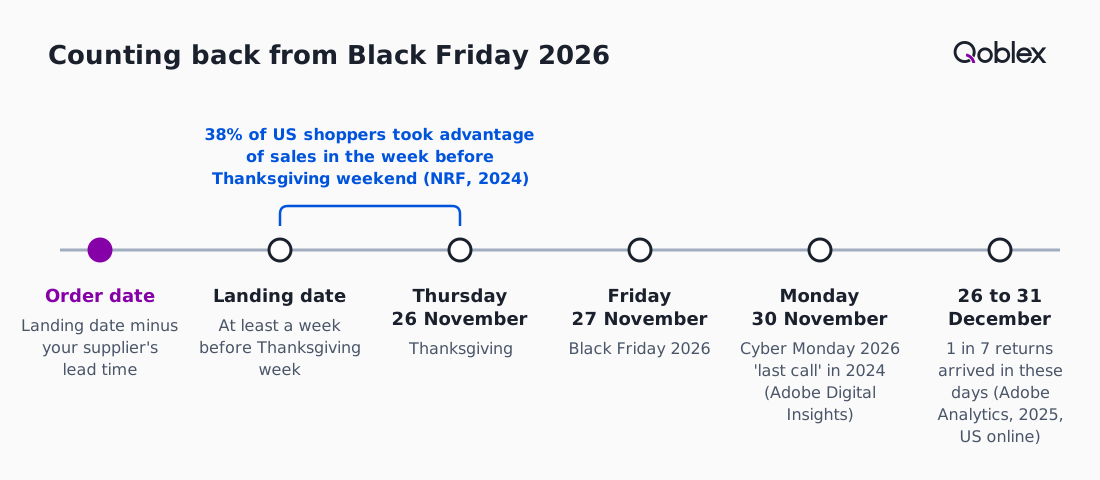
Let’s assume a brand sold 40 units a week of its hero product through last autumn, and its supplier needs 14 days door to door. It sold 50 units in the week of 17 November 2025 (early offers), 130 in the Black Friday week starting 24 November and 70 in the Cyber Monday week starting 1 December. The Black Friday week was 130 / 40 = 3.25 times a normal week, and that uplift is the brand’s own.
- Total the peak: 50 + 130 + 70 = 250 units against 3 x 40 = 120 in normal weeks, so 130 extra.
- Line up the weeks: 364 days on, Monday 17 November 2025 becomes Monday 16 November 2026, and Black Friday 2025 becomes Friday 27 November 2026.
- Land the stock by Monday 16 November 2026, eleven days before Black Friday, so the early offers are covered.
- Count back 14 days: the order goes out by Monday 2 November 2026. A five-week lead time would have meant 12 October.
- Hold back 20% of 250, so 50 units, because one year is one observation. The 20% is the brand’s judgement, not a rule.
- Size the purchase order: 250 + 50 = 300 units needed from 16 November to 6 December. The brand expects 60 units still on the shelf on 16 November, after two normal weeks of selling, so it orders 300 minus 60, which is 240 units.
As a sense check, Adobe Analytics put 2025 growth in US online Cyber Week spend at 7.7%, which on 250 units adds about 19 (250 x 0.077 = 19.25), inside the holdback. That is market growth year over year, so it never goes on a normal week: the jump from 40 to 130 is the brand’s own. If the product sold out on the Sunday, 130 understates demand and the brand adjusts by hand.
Repeating that week by week is what a seasonal forecast does; our demand forecasting guide covers the methods.
How does Qoblex’s Seasonal forecast use last year’s Cyber Week?
Qoblex’s Seasonal forecast method, available on the Business and Scale plans, projects each week by looking back 364 days to the matching week one year earlier, so a brand’s own Black Friday week of 2025 stands in for the Black Friday week of 2026 with the weekday alignment intact. Friday 28 November 2025 plus 364 days is Friday 27 November 2026, and Cyber Monday lines up the same way. Forecasting is not in Starter; see pricing.
The buyer sets the method per variant, under Forecast method; every variant starts on Historical Average, so a peaking hero product has to be switched to Seasonal. If the matching week falls before the variant’s first ever sale, the week is marked Insufficient history and forecast as zero, so a product launched in spring needs another method. There is more in demand forecasting software and multichannel demand forecasting.
Exclude stockout days has no effect on Seasonal variants, which read last year’s weeks rather than a run rate, so a sold-out week carries into the forecast and the buyer corrects it by hand. The Growth factor does apply to Seasonal, for the brand’s own growth assumption, not the market’s.
Qoblex then dates a recommended receipt by working back from the projected shortage through the supplier’s lead time, sized to the shortfall plus the buyer’s Coverage weeks of forecast demand (a separate control from the holdback). It can create the purchase orders as Draft, grouped by supplier with no prices on the lines. Building on the brand’s own weeks also sidesteps a problem with market figures: they disagree.
Where do the Black Friday and Cyber Monday figures disagree?
The sources for Black Friday and Cyber Monday 2024 and 2025 disagree on US Cyber Monday spend, on which day was biggest, on whether Black Friday or Cyber Monday grew faster in 2025, on returns, and on the direction of discounts, because each measures a different population with a different method.
On US Cyber Monday, Adobe Analytics counted $14.25 billion online in 2025, up 7.1%. Salesforce put US Cyber Monday 2025 at $13.6 billion, up 6%. For 2024, Adobe Analytics counted $13.3 billion online, up 7.3%, while Salesforce reported $12.8 billion in the US for 2024, up 3%.
On the biggest day, Adobe’s 2025 release says Cyber Monday “remains the biggest online shopping day of all time”, as its 2024 recap did. Salesforce’s 2024 release called Black Friday “the strongest shopping day of the week”, and its US figures agree: $17.5 billion of US online sales on Black Friday, up 7%, against $12.8 billion in the US on Cyber Monday.
On 2025 growth, Adobe Analytics found US online Black Friday spend up 9.1% against 7.1% for Cyber Monday. Klaviyo’s brands saw Cyber Monday up 11% in 2025 against 10% for Black Friday.
On returns, Adobe Analytics reported US online returns down 1.2% over the 2025 season, with 1 in 7 arriving between 26 and 31 December. Salesforce reported more than $181 billion of global online purchases from 1 November to 31 December 2025 already returned, 14% of purchases, up 10%.
On discounts, Adobe Analytics found 2025 US online peak discounts deeper than in 2024 in seven of the eight categories it reported, with apparel peaking at 25.1% off listed price against 23.2%. Klaviyo reported that across its brands in 2025, discounts fell 10% while consumer spending rose 11%. Adobe measures category peaks, Klaviyo averages across brands, and when the measurers disagree, a brand’s own history is the tiebreak.
What can market statistics not tell a small Shopify brand about its own stock?
Market statistics cannot tell a small Shopify brand how many units of its own products will sell, because every figure is an average of other businesses, in other categories, at other prices, and a brand’s own sales history for the same weeks is a better guide than any of them.
Market figures are a sense check on direction and timing. Adobe Analytics’ 7.7% for 2025 is year-over-year growth of US online Cyber Week spend, not a brand’s uplift over a normal week. Nor can the figures see a brand’s promotions, prices, sell-outs, new products or email list. Salesforce’s 2025 Cyber Week data put the average selling price up 6% while US order volumes rose 1%, so dollar growth is not unit growth.
A brand with no November history, a first product, or a need for a rough figure for a supplier can use the table for direction, buy small, and re-order if the lead time allows.
A brand with a year of weekly sales has the better base, and its history beats any market number. Before trusting it, ask what has to be checked by hand before the team believes the 130, and where someone has to remember what the system does not know, such as the hero product running out of stock on the Sunday.
Frequently asked questions
How much did Americans spend online over Cyber Week 2025?
Adobe Analytics counted $44.2 billion of US online spend over Cyber Week 2025, Thanksgiving to Cyber Monday, up 7.7%. In 2024 Adobe counted $41.1 billion, up 8.2%. Salesforce’s modelled US figure for Cyber Week 2025, $79.6 billion, uses a different method.
Was Black Friday or Cyber Monday bigger in 2025?
It depends on the source. Adobe Analytics counted Cyber Monday 2025 as the biggest US online day at $14.25 billion, while Black Friday, at $11.8 billion, grew faster: 9.1% against 7.1%. Across Klaviyo brands, Cyber Monday grew faster in 2025, 11% against 10%. Salesforce’s 2024 release called Black Friday that week’s strongest day.
How did Shopify merchants do over Black Friday Cyber Monday in 2025?
Shopify reported that its merchants worldwide made $14.6 billion in sales over the Black Friday Cyber Monday weekend in 2025, up 27%, or 24% at constant currency. In 2024 the figure was $11.5 billion, up 24%. The data is gross merchandise volume in dollars, not units.
Did people shop earlier in 2024 and 2025?
Yes. Adobe Digital Insights said early discounts led many US online shoppers to buy earlier in 2024, with Cyber Monday becoming the “last call”. Adobe Analytics found Black Friday outgrew Cyber Monday in both years. In the NRF’s 2024 survey, 38% of US shoppers took advantage of sales in the week before Thanksgiving weekend.
Were Black Friday and Cyber Monday 2025 sales growth driven by price or volume?
In Salesforce’s 2025 Cyber Week data the average selling price rose 6% while order volumes rose 2% globally and 1% in the US, so more of the dollar growth came from price than from units, in our reading. Adobe Analytics’ 7.7% growth in US online Cyber Week spend in 2025 is in dollars too. Compare units with units.
Should a small brand scale last year’s order by the market growth rate?
No. Adobe Analytics’ 7.7% is the year-over-year growth of US online Cyber Week spend in 2025, not the uplift a brand sees over a normal week. Start from the brand’s own last Cyber Week against its own normal week, in units, and use market growth only as a sense check.
When are Black Friday and Cyber Monday in 2026?
Black Friday 2026 is Friday 27 November and Cyber Monday is Monday 30 November, with Thanksgiving on Thursday 26 November. In 2025 the two days fell on 28 November and 1 December, and in 2024 on 29 November and 2 December. Black Friday 2025 plus 364 days is Black Friday 2026.