


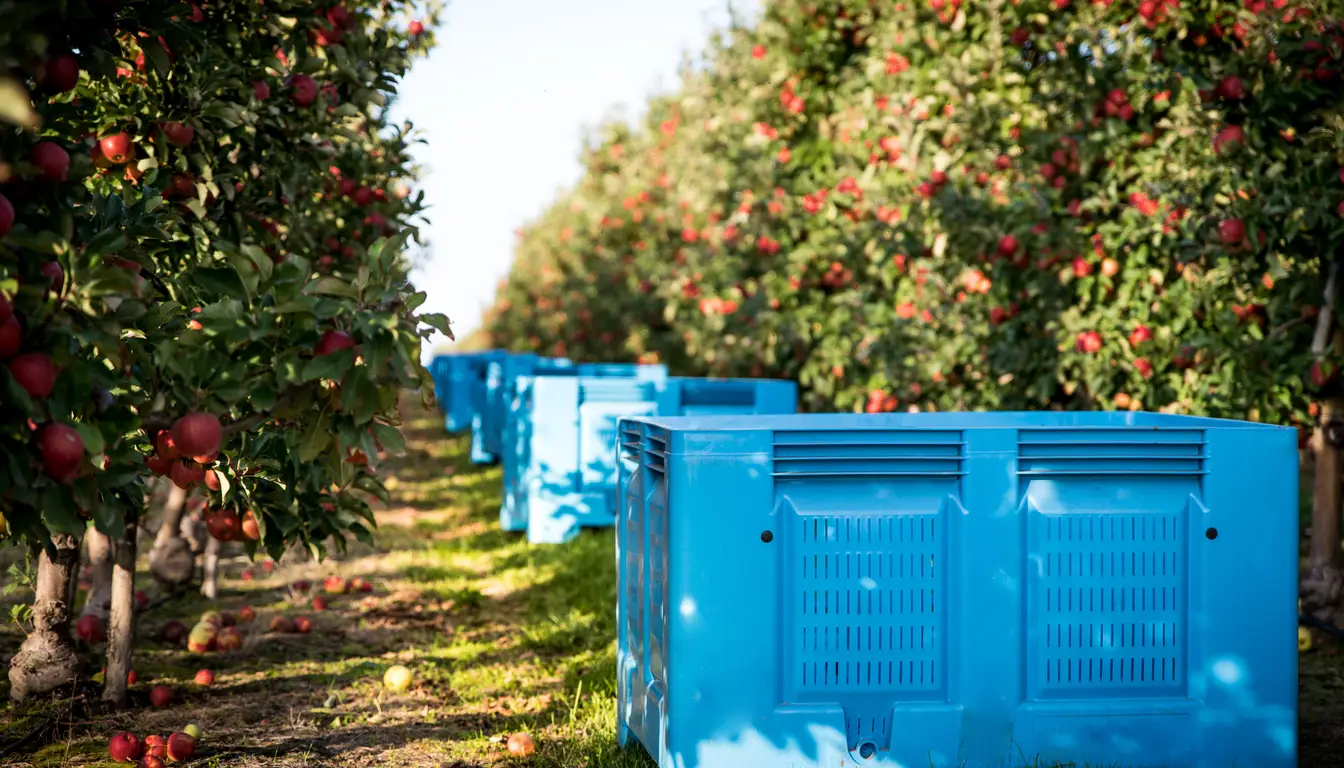
At a glance: A small food manufacturer grows and harvests its main crop, then cooks and jars it in-house. It buys sugar, jars and lids from suppliers and sells through its Shopify stores. Every harvest weighs and behaves differently. A fixed recipe says 100 kg of fruit, while the kitchen weighs out 115 kg and uses 110. So the stock count drifts from the shelves, and the cost of a jar is a guess on every run.
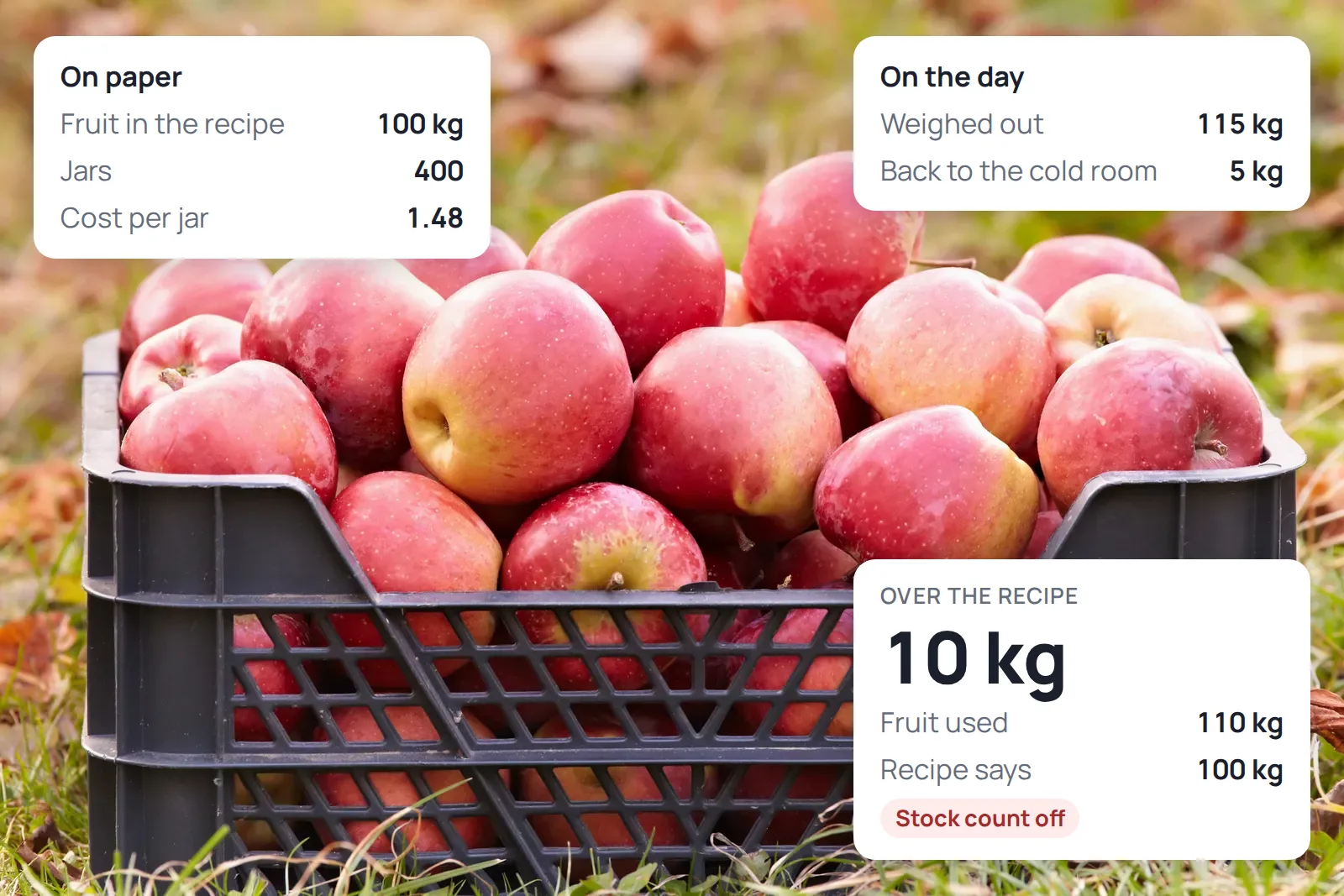
- On paperFruit in the recipe100 kgJars400Cost per jar1.48
- On the dayWeighed out115 kgBack to the cold room5 kg
- Over the recipe10 kgFruit used110 kgRecipe says100 kgStock count off
The rest of this page follows one batch of fruit preserve, starting with how the kitchen used to run it.
How does a small food maker that grows its own crop run a batch of preserves?
A small food maker that grows its own fruit runs a batch by weighing, cooking and jarring it, then listing the jars in its Shopify stores. The fruit came in from the field and went into the cold room. Sugar, jars and lids came from suppliers.
Let’s assume the recipe for one jar is 0.25 kg of fruit, 0.15 kg of sugar and a jar with its lid. A run of 400 jars therefore called for 100 kg of fruit and 60 kg of sugar. The cook boiled the fruit down with the sugar and filled the jars that afternoon. The jars went on the shelf and into the stores.
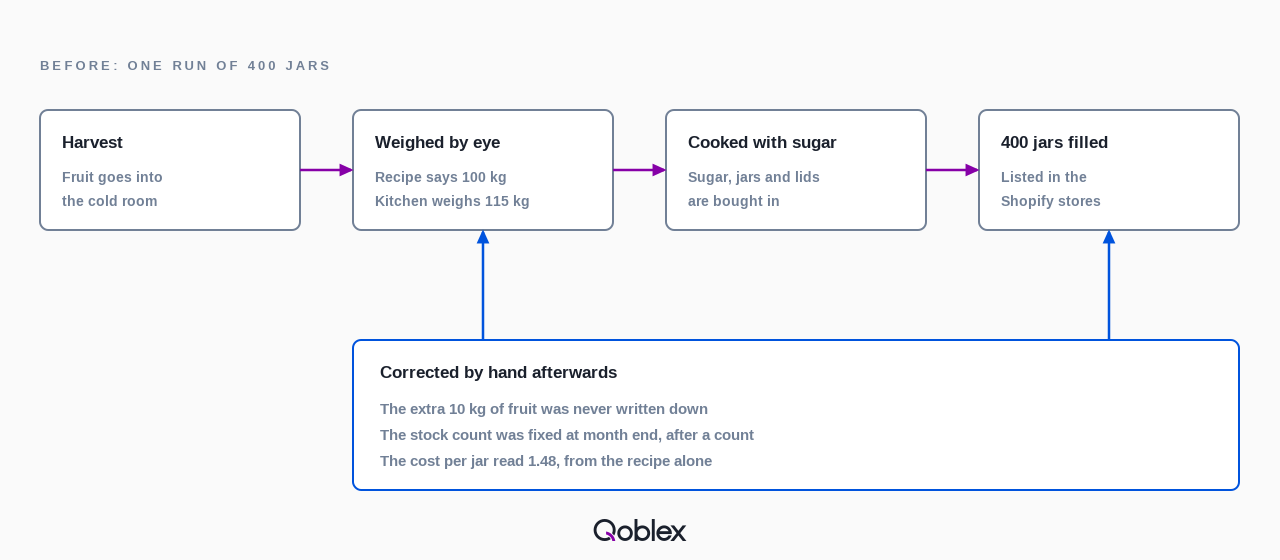
That worked for years. One cook knew the crop and trusted the eye. A notebook recipe and a stock spreadsheet were enough while one person held the rest in their head. The gaps only showed in the numbers.
Why do ingredient weights that change every run leave a food maker’s stock and costs wrong?
Ingredient weights that change every run leave a small food manufacturer’s stock and costs wrong, because the recipe holds one quantity and the crop another. One week the harvest came in wetter and stalkier than usual. The cook weighed out 115 kg of fruit instead of 100 and put 5 kg back in the cold room by evening. The pots had taken 110 kg, 10 kg more than the recipe.
Nobody changed the recipe, and sensibly, because next week’s crop would ask for something else. So the spreadsheet took 100 kg off the fruit stock while the cold room had lost 110. Someone corrected the gap by hand at month end, after going in to count.
The cost of a jar had the same blind spot. Let’s assume the harvest sits in stock at 2.00 a kilo, sugar at 1.20 a kilo and a jar with its lid at 0.40. Amounts are in the business’s own currency, before tax. The day’s labour, 8 hours at 20.00, went on top. Costed on the recipe alone, a jar read 1.48, though the run really carried more.
A more exact recipe was never the fix, because the crop will never allow one. The business needed a recipe that stays put and a record of what each run used.
What should food manufacturing inventory software do for a small food manufacturer?
Food manufacturing inventory software for a small food manufacturer should keep a standard recipe and record what each run really used. It should scale the recipe to the run and give each run a place for extra and returned fruit. Stock should move by what was used, not by what the recipe said.
The cost of a jar should include labour and overhead and divide by the jars actually produced. Each run should keep its own record, so daily batches stay separate. A small maker does not need the kitchen scheduled, because the owner plans the day by eye.
There is an honest limit too. A system that wants every ingredient weighed into a screen at the pot costs the kitchen time. The useful minimum is a standard, a record of the difference and a cost built from both. Qoblex handles that split, and the next section follows one run through it.
How does Qoblex handle ingredient quantities that change from run to run?
A small food manufacturer on Qoblex keeps its recipe as a bill of material and records what each run really used on the manufacturing order. The difference from the recipe goes in two fields on the order, Wastage and Unconsumed. Bills of material, production orders, assembly and disassembly are on every Qoblex plan.
The kitchen team sets up the preserve once as a bill of material of fruit, sugar and a jar with its lid. The recipe holds the amount for one jar, and the order multiplies it by Quantity To Produce. So a manufacturing order for 400 jars loads 100 kg of fruit, 60 kg of sugar and 400 jars with lids. Those quantities are read-only, so the recipe stays the standard for every run.
Each part’s cost is its moving average cost, captured when the owner chooses the Finished Product. On this run that is 2.00 a kilo for the harvest, 1.20 for sugar and 0.40 for a jar with its lid. Next comes the crop’s variation.
Where does the variation in a run go, before the run starts and after it?
A small food manufacturer records a run’s variation on the Qoblex manufacturing order in two places: Wastage in Draft and Unconsumed In Production. Wastage is extra input that is scrapped, lost or used beyond the standard recipe quantity. Seeing a wet, stalky harvest, the cook sets 15 kg of Wastage on the fruit line while the order is still Draft.
Then the cook starts production. The order reserves the Quantity plus the Wastage: 115 kg of fruit. On-hand stock has not moved yet. If the cold room cannot cover it, the order stays in Draft. A shortfall shows before the stove is lit.
By evening 5 kg of fruit has gone back to the cold room, and the cook enters it as Unconsumed. Completion consumes Quantity plus Wastage minus Unconsumed, so 100 + 15 – 5 = 110 kg. The help-centre article on costs, wastage and yield covers each field.
The jars posted are the Yield Quantity, which Qoblex sets to match Quantity To Produce. So the owner raises the order for the 400 jars the kitchen fills. The crop’s variation shows up in Wastage and Unconsumed instead. That leaves the cost of a jar.
What does one jar cost once the run is complete?
For a small food manufacturer on Qoblex, one jar of preserve costs 1.53 once the manufacturing order is complete. The unit cost is everything consumed, plus Labor / Overhead, divided by the Yield Quantity of 400.
The fruit consumed is 110 kg at 2.00, or 220.00. Sugar adds 72.00 and the jars with lids 160.00, so the components come to 452.00. The owner adds the day’s labour as one Labor / Overhead line, 8 hours at 20.00, or 160.00. That makes 612.00, and 612.00 over 400 jars is 1.53.
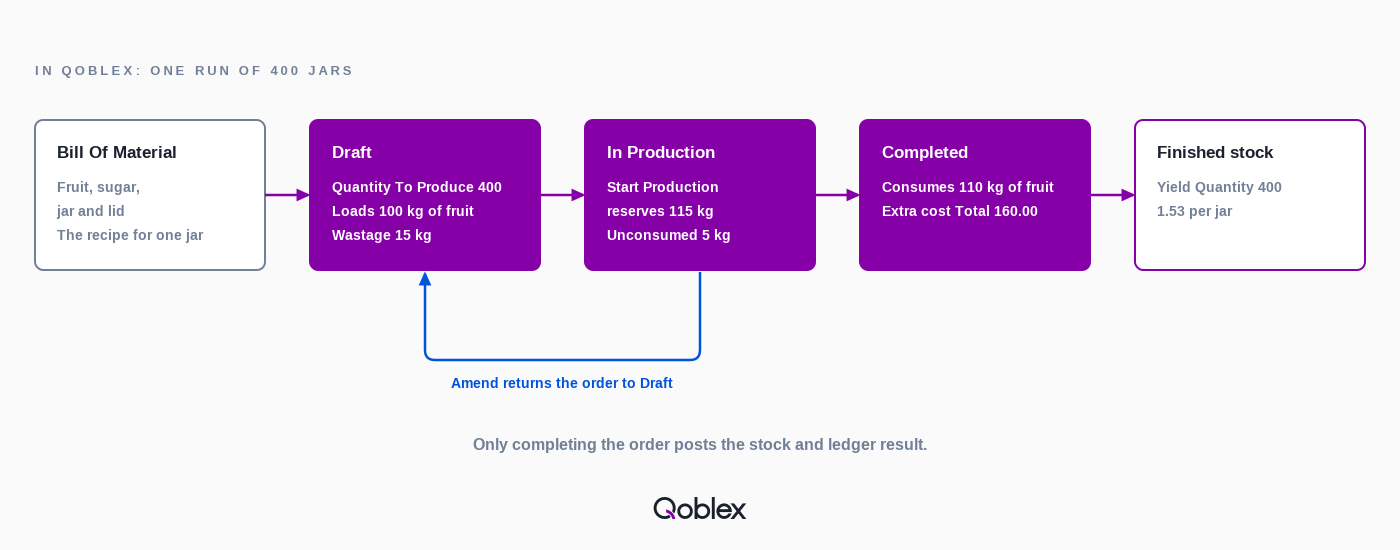
The recipe alone said 1.48, so the wetter harvest cost 0.05 a jar. That is 10 kg of extra fruit at 2.00, spread over 400 jars. Completing the order is the only step that posts a stock and ledger result. The fruit stock falls by 110 kg, not 115, because the cook recorded the 5 kg that went back as Unconsumed.
| Part of the run | Before | In Qoblex |
|---|---|---|
| The recipe | One fixed quantity per jar, kept in a notebook | One bill of material; the order multiplies it by Quantity To Produce |
| The crop varies | The cook adjusted by eye and nobody wrote it down | 15 kg of Wastage in Draft; 5 kg Unconsumed In Production |
| Fruit stock after the run | Off by about 10 kg until a count fixed it | Down 110 kg: Quantity + Wastage – Unconsumed |
| Labour | Added on top of the recipe in the spreadsheet | One Labor / Overhead line: 8 hours at 20.00 = 160.00 |
| Cost per jar | 1.48, from the recipe alone | 1.53: (452.00 + 160.00) over a Yield Quantity of 400 |
Because the 1.53 comes from the kitchen’s record, a wet harvest and a dry one now cost differently per jar. The business’s calls tested that same flow.
What did the business ask about running variable recipes in Qoblex?
A small food manufacturer with a cook-and-fill step asked whether its production could run in Qoblex’s manufacturing module, which is what MRP means at Qoblex. The module is on every plan and records and costs each run. The business’s questions on its calls checked how its own workflow would run there.
The owner asked how quantities that vary between runs are handled. The owner also asked whether recipes that are not exact still work. Both come down to the same split: a standard recipe and a recorded difference. A third question was whether a team member could record each day’s real run. Each day’s run is its own manufacturing order, so the team records that run’s Wastage and Unconsumed on it.
Turning demand into a list of materials is forecasting, on Business and Scale, and the plans are on the pricing page. Recording which ingredient lot went into a run needs lot tracking, a paid add-on on Starter and Business and included on Scale. Here is the whole run in five steps.
How does one run go from harvest to cost per jar?
A small food manufacturer takes one run from harvest to cost per jar on a Qoblex manufacturing order, in five business steps.
- Bring the harvest into the cold room and buy sugar, jars and lids on purchase orders, so each is in stock at its cost.
- Raise one manufacturing order for the jars the kitchen will fill, 400 in the example, so the recipe’s quantities load for the run.
- Before starting, set the extra fruit the crop needs as Wastage, 15 kg in the example, then start production to reserve the stock.
- Cook and fill the jars, then enter what went back to the cold room as Unconsumed, 5 kg in the example.
- Add the day’s labour as one Labor / Overhead line, 160.00, and complete the order so the jars arrive at 1.53 each.
Before step 5, the cook and the owner check the figures against the production notes, the cold room and the hours worked. The order stays In Production until they confirm the result. If the Wastage turns out wrong, Amend returns the order to Draft without moving on-hand stock.
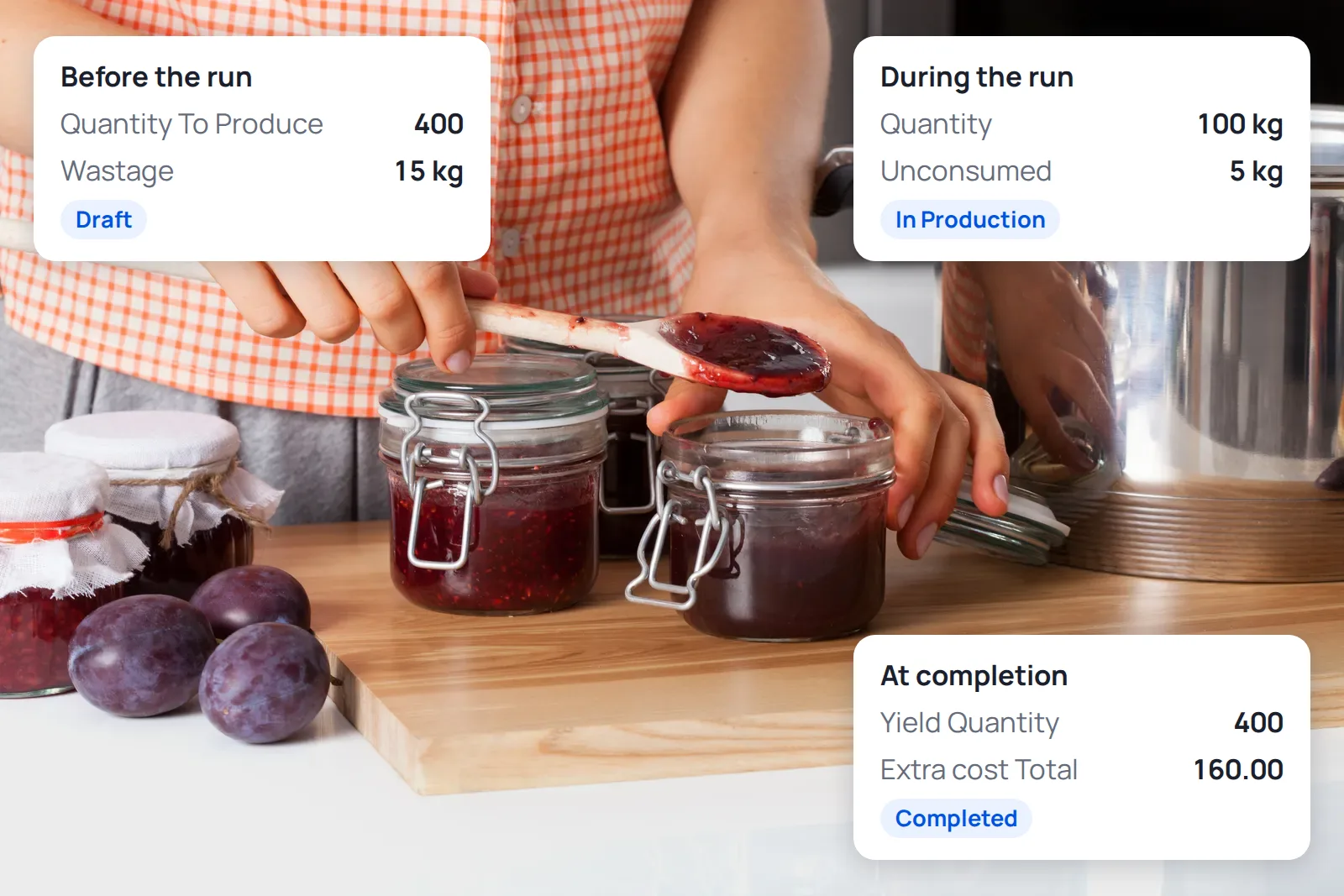
- Before the runQuantity To Produce400Wastage15 kgDraft
- During the runQuantity100 kgUnconsumed5 kgIn Production
- At completionYield Quantity400Extra cost Total160.00Completed
After the jars post at 1.53, the same five steps repeat for the next harvest, whatever it weighs, and in other kitchens too.
Does this fit your business?
The Qoblex flow of a standard recipe, a recorded variation and a cost per unit fits any small food maker whose inputs vary by run. A fresh pet food maker with daily runs follows it with one manufacturing order per run. Qoblex can start or complete several of those orders at once. Sauce, condiment, juice and cordial makers fit too, as do honey and spice packers whose input varies. A maker on Xero can see what reaches the books in the tea and coffee blender’s story.
A maker that must trace an ingredient batch to its jars has its own story, ending in a recall. The flow does not fit a business that needs work-centre scheduling, sequencing or capacity planning of the kitchen floor. Qoblex also does not handle subcontracting, where material goes to an outside processor. A dedicated production-planning system is the honest answer for those shapes. A business that only resells finished food has no recipe to cost.
Frequently asked questions
How do I handle ingredient quantities that vary from one run to the next in a bill of materials?
In Qoblex, the bill of material holds the standard recipe. Each manufacturing order records extra input as Wastage in Draft and stock that went back as Unconsumed In Production. Completion consumes Quantity plus Wastage minus Unconsumed. Costing a jar from the recipe alone leaves that extra input out.
Should the recipe change every time the crop changes?
No. In Qoblex, the bill of material stays the standard recipe for every run. Each manufacturing order records the run’s difference: extra input as Wastage before the run starts, and stock that went back as Unconsumed during it. Comparing runs against one standard shows which harvests cost more per jar.
Does completing a run take stock out automatically?
Yes, at completion. Qoblex consumes each component as Quantity plus Wastage minus Unconsumed and adds the finished product at the Yield Quantity. Starting a run only reserves stock. Starting, amending and cancelling an order post nothing, so stock follows what the team recorded, not the recipe alone.
Does Qoblex do MRP for a small food manufacturer?
At Qoblex, MRP means the manufacturing module: bills of material, production orders, assembly and disassembly, on all plans. It records and costs each production run. It does not schedule work centres or sequence jobs. The demand-to-materials breakdown is forecasting, available on the Business and Scale plans.
Can a fresh food maker with daily runs use Qoblex manufacturing?
Yes. A fresh food maker with daily runs raises one Qoblex manufacturing order per run, which keeps each day’s batch separate. Qoblex can start or complete several of those orders together in one action. There is no scheduling, so the team decides each day what to make.
What if the recorded wastage turns out wrong after the run starts?
In Qoblex, Amend returns an In Production order to Draft and releases the reserved stock. No on-hand stock moves. The team can correct the Wastage there and start the order again. Once an order is Completed it is final, so the team reviews the figures before completing it.