



A practical guide, written from the point of view of a DTC beauty brand that has outgrown its spreadsheet but does not want to rip out the storefront and accounting tools that already work.
For the first year or two, a direct-to-consumer beauty brand runs fine on Shopify and a spreadsheet, or Shopify and Xero or QuickBooks. Orders come in, stock counts down, the accountant reconciles at month end. Then a moment arrives that the current setup has no answer for. A retail buyer asks for lot numbers on the delivery paperwork, and there is nowhere in Shopify those numbers live. A batch of serum ships without any record of which raw material lot it came from. Someone tries to pick the older stock first so it does not expire on the shelf, and realizes there is no expiry field to sort by. The question at that point is not “do I need software?” It is “which piece is actually missing, and does fixing it mean replacing everything I already run?” The answer to the second half is no.
Inventory software for beauty brands fills the operational gap that Shopify and accounting tools leave open: lot and batch tracking, expiry date and PAO management, FEFO picking, purchase order management, and multi-location stock visibility. It connects to Shopify as the sales channel and to QuickBooks or Xero as the book of record, so brands do not need to replace what already works. Qoblex is the inventory operations layer that sits between the storefront and the ledger, closing each gap while both tools stay in their roles.
What does Shopify not do for beauty brand inventory?
Shopify is a genuinely capable storefront. It tracks quantity on hand, supports multiple locations as separate quantity buckets, sends low-stock alerts, and keeps a basic cost figure for margin reporting. For a brand selling a handful of SKUs to consumers, that is often enough, and there is nothing wrong with running that way while it works.
The wall is not about quantity. It is about everything a beauty product carries beyond a quantity: the lot it was made in, the date it expires or the period it stays good after opening, and the supplier order it arrived on. Shopify does not natively track lot or batch numbers; as the Qoblex lot tracking page confirms, every unit of a variant is treated as identical. It has no expiry date field and no way to enforce first-expired-first-out picking. Its Locations feature tracks a quantity per location but does not segregate stock by lot, hold an expiry per location, or manage bins. And it has no native purchase order management for raising and receiving supplier orders.
The accounting layer does not close this gap either. Xero and QuickBooks Online hold the finances accurately, but neither natively tracks lot numbers or expiry dates, and neither enforces FEFO. That is not a fault in them; a general ledger is not built to know which lot of lip balm is sitting on which shelf. The missing piece is the operations layer in the middle, the part that connects the sales channel, the physical stock, and the accounting book so they agree with each other.
Does Shopify track lot numbers or expiry dates for cosmetics?
Lot tracking is usually the first hard requirement a growing beauty brand runs into, and it tends to arrive from outside. A retail buyer or a cosmetics-specialist 3PL will ask for lot numbers on the delivery documentation, because that is how their side traces and isolates stock if something goes wrong. A brand running on Shopify alone has no lot numbers to give them, because the storefront does not record lots at all.
The same gap bites internally the day a brand needs to trace a finished batch back to the ingredient lot it was made from, whether for a quality question, a supplier issue, or a recall. Without lot tracking, that trace is a manual reconstruction from emails, invoices, and memory, done under exactly the time pressure where memory fails. Lot tracking is what turns that from an afternoon of stress into a report. For the fuller treatment of this, see the piece on cosmetics batch traceability.
Can Shopify track expiry dates for cosmetics?
Shopify has no expiry date field on inventory, so a brand selling products with a minimum durability date, or managing shelf life against a Period After Opening symbol, has nowhere to record when stock goes off. That has two costs. The first is quiet and financial: older stock sits behind fresher stock, nobody sees it aging, and eventually it becomes a write-off. The second is a compliance exposure, because near-dated or expired product can ship without anything in the system flagging it.
The fix is an inventory layer that records an expiry (or a manufacture date and a PAO window that computes a proxy expiry) at the point stock is received, surfaces near-dated lots before they become a problem, and enforces FEFO so the oldest good stock is picked first. That is the difference between hoping the warehouse remembers and having the system enforce it. The dedicated guide to cosmetics expiry and PAO management covers how this works in practice.
Does Shopify have purchase order management?
A beauty brand buying finished goods from a co-manufacturer, or raw materials for in-house production, needs to raise supplier orders, track them against lead times, and receive stock in against them. Shopify has no native purchase order management, so most brands fill this gap with email and a spreadsheet. That works until it doesn’t: the incoming stock lives in one place and the inventory record lives in another, and the two only meet when someone manually reconciles them.
The more important loss is the lot number. When a PO is received against specific lots, the lot is captured at the moment stock lands, which is the only clean point to capture it. Without a PO module linked to the inventory system, that first traceability link never gets recorded, and everything downstream inherits the gap.
What does inventory software add to a Shopify beauty brand stack?
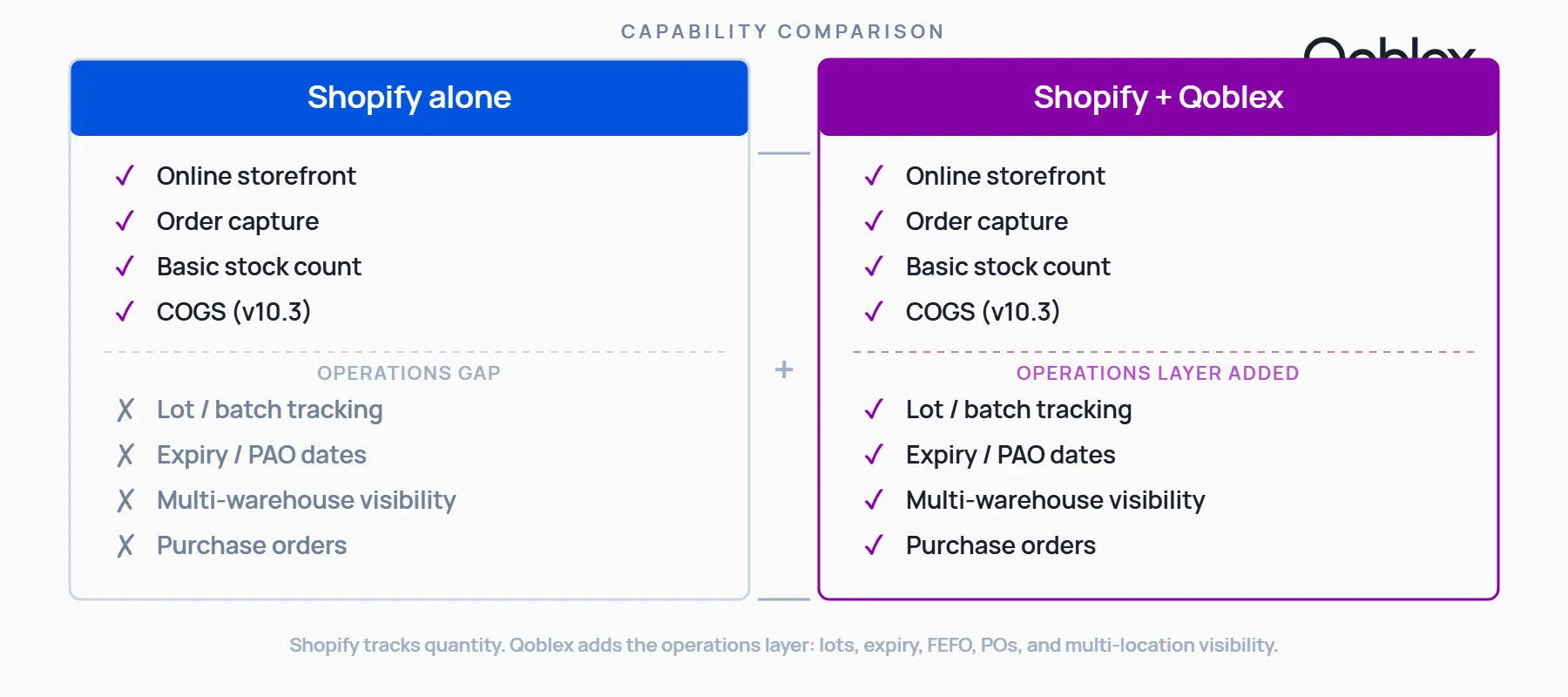
The point here is not that Shopify is bad. Shopify does its job: storefront, orders, and quantity-level stock. An inventory layer does a different job: lots, expiry, FEFO, purchase orders, and lot-level multi-location visibility. Two tools, two jobs. The table below shows what the stack covers with and without that second piece.
| Capability | Shopify alone | Shopify + Qoblex |
|---|---|---|
| Lot / batch tracking | ✗ Not supported natively | ✓ Lot assigned at PO receiving, tracked through production and shipment |
| Expiry date tracking | ✗ Not supported natively | ✓ Expiry recorded at lot receiving, FEFO enforced at pick time, expiry alerts |
| PAO / manufacture date management | ✗ Not supported natively | ✓ Manufacture date tracked at lot level, proxy expiry computed for PAO-only products |
| FEFO picking enforcement | ✗ Not supported natively | ✓ Near-dated lots prioritized at pick time |
| Purchase order management | ✗ Not supported natively | ✓ Supplier POs with lot receipt, quantities reconciled against the order |
| Multi-location with lot visibility | Quantity per location (Locations); no lot-level per-location | ✓ Lot and expiry quantity visible across all warehouses and 3PLs |
| Recall trace (ingredient lot to customer) | ✗ Not supported natively | ✓ Backward and forward lot trace, one-click recall report |
| Accounting integration | Connects to Xero and QBO via apps | ✓ Two-way sync with Xero and QBO; both tools stay in their roles |
How does Qoblex integrate with Shopify for a beauty brand?
Once the gap is clear, the shape of the fix is simple. Qoblex sits between the storefront and the ledger as the operations layer. Orders placed on Shopify flow into Qoblex for fulfillment, lot-tracked picking, and inventory adjustment, and Shopify stays exactly what it is: the storefront and the customer-facing channel. On the finance side, Qoblex integrates two-way with QuickBooks Online and Xero, so the accounting platform remains the book of record for invoicing and reconciliation. Nothing gets replaced; the piece in the middle gets added.
What that operations layer holds, per the capabilities listed on the Qoblex lot tracking page, is the set of things Shopify and the accounting tools do not: full lot and serial traceability with recall-ready audit trails, FEFO-driven picking with automated expiry alerts and write-off tracking, purchasing and vendor workflows, support for one or many warehouses, one-click recall reports that identify affected batches and who received them, and traceable bills of materials that connect raw materials to finished goods. Lot, batch, serial, and expiry tracking is a paid add-on rather than part of the base plan; the pricing page has the current structure.
Shopify is not the only channel this works with. Qoblex also connects to WooCommerce, so a brand not on Shopify gets the same operations layer behind its store; the WooCommerce inventory management guide covers that setup. And to be clear about the boundary: Qoblex is not a Shopify replacement. It runs alongside Shopify, adding the inventory operations layer while the storefront keeps doing what it already does well.
When is Shopify enough for a beauty brand?
Adding an inventory system before you need one is its own kind of waste, so it is worth being honest about the stages where Shopify alone is genuinely enough.
The first is the very early-stage brand: under ten SKUs, a single location, direct-to-consumer only, with no retailer or 3PL asking for lot documentation and no product carrying meaningful expiry risk. Shopify’s built-in quantity tracking, low-stock alerts, and basic cost figure cover that situation completely. There is no gap to close yet.
The second is the brand with long-shelf-life products and no multi-location complexity. If everything you sell stays good well beyond thirty months and carries only a PAO symbol, and a single 3PL handles fulfillment and already tracks lot and expiry on your behalf, layering an inventory system on top mostly duplicates work someone else is already doing.
The third is closely related: some cosmetics-specialist 3PLs provide lot and expiry visibility in their own warehouse system, with reporting exports. If that already satisfies your retailers’ requirements and leaves you recall-ready, you may not need your own inventory layer yet.
The honest rule of thumb is this. The right time to add an inventory system is when the spreadsheet workaround starts costing more in time, errors, and stress than the software costs in money. Before that point, keep it simple. This page sits within the broader cosmetics inventory management software guide if you want to see where your brand fits across the full picture, including lot control software and Shopify lot and expiry tracking in more depth.
Frequently asked questions
What does inventory software for beauty brands do that Shopify does not?
Shopify tracks quantity and order management; it does not natively track lot numbers, expiry dates, or enforce FEFO picking, and it has no native purchase order management. An inventory layer adds those capabilities while keeping Shopify as the sales channel and the accounting platform as the financial book of record.
Does Shopify track lot numbers or expiry dates for cosmetics?
No. Shopify does not natively support lot or batch number tracking, expiry date fields, or FEFO picking. Every unit of the same product variant is treated as identical. For cosmetics brands needing lot tracking, a separate inventory management system is required.
How does Qoblex integrate with Shopify for a beauty brand?
Qoblex connects to Shopify so that orders placed on the storefront flow into the inventory system for fulfillment, lot-tracked picking, and inventory adjustment. Shopify continues to serve as the storefront and customer-facing channel; Qoblex manages the operational layer of lot assignment, expiry management, and purchase orders.
Can I keep using Xero or QuickBooks with Qoblex?
Yes. Qoblex integrates two-way with QuickBooks Online and Xero, keeping them as the financial book of record. The accounting platform handles invoicing and reconciliation; Qoblex handles the operational inventory layer.
Do beauty brands need lot tracking if they sell only DTC on Shopify?
Not necessarily at the very early stage. Lot tracking becomes necessary when a retailer or 3PL requests lot documentation on delivery, when products have meaningful expiry risk, when a production event requires tracing a batch back to its ingredient lot, or when a recall or quality event makes the absence of tracking immediately costly.
What is the “operations wall” that DTC beauty brands hit as they grow?
The operations wall is the point where basic stock quantity tracking in Shopify and a spreadsheet is no longer enough: when lot traceability, expiry management, FEFO picking, purchase orders, or multi-location visibility become requirements and the existing tools have no place to put that data.
Is Qoblex a Shopify replacement for beauty brands?
No. Qoblex is an inventory management layer that operates alongside Shopify, not a replacement for it. Shopify continues to manage the storefront, orders, and customer experience. Qoblex adds the operational layer of lot tracking, expiry and PAO management, FEFO picking, purchase orders, and recall traceability.