


At a glance: A skincare brand sells on a busy Shopify store, through a distributor into pharmacies and to overseas wholesalers. Its books are in Xero. Three contract manufacturers make its products, some offshore and some local, and a 3PL ships the orders. A manufacturer’s bill can arrive weeks before the goods. So at month-end the books and the warehouse can disagree, and someone explains the gap by hand. The team must decide where purchase orders and supplier bills belong.
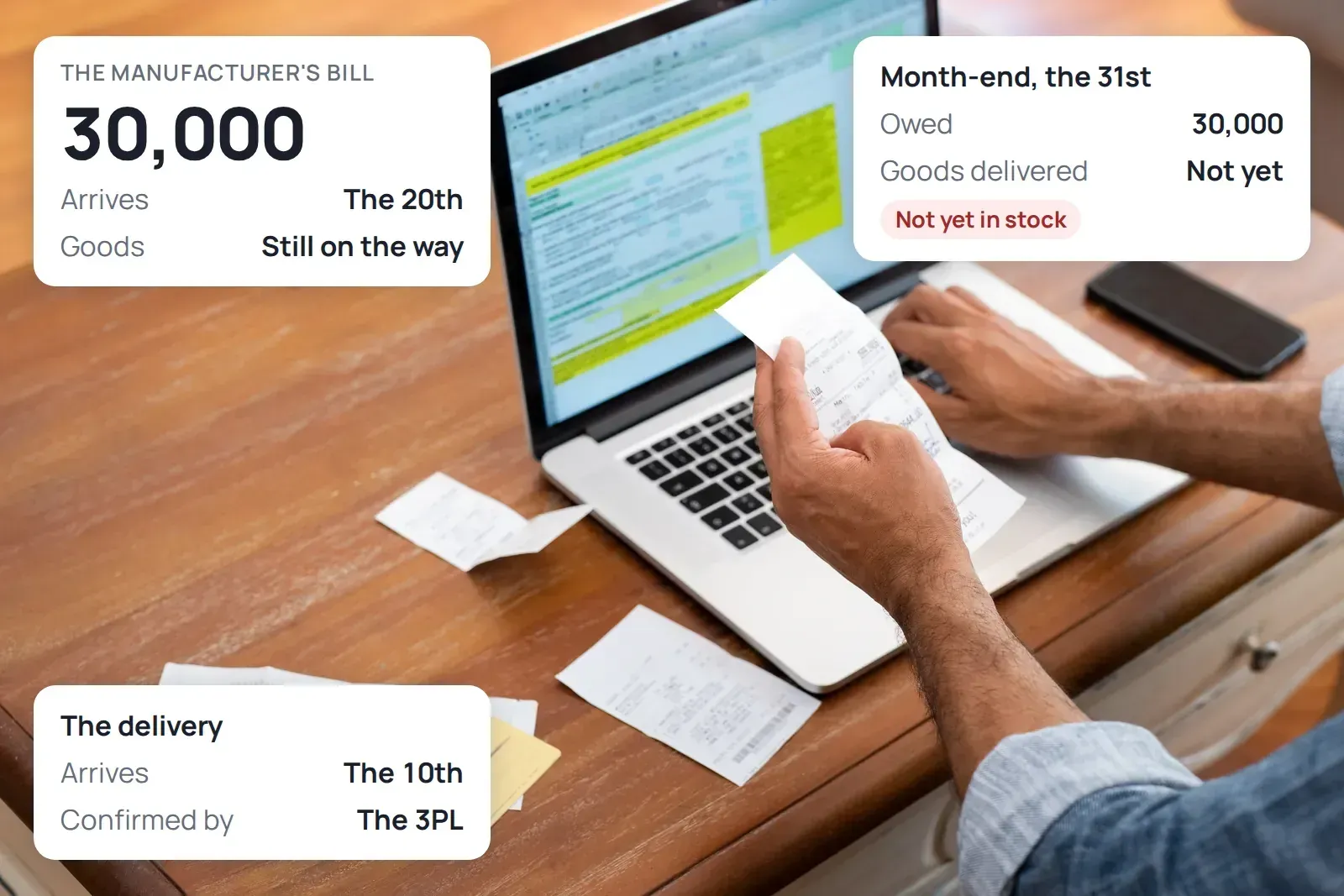
- The manufacturer's bill30,000ArrivesThe 20thGoodsStill on the way
- Month-end, the 31stOwed30,000Goods deliveredNot yetNot yet in stock
- The deliveryArrivesThe 10thConfirmed byThe 3PL
When should a skincare brand move purchase orders out of Xero and into an inventory system?
A skincare brand should look at moving purchase orders into an inventory system when its contract manufacturers bill before the goods arrive. When a month-end falls between the bill and the delivery, the books and the warehouse can then disagree.
The brand also supplied some packaging to its factories, but this story is about the finished goods it bought from its manufacturers. Xero handled that buying well. Xero’s purchase order page puts it simply: “Raise, send, and track purchase orders online, then convert them into bills in a click.” For many brands, that is the right place to buy.
The question was timing. Xero’s inventory page says the stock count “adjusts once you approve the invoice or bill”. That suits a brand whose bills and goods arrive together. An offshore manufacturer, though, billed when the order shipped.
Let’s assume a bill for 30,000 was approved on the 20th. The 3PL confirmed the delivery on the 10th of the next month. The month-end on the 31st fell in between. Wherever stock moved with the bill, the accountant was left explaining 30,000 of serum that nobody at the 3PL could pick.
The other signs were familiar. The order was raised in one place, the delivery confirmed by the 3PL in another and the bill approved in a third. Offshore and local manufacturers worked on different terms, so no two orders behaved alike. And with a busy store, the stock that could be sold mattered more than the stock that had been billed.
Two questions show where a brand stands. What has to be checked by hand before anyone trusts the month-end stock figure? Where does someone have to remember a bill that arrived before its goods? With a handful of orders a year, bill and delivery landed in the same month, so the old way made sense. Once that changed, the brand needed to know what its purchasing tool should do.
What should purchase order and inventory software do for a skincare brand?
Purchase order software for a skincare brand should record each order, each delivery and each bill, and book the stock when the goods arrive.
The order, the receipt and the bill are three events with their own dates. Deliveries are recorded as they arrive, in parts if need be. Bills can come in stages. The bill reaches the books without retyping, and the stock reaches them on receipt. An offshore bill keeps its currency, and payments follow the books’ own process.
Xero keeps the books well, and its purchasing suits a business that is billed when the goods arrive. The Xero cells below quote Xero’s US pages, so check your own region and plan.
| What the brand wants to know | Stay with Xero purchase orders and bills | Xero's own tracked inventory | An inventory system that posts bills and receipt journals to Xero (such as Qoblex) |
|---|---|---|---|
| Raising the order and billing it | Xero: "In Xero, an approved purchase order converts into a bill you can pay." | As in the first column. | Raised and billed in Qoblex, in stages if needed. Each authorized bill posts to Xero. |
| A part delivery | Xero: "For a partial delivery, bill what you received and the order stays open for the rest." | As in the first column. | Each delivery gets its own goods receipt note, and one order can carry more than one bill. |
| When stock reaches the books | Not compared here. | Xero's inventory page says the stock count "adjusts once you approve the invoice or bill". | On receipt, an inventory journal debits the Stock On Hand Account and credits Purchases. The bill posts to Purchases and Accounts Payable. |
| What shows what is still coming | Xero: "Xero shows which orders have been sent, filled, and billed, and which are still open, all in one place." | As in the first column. | Separate Receiving and Billing badges beside the order status, set by receipts and bills. |
| Plan and add-ons | Check your own Xero plan and region. | Xero: "Inventory tracking is included in Xero plans, and Xero Inventory Plus and inventory apps are paid add-ons." | Advanced purchase orders are on every Qoblex plan. The Xero connection is a paid add-on on Starter and Business. |
The columns differ in who keeps the three dates. In the first two, the order and the bill live in Xero. In the third, the inventory system keeps the order and the receipt. Each reaches Xero as its own posting. Xero’s own pages word the timing of tracked stock in more than one way. So check in your own Xero organisation when tracked stock updates before relying on it.
When is staying with Xero purchase orders the right call?
Staying with Xero purchase orders is the right call for a skincare brand whose bills and deliveries land in the same month. That brand buys a handful of lines a year from manufacturers that bill when the goods ship or arrive. One person approves each bill and knows the goods are in.
Xero’s purchasing serves that brand well. As Xero puts it, “Purchase orders, bills, and invoices connect inside Xero, so your work flows from one task to the next.” The test is the month-end: if it never carries a bill without its goods, stay put. The wider one-tool-or-two question is covered in inventory and accounting software for a small business. Where bills and goods land in different weeks, here is how the work runs in Qoblex.
How does a skincare brand run purchase orders and receiving in Qoblex with supplier bills posting to Xero?
A skincare brand runs purchase orders and receiving in Qoblex, with Xero staying the books. Each manufacturer’s order is raised in Qoblex, each delivery is recorded on a goods receipt note, and each authorized supplier bill posts to Xero.
The person who buys from the manufacturers raises each order. The order carries the supplier, the Ship To location and an estimated delivery, as create a purchase order shows. When goods arrive, the team records them on a goods receipt note, one per delivery. Authorizing the note brings the stock into inventory, as receive goods and manage GRNs covers.
Once an order is approved, the team can bill it before anything is received. One order can carry more than one bill, so a manufacturer that ships in stages is billed in stages. The help centre covers how to create and manage supplier bills and how to record payments and supplier deposits against an authorized bill.
Two postings carry this into Xero. Each authorized bill posts as an Accounts Payable bill, and each receipt as an inventory journal. Both pass through the Purchases account, a clearing account chosen in the Xero purchases settings. A bill that fails to reach Xero shows on the Sync Status tab, as Xero sync status and manual sync explains.
The Xero integration overview sets out what syncs and when. The Xero and purchase orders pages show each side as a whole, and the pricing page lists the plans. One order to an offshore manufacturer shows the postings best.
What does one purchase order to an offshore contract manufacturer look like when the bill arrives first?
When an offshore manufacturer bills a skincare brand first, Qoblex posts the bill to Xero when authorized and the stock once the receipt is recorded.
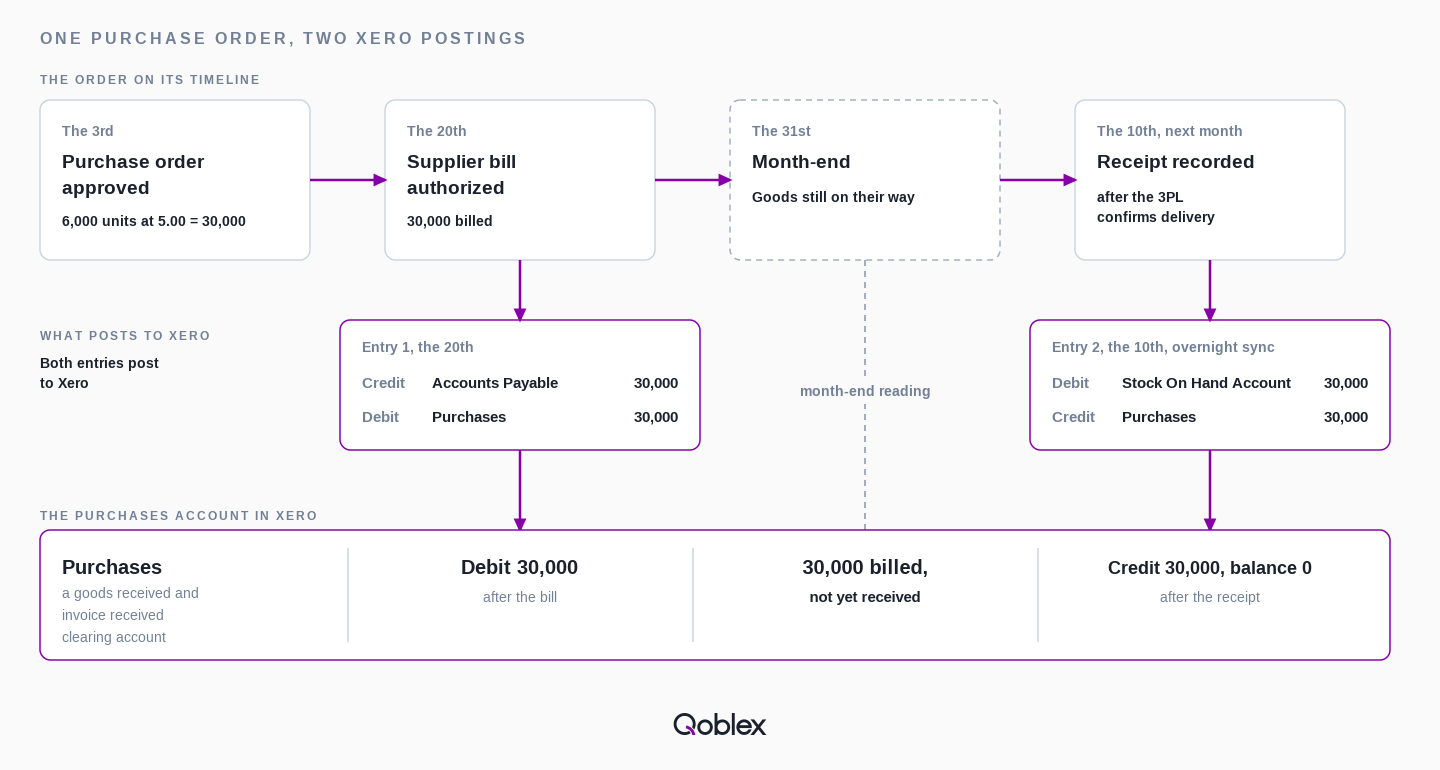
Let’s assume the brand orders 6,000 units of a serum from an offshore contract manufacturer at 5.00 a unit. There is no freight or tax, so the order comes to 30,000. The manufacturer bills when the order ships, weeks before the goods reach the 3PL.
- On the 3rd, the team approves a purchase order to the manufacturer for 6,000 units, 30,000 in all.
- The manufacturer’s bill for 30,000 arrives on the 20th, and the team bills the order and authorizes the bill, which posts to Xero.
- The month ends on the 31st with the goods still on their way.
- The 3PL confirms the delivery on the 10th of the next month, and the team records the receipt.
- The receipt posts to Xero as an inventory journal that night, and the Purchases account nets back to zero.
On the 20th, the bill credits Accounts Payable 30,000 and debits Purchases 30,000. It reaches Xero within a few minutes of being authorized. On the 10th, the receipt journal debits the Stock On Hand Account 30,000 and credits Purchases 30,000. Inventory journals go on the overnight sync, so the accountant sees this one the next morning. Because Purchases works as a goods received and invoice received clearing account, stock enters the books with the goods.
That leads to the question the brand checked first: could purchasing live outside Xero altogether?
Can a skincare brand raise purchase orders and receive stock outside Xero and never manage purchasing there?
A skincare brand can raise purchase orders and receive stock in Qoblex without managing purchasing in Xero, because authorized bills and payments post to Xero.
That was the first thing the brand checked when it walked its own routine through Qoblex. Each authorized bill reaches Xero as an Accounts Payable bill, so nobody types it in again. The brand chooses the status synced bills arrive with in Xero, and Draft is one of them. So an accountant who wants to review each bill in Xero first can pick Draft.
Supplier payments recorded in Qoblex post to Xero as well. If the accountant pays bills in Xero instead, an optional payment sync brings those payments back into Qoblex. The help centre asks the brand and its accountant to agree first which system is the source of truth for supplier payments.
An offshore manufacturer’s bill can reach Xero in the supplier’s own currency, with its exchange rate. Local manufacturers’ orders run the same path, with each receipt recorded when the 3PL confirms the delivery. Rent and other non-stock costs stay in Xero as usual. What the accountant reads there at month-end is the last piece.
What does the Purchases account in Xero show at month-end, between the bill and the goods?
A skincare brand that receives stock in Qoblex sees each manufacturer’s bill on the Purchases account in Xero until its goods arrive. So at a month-end between the two, Purchases holds the full value of that bill.
On the 31st, Purchases carries the 30,000, which the help centre describes as goods billed but not yet received. Accounts Payable carries the 30,000 owed. The Stock On Hand Account holds none of this order yet. Once the goods are both billed and received at the same value, Purchases is back to 0.
A balance left on Purchases means goods billed but not yet received, received but not yet billed, or billed and received at different prices. Supplier returns and later cost changes on a receipt post there too. The idea is the classic GR/IR clearing account. In reverse, a delivery recorded before its bill leaves a credit of 30,000 until the bill posts. The brand can also have receipt journals arrive in Xero as drafts, so the accountant posts each one after a check.
So the accountant reads one balance and knows which cause to look for. The person who buys from the manufacturers sees which bill still waits on its goods, from the order’s Receiving and Billing badges. Nobody has to remember a bill that arrived early.
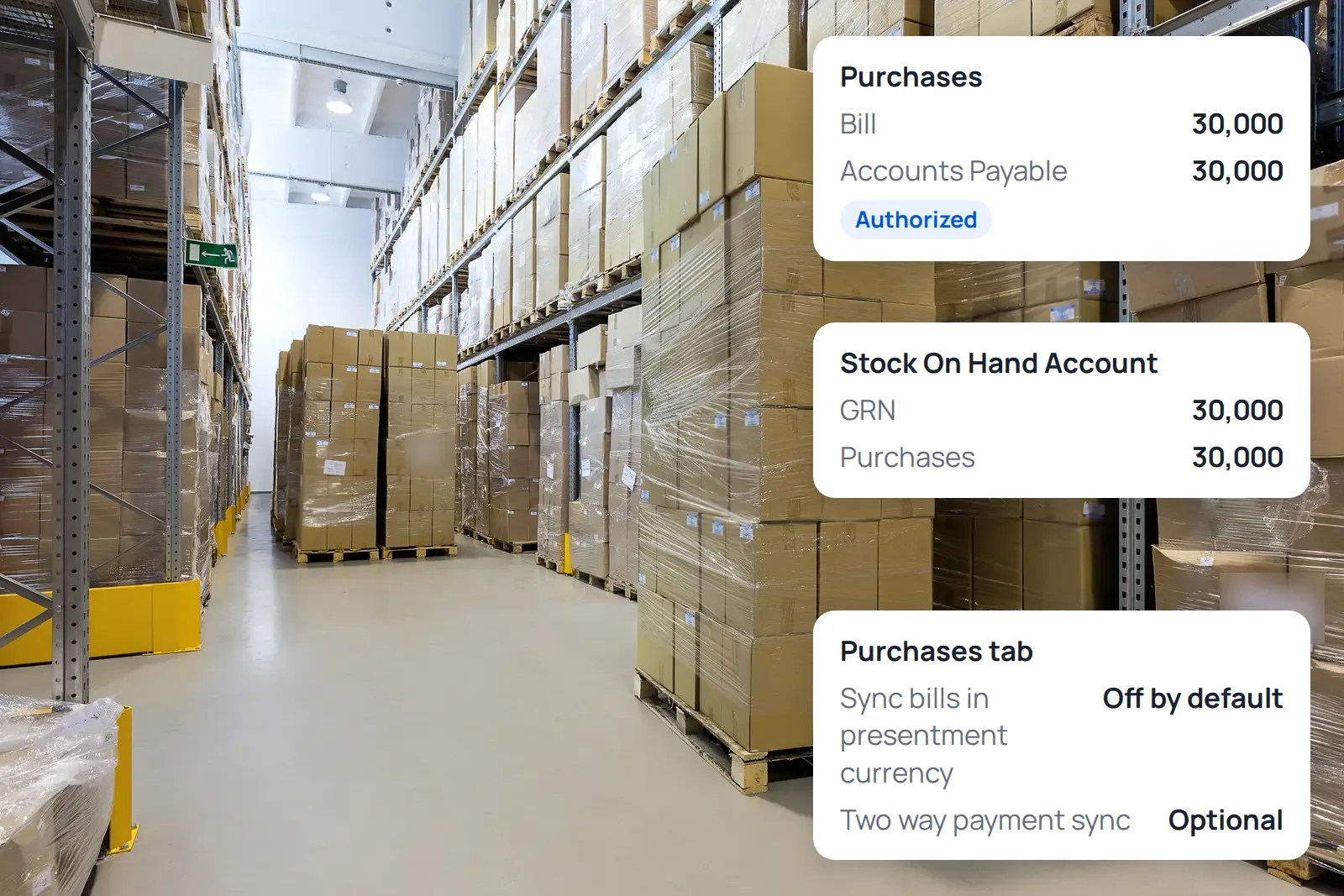
- PurchasesBill30,000Accounts Payable30,000Authorized
- Stock On Hand AccountGRN30,000Purchases30,000
- Purchases tabSync bills in presentment currencyOff by defaultTwo way payment syncOptional
Whether that routine suits another brand depends on how its manufacturers bill and ship.
Does this fit your business?
Purchase orders and receiving in Qoblex, with supplier bills posting to Xero, fit a skincare brand that buys finished goods from contract manufacturers. The fit is strongest when bills and deliveries land in different weeks.
Haircare, cosmetics and personal care brands with contract manufacturers fit the same story. So do supplement and candle brands that buy finished goods from co-packers and keep their books in Xero. For the accountant’s side, see how the inventory journals reach Xero for a skincare brand. For orders that arrive in parts, see how one part-shipped purchase order stays matched.
Other brands should stay put or look closer. A brand that buys a handful of lines a year may be happy with Xero’s purchase orders and bills. That brand should keep using Xero’s own purchasing. A brand that needs components tracked at a subcontractor should know Qoblex does not do subcontracting. And on Starter and Business, the Xero connection is a paid add-on to plan for.
Frequently asked questions
How do purchase orders in inventory software sync with my accounting software?
A skincare brand raises the purchase order in Qoblex, records each delivery on a goods receipt note and authorizes the supplier bill. Qoblex posts that bill to Xero within a few minutes, crediting Accounts Payable and debiting Purchases. The receipt posts as an inventory journal on the overnight sync. The Xero connection is a paid add-on on Starter and Business.
Can I raise purchase orders and receive stock outside Xero, with bills syncing to Xero?
Yes. A skincare brand can raise purchase orders and record receipts in Qoblex, with Xero staying the books. Each authorized bill posts to Xero as an Accounts Payable bill, in the status the brand chose for synced bills, so nobody types it in again. Supplier payments can post from Qoblex, with an optional two-way payment sync.
When does stock reach the books if the brand receives goods in Qoblex?
Stock reaches the books when the receipt is recorded, not when the bill arrives. The bill debits Purchases and credits Accounts Payable. On the overnight sync, the receipt posts an inventory journal that debits the Stock On Hand Account and credits Purchases by the value received. Purchases then nets back to zero.
What does a balance left on the Purchases account mean?
Qoblex uses the Purchases account as a goods received and invoice received clearing account. A balance left on it means goods billed but not yet received, received but not yet billed, or billed and received at different prices. Supplier returns and later cost changes on a receipt also post to this account.
Can supplier bills sync to Xero in the supplier’s currency?
Yes, when Sync bills in presentment currency is on. Qoblex then sends the bill to Xero in the supplier’s currency with its exchange rate. The option is off for a new configuration, and Qoblex otherwise converts the bill to the company base currency. Agree the setting with the accountant first.
Do non-stock costs like rent go through the inventory system?
No. Rent, software and other non-stock costs stay in Xero, entered there as usual. Qoblex raises bills from purchase orders. A service or other untracked product on a Qoblex order posts to the Xero expense account the brand chooses as its Expenses Account, not the Purchases account. So a service never waits for a receipt.
Can the same products be tracked in both Xero and Qoblex?
No. Track each product in one place only. Qoblex syncs products to Xero as untracked items and posts the inventory value itself, as journals to the Stock On Hand Account. Tracking the same items in Xero too counts their value twice, so the brand and its accountant choose one home for stock.