



The best SkuVault Core alternatives in 2026 are Qoblex, Katana, Fishbowl, MRPeasy, Zoho Inventory, inFlow, Cin7 Core, and Unleashed. SkuVault Core, now owned by Linnworks, is a capable warehouse management system with lot tracking and FEFO picking, but it has no bill of materials, production orders, or MRP. For product-based SMBs that also need light manufacturing alongside inventory and traceability, Qoblex is the top pick.
Why look for a SkuVault Core alternative?
SkuVault Core has earned its place. It is a warehouse execution tool built for ecommerce operators who need barcode-driven accuracy: real-time stock sync, digital picklists, multi-warehouse counts, and connections to the marketplaces where they sell. If your daily problem is that the warehouse and the storefront disagree about what is actually on the shelf, SkuVault Core was built to solve exactly that. Most operators who go looking for an alternative are not unhappy with it as a warehouse tool. They have hit one specific wall, and it is usually the same wall.
One thing worth knowing up front, because it shapes the product’s direction and support: SkuVault Core is now part of Linnworks. Linnworks, the UK-based order and inventory management platform, completed its acquisition of the Louisville-based WMS provider SkuVault in 2022, and the product is now marketed as SkuVault Core by Linnworks. That is a helpful fact to have when you are evaluating where the platform is headed, not a reason for alarm. If you are weighing up the broader Linnworks platform rather than SkuVault Core specifically, that is a different comparison.
What SkuVault Core does well, and where it hits its limits
SkuVault Core is a warehouse management system (WMS). Its job is warehouse execution, and it does that job well: barcode scanning, digital picklists, route-optimized picking, cycle counts, multi-warehouse accuracy, kitting, quality control, and real-time inventory sync across sales channels, with 100+ direct integrations to marketplaces, 3PLs, and shipping solutions. It connects to Shopify, Amazon, and eBay on the channel side. One scope note for teams outside North America: the Linnworks product page states that the SkuVault Core features on offer are only available in North America, so this is a North America-first tool.
The limit is not traceability, and it is worth being accurate about that (more on this below, because SkuVault Core is genuinely good at it). The limit is manufacturing. SkuVault Core is a warehouse execution layer, not an inventory-plus-manufacturing platform. There is no bill of materials, no production orders, and no MRP anywhere in the product. That is not a knock on the tool; it is the documented boundary of what a WMS is built to do.
Who finds SkuVault Core too narrow (and why)
The friction that sends people looking usually falls into one of three places.
- You make product, not just move it. If your operation includes any real production, assembling a finished good from raw materials and components, you need a BOM and a production order to run it. SkuVault Core has neither. It can kit and bundle finished SKUs together, but it cannot explode a bill of materials or account for the components a production run consumed.
- You want one platform instead of a warehouse layer bolted onto everything else. SkuVault Core is a WMS, so the accounting, order management, and manufacturing depth live in other systems you connect it to. Some operators would rather run inventory, purchasing, light manufacturing, and accounting sync from a single platform than stitch a warehouse tool into a wider stack.
- You are a regulated or expiry-sensitive brand that also produces. SkuVault Core handles lot and FEFO picking on the warehouse side, but the trace stops at the warehouse. If your lots need to survive a production run, from raw-material receipt through the build to the finished-goods batch, that is a job for a platform with manufacturing built in.
None of this makes SkuVault Core the wrong choice. It makes it a specific choice, for a specific kind of operation. The question is whether that is you.
What should a SkuVault Core alternative include?
Before you compare tools, get clear on what you actually need to run. For an SMB that needs more than warehouse execution, a good SkuVault Core alternative usually covers most of this:
- Real manufacturing when you need it. Not kits and bundles, but a bill of materials, production orders, and enough MRP to build a finished good and have the system account for the components it consumed. If you make anything, this is the line a WMS cannot cross.
- Traceability that survives production. Lot and batch tracking with expiry dates that stays intact from raw-material receipt through the production run to the finished-goods shelf, so a recall question can be answered quickly.
- Multichannel plus a real accounting sync. Two-way sync with the channels you sell on (Shopify, Amazon, WooCommerce) and a genuine connection to Xero or QuickBooks Online, so your books stay your book of record.
- A structure you can start on your own. Month-to-month billing where you can get it, and self-serve onboarding so you are operational in days rather than committed to an implementation project. Several alternatives here bill monthly with no mandatory long-term contract; confirm current terms with each vendor.
Most tools on this list clear the warehouse basics that SkuVault Core also covers. What separates them is whether manufacturing is real or just kitting, whether traceability survives production, and whether the accounting sync treats Xero and QuickBooks as first-class.
The 8 best SkuVault Core alternatives in 2026: quick comparison
Here is the shortlist at a glance, ranked and compared on the capabilities that actually decide the choice. The SkuVault Core row is included at the top as a reference point. Capability details for each tool are based on their published product documentation, as of July 2026; confirm current scope with each vendor before you commit.
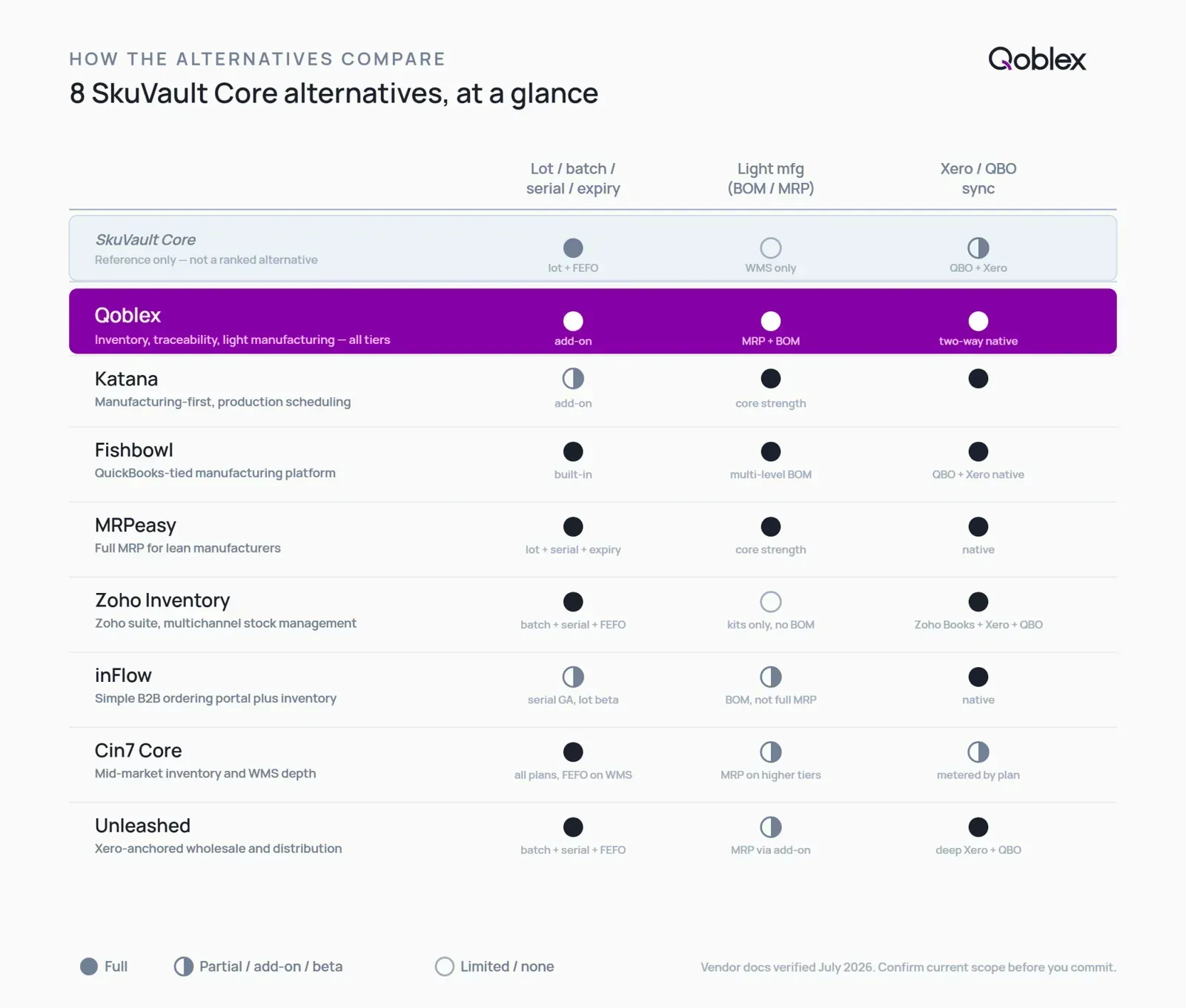
| Tool | Lot / batch / serial / expiry traceability | Light manufacturing (BOM / MRP) | Multichannel + accounting sync | Best for |
|---|---|---|---|---|
| SkuVault Core (reference) | Lot tracking, FIFO, and FEFO picking; lots map to one SKU; no expiry-notification alerts | No BOM, no production orders, no MRP (WMS only) | Shopify, Amazon, eBay; connects to QuickBooks Online and Xero (confirm sync depth with vendor) | Ecommerce warehouse execution and marketplace fulfillment |
| Qoblex | Lot, batch, serial, and expiry tracking (tracking add-on); links cleanly with your accounting | Yes: lightweight MRP and BOM, production orders, on all tiers | Shopify, WooCommerce, Amazon; two-way Xero and QuickBooks Online | Product-based SMBs needing inventory, traceability, and light manufacturing in one place |
| Katana | Batch, serial, and expiry via Full Traceability add-on, separate from the Core base plan | MRP is the core strength | Shopify, WooCommerce, Amazon; Xero and QuickBooks Online | Small manufacturers whose core problem is production scheduling |
| Fishbowl | Lot, batch, serial, and expiry as built-in part-tracking types | Multi-level BOM, work orders, MRP | QuickBooks and Xero native; Shopify via Commerce hub | QuickBooks-tied manufacturers ready for an implementation |
| MRPeasy | Lot and serial traceability with expiry dates | Full MRP is the core strength | Shopify, WooCommerce; native Xero and QuickBooks Online | Lean manufacturers wanting MRP depth with traceability included |
| Zoho Inventory | Batch tracking with expiry and FEFO batch selection; serial tracking | Kits and bundles via composite items; no BOM or MRP module | Shopify, Amazon, WooCommerce; Zoho Books, Xero and QuickBooks Online | Teams standardised on the Zoho suite that do not manufacture |
| inFlow | Serial tracking generally available; lot/batch and expiry in beta as of mid-2026 (confirm with vendor) | BOM and manufacture orders for assembly and kitting; not full MRP | Shopify, Amazon; native Xero and QuickBooks Online | Small teams wanting a simple B2B ordering portal alongside inventory |
| Cin7 Core | Batch, serial, and expiry on all plans; FEFO enforcement on higher-tier WMS | Assembly and BOM on all plans; full MRP on higher tiers | Multichannel metered by plan; Shopify, Amazon, Xero and QuickBooks Online | Growing businesses wanting mid-market WMS depth |
| Unleashed | Batch tracking with expiry and FEFO batch selection; serial tracking on every plan | Multi-level BOM (manual level-by-level); MRP via Advanced Inventory Manager add-on | Shopify; deep two-way Xero sync, QuickBooks Online | Xero-anchored wholesale and distribution businesses |
A note on cost. We are keeping specific figures off this page because they move; check each vendor’s own pricing page for current numbers. The lighter alternatives here tend to be flat, self-serve subscriptions you can start without a formal implementation, while Fishbowl and Cin7 Core are heavier platforms that expect a setup effort to match their depth. Qoblex’s current structure and figures are on the pricing page.
Detailed reviews
1. Qoblex, the best SkuVault Core alternative for product-based SMBs needing manufacturing depth
Qoblex is the operational system between a spreadsheet and a bloated ERP. It handles inventory, purchasing, order management, light manufacturing, and traceability in one place, and it connects natively to Shopify, WooCommerce, Amazon, Xero, and QuickBooks Online. That combination is the point for a SkuVault Core shopper who has hit the manufacturing wall: Qoblex closes the inventory, traceability, and light-manufacturing gap while your existing accounting stays your book of record, rather than asking you to bolt a warehouse layer onto a wider stack.
Where SkuVault Core stops at kitting and bundling, Qoblex ships lightweight MRP and bill of materials with production orders, on all tiers, so you can build a finished good and have the system account for the components it consumed. Traceability is a paid tracking add-on that gives you lot, batch, serial, and expiry tracking, and because manufacturing is built in, the trace passes through production rather than stopping at the finished-goods shelf. FEFO picking is part of that: Qoblex can direct picking by expiry so the nearest-to-expire stock goes first. Setup is self-serve, with no mandatory implementation project, and there is a 14-day free trial with no credit card required, so you can load your own data and confirm the fit before committing. Current structure and figures are on the pricing page.
Best for: food, beverage, supplement, and cosmetics brands, and other growing SMBs that want real traceability alongside purchasing and light manufacturing, with a two-way sync to Xero or QuickBooks Online.
The trade-off, honestly: Qoblex ships lightweight MRP, not a deep standalone WMS with automated route optimization at large warehouse scale. If your only problem is warehouse execution and you do not make product, SkuVault Core already does that job. Qoblex is the answer when you also need manufacturing.
2. Katana
Katana is manufacturing-first. It is built around a real-time production scheduler, BOM management, and shop-floor visibility, and for a maker whose core problem is production it does that job well. It connects natively to Shopify, WooCommerce, Amazon, Xero, and QuickBooks Online. Worth knowing for the regulated buyer: batch, serial, and expiry tracking live in the Full Traceability add-on, purchased on top of the Core base plan. Compared with SkuVault Core, which has no manufacturing at all, Katana is a genuine production engine. Is Katana better than SkuVault Core for manufacturing? For production it is not a close call, Katana does manufacturing and SkuVault Core does not; for pure warehouse execution the comparison runs the other way.
Best for: small manufacturers whose center of gravity is production scheduling and who are comfortable adding the traceability module on top.
3. Fishbowl
Fishbowl is a manufacturing and inventory platform with deep QuickBooks ties. It ships lot, batch, serial, and expiry tracking as built-in part-tracking types, multi-level BOMs, work orders, and MRP, and it connects to both QuickBooks and Xero natively. The trade-off is weight: its manufacturing-depth tier expects a formal implementation, which is more than a lean SMB usually wants. We cover it in detail in our Fishbowl alternatives comparison.
Best for: QuickBooks-tied manufacturers with genuine production depth and the appetite for an implementation.
4. MRPeasy
MRPeasy is the closest like-for-like if what you want is a real manufacturing engine with lot and serial traceability and expiry dates in the same tool. It is a genuine MRP platform for small manufacturers, with production planning, BOM, and stock control, and it connects natively to Xero and QuickBooks Online. Where SkuVault Core offers no manufacturing at all, MRPeasy is built around it. The trade-off runs the other way: it is a manufacturing tool first, so if warehouse-execution depth is your priority, weigh that up.
Best for: lean manufacturers who want MRP depth with traceability included in the same tool.
5. Zoho Inventory
Zoho Inventory is a stock and multichannel order tool that sits inside the wider Zoho suite. It offers batch tracking with expiry dates, FEFO batch selection at the invoice stage, and serial tracking, and it connects to Shopify, Amazon, WooCommerce, Zoho Books, Xero, and QuickBooks Online. Like SkuVault Core, it has no real manufacturing module: it handles kits and bundles through composite items, but there is no BOM explosion, production order, or MRP. If you already live in the Zoho suite and do not manufacture, it is a coherent choice; we cover it in our Zoho Inventory alternatives comparison.
Best for: teams standardised on the Zoho suite whose inventory work is stock and order management rather than manufacturing.
6. inFlow
inFlow is a clean, approachable tool for small teams. Its serial number tracking is generally available, while lot/batch tracking with expiry dates is in beta as of mid-2026, so if lot traceability is your reason for buying, confirm its current availability with the vendor before you commit. It offers BOM and manufacture orders for assembly and kitting rather than full MRP, along with a built-in B2B showroom for wholesale orders, and it connects to Xero and QuickBooks Online. It bills monthly with no mandatory long-term contract.
Best for: small teams wanting a simple B2B ordering portal alongside inventory.
7. Cin7 Core
Cin7 Core is a step up in weight: a mid-market inventory and warehouse platform with batch, serial, and expiry tracking on all plans and real warehouse depth. Worth knowing for a regulated buyer: FEFO enforcement, the pick validation that blocks a non-FEFO pick, sits in the higher-tier WMS, and full MRP is a higher-tier feature too, while assembly and BOM are available on all plans. That depth is the appeal and the friction: it expects a setup effort and a team to run it.
Best for: growing businesses that need mid-market WMS depth and are ready to invest in setup.
8. Unleashed
Unleashed is a wholesale and distribution platform with strong Xero ties. It ships batch tracking with expiry dates and FEFO batch selection and serial number tracking on every plan, and it offers multi-level BOM (built manually level by level rather than as an automated explosion) with MRP through the Advanced Inventory Manager add-on. Its two-way Xero sync is a highlight. If you are Xero-anchored and wholesale-first, it is a strong fit; we cover it in detail in our Unleashed alternatives comparison.
Best for: Xero-anchored wholesale and distribution businesses.
What manufacturing and traceability gaps do SkuVault Core alternatives close?
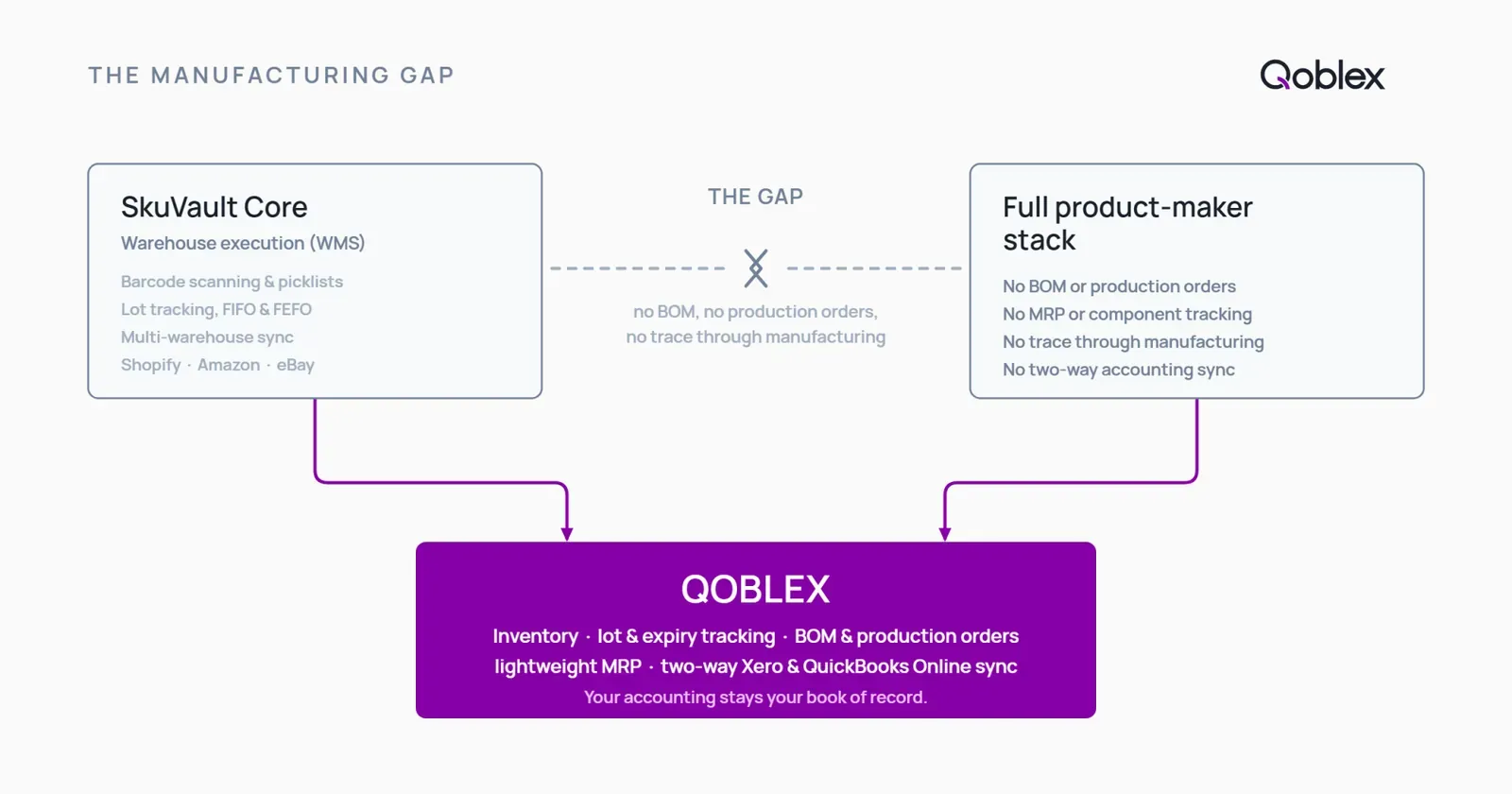
This is the section that matters most if you make anything, because it is the exact place SkuVault Core stops. Let us be precise about where the line is.
What SkuVault Core covers at the warehouse layer (and what stops there)
SkuVault Core covers the warehouse well. It natively supports FIFO and FEFO picking strategies and lets you assign lots with expiry dates at receiving, so pickers can be directed to the soonest-expiring stock first. Two scope notes are worth knowing: a lot can only be assigned to one SKU, and there are no built-in expiry-notification alerts, so date monitoring is a manual step. Even so, for warehouse-side traceability, SkuVault Core is genuinely capable. You should never read this page as saying SkuVault Core cannot track lots or cannot do FEFO. It does both.
What SkuVault Core does not do is manufacturing. There is no bill of materials, no production order, and no MRP anywhere in the product. The trace therefore lives at the warehouse layer and stays there. It cannot follow a lot through a production run, because there is no production run inside the tool.
What a product maker or regulated brand actually needs beyond WMS
Here is the distinction that decides this whole page: a WMS and an inventory management platform are not the same thing. A WMS optimizes what happens inside the four walls of the warehouse, receiving, putaway, picking, packing, counting. An inventory management platform covers the wider operational chain: purchasing, stock across locations, production, and the sync to accounting. SkuVault Core is the former. The buyer Qoblex wins needs the latter.
For a food, beverage, or supplement brand, the real-world requirement runs as a chain: capture the lot on receipt or on production, attach an expiry date, pick so the soonest-to-expire stock goes first, and keep the trace intact so a recall question can be answered quickly, which lots are affected, and where did they go. FEFO is the picking rule that orders stock by expiry date; FIFO orders it by receipt date. The two often line up, but when a later delivery expires sooner, only FEFO catches it, which is why expiry-sensitive operations rely on it. The chain also has to survive production, so the link from raw-material lot to finished-goods batch lives inside the system rather than in a spreadsheet beside it. SkuVault Core can capture a lot and pick it FEFO in the warehouse, but because there is no production run inside the tool, the trace cannot follow a lot through manufacturing. For a maker or a regulated brand, that is the gap. See our guides to lot and batch tracking, expiry and FEFO picking, and recall readiness for the full picture.
How Qoblex covers the full stack at SMB scale
Qoblex gives you lot, batch, serial, and expiry tracking as a paid tracking add-on, with self-serve setup and no mandatory implementation. Because Qoblex also ships lightweight MRP and bill of materials with production orders on all tiers, the trace passes through production rather than stopping at the finished-goods shelf, and your purchasing and multichannel sync sit in the same system. The difference from SkuVault Core for this buyer is not one feature, it is the shape of the platform: warehouse accuracy and FEFO picking, plus real manufacturing (BOM and production orders, not just kitting), plus a trace that survives that manufacturing, plus a first-class two-way accounting sync to Xero or QuickBooks Online, all in one place. For a food or supplement operation, our food and beverage inventory guide walks through how that chain holds together end to end.
How to pick your SkuVault Core alternative
A quick way to narrow it down:
- You make food, beverage, supplements, or cosmetics and want traceability plus light manufacturing, with a two-way Xero or QuickBooks sync: Qoblex.
- Your core problem is production scheduling and you want full MRP: MRPeasy, or Katana if you also want tight Shopify integration and are happy to add the traceability module.
- QuickBooks is central and you want deep manufacturing integration with it: Fishbowl.
- You are Xero-anchored and wholesale-first: Unleashed.
- You take a lot of wholesale or B2B orders and want something simple: inFlow.
- You have genuinely grown into mid-market WMS needs: Cin7 Core.
- You already live in the Zoho suite and do not manufacture: Zoho Inventory.
- Your only problem is warehouse execution and you do not make product: stay on SkuVault Core. More on that next.
When SkuVault Core is genuinely the right call
SkuVault Core earns its place, and it is worth being straight about who it is built for. Choose or stay on SkuVault Core when:
- Your core operational problem is warehouse accuracy. SkuVault Core was built for exactly this: barcode scanning, digital picklists, route-optimized picking, multi-warehouse accuracy, and real-time sync to Shopify, Amazon, and eBay. If warehouse execution is the job, it does that job well.
- You need FEFO and lot tracking for perishable or expiry-sensitive goods, and manufacturing is not part of your operation. SkuVault Core natively supports lot tracking, FIFO, and FEFO picking. If you move product through a warehouse and want expiry-guided picking but do not make the product yourself, it covers the traceability side of that requirement.
- You sell heavily on marketplaces and want a dedicated WMS layer. With 100+ direct integrations to marketplaces, 3PLs, and shipping solutions, SkuVault Core is purpose-built to bolt a warehouse layer onto an existing multichannel ecommerce stack.
- You have already implemented SkuVault Core and it is working. Switching cost is real. If the team knows the system and warehouse accuracy is the job it is doing, a feature that lives elsewhere does not justify the disruption.
The question this page answers is the other one: whether warehouse execution is all you need, or whether you also need a manufacturing layer and a trace that survives production, which SkuVault Core does not cover. If it is the former, SkuVault Core is a sound choice and no shortlist should talk you out of it.
How to move from SkuVault Core to a new platform
If you decide the gap is real, a move is more manageable than it looks, because most of the work is data you already have in clean shape. A practical sequence:
- Export your master data first. Your product list, SKUs, barcodes, suppliers, and current stock-on-hand by location are the core of the migration, and SkuVault Core already holds them in structured form.
- Rebuild your bills of materials in the new platform. This is the piece SkuVault Core never had, so it is net-new work, but it is also the reason you are moving. Start with your highest-volume finished goods.
- Reconnect your channels and accounting. Re-establish the Shopify, Amazon, and accounting connections in the new tool, and reconcile stock once at cutover so the new system and your books agree from day one.
- Run parallel for a short window if you can. Many teams keep the old warehouse workflow live for a week or two while they validate picking and counts in the new platform, then cut over fully.
How long it takes depends mostly on catalog size and how much manufacturing structure you are building for the first time. A self-serve platform with a free trial lets you load real data and validate the fit before you commit, rather than discovering gaps after cutover.
FAQ
Is SkuVault Core the same as Linnworks? No. SkuVault Core is a separate product, now owned by Linnworks since the 2022 acquisition. SkuVault Core focuses on warehouse management (WMS); Linnworks is the broader multichannel order and inventory management platform. If you are evaluating the full Linnworks platform rather than SkuVault Core specifically, that is a separate comparison.
Does SkuVault Core have a bill of materials or manufacturing module? No. SkuVault Core is a WMS focused on warehouse execution, barcode scanning, picking, and multi-warehouse accuracy. It has no BOM, production orders, or MRP, per its published product documentation as of July 2026. If you make product and need manufacturing alongside inventory, a platform with a built-in BOM and production orders is the right fit.
Does SkuVault Core support lot tracking and expiry dates? Yes. SkuVault Core supports lot tracking, FIFO, and FEFO picking, so pickers are directed to the soonest-expiring stock first. A scope note: a lot can only be assigned to one SKU, and there are no built-in expiry-notification alerts, so date monitoring is manual.
Does SkuVault Core support FEFO picking? Yes. SkuVault Core natively supports FEFO (first-expired, first-out) picking, directing pickers to the location holding the nearest-expiry product. This is a genuine strength for food, supplement, and perishable operators.
Does SkuVault Core integrate with Xero or QuickBooks? It connects to both QuickBooks Online and Xero per its feature list. Confirm the direction and depth of each sync with the vendor before you commit.
What is the best SkuVault Core alternative for small manufacturers? Qoblex for the full stack, inventory, BOM and production orders, traceability, and accounting sync in one place; Katana if production scheduling is the center of gravity; MRPeasy for lean manufacturing with deep MRP.
What is the best SkuVault Core alternative for food, beverage, or supplements? Qoblex: lot, batch, and expiry tracking as a paid tracking add-on, FEFO picking, BOM and production orders, and native Xero and QuickBooks Online sync. See our food and beverage inventory guide for the full picture.
Is SkuVault Core good for small businesses? Yes, for small ecommerce businesses that need warehouse accuracy and picking workflows on Shopify and Amazon. It is less suited to businesses that also make product, because there is no manufacturing module.
Which SkuVault Core alternatives bill monthly with no long-term contract? Qoblex, MRPeasy, inFlow, Katana, and Zoho Inventory offer monthly billing. Confirm the current terms with each vendor before you commit.
Does Qoblex have FEFO picking, and can I try it before switching? Yes on both. Qoblex can direct picking by expiry so the nearest-to-expire stock goes first, and it offers a 14-day free trial with no credit card required, so you can load your own data and confirm the fit before committing. See qoblex.com/pricing for current terms.
Conclusion: your next move
SkuVault Core is a genuinely capable warehouse management system for the operation it is built for. If your world is marketplace fulfillment and warehouse accuracy, and you do not make product, it can be exactly right, and its lot and FEFO support cover the traceability that most ecommerce warehouses need. But if the reason you are looking is the manufacturing ceiling, no BOM, no production orders, no way for a lot to survive a production run, then the honest question is whether a warehouse-execution layer matches how you actually make and move product.
Start by writing down the one operational problem that made you search for an alternative. If it is getting real light manufacturing, traceability that survives production, and a genuine two-way sync to whichever accounting platform you run, that is the gap to close first, and it is the gap Qoblex was built for.