



At a glance: A cosmetics importer and wholesale distributor buys skincare from several European brands in euros. It keeps its books in dollars and sells to retailers, including chains with many stores. Freight and duty arrive on separate bills, one in another currency, so they never reach each product’s unit cost. The sales team quotes from the supplier price. On one chain order of 600 serums, the margin looks like 40% when it is really 34%, a gap of $414.
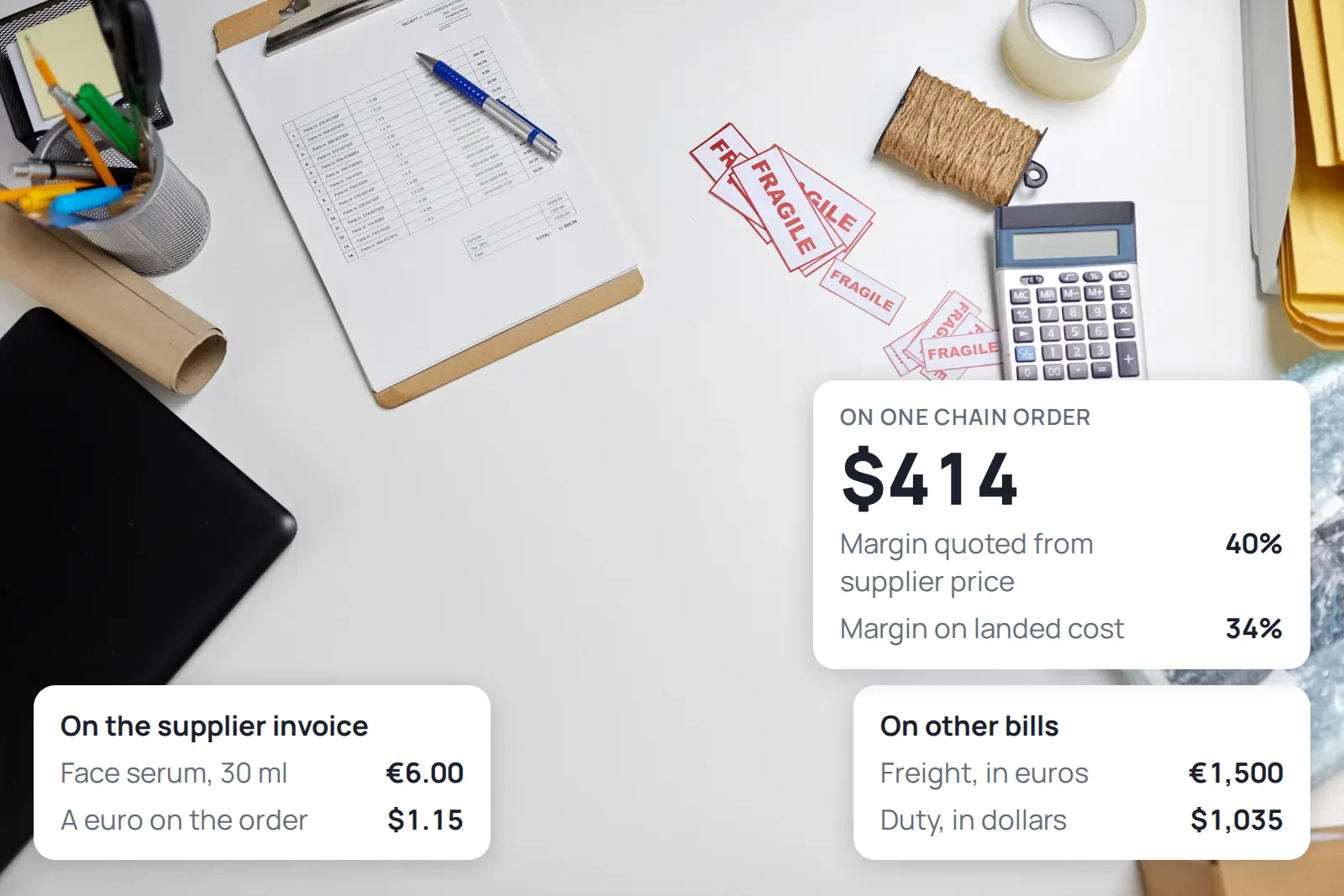
- On the supplier invoiceFace serum, 30 ml€6.00A euro on the order$1.15
- On other billsFreight, in euros€1,500Duty, in dollars$1,035
- On one chain order$414Margin quoted from supplier price40%Margin on landed cost34%
This page follows one euro shipment to that chain order, starting with how the importer used to work.
How does a cosmetics importer end up quoting a chain from the wrong cost?
A cosmetics importer quotes a chain from the wrong cost when freight and duty never reach each product’s unit cost. Those costs arrive on other bills, after the supplier’s invoice. The importer in this story carries a multi-brand range of serums, moisturisers and hand creams.
Each shipment followed the same path. The buyer entered the supplier’s invoice at the supplier’s price. A week later the forwarder’s freight bill came in, in euros. The duty was paid in dollars on the day the goods cleared. The finance person booked both as costs of the month. Neither ever touched the price of a single serum.
For years that was a reasonable way to work. The range was small, and the buyer knew the usual uplift by feel. A spreadsheet held the supplier price, a rough uplift and a selling price, and it did the job. The weak spot was that the uplift lived in one person’s head.
It broke on a chain’s request for a price on 600 of one serum. The sales team quoted from the supplier price, the only cost on the product. The margin they believed in was not the margin the shipment would earn. Nobody could say by how much without rebuilding the shipment by hand.
How do you calculate landed cost per unit for imported skincare?
To calculate landed cost per unit for imported skincare, add the supplier price, freight, duty and the other costs of landing the goods. Then give each product its share and divide by its units. Brokerage and insurance belong in the sum too. A tax the business reclaims, such as recoverable import VAT, is not a cost of the goods.
The sales terms agreed with the supplier decide who pays which cost. Customs sets the value duty is charged on, and the rule differs by country, so the team takes the duty from the customs entry. Several products also need a rule for sharing one freight bill. Businesses spread it by value, weight, volume or units, which moves each product’s cost but not the shipment total.
Which method suits a range is the buyer’s call. This importer spreads by value, so a line with more of the goods value carries more of the freight. With two currencies, it also picks one rate for the whole shipment and keeps it with the order.
Let’s assume one shipment carries three products new to the shelves, so no earlier stock blends with it. It holds 2,000 face serums at €6.00, 1,500 moisturisers at €4.00 and 3,000 hand creams at €2.00. That is €24,000 of goods, before tax. A euro is worth $1.15 on the order. The forwarder bills €1,500 of freight, and customs takes $1,035 of duty, which is €900 at the order’s rate. Together that makes €2,400, or 10% of the goods value.
One serum costs €6.00 from the supplier, which is $6.90 at the order’s rate. Its share of freight and duty is €0.60, so it lands at $7.59. The chain’s order of 600 serums at $11.50 comes to $6,900. At $6.90 of cost, the margin is $2,760, or 40%. At $7.59 it is $2,346, or 34%. The quote overstated the margin by $414 and 6 points on one order.
The sum is easy once. The hard part is doing it on every shipment, so the number reaches the people who quote.
What should inventory software do for a cosmetics importer?
Inventory software for a cosmetics importer should keep freight and duty with the goods and carry them into each product’s unit cost. The buyer should enter those costs on the purchase, before the goods arrive. Each cost should be valued at the order’s one rate, whatever currency it was billed in.
The sharing method should be stated, so the buyer can judge it. A recoverable tax needs a place outside the unit cost, and a late freight bill needs a home too. Then the landed unit cost should flow into the margin on the sales order.
A system that cannot explain how it shares a bill gives a number nobody trusts. Qoblex covers that chain on the purchase order, and the next section follows the euro shipment through it.
How does Qoblex add freight and duty to the unit cost of imported products?
A cosmetics importer on Qoblex adds freight and customs duty to the unit cost of imported products as Landed Costs lines on the purchase order. Qoblex shares them across the received lines by value and carries each share into the product’s moving average cost at receipt.
The buyer raises one purchase order in euros for the three lines, €24,000 of goods. The finance person adds the forwarder’s €1,500 and the €900 of duty as two lines in the order’s Other Costs table. Both are Landed Costs, the kind of cost Qoblex shares across the received lines.
Qoblex shares the €2,400 in proportion to each line’s net value. Every line therefore takes 10% of its own value: the serum €1,200, the moisturiser €600 and the hand cream €600. Qoblex recalculates the split each time the order is saved, so the team enters the costs before the goods arrive.
A recoverable import VAT goes in the same table as an Expenses line. That line stays on the order but is not shared across the products, so the unit cost never sees it. The freight was billed in euros, like the order, but the duty was paid in dollars.
How does Qoblex handle freight and duty paid in a different currency from the order?
A cosmetics importer that books in dollars and buys in euros keeps the purchase order in euros in Qoblex. The finance person enters each landed cost in the order’s currency, and the order’s exchange rate converts the whole shipment to dollars.
When a supplier has its own currency, the purchase order switches to it. Because euros are not the base currency, the order carries an Exchange rate, and here a euro is worth $1.15. The order’s total also shows in dollars. The forwarder’s €1,500 goes on as billed. A landed cost’s price is entered in the order’s currency. So the finance person converts the $1,035 of duty at that rate and enters €900.
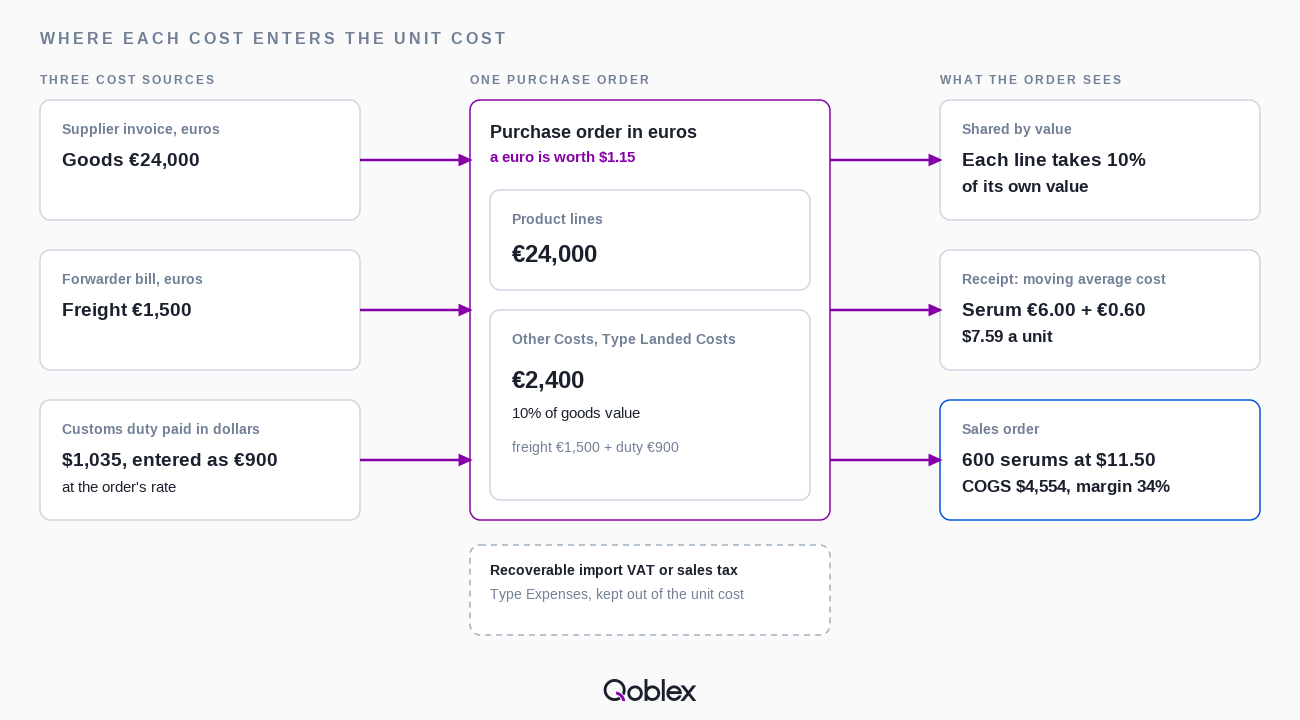
Qoblex keeps that saved exchange rate with the order, so the goods, the freight and the duty are all valued at the same $1.15. An audio equipment importer’s story follows a similar order on into the books. What each product now costs on the shelf comes next.
What does one serum cost, and what does a chain order earn, once the shipment is received?
For a cosmetics importer on Qoblex, one face serum lands at a moving average cost of $7.59 once the shipment is received. A chain order of 600 serums at $11.50 then earns a 34% gross margin. That is not the 40% that quoting from the supplier price suggests. When the warehouse team receives the goods, each line carries its share of the €2,400 into the unit cost. The moisturiser comes in at $5.06 and the hand cream at $2.53.
All three products are new to the shelves, so the moving average cost is the shipment’s cost. With earlier stock on hand, moving average cost would blend the two.
| Product | Units | Supplier price | Freight and duty share per unit | Landed cost per unit | Landed cost of the line |
|---|---|---|---|---|---|
| Face serum, 30 ml | 2,000 | €6.00 | €0.60 | $7.59 | $15,180 |
| Moisturiser, 50 ml | 1,500 | €4.00 | €0.40 | $5.06 | $7,590 |
| Hand cream, 75 ml | 3,000 | €2.00 | €0.20 | $2.53 | $7,590 |
| Shipment | 6,500 | €24,000 | €2,400 | $30,360 |
At the supplier’s prices alone, the same shipment would read $27,600. The $2,760 gap is the freight and the duty.
The chain’s sales order is raised for 600 serums at $11.50, or $6,900. It shows COGS and Margin, rolled up from its lines and marked as estimated until dispatch. At dispatch, the COGS is the quantity shipped times the product’s moving average cost at that moment. So 600 times $7.59 is $4,554, and the margin is $2,346, or 34%. The importer’s questions on the call checked this flow.
What did the importer ask about adding freight and duty in Qoblex?
The cosmetics importer asked how to add shipping and customs duty to the unit cost of each imported product in Qoblex. Some of those costs are paid in a foreign currency. The answer was the Landed Costs lines on the purchase order, each entered in the order’s currency at the order’s rate.
The importer was checking that its own euro shipments, with duty paid in dollars, would reach the unit cost without a spreadsheet. Two details matter in practice. Freight and duty known up front go on the purchase order before receiving. A freight bill that arrives after the goods goes on a separate Freight Order. That order is recorded after receipt and allocated across the purchase orders it covers. On the euro shipment, every cost was known before the goods arrived, so the whole run fits in five steps.
How does one shipment go from the supplier invoice to the unit cost the sales team quotes from?
A cosmetics importer takes one shipment from the supplier’s invoice to the unit cost its sales team quotes from in five steps. They run from the Qoblex purchase order to the sales order.
- Raise the purchase order in the supplier’s currency, euros, so the goods are valued in dollars at the order’s rate.
- Add the forwarder’s freight, €1,500, and the import duty, €900 (the $1,035 paid), as landed costs before the goods arrive.
- Keep any recoverable import VAT or sales tax as an expense, so it stays out of the unit cost.
- Receive the goods, so each product’s share of the €2,400 moves into its moving average cost, $7.59 for the serum.
- Quote and sell from that cost: the chain order of 600 serums at $11.50 carries COGS of $4,554 and a margin of $2,346.
Once the freight and duty lines match the forwarder’s bill and the customs entry, the finance person enters the supplier’s bill against the order.
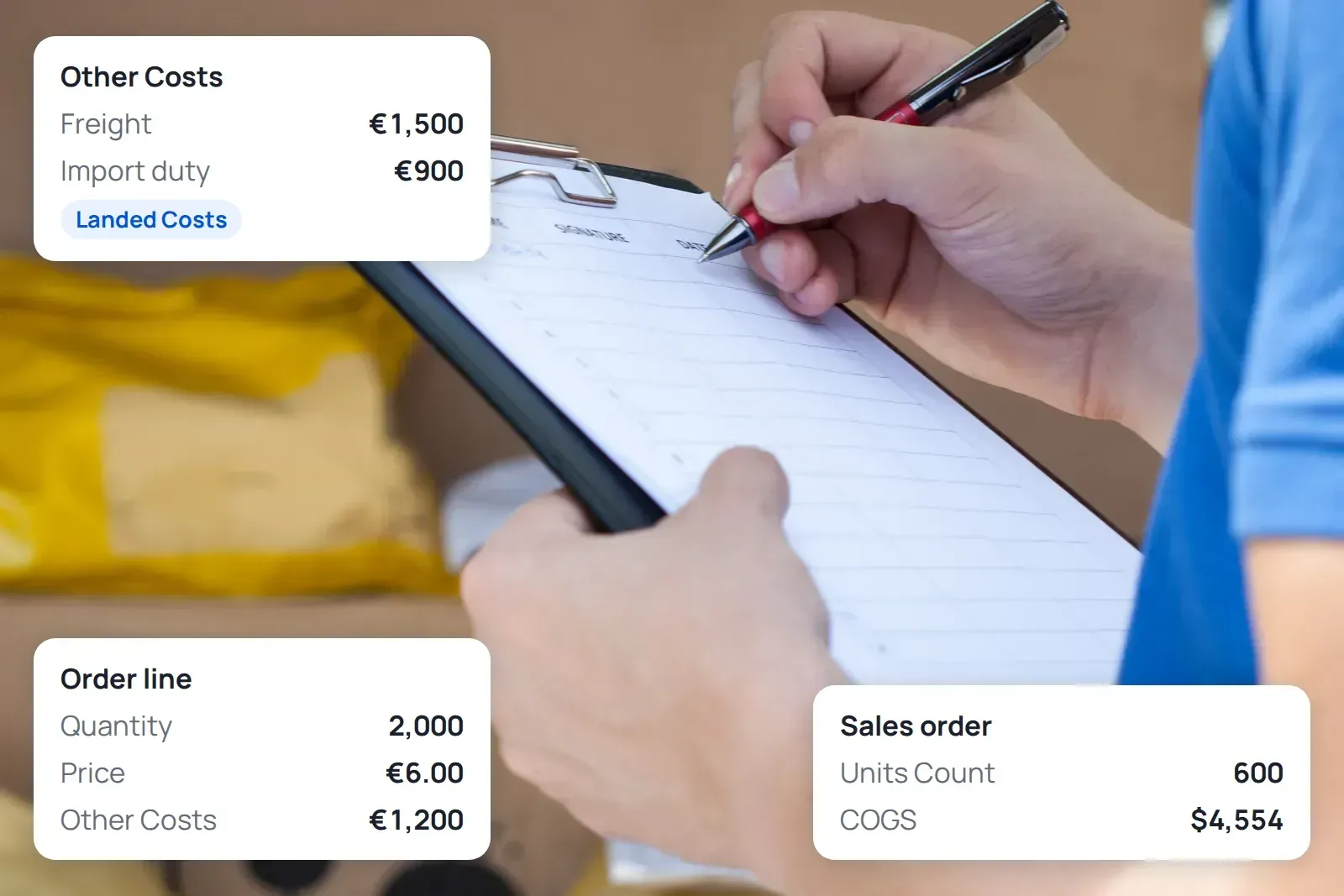
- Other CostsFreight€1,500Import duty€900Landed Costs
- Order lineQuantity2,000Price€6.00Other Costs€1,200
- Sales orderUnits Count600COGS$4,554
Until the next shipment of serums lands, every chain quote for the serum starts from $7.59. The same five steps then repeat for the next brand.
Does this fit your business?
The landed cost flow in Qoblex fits a cosmetics importer that buys in euros and sells to retailers. It also fits any distributor that pays freight and duty in another currency. Fragrance, haircare and nail importers run the same flow, and so do supplement, vitamin and specialty food importers. In each, costs go on the purchase order, are shared by value and reach the unit cost at receipt. The cosmetics inventory guide covers the wider setup.
Neighbouring stories cover other parts of the work. A cosmetics importer tracks partial deliveries and supplier invoices. A cosmetics wholesaler picks by expiry on moving average cost. A wine and spirits trader buys across several currencies and countries.
An importer that needs freight shared by weight, volume or units is outside this flow, because Qoblex shares landed costs by value. A business that buys only in its own currency, with no freight or duty, has no landed cost to spread. Advanced purchase orders are on every Qoblex plan, as the pricing page lists.
Frequently asked questions
How do I add freight and duty to imported stock to get landed cost per unit?
A cosmetics importer on Qoblex enters freight and duty as Landed Costs lines on the purchase order, before receiving. Qoblex shares them across the received lines by value. Each line’s share goes into the product’s moving average cost at receipt, $7.59 for a face serum bought at €6.00.
How do I add shipping and customs duty paid in another currency to the unit cost of each product?
A cosmetics importer enters each cost on the Qoblex purchase order in the order’s currency. A duty paid in dollars on a euro order goes on as its euro amount at the order’s rate. With a euro worth $1.15, $1,035 becomes €900. Qoblex shares it by value across the received lines.
Why is my margin on imported goods wrong when I use the supplier price?
A cosmetics importer’s supplier price leaves out freight, duty and any other landing cost, so the cost looks lower than it is. A serum at $6.90 from the supplier lands at $7.59. A chain order of 600 serums at $11.50 shows a 40% margin on the supplier price and 34% on landed cost.
Does recoverable import VAT or sales tax belong in landed cost?
Usually not. A tax a cosmetics importer reclaims from the tax authority is not a cost of the goods. In Qoblex, that tax goes on the purchase order as an Expenses line. It stays on the order but is not shared across the products, so it changes neither the unit cost nor the moving average cost.
What if the freight bill arrives after the goods are received?
In Qoblex, a freight bill that arrives after the goods goes on a separate Freight Order, recorded after receipt. A Freight Order holds freight or transport costs. It is allocated across the one or more purchase orders it covers. Freight and duty known up front are best entered on the purchase order before receiving.
Can I change the exchange rate after entering freight and duty?
Yes, a cosmetics importer can change the order’s exchange rate in Qoblex until the order has a bill. Qoblex re-converts the landed cost prices the same way it re-converts product prices. Check the direction of the rate before saving, because an inverse rate makes the values look badly wrong. A landed cost line locks once it is billed.
What happens to the unit cost when earlier stock of the same product is on hand?
In Qoblex, moving average cost blends the earlier stock of a product with a new shipment. The new average is the total value of the stock on hand, freight and duty included, over the units on hand. When the products are new to the shelves, the average equals the shipment’s cost.