



The best SkuVault alternatives in 2026 are Qoblex, Cin7 Core, Finale Inventory, inFlow Inventory, Fishbowl, and Unleashed. SkuVault (now part of Linnworks) is a capable warehouse execution tool with strong barcode-driven picking and 100-plus channel integrations. Businesses that need native Xero sync, B2B wholesale pricing, landed cost tracking, or proactive expiry alerts will find that gap elsewhere. Qoblex is the top pick when any of those apply.
What is SkuVault, and who is it actually built for?
SkuVault was designed to solve one problem well: keeping a warehouse floor accurate when you sell across multiple channels. It earns its keep for ecommerce operators who need barcode-scan-verify workflows, route-optimized picking, digital picklists, and real-time stock sync across marketplaces. When a team’s biggest daily headache is that the warehouse and the storefront disagree about what is on the shelf, SkuVault was built to fix that.
What SkuVault does well
The majority of SkuVault reviews cite picking accuracy specifically as a strength, not a coincidence, because that is the job it was engineered for. The confirmed strengths:
- Barcode-driven pick-pack-ship QC workflow built to eliminate fulfillment errors at the warehouse floor level
- Multi-location warehouse management with zone and bin mapping
- FIFO and FEFO lot rotation, native and not an add-on: pickers are directed to the nearest-expiry lot when filling orders
- Real-time multichannel inventory sync across more than 100 channels, including Amazon, eBay, Shopify, Walmart, and TikTok Shop simultaneously
- Lot and batch tracking that links lots to received stock, so the warehouse knows what came in and when
If your business is a multichannel ecommerce operation whose core problem is warehouse floor accuracy and channel sync, SkuVault is doing exactly what it was designed for.
How SkuVault fits into the Linnworks family
One thing worth knowing upfront: SkuVault is now part of Linnworks. Linnworks completed its acquisition of SkuVault in September 2022, and the product is now marketed as SkuVault Core by Linnworks. The app and support portal still carry the SkuVault name. This is worth knowing when evaluating the platform’s direction. If you are weighing the broader Linnworks platform rather than SkuVault Core specifically, see our Linnworks alternatives guide for that comparison.
What SkuVault does not cover
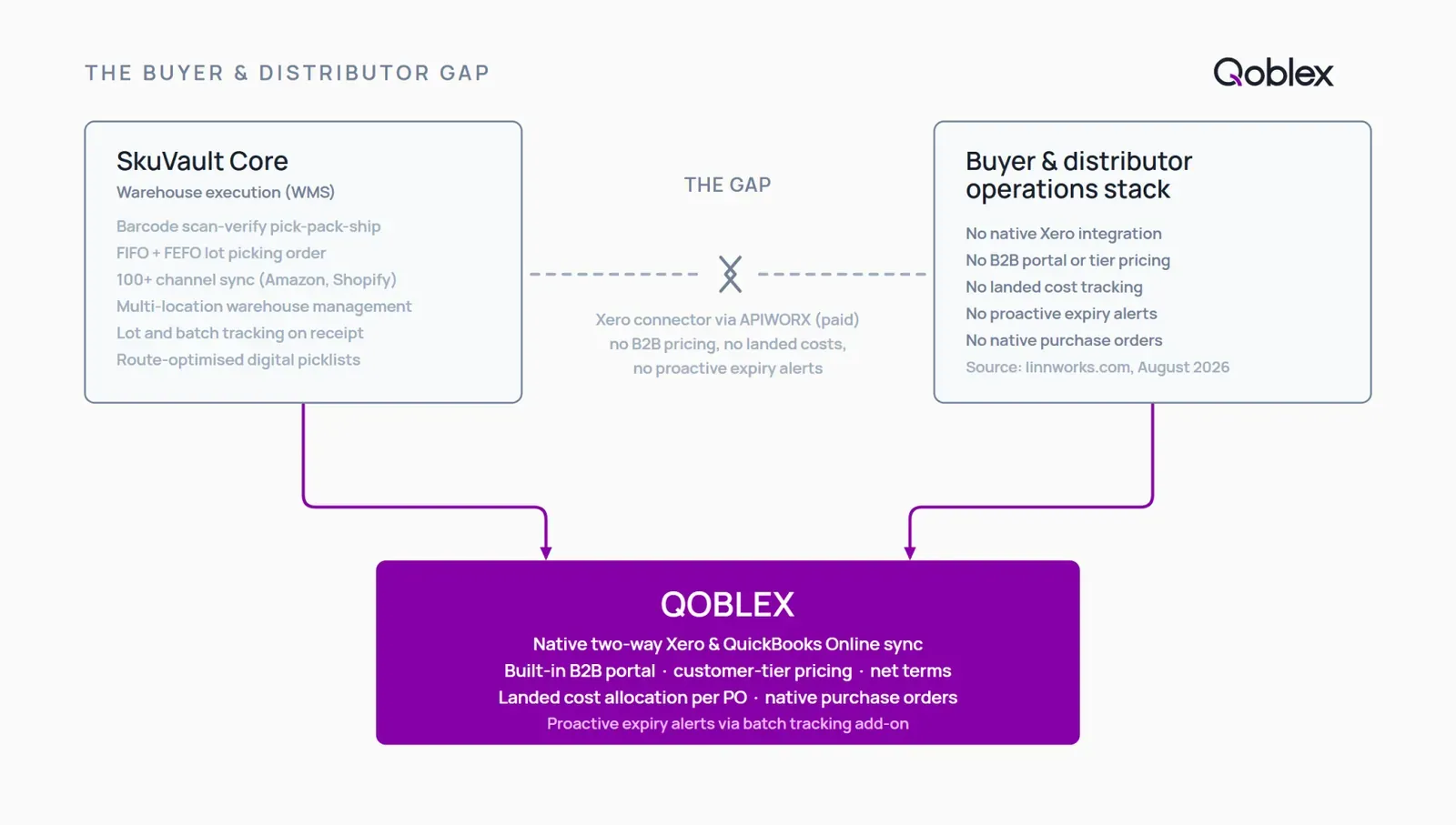
SkuVault is a warehouse management system (WMS). Its scope is receiving and fulfillment. Several capabilities that a distributor, wholesaler, or Xero-based operation needs are absent from the product:
- No native Xero integration. The Linnworks product page for SkuVault Core does not list Xero as a native integration. Connecting SkuVault to Xero requires a paid third-party connector such as APIWORX. That is an additional cost and dependency, not a built-in sync.
- No B2B wholesale portal or customer-tier pricing. SkuVault has no documented B2B portal, no customer-specific price lists, and no net-terms support. The platform is built for DTC ecommerce fulfillment, not wholesale order management.
- No landed cost tracking. Multiple sources confirm the platform does not support allocating freight, duties, or import costs to product COGS.
- No proactive expiry alerts. SkuVault supports FEFO picking order (directing pickers to the nearest-expiry lot), but it does not push proactive notifications. Linnworks’ own blog states it plainly: “We don’t have notifications that say a Lot is about to expire.”
- No native purchase order creation. SkuVault is a receiving and fulfillment system, not a procurement platform. Native PO creation and management are absent from the product.
- No billing, invoicing, or COGS journal entries. SkuVault is a WMS, not an operations platform. Financial workflows require a separate system.
For the DTC seller who only needs warehouse execution, none of these are blockers. For the buyer, distributor, or Xero-based operation, each one is.
If your business also makes product and needs bill of materials or production orders, that specific gap is covered in our companion piece on SkuVault alternatives for manufacturers. This page focuses on the buyer and distributor who needs operations completeness: accounting sync, B2B pricing, landed costs, and proactive expiry management.
Why operators look for a SkuVault alternative
The buyers who go searching for a SkuVault alternative are not usually unhappy with its warehouse execution. They have run into a specific wall, and it tends to be one of these.
The Xero problem. A business running Xero as its accounting system of record finds that SkuVault does not connect to it natively. A third-party connector can bridge the gap, but that adds a monthly fee, a dependency, and a point of failure that did not exist when the accounting tool was chosen. Businesses that use Xero for bills, invoicing, and COGS want their inventory platform to sync to it without a middleware layer.
The B2B pricing problem. A wholesale or distribution business needs to quote different prices to different customers, manage net-terms orders, and ideally give trade buyers a way to place orders without a phone call. SkuVault has none of that. It is a fulfillment tool, not a wholesale order management system.
The landed cost problem. Importers and distributors need to allocate freight, insurance, and duties to product cost so that COGS reflects what the inventory actually cost to land. Without landed cost tracking, every margin calculation is an approximation.
The expiry alert problem. A food, supplement, or cosmetics brand needs advance warning before lots expire, not just FEFO picking order. Knowing that lot 24Q3 goes out before lot 25Q1 does not help if nobody told you that lot 24Q3 expires in three weeks.
The “no purchase orders” problem. A distributor that sources from multiple suppliers needs to create, send, and track purchase orders natively. SkuVault’s job starts at receiving, after the PO has been placed somewhere else.
What to look for in a SkuVault alternative
Before you compare specific tools, build a clear list of what your operation actually needs. The capabilities most relevant to a SkuVault shopper looking beyond warehouse execution:
Native accounting integration. Not a connector you pay for separately. A two-way sync to Xero or QuickBooks Online that posts purchase invoices, sales invoices, and COGS journals automatically, so your books stay accurate without a manual export step.
B2B wholesale tools. Customer-specific price lists, a self-serve order portal for trade buyers, and net-terms support. If your sales motion includes a wholesale channel, a DTC fulfillment tool will not cover it.
Landed cost tracking. The ability to allocate freight, duties, and other import costs to the cost of goods at the product level, so COGS reflects actual landed cost rather than supplier invoice price alone.
Proactive expiry alerts. Not just FEFO picking order. A push notification or dashboard warning before a lot expires, so you can sell through, return, or dispose before the write-off happens.
Native purchase order management. Creating, sending, and tracking POs inside the platform, with receipts linked to inventory movements and landed costs allocable on each PO.
WooCommerce sync frequency. If you sell on WooCommerce, confirm sync frequency directly with any vendor you evaluate. Real-time sync and batch sync produce very different stock accuracy outcomes at volume. For a broader look at WooCommerce inventory management options, see our WooCommerce inventory management guide.
Which SkuVault alternatives have native Xero integration? Qoblex, Unleashed, inFlow, Cin7 Core, and Fishbowl all connect to Xero natively. Which have landed cost support? Qoblex, Cin7 Core, and Finale Inventory are the confirmed options on this list. Which have a B2B portal? Qoblex (built-in), inFlow (B2B Showroom), Unleashed (B2B store as an add-on), and Cin7 Core (add-on) cover this.
The 6 best SkuVault alternatives in 2026: quick comparison
The table below compares on the five capabilities that drive most SkuVault replacement decisions. SkuVault is included as a reference row. Capability details are based on published product documentation as of August 2026; confirm current scope with each vendor before committing.
| Tool | Native Xero integration | B2B wholesale portal | Landed cost tracking | Proactive expiry alerts | Native PO creation | Best for |
|---|---|---|---|---|---|---|
| SkuVault (reference) | Via paid third-party connector (APIWORX) | No | No | No (Linnworks blog: “We don’t have notifications that say a Lot is about to expire”) | No | DTC ecommerce warehouse execution and channel breadth |
| Qoblex | Yes, native two-way | Yes, built-in | Yes | Yes (via paid batch and expiry tracking add-on) | Yes | Xero users; B2B/wholesale; businesses needing landed costs and operations depth |
| Cin7 Core | Yes, native | Add-on | Yes | Yes | Yes | Omnichannel retail scaling toward mid-market |
| Finale Inventory | No (QuickBooks primary) | No (confirm with vendor) | Yes | Confirm with vendor | Yes | Multi-warehouse DTC operations with QuickBooks |
| inFlow Inventory | Yes, native | Yes (B2B Showroom) | Confirm with vendor | Confirm with vendor | Yes | Wholesale and B2B with low entry cost |
| Fishbowl | Yes, native | No | Yes (landed costs on purchase) | Expiry dates tracked; alert mechanism, confirm with vendor | Yes | QuickBooks users needing manufacturing plus traceability |
| Unleashed | Yes, strong | Add-on | Confirm with vendor | Batch expiry dates tracked; proactive alert mechanism, confirm with vendor | Yes | B2B wholesale distributors with Xero as accounting system |
A note on pricing: specific figures are off this table because they change. Where research confirmed starting prices, those are noted in the detailed reviews below. For Qoblex, current structure is on the pricing page; no dollar figures are stated here.
Detailed reviews
1. Qoblex: best for businesses needing Xero sync, B2B pricing, and landed costs
Qoblex is an inventory and operations platform built for the buyer and distributor who has grown beyond a spreadsheet but does not need a full ERP. It handles purchasing, inventory, sales order management, B2B pricing, and accounting sync in one place, with native two-way integrations to Xero, QuickBooks Online, Shopify, WooCommerce, and Amazon. That combination is the direct answer to SkuVault’s gap list: Qoblex closes the Xero sync, B2B portal, landed costs, and expiry alerts gaps simultaneously rather than asking you to add a connector for each one.
Native purchase orders with supplier bill management and landed cost allocation mean that freight and duties are allocable to COGS on each PO rather than estimated after the fact. The B2B portal lets trade buyers browse your catalog and place orders directly, with customer-specific pricing already applied. On the expiry side, batch and expiry tracking is a paid add-on (not in the base plan) that gives lot-level visibility, FEFO picking, and proactive expiry alerts, so a lot approaching expiry surfaces before the write-off date rather than after. Current pricing structure is at qoblex.com/pricing; the tracking add-on cost is listed there. For Xero users specifically, the sync posts purchase invoices, sales invoices, and inventory adjustments to Xero automatically, with no third-party middleware. See Qoblex integrations for the full connector list.
Best for: wholesale distributors, importers, and B2B-facing operations that need native Xero or QuickBooks Online, a B2B pricing portal, landed cost tracking, and proactive expiry management in one platform. Not the answer if your only need is warehouse floor execution and DTC fulfillment: SkuVault does that job and does it well.
Setup: self-serve with no mandatory implementation project; 14-day free trial with no credit card required.
2. Cin7 Core: best for omnichannel retailers scaling toward mid-market
Cin7 Core is a fuller operations platform than SkuVault: it covers sales orders, purchasing, inventory, B2B, and accounting sync in one system, with a multichannel retail focus. Native Xero and QuickBooks Online integrations are included, and batch and expiry tracking are available on all plans. A B2B portal is available as an add-on. Landed cost tracking is included.
The trade-offs: Cin7 Core is metered by order volume on some plans, which can raise the effective cost at scale; implementation is heavier than lighter tools; and the per-plan WMS depth varies. Starting price is around $349/month (confirm current pricing directly with Cin7 Core, as this was the research-confirmed figure at time of writing and may have changed). If you want to compare tools at that tier, see our Cin7 Core alternatives comparison.
Best for: growing omnichannel retailers that need mid-market WMS depth and a full accounting sync without stitching multiple tools together.
3. Finale Inventory: best for multi-warehouse sellers with strong QuickBooks integration
Finale is a multi-warehouse inventory and order management platform with a well-regarded QuickBooks integration and native landed cost tracking. If QuickBooks is your accounting system and landed cost allocation is a core requirement, Finale covers both without a middleware layer. It also handles receiving workflows, cycle counts, and pick-pack-ship with solid warehouse accuracy.
The gaps relative to this page’s angle: Finale’s primary accounting integration is QuickBooks, not Xero. A native B2B portal is not a documented feature (confirm with vendor before relying on it). Expiry alert mechanism should also be verified directly. Starting price is around $499/month (confirm current pricing). For context on where Finale sits in the broader WMS market, see our Linnworks alternatives guide.
Best for: multi-warehouse DTC businesses with QuickBooks as their accounting system that need landed cost tracking and warehouse accuracy.
4. inFlow Inventory: best for wholesale and B2B with a built-in buyer portal
inFlow is one of the few platforms at its price point that ships a B2B self-serve portal (the inFlow Showroom) as a standard feature rather than an add-on. Trade buyers can browse your catalog, see their customer-specific pricing, and place orders directly, without a phone call. Native Xero and QuickBooks Online integrations are included. Starting price is around $149/month, making it one of the more accessible options on this list (confirm current pricing with inFlow).
One important hedge: lot and expiry tracking was documented as a beta feature in mid-2026. Whether it has reached general availability by the time you read this is worth confirming directly with inFlow, especially if you are managing regulated stock where lot traceability is a compliance requirement rather than a nice-to-have. The inFlow alternatives comparison covers the broader picture.
Best for: small wholesale and B2B operations that need a buyer portal and Xero/QuickBooks sync at a lower starting price, with an appetite to verify the lot tracking status for their use case.
5. Fishbowl: best for QuickBooks users needing manufacturing plus traceability
Fishbowl ships lot, serial, and expiry tracking as built-in part-tracking types: they are core to the product, not an add-on tier. It also covers multi-level BOMs, work orders, MRP, and manufacturing depth alongside inventory management, with native Xero and QuickBooks integrations. If you are anchored to QuickBooks Desktop specifically, Fishbowl is the most frequently cited option that connects to it natively.
The practical trade-off is weight. Fishbowl is an implementation project, not a self-serve signup. Pricing is quote-based with no published figure, so budget planning requires a vendor conversation. The Fishbowl alternatives comparison covers the setup and cost detail more thoroughly.
Best for: QuickBooks Desktop users who need manufacturing and real traceability built in, and have the appetite for an implementation.
6. Unleashed: best for B2B wholesale distributors with Xero as their accounting system
Unleashed is built around wholesale distribution. Its Xero integration is widely regarded as one of the strongest in the market, not a basic push but a genuine two-way sync with full purchase and sales accounting. Batch tracking with FEFO and expiry dates is a standard feature on all plans. A B2B store is available as an add-on for businesses that need a self-serve portal for trade buyers.
A few things to confirm with Unleashed before committing: the proactive expiry alert mechanism (batch expiry dates are tracked; whether a notification system sends alerts proactively is worth verifying), landed cost handling, and Amazon channel connectivity (Amazon is a paid add-on, not a core included channel). Manufacturing depth is lighter than purpose-built platforms. The Unleashed alternatives comparison covers more on the product’s trade-offs.
Best for: B2B wholesale distributors that run on Xero and need batch tracking with FEFO as a core capability.
When SkuVault is the better choice
This section is not a formality. There are genuine buyer profiles for whom SkuVault is the better tool, and they should know who they are.
You are a pure DTC ecommerce seller whose core daily problem is warehouse floor accuracy. SkuVault was built for exactly this: barcode-scan-verify before every shipment, route-optimized picking, digital picklists, and real-time sync across the channels where you sell. If warehouse execution accuracy is the job and the job alone, SkuVault does it well, and the 83% positive review sentiment around picking accuracy reflects a product performing its designed function. None of the alternatives on this page are better at pure warehouse floor execution.
You sell on 10-plus channels simultaneously and need one sync layer. SkuVault’s 100-plus channel integrations are a genuine differentiator that few tools match. If you are managing large SKU counts across many marketplaces and need a dedicated WMS to coordinate all of them, SkuVault’s channel breadth is its strongest argument.
You already use Xero or QuickBooks via a connector and it is working. If a third-party accounting connector has already been set up and the team is using it without friction, this is not a compelling reason to switch. Switching cost is real. A new platform introduces risk proportional to how embedded the existing setup is.
You need FEFO lot rotation but not proactive expiry alerts. SkuVault does FEFO picking natively, directing pickers to the soonest-expiring lot when filling orders. If your lot management requirement is picking order rather than push-notification alerts before a lot expires, SkuVault covers that specific need.
You have already built operational workflows around SkuVault and they are working. If warehouse accuracy has measurably improved since implementation and the team knows the system, a marginal feature gap does not justify the disruption of a platform migration. That is arithmetic, not loyalty.
The honest summary: SkuVault wins clearly when the buyer is a multichannel DTC seller who needs channel breadth and warehouse floor execution, and does not need native Xero, B2B pricing, landed costs, or proactive expiry alerts. Every alternative on this page wins when one or more of those requirements is present.
How to choose your SkuVault alternative: a decision framework
If you need native Xero and B2B pricing together: Qoblex or Unleashed. Qoblex covers both with a built-in B2B portal and two-way Xero sync. Unleashed covers Xero deeply with a B2B add-on. inFlow covers both at a lower starting price if the lot tracking beta status is acceptable for your use case.
If you need landed cost tracking and QuickBooks: Finale Inventory covers multi-warehouse operations with native QuickBooks and landed costs. Cin7 Core covers landed costs with both Xero and QuickBooks. Fishbowl covers landed costs on POs with deep QuickBooks Desktop integration.
If you need a B2B buyer portal at low cost: inFlow’s B2B Showroom is the most accessible entry point. Confirm lot tracking status with inFlow if it matters for your stock type.
If you want to stay on SkuVault: the best argument for staying is if warehouse execution is your core problem and you do not need any of the five gaps above. SkuVault genuinely does the warehouse job well. Adding a third-party Xero connector is a real cost but not an impossible one. The question is whether the connector cost and dependency is preferable to a full platform switch.
For the buyer who also makes product and needs bill of materials or production orders, the right comparison is our SkuVault alternatives for manufacturers guide, which covers the manufacturing-depth angle.
Frequently asked questions
Does SkuVault integrate with Xero?
Not natively. The Linnworks product page for SkuVault Core does not list Xero as a native integration. Connecting SkuVault to Xero requires a paid third-party connector (APIWORX). If native Xero sync matters to your workflow, a platform with a built-in two-way Xero integration avoids that additional cost and dependency. Qoblex, Unleashed, inFlow, Cin7 Core, and Fishbowl all connect to Xero natively.
Does SkuVault send expiry date alerts?
No. Linnworks’ own blog states explicitly: “We don’t have notifications that say a Lot is about to expire.” SkuVault supports FEFO picking (directing pickers to the nearest-expiry lot when fulfilling an order), but it does not push proactive expiry alerts. Businesses that need advance warning before lots expire will need a platform that includes that feature.
Does SkuVault support B2B or wholesale pricing?
No B2B portal or customer-tier pricing is documented for SkuVault. The platform is focused on DTC ecommerce warehouse execution. Businesses that need customer-specific pricing, a self-serve wholesale portal, or net-terms order management will need to look at other tools.
Does SkuVault track landed costs?
No. Multiple sources confirm SkuVault does not support landed cost tracking. If allocating freight, duties, or other import costs to product COGS is a requirement, Qoblex, Cin7 Core, and Finale Inventory cover this natively.
Can SkuVault create purchase orders?
SkuVault does not include native purchase order creation. It is a warehouse management system focused on receiving and fulfillment workflows, not a full procurement module.
Is SkuVault part of Linnworks?
Yes. Linnworks completed its acquisition of SkuVault in September 2022. The product is now marketed as SkuVault Core by Linnworks, with the app and support portal still operating under the SkuVault name. If you are evaluating the broader Linnworks platform rather than SkuVault specifically, see our Linnworks alternatives guide.
How much does SkuVault cost?
SkuVault’s pricing is fully gated behind a sales conversation. No figures are published on their website. Third-party estimates suggest a range of roughly $350 to $1,149 per month, but those are not first-party verified. Request a quote directly at skuvault.com.
What is the best SkuVault alternative for Xero users?
Qoblex and Unleashed are the strongest options for Xero-native sync. Qoblex offers a two-way Xero integration alongside B2B pricing and landed cost tracking. Unleashed is widely regarded for the depth of its Xero integration and is well-suited to wholesale distribution. inFlow also integrates with Xero natively and includes a B2B Showroom portal at a lower starting price.
What is the best SkuVault alternative for wholesale distribution?
Unleashed is built around B2B wholesale and distribution with a strong Xero integration and batch tracking with FEFO. Qoblex covers wholesale via a built-in B2B portal with customer-specific pricing alongside inventory, purchasing, and Xero sync. inFlow includes a B2B Showroom portal and starts at a lower price point.
Which SkuVault alternatives offer a free trial?
Qoblex offers a 14-day free trial with no credit card required. inFlow offers a free plan. Cin7 Core and Unleashed offer trials; confirm current terms on each vendor’s site before committing. SkuVault pricing requires a sales conversation.