



The best right-sized NetSuite alternatives for small business in 2026 are Qoblex, Katana, Fishbowl, MRPeasy, Unleashed, inFlow, Cin7 Core, and Zoho Inventory. NetSuite is a full Oracle-owned cloud ERP built for mid-market operations. If you are a growing product business that needs inventory, purchasing, light manufacturing, and lot or expiry traceability while keeping Xero or QuickBooks Online as your book of record, these tools cover the work without an ERP-scale project. Qoblex is the top pick for that buyer.
Why look for a NetSuite alternative?
NetSuite is not an inventory tool that grew up. It is a full enterprise resource planning suite, and that distinction is the whole reason this page exists. Most operators who go looking for an alternative are not unhappy with what NetSuite does. They are asking a stage question: does my business actually need an ERP yet, or do I need the operational middle handled properly while my accounting platform stays where it is?
What NetSuite actually is, and who it is built for
NetSuite is a multi-tenant, cloud-native ERP suite that covers financials, CRM, inventory and supply chain, order management, e-commerce, manufacturing, and HR on a single platform. It is owned by Oracle, which completed its acquisition of NetSuite in 2016. It is aimed broadly at growing mid-market businesses, and its real strength shows up when a company runs multiple legal entities, needs intercompany transactions, financial consolidation, and global operations in one system.
That is a genuine capability, and it is why NetSuite has the reputation it has. When a business has grown into that complexity, a single system that ties finance, operations, and reporting together is worth the investment. NetSuite is a serious platform built for serious scale.
What makes it more than most growing product businesses need
The friction for a smaller operator is not that NetSuite lacks features. It is that the whole model assumes ERP scale. Three things tend to surface once a growing product business looks closely.
The commercial model is built for a committed rollout. NetSuite does not publish prices. Every quote is negotiated, and the standard structure is an annual subscription made up of a base platform license, per-user seat licenses, and separately licensed add-on modules. Implementation is a separate project on top of the license. If you want lot and expiry tracking, you license the inventory add-on. If you want manufacturing, you license that too. For a single-entity business that just needs inventory and traceability, the module stack adds up to more platform than the job requires. We are keeping specific figures off this page for everyone, because NetSuite pricing is negotiated and not public; for a real number you have to talk to their sales team.
It is sold and set up through partners, not self-serve. NetSuite is implemented largely through a global network of certified solution providers rather than through a sign-up-and-go trial. That is appropriate for an ERP. It also means the shortest path in is an implementation engagement, not a weekend of loading your own data.
Implementation is a project, not a setup. A typical NetSuite rollout runs roughly three to four months on the SuiteSuccess path, and six to twelve months for multi-subsidiary or complex deployments. That timeline earns its keep when you are consolidating several entities. For a growing brand that needs traceability working next month, it is a heavy front-loaded commitment before the tool starts paying back.
None of this makes NetSuite the wrong choice. It makes it a stage choice. The question is whether your stage requires it yet, and for a lot of single-entity product businesses on Xero or QuickBooks Online, the honest answer is not yet.
What should a NetSuite alternative include?
Before you compare tools, get clear on what you actually need to run. A right-sized alternative is not a smaller ERP. It is a tool that closes the specific operational gap while your accounting platform stays your book of record. For most growing product businesses that usually means:
- Traceability you can actually reach. If you handle food, beverage, supplements, cosmetics, or anything with an expiry date, lot and batch tracking with expiry dates matters. You want it available without a full ERP module rollout.
- A real accounting sync, on your platform. A two-way connection to Xero or QuickBooks Online, so your books stay your book of record regardless of which one you run. You are not looking to replace accounting; you are looking to feed it clean inventory data.
- Native multichannel. Two-way sync with Shopify, Amazon, and WooCommerce if you sell online, without an integration project for each channel.
- Light manufacturing when you need it. Bill of materials and production orders for real assembly work, without buying and staffing a full manufacturing ERP.
- Self-serve setup. You should be able to import your data and be operational in days, not sign an implementation statement of work. Several tools here offer a free trial so you can validate the fit before committing.
Most tools on this list clear those basics. What separates them is where traceability lives, whether the accounting sync is equal on both platforms, and how much implementation weight each one expects.
The 8 best NetSuite alternatives in 2026: quick comparison
Here is the shortlist at a glance, ranked and compared on the capabilities that decide the choice for a growing product business. NetSuite is the platform you are comparing against, so it is not a row here; these are the right-sized tools you would weigh instead of an ERP rollout. Capability details are based on each vendor’s published product documentation, verified in July 2026; confirm current scope with each vendor before you commit.
A note on cost. NetSuite is an annual subscription negotiated by quote, built from a base platform license, per-user seats, and separately licensed modules, with implementation as a separate project. The tools on this list are lighter and mostly self-serve: you can start several of them without a formal implementation, while Fishbowl and Cin7 Core sit at the heavier end and expect a setup effort to match their depth. If avoiding an ERP-scale commitment is your driver, the self-serve subscription tools are the lighter path for a small team. We are keeping specific figures off this page because they move and, in NetSuite’s case, are not public; check each vendor’s own pricing page for current numbers, and Qoblex’s pricing here.
Detailed reviews
1. Qoblex, the best NetSuite alternative for SMBs
Qoblex is the operational system between a spreadsheet and a bloated ERP. It handles inventory, purchasing, order management, light manufacturing, and traceability in one place, and it connects natively to Shopify, WooCommerce, Amazon, Xero, and QuickBooks Online. That last part is the point for a NetSuite shopper: Qoblex closes your inventory, purchasing, and traceability gap while your existing accounting platform stays your book of record. You are not replacing your finance system. You are giving it clean operational data without an ERP rollout.
For the operator weighing a full ERP against their actual stage, the fit is the story. You get lot and batch tracking, expiry dates, serial number tracking, purchase orders, multi-warehouse, and native lightweight MRP and bill of materials in one platform. Traceability is a paid tracking add-on rather than an ERP module you license through a partner, and setup is self-serve with no mandatory implementation project. The current structure and figures are on the pricing page, and there is a 14-day free trial with no credit card required, so you can load your own data and validate the fit before you commit.
Best for: food, beverage, supplement, and cosmetics brands, and other growing SMBs that want real traceability alongside purchasing and light manufacturing, keeping Xero or QuickBooks Online as book of record, without an ERP-scale project.
The trade-off, honestly: Qoblex ships lightweight MRP, not a full financials suite, deep WMS, or multi-entity consolidation. If your reason for looking at NetSuite is complex global finance or several legal entities to consolidate, a right-sized inventory tool is not the answer, and that is covered plainly further down.
2. Katana
Katana is manufacturing-first. It is built around a real-time production scheduler, BOM management, and shop-floor visibility, and for a maker whose core problem is production it does that job well. It connects natively to Shopify, WooCommerce, Amazon, Xero, and QuickBooks Online. Worth knowing for the regulated buyer: batch, serial, and expiry tracking live in the Full Traceability add-on, purchased on top of the Core base plan. Against a full ERP, Katana is a far lighter way to get real production scheduling if that is your center of gravity.
Best for: small manufacturers whose center of gravity is production scheduling and who are comfortable adding the traceability module on top.
3. Fishbowl
Fishbowl is a manufacturing and inventory platform with deep QuickBooks ties. It ships lot, batch, serial, and expiry tracking as built-in part-tracking types, multi-level BOMs, work orders, and MRP, and it connects to both QuickBooks and Xero natively. The trade-off is weight: its manufacturing-depth tier expects a formal implementation, which is heavier than most of this list, though still short of an ERP rollout. We cover it in detail in our Fishbowl alternatives comparison.
Best for: QuickBooks-tied manufacturers with genuine production depth and the appetite for an implementation.
4. MRPeasy
MRPeasy is the closest like-for-like if what you want is a real manufacturing engine with lot and serial traceability and expiry dates in the same tool. It is a genuine MRP tool for small manufacturers, with production planning, BOM, and stock control, and it connects natively to Xero and QuickBooks Online. It gives a lean manufacturer the MRP depth an ERP would, without the finance-suite scope you are trying to avoid.
Best for: lean manufacturers who want MRP depth with traceability included in the same tool.
5. Unleashed
Unleashed is a capable wholesale and distribution platform, anchored on Xero and strongest in Australia, New Zealand, and the UK. It ships batch tracking with expiry dates and FEFO batch selection and serial number tracking on every plan. Its multi-level BOM and assembly are managed manually, with MRP arriving through the Advanced Inventory Manager add-on. It sells on a per-seat model. We cover it in detail in our Unleashed alternatives comparison.
Best for: wholesale and distribution businesses anchored on Xero, primarily in AU, NZ, and the UK.
6. inFlow
inFlow is a clean, approachable tool for small teams, with a built-in B2B ordering portal alongside inventory. Its serial number tracking is generally available, while lot and batch tracking with expiry dates is in beta as of mid-2026, so if lot traceability is your reason for buying, confirm its current availability with the vendor before you commit. It offers BOM and multi-level assembly through manufacture orders, which is kitting and assembly rather than full MRP, and it connects to Amazon, Xero, and QuickBooks Online. We cover it in detail in our inFlow alternatives comparison.
Best for: small teams wanting a simple B2B ordering portal alongside inventory.
7. Cin7 Core
Cin7 Core is a step up in weight: a mid-market inventory and warehouse platform with batch, serial, and expiry tracking on all plans and real warehouse depth. Worth knowing for a regulated buyer: FEFO enforcement, the pick validation that blocks a non-FEFO pick, sits in the higher-tier WMS, and full MRP is a higher-tier feature too. It is heavier than the rest of this list without reaching ERP scope, and it expects a setup effort and a team to run it.
Best for: growing businesses that need mid-market WMS depth and are ready to invest in setup.
8. Zoho Inventory
If your business already runs on Zoho, Zoho Inventory is the path of least resistance. It handles multichannel orders, batch tracking with expiry dates and FEFO batch selection, and warehouse basics, and it slots into Zoho Books, Xero, and QuickBooks Online. The catch is that its manufacturing is limited to kits and bundles via composite items, with no BOM or MRP module, so a maker who needs real production workflows will feel the ceiling.
Best for: small teams already committed to the Zoho ecosystem.
Traceability, manufacturing, and multichannel: where NetSuite and the alternatives differ
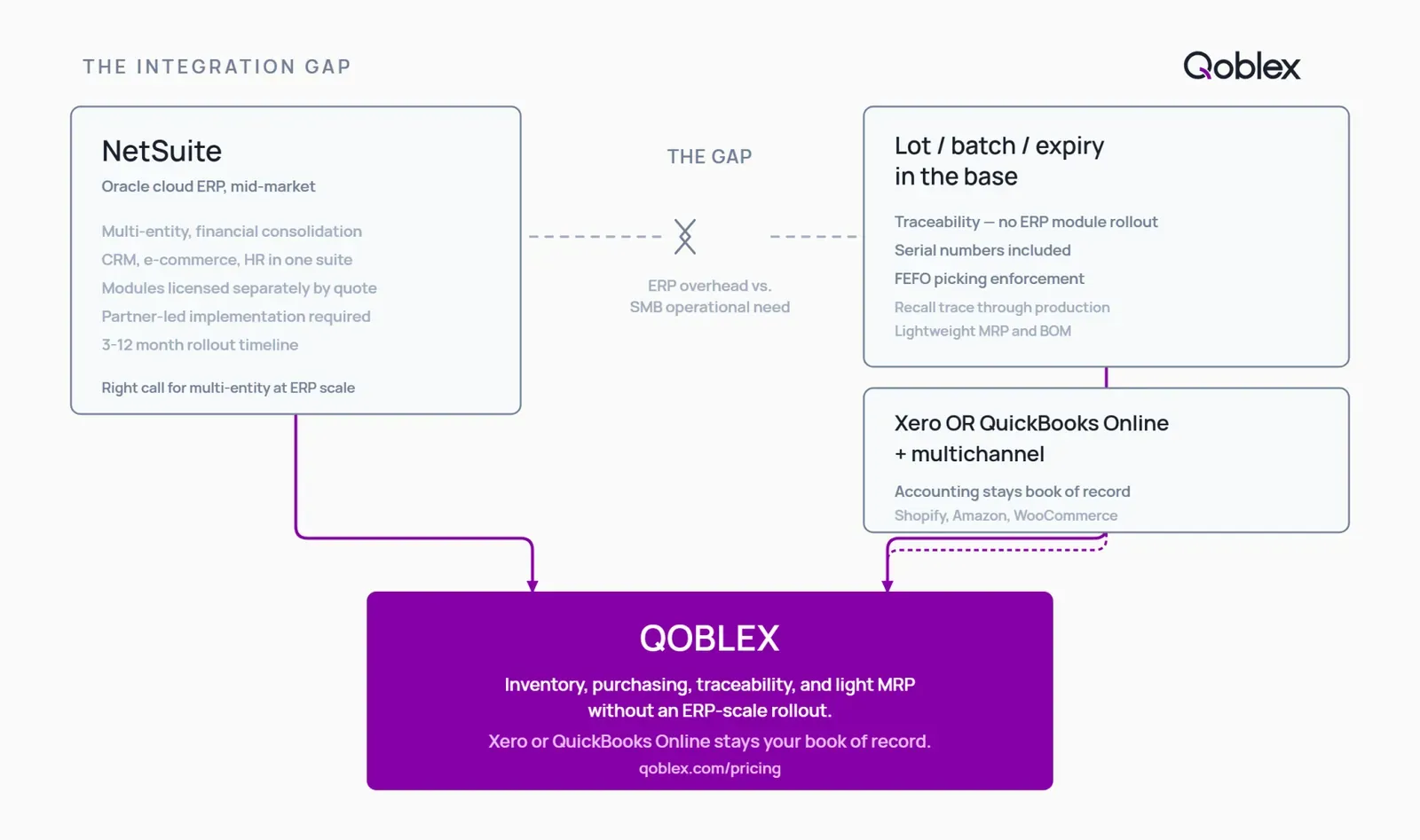
It is worth being accurate about NetSuite here, because the wedge is stage fit, not missing features. NetSuite does traceability and manufacturing. What differs is that both live inside an ERP scope you license and implement as modules, rather than in a tool you can turn on at SMB scale.
What NetSuite’s inventory and traceability scope looks like inside an ERP
NetSuite’s Advanced Inventory add-on module covers lot tracking, serial number tracking, expiry dates on lot-tracked items with FEFO enforcement, and bin management. A separate WMS module adds mobile scanning and directed picking, and it requires Advanced Inventory as a prerequisite. On the production side, NetSuite includes BOM, work orders, MRP for discrete manufacturing, shop-floor control, and WIP accounting through its Standard and Advanced Manufacturing modules. So the capability is genuinely there. The point is that each of these is a licensed module inside the platform, sold and configured as part of an ERP engagement.
What a food, beverage, or regulated brand actually needs at SMB scale
The real-world requirement for a regulated brand runs as a chain: capture the lot on receipt or production, attach an expiry date, pick so the soonest-to-expire stock goes first (FEFO, which orders picking by expiry rather than by receipt date the way FIFO does), and keep the trace intact so a recall question can be answered quickly: which lots are affected, and where did they go? The chain also has to survive production, so the link from raw-material lot to finished-goods batch lives inside the system rather than in a spreadsheet beside it. A single-entity brand needs that chain to work. It does not necessarily need multi-subsidiary consolidation and a finance suite wrapped around it. If you want the fuller picture, see our guides to lot and batch tracking, expiry, FEFO, and recall readiness, and food and beverage inventory management.
How Qoblex covers it without the ERP overhead
Qoblex gives you lot, batch, serial, and expiry tracking as a paid tracking add-on on top of its base plan, with self-serve setup and no mandatory implementation. Because Qoblex also ships lightweight MRP and bill of materials, the trace passes through production rather than stopping at the finished-goods shelf, and your purchasing and multichannel sync sit in the same system. The difference from NetSuite for this buyer is not whether the traceability exists. It is that you reach it without licensing an inventory module inside an ERP and running a multi-month rollout to switch it on, and your accounting stays on Xero or QuickBooks Online as your book of record. The current structure and figures are on the pricing page.
How to pick your NetSuite alternative
A quick way to narrow it down by business profile:
- You sell food, beverage, supplements, or cosmetics and want traceability, purchasing, and light manufacturing without an ERP rollout, keeping Xero or QuickBooks as book of record: Qoblex.
- Your core problem is production scheduling and you want full MRP: MRPeasy, or Katana if you also want tight Shopify integration and are happy to add the traceability module.
- QuickBooks is central and you want deep manufacturing integration with it: Fishbowl.
- You are already in Zoho: Zoho Inventory.
- You take a lot of wholesale or B2B orders: inFlow, or Unleashed if you are Xero-anchored in AU, NZ, or the UK.
- You have genuinely grown into mid-market WMS needs: Cin7 Core.
- You have multiple legal entities, complex global finance, or real consolidation needs: stay with a full ERP like NetSuite. That is the next section.
When NetSuite is genuinely the right call
NetSuite is the right ERP for the business that needs it. The question is whether your stage requires it yet, and for some businesses the honest answer is yes. Choose NetSuite when:
- You run true multi-entity or multi-subsidiary operations. Multiple legal entities, intercompany transactions, and consolidated reporting across subsidiaries are what NetSuite was designed for. A lightweight inventory tool cannot replicate that, nor should it try.
- You have complex global finance, multi-currency consolidation, or revenue recognition requirements. NetSuite’s financial module is the reason many businesses choose it. A growing company with these requirements at scale is a legitimate NetSuite buyer.
- You have the team and infrastructure to run an ERP. A dedicated IT function, an operations manager, a finance team, and the time and budget for an implementation project. At that scale, the ERP investment makes sense and pays back.
- You are already live on NetSuite and it is working. Switching cost is real. If the team knows the system and it covers the operational requirement, a marginal capability elsewhere does not justify the disruption.
If that is you, NetSuite is a sound choice, and no shortlist should talk you out of it. The question this page answers is the other one: if you are a single-entity product business that needs inventory, traceability, and light manufacturing while your accounting stays your book of record, an ERP is more platform than the stage requires, and that is where the tools on this list come in.
How to move away from a NetSuite evaluation (or avoid over-committing)
If you are mid-evaluation rather than mid-implementation, you have more room to move than the sales cycle suggests. A sequence that keeps you in control:
- Write down the one operational problem that started the search. Usually it is a specific gap: traceability, purchasing visibility, multichannel stock, or light manufacturing. Name it plainly before you weigh platforms.
- Separate the must-have from the ERP scope. Ask which of the modules you were quoted you actually need in the next twelve months. Multi-entity consolidation and a full finance suite are not the same requirement as lot tracking.
- Validate a right-sized tool in parallel. Most of the tools on this list offer a self-serve trial. Load a slice of your real data and confirm it closes the gap before you sign anything larger.
- Keep your accounting where it is. If Xero or QuickBooks Online is working as your book of record, a tool that syncs to it lets you close the operational gap without migrating your finances.
- Revisit the ERP question at the next stage. If you later grow into multiple entities or genuine consolidation needs, NetSuite is still there. Choosing a lighter tool now does not close that door.
Done this way, stepping back from an ERP evaluation is a considered decision, not a missed opportunity. You are matching the tool to the stage.
FAQ
Is NetSuite good for a small business? NetSuite is built for growing mid-market businesses and shows its strength at multi-entity scale, financial consolidation, and global operations. For a single-entity SMB product business that wants to keep Xero or QuickBooks Online as its book of record and just needs inventory, purchasing, and traceability, the ERP scope and the implementation project are usually more than the stage requires.
Who owns NetSuite? Oracle. Oracle completed its acquisition of NetSuite in 2016.
How much does NetSuite cost? NetSuite does not publish prices. Every quote is negotiated, and the standard structure is an annual subscription made up of a base platform license, per-user seat licenses, and separately licensed add-on modules, with implementation as a separate project. For a real figure you have to request a quote from NetSuite.
How long does a NetSuite implementation take? A typical rollout runs roughly three to four months on the SuiteSuccess path, and six to twelve months for multi-subsidiary or complex deployments. Implementation is a separate project cost on top of the license.
Does NetSuite have lot tracking and expiry dates? Yes. Lot tracking, serial numbers, expiry dates, and FEFO enforcement are part of the separately licensed Advanced Inventory add-on module. A separate WMS module adds mobile scanning and directed picking and requires Advanced Inventory as a prerequisite.
Does NetSuite have manufacturing or MRP? Yes. BOM, work orders, and MRP for discrete manufacturing are included via NetSuite’s Standard and Advanced Manufacturing modules within the ERP scope.
What are the best NetSuite alternatives for food and beverage or supplements? Qoblex is the top pick for a single-entity brand: lot, batch, serial, and expiry tracking as a paid add-on, lightweight MRP and BOM, and native Xero and QuickBooks Online sync, without an ERP rollout. For the full picture, see our food and beverage inventory guide and expiry and FEFO guide.
Which NetSuite alternatives work with Xero? Qoblex, Katana, Fishbowl, MRPeasy, Unleashed, inFlow, and Zoho Inventory all connect to Xero. Odoo reaches Xero through a third-party App Store connector rather than a native integration. Confirm the direction and depth of each sync against the vendor’s current documentation for your setup.
Which NetSuite alternatives work with QuickBooks Online? Qoblex, Katana, Fishbowl, MRPeasy, inFlow, Cin7 Core, and Zoho Inventory all connect to QuickBooks Online. Confirm the depth of each sync with the vendor before you commit.
Can I try Qoblex before switching? Yes. Qoblex offers a 14-day free trial with no credit card required, so you can load your own data and confirm the fit before committing. See qoblex.com/pricing for current terms.
Conclusion: your next move
NetSuite is a genuinely capable ERP for the operation it is built for. If you run multiple entities, need real financial consolidation, and have the team to run an implementation, it can be exactly right, and no comparison page should tell you otherwise. But if the reason you are looking is that a full ERP feels like more platform, cost, and rollout than your stage requires, then the honest question is whether you need an ERP yet or need the operational middle handled properly while your accounting stays where it is.
Start by writing down the one operational problem that put NetSuite on your shortlist. If it is getting inventory, purchasing, and traceability working, connected to whichever accounting platform you run, without a multi-month project, that is the gap to close first, and it is the gap Qoblex was built for.