



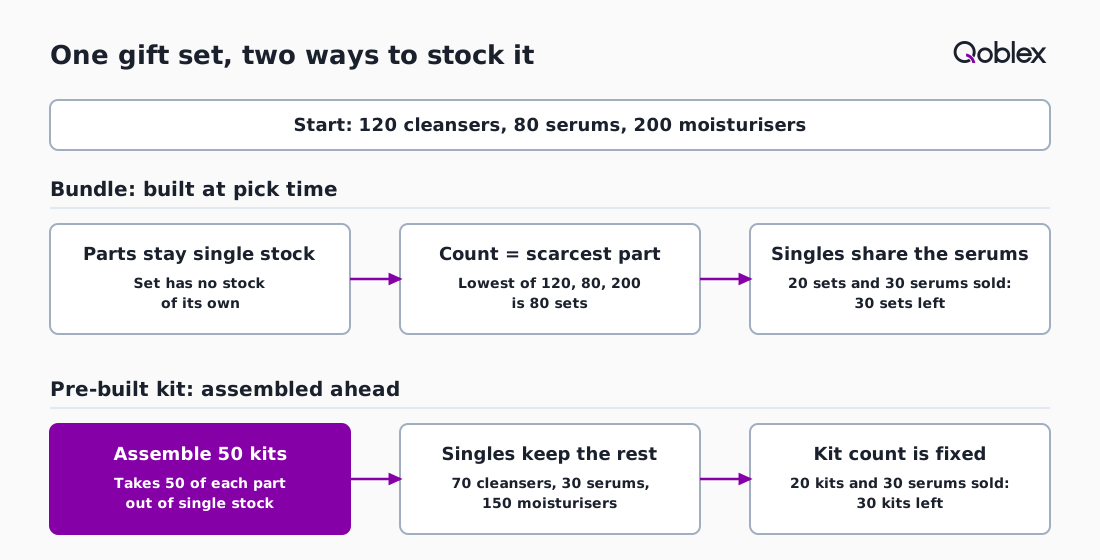
A Black Friday gift set is either a bundle, which holds no stock of its own and is worked out from its single items when an order arrives, or a pre-built kit, assembled before the rush and stocked as its own item. A bundle can show only as many sets as its scarcest part allows, shared with single sales. A kit fixes the count the day it is built.
Black Friday falls on Friday 27 November and Cyber Monday on Monday 30 November. The gift set is often the offer a cosmetics, food or supplement brand leads with, and the one line on the store whose count depends on three other counts.
What is the difference between a bundle and a pre-built gift set?
A bundle is a gift set that holds no stock of its own, because its count is worked out from the single items inside it and its parts are picked when an order arrives, while a pre-built kit is assembled before the rush and stocked as its own item with a count fixed on the day it is built.
A bundle stays a list of parts until someone picks the order, so the person packing pulls a cleanser, a serum and a moisturiser from three bins. A pre-built kit is made on the packing bench before the sale, and from then on the team handles it like any other product.
Black Friday sharpens the choice because the singles sell from the same shelves, so the part that runs short first decides how many sets can be filled, and how many the store can show at all.
How many gift sets can a store honestly show as available?
A store can show as many gift sets as its scarcest part allows, which is the lowest result of each part’s available stock divided by the quantity of that part in one set, rounded down, and the honest count is the same sum worked out after taking out of each part’s stock the units the single items are expected to sell.
Let’s assume a skincare brand sells a three-item gift set, one cleanser, one serum and one moisturiser, next to the same three items sold singly. Before Black Friday it holds 120 cleansers, 80 serums and 200 moisturisers. Each set takes one of each, so the serum is the scarcest part, and sold as a bundle the set shows 80.
That 80 is a ceiling, not a promise. The buyer expects to sell 50 sets and 30 single serums over the long weekend, exactly 80 serums, so the honest count is 80 minus 30, or 50 sets. The arithmetic still says 80; only the buyer knows the forecast.
Now suppose that by Friday afternoon 20 sets and 30 single serums have sold. The shelves hold 100 cleansers, 30 serums and 180 moisturisers, and the set count has fallen from 80 to 30 without anyone touching the set. A figure typed in on Monday would still read 80, which is why the store’s count has to come from the stock. A pre-built kit settles the serum question earlier.
How does a pre-built kit change the count, and when is each the right choice?
A pre-built kit takes its parts out of single stock when it is assembled, so the kit count is fixed at the number built and single sales cannot reduce it, while a bundle keeps every part available to singles and shows a count that moves with them.
On the same stock, the brand assembles 50 kits, which leaves 70 cleansers, 30 serums and 150 moisturisers as singles. After the same sales of 20 kits and 30 single serums, the kits stand at 30 and the single serums at 0, sold out without touching a kit.
The physical stock is identical on both paths: 70 loose cleansers plus 30 in kits make the bundle path’s 100, and the serums and moisturisers match the same way. What differs is who decided where the serums went. The bundle let sales decide; the kit committed 50 serums to sets the day they were boxed.
| Question | Bundle (built at pick time) | Pre-built gift set (assembled ahead, its own item) |
|---|---|---|
| Where is the stock? | In the single items; the set has no stock of its own | In the kit; the parts leave single stock when it is built |
| What is the set count? | Lowest of each part's stock divided by quantity per set, rounded down | The number built, less the kits sold |
| What do single sales do to it? | Each single of the scarcest part takes one set off | Nothing; the parts are already inside the kits |
| When is the work done? | At pick time, once per order | Before the rush, once per batch |
| What happens to unsold sets? | Nothing to undo; the parts never left single stock | Keep as stock or unpack into singles |
| Right choice when | The set is a loose combination sold next to its singles, with unsure demand | The set is a boxed, sealed or barcoded product, or pick and pack time is the limit |
A bundle suits a set whose demand nobody can call, because every part stays free for whatever customers order. A kit suits a set that is a product in its own right, or a weekend limited by pick and pack time, because the work moves to a quieter afternoon. Its cost is commitment: unsold kits hold serums the singles could have sold. So the number to build matters.
How many kits should you assemble before the rush?
Assemble the number your forecast says the set will sell over the long weekend, rounded to a batch your team can build in one session and never above what the scarcest part allows after the singles’ share.
In the example, 50 is the forecast for the set and a round batch for one session, and it leaves 30 serums for the 30 singles the buyer expects, so no serum is promised twice. Your forecast for the set decides how many kits to assemble; our guide to forecasting from last year’s sales shows how to build one.
If the supplier cannot deliver more serums before the weekend, 80 is the ceiling for kits and singles together, and building more kits only moves serums from one listing to another. Whether a reorder can still land in time is the subject of our supplier lead times guide.
How do you set up a gift set before Black Friday, step by step?
A brand sets up a gift set for Black Friday by working out the scarcest part, choosing bundle or kit, fixing the number to build, and making the count the store shows follow the stock instead of a typed figure.
- List the parts of the set and the quantity of each in one set.
- Count each part and find the scarcest one: the lowest of stock divided by quantity per set, rounded down.
- Estimate what the singles of each part will sell, take that out of the part’s stock, and redo step 2 on what is left; the lowest result is the honest count.
- Decide bundle or pre-built kit for this set, using the table above.
- If it is a kit, choose the number to build from the forecast, build it, and take those parts out of single stock.
- Check that the count the store shows for the set comes from this arithmetic and not from a typed figure.
- Recheck the scarcest part each morning until the weekend ends.
Step 2 is only as good as the count behind it, so the parts that feed a set belong in the pre-sale count of fast movers. Whether the set itself needs a line on the count sheet is answered in our Black Friday inventory checklist.
What do you check while the sets sell, and what happens to the kits after Cyber Monday?
While gift sets sell, the person running stock checks the scarcest part each morning, because that one count decides the set’s count on a bundle and the number of singles left on a kit, and after Cyber Monday unsold kits are either kept as stock or unpacked into singles.
That read fits inside the routine in our guide to running the weekend from the stock side. When the scarcest part is nearly gone, the question is whether a reorder can still arrive.
Unsold kits then stay on the shelf or are unpacked so their parts sell as singles again, and stock still sitting there in December is the subject of our slow stock clearance guide. The numbers worth keeping are in our guide to the numbers to capture. Whether a brand needs more than its store’s own bundles is the next question.
When are the store’s own bundles enough?
The store’s own bundles are enough for a brand that sells fixed sets from one store, holds its stock in one place and keeps the number of parts in a set small, because a small fixed set in a single place leaves little for a second system to do.
Shopify’s Bundles app is free, and its listing describes a way to “create fixed bundles and multipacks directly from the Shopify admin”; Shopify’s help centre says a store can “create and edit fixed product bundles and multipacks right from your Shopify admin”. For that brand, the store’s own tool is a sound answer.
The picture changes with the brand rather than the tool: sets boxed ahead of the rush, parts tracked by batch or expiry date, stock in several places, or books that must follow the parts. Each sits in the messy middle between a spreadsheet and a manufacturing system.
How does this look in Qoblex?
In Qoblex, a bundle holds no stock of its own: its stock at each location is worked out from its parts, taking each part’s available stock divided by its Quantity in Bundle and keeping the lowest result, rounded down to whole bundles.
With the three items added as parts at a Quantity in Bundle of 1 each, the bundle’s Inventory tab shows 80 at the location for the example stock, falling as the parts sell to 30 after the Friday afternoon sales. Nobody can type a stock level for a bundle, and a warning icon marks any location where a part’s In stock is 0; the bundles help article walks through the setup.
A bundle uses Standard tracking, and only its parts can be batch or serial tracked. A bundle can oversell only when all of its parts are allowed to, as our piece on overselling across several stores explains. Only the parts are recorded in the inventory ledger, so a shipped set’s cost of goods sold is the cost of the parts shipped; its moving average cost is the sum of each part’s moving average cost times its quantity in the bundle.
The pre-built kit takes a different route, because a bundle cannot be manufactured. The brand creates the gift set as a Bill of Material and builds it with an Assembly production order, the type the manufacturing overview gives for building a gift set from individual products. With Quantity To Produce at 50, Yield Quantity follows it; on completion, with no wastage recorded, cleansers go from 120 to 70, serums from 80 to 30 and moisturisers from 200 to 150, and the kit shows 50. Bills of Material, production orders, assembly and disassembly are on every plan.
Frequently asked questions
What is the difference between a bundle and a pre-built gift set kit?
A bundle is a gift set that holds no stock of its own: its count is worked out from the single items inside it, and the parts are picked when an order arrives. A pre-built kit is assembled before the rush and stocked as its own item, so its count is fixed on the day it is built.
How do I work out how many gift sets I can sell?
Divide each part’s available stock by the quantity of it in one set, take the lowest result and round down. With 120 cleansers, 80 serums and 200 moisturisers in a one-of-each set, the serums limit it to 80 sets. Subtract the single serums you expect to sell to get the honest count.
Do single sales reduce my bundle stock?
A bundle’s count falls with single sales while the single item is the scarcest part. A bundle draws on the same stock as the singles, so each single serum sold takes one set off the count. A kit assembled ahead has already taken its parts out of single stock, so single sales cannot reduce it.
How many gift sets should I assemble ahead of Black Friday?
Assemble what your forecast says the set will sell over the weekend, rounded to a batch your team can build in one session, and never more than the scarcest part allows after the singles’ share. Built kits are committed: their parts cannot sell as singles unless you unpack the kits.
When is a pre-built gift set better than a bundle?
When the set is a physical product in its own right, sealed in a box, tied with ribbon or carrying its own barcode, or when pick and pack time is the constraint on the busiest days. Building it before the rush moves the labour out of the peak, at the price of fixing the count in advance.
Can a Qoblex bundle be built with a production order?
A Qoblex bundle cannot be built with a production order, because it cannot be manufactured and holds no stock of its own. A kit you build ahead must be a Bill of Material, made with an Assembly production order, which lowers each component’s stock and raises the finished product’s stock by the Yield Quantity. Assembly is on every plan.